 PalV's Kasti
On this page
A dakhma is built on raised ground away from homes and is consecrated through three ceremonies. J.J. Modi, writing in 1922, names them as the Kodari marvi (striking the first spade), the Tana (laying out the foundation with a sacred thread and 301 iron nails) and the consecration proper, which lasts four days. Ervad Dr Ramiyar Karanjia's Jame Jamshed column of 7 and 14 May 2017, reposted on his website, describes the same ceremonies. During the four days, two priests perform the Yasna and Vendidad inside the central well, and the rites close with a Jashan that names the donor. Until that point anyone may look inside. Once it is consecrated, Dosabhai Framji Karaka wrote in 1884, it is closed to everyone, Zoroastrian or not.
For what a dakhma is and how it is used at a funeral, start with our Tower of Silence guide.
શહેરેવર રોજ
Shehrevar Roj, Tir Mah · 1396 Y.Z.
Where is a dakhma built?
On high ground. Karanjia writes that an elevated site away from where people live is chosen. Both the scripture and the priests' catechism point the same way: Vendidad 6.45 tells the faithful to lay the dead on the highest summits, and the 19th-century catechism of Erachji Meherjirana, as translated by Dastur Firoze Kotwal and James Boyd, says a dakhma should be built on a mountain. The reasons behind this are explained in Why dokhmenashini is ordained.
What material is a Tower of Silence made of?
Erachji's catechism answers this directly: stone and lime first, and bricks and mud if stone and lime cannot be had, as long as nothing from the body can seep into the soil. Kotwal and Boyd add in their commentary that solid stone is the least porous and so the best, and that Parsis in India have built dakhmas from all three materials as their means allowed.
What ceremonies are performed to build and consecrate a dakhma?
Preparing the ground
Only Karanjia describes this step. A well is dug about 300 paces away for ritual water, cows graze the land for a while to clean it, and after water is sprinkled and a cloth curtain put up, Baj-dharna rituals and a Jashan are performed.
Kodari marvi: striking the first spade
Modi records that a priest who holds the Bareshnum marks off a spot in the centre of the plot with a pavi, a shallow ritual furrow, and performs the Khub ceremony there. He then recites Baj prayers in honour of Sraosha, Ahura Mazda, Spenta Armaiti (who presides over the earth), Ardafrosh (the souls of the departed) and the seven Amesha Spentas. Karaka lists the same five in 1884. The priest takes the spade, recites the Srosh Baj up to Ashahe, and digs part of the ground himself while reciting the Yatha Ahu Vairyo 21 times. Karanjia gives the same count and calls the rite the "Kodali Marvani Kriya". Labourers then dig the foundation, which Karanjia puts at about eight feet deep and about two weeks' work.
The Tana: thread and 301 nails
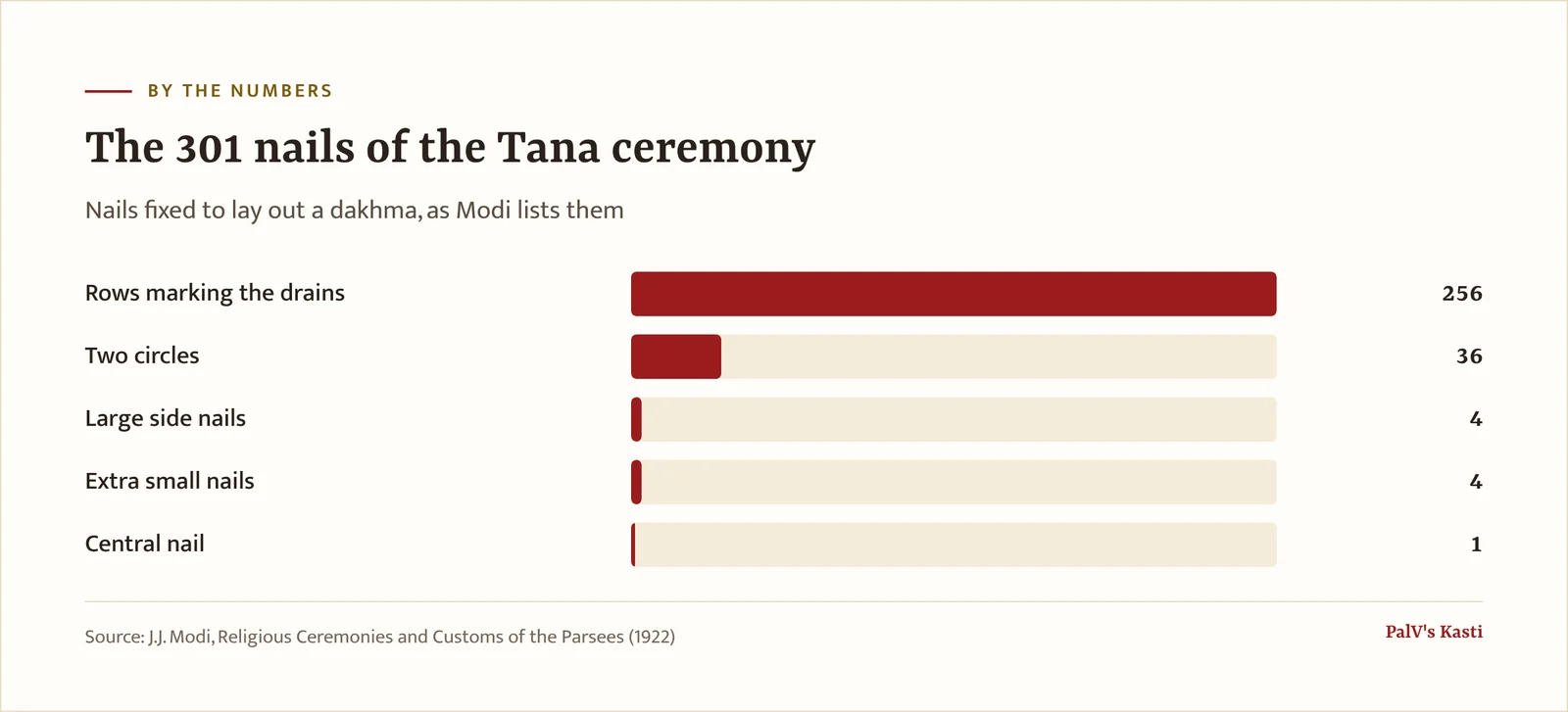
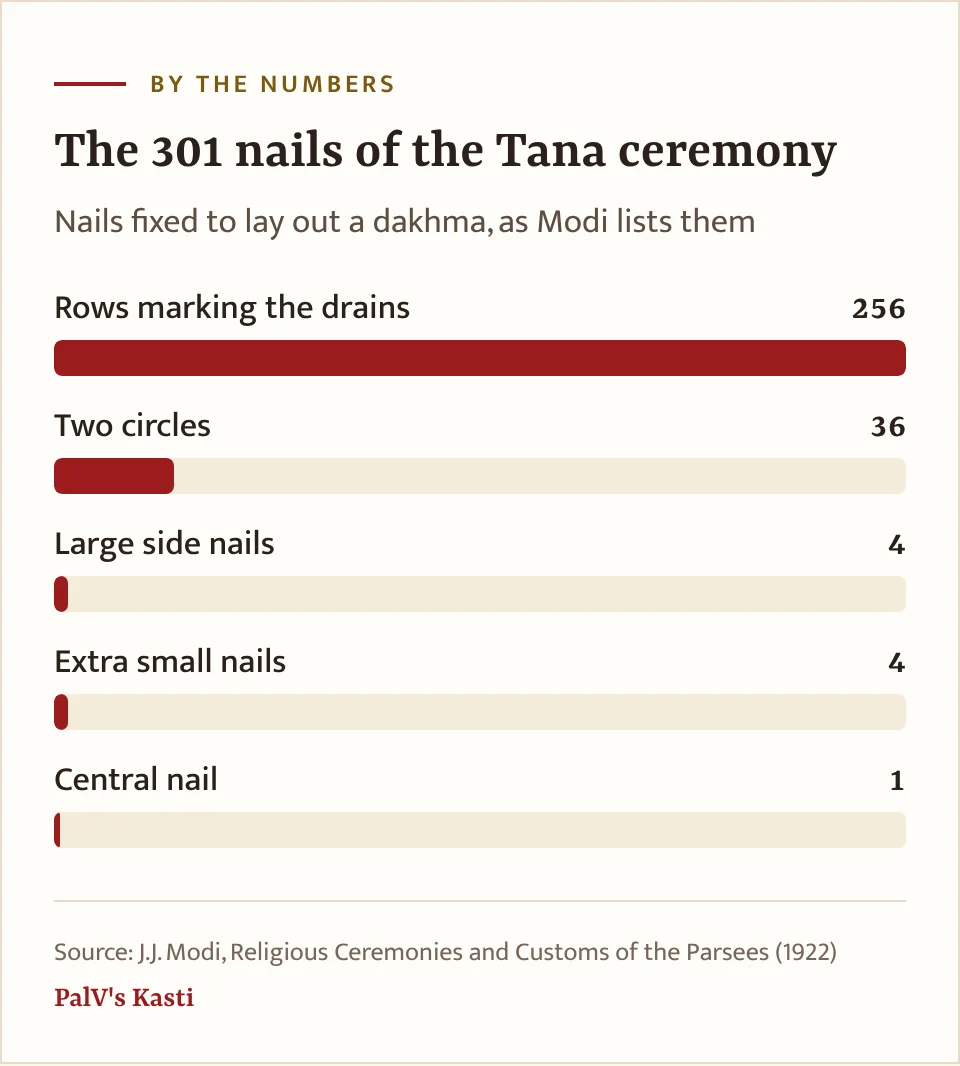
The Tana takes its name from the tana, the thread. Modi records that 101 fine threads are woven into one strong cord, long enough to go round the whole plan three times, and purified before use. Two Bareshnum-holding priests go down into the excavation in full priestly dress, holding the paiwand between them, recite the Srosh Baj and start fixing the nails, one Yatha Ahu Vairyo for each nail. Modi lists the 301 nails as follows.
- One large central nail, marking where the central well (bhandar) will be. It is struck first.
- Four side nails at the south-east, south-west, north-west and north-east, each with three holes for the thread.
- Thirty-six nails in two circles, 16 outer and 20 inner.
- 256 nails in eight rows of 32, marking the drains.
- Four more nails of the same small size.
The thread is then carried from nail to nail, always moving to the right, three times round. What is left is wound on the central nail, and the priests finish the Srosh Baj. Modi gives the weights in maunds; Karanjia says the heaviest nail weighs about 20 kg, all the nails together about 100 kg, and the ceremony takes about three hours. The circles the nails mark become the three rings of stone beds: Modi says the inner ring is for children, the middle for women and the outer for men.
What does the Tana thread mean?
Modi notes that the Avesta and old Pahlavi books say nothing about the Tana, so the meanings below come from later writers. His own reading is that the thread marks the limit of any pollution: the tower may affect only the ground it stands on. He also reads the central nail, where nailing begins and the thread ends, as a sign of unity at the beginning and the end. Karaka adds that the thread is kept from touching the ground, to show that the dead must not lie directly on the earth, and that iron is used instead of wooden pegs because wood is more porous. Karanjia says the Tana is meant to control the nasa, which he glosses as physical and spiritual contagion.
The consecration proper: four days
When the building is finished, a day is fixed. Modi says the consecration is usually held in the dry season, since much of it happens in the open. Both Modi and Karaka describe the same sequence:
- A pavi is dug all round the tower. Karaka gives it as about half a foot deep and as wide.
- For three days, two priests perform the Yasna by day and the Vendidad by night inside the bhandar, in honour of Sraosha. Modi links this to Sraosha's protection of the soul for the three days after death.
- On the fourth morning, a Yasna is performed in honour of Ahura Mazda.
- Baj prayers follow, which Karaka lists for Ahura Mazda, Spendarmad, Srosh and Ardafrosh.
- A Jashan with Afringan prayers is held before the gathered community, and the donor who paid for the tower is named and blessed. Karanjia says the Tandarosti is recited for the sponsor.
After the Jashan, Modi and Karaka both say, people go in to see the tower and throw coins, and sometimes rings, into the bhandar. If the community built the tower, the money goes to the building costs. If a single donor paid, it goes to the head priest of the district. Karanjia adds that the first body laid there should preferably be a child's or a pious man's.
Practice varies between families and Agiaries; your family priest's guidance comes first.
Why did thousands attend a dakhma consecration?
Because attending was an act of merit. Karaka wrote in 1884 that Parsis saw taking part as piety, and paying for a dakhma as one of the most meritorious religious acts. Modi recorded a popular belief that it is meritorious to see the consecration of at least seven towers in a lifetime.
The crowds were large. For the Tana at Deolali, about 100 miles from Bombay, Modi says six special trains carried people from the city, more than 5,000 attended, and a little over Rs 2,000 was thrown into the excavation. The nails and thread stayed open to view for two or three weeks (Karanjia says about two), and building then went ahead right over them.
Who can enter a dakhma after it is consecrated?
Before the consecration, Karaka wrote, the dakhma is open for anyone to inspect. Afterwards it is closed to everyone, whether Zoroastrian or not. At a funeral, Modi describes the corpse bearers, the Nassasalars, as the ones who carry the bier into the tower. What happens inside is covered in our Tower of Silence guide, and the old link between the tower and equality in death is the theme of the Tower of Silence poem by Dastur Dhalla.
Frequently asked questions
How many nails are used in a dakhma's Tana ceremony?
J.J. Modi records 301 iron nails: one central nail, four large side nails, 36 nails in two circles, 256 nails in eight rows, and four more. Ervad Ramiyar Karanjia gives the same total and says the heaviest weighs about 20 kg. A cord of 101 fine threads is taken round them three times.
How long does it take to consecrate a Tower of Silence?
The final consecration lasts four days, according to both Modi and Karaka. For three days two priests perform the Yasna and Vendidad inside the central well in honour of Sraosha. On the fourth day a Yasna for Ahura Mazda, Baj prayers and a Jashan naming the donor complete it.
What does Kodari marvi mean?
Modi translates Kodari marvi as "to strike the first spade". It is the first of the three dakhma ceremonies. A priest recites Baj prayers, then digs part of the ground himself while reciting the Yatha Ahu Vairyo 21 times. Karanjia calls the same rite the Kodali Marvani Kriya.
Can visitors go inside a dakhma or Dokhma?
According to Karaka, only before it is consecrated. He wrote in 1884 that a new dakhma is open for everyone to inspect until the consecration, and is then closed to all, Zoroastrian or not. After that, Modi records, it is the Nassasalars who carry the bier inside at a funeral.


