 PalV's Kasti
On this page
Dokhmenashini, the Zoroastrian practice of laying the dead in a dakhma to be consumed by birds of prey and the sun, is controversial today because the vultures that made it work in Mumbai have almost vanished. The disagreement is over what follows from that. Orthodox voices, including Bombay Parsi Punchayet (BPP) trustees, high priests and the scholar Khojeste Mistree, hold that cremation and burial go against the faith and that the dakhmas still work. Reformist voices, among them former BPP trustee Dinshaw Tamboly and Parsiana editor Jehangir Patel, say the system has failed in Mumbai, and reformist priests such as Framroze Mirza and Khushroo Madon pray for Parsis who are cremated. The fight over those priests went to the Bombay High Court in 2010 and 2011 and to the Supreme Court in 2015, and reports from 2025 and 2026 show the wider argument is unresolved.
શહેરેવર રોજ
Shehrevar Roj, Tir Mah · 1396 Y.Z.
How did the vulture decline turn dokhmenashini into a dispute?
The Tower of Silence at Doongerwadi depends on exposure to the sun and to birds of prey. Why the birds disappeared across India is explained in our piece on Vultures and the Tower of Silence. Within the community, the turning point came when trustees saw the result for themselves.
Dinshaw Tamboly, who became a BPP trustee in the late 1990s, told Open magazine in February 2014 that after he asked fellow trustees to visit the dakhmas, "all of us realised that the entire system had collapsed". Open reports that Tamboly then urged the trustees to build an electric crematorium within Doongerwadi, or at least to let families of the cremated pray in the community's prayer halls. According to Tamboly, the high priests allowed neither.
The argument went public in 2006. Dhun Baria, a Mumbai Parsi, secretly photographed inside the Doongerwadi grounds and handed out handbills with the images across the community, the Associated Press reported in September 2006. Open, recounting the episode in 2014, says she went in with a photographer. "The dead have no dignity," Baria told AP. BPP trustee Burjor Antia said in the same report that she had committed a religious offence, adding that cremating or burying would mean "breaching our sacred religious injunction."
What do orthodox Parsis and the high priests say?
The orthodox case rests on two points: that the faith forbids burning or burying the dead, and that dokhmenashini still works.
- The BPP in court. In the 2011 Bombay High Court appeal, the court recorded the trustees' case that fire is the seventh creation of Ahura Mazda, which is why, they argued, cremation goes against the basic tenets of the faith. They also relied on the Athornan Mandal's position, repeated over the last hundred years according to the trustees, that no priest should take part in the funeral of a Parsi disposed of by another method where a dokhma is available.
- Khojeste Mistree, described by AFP as an orthodox scholar, told the agency in June 2016 that the dakhmas still "work effectively, although slightly slower" and that a "massive majority" still favour the traditional way. He added that people who want cremation can choose it, but that it is wrong from a religious point of view.
- Dastur Feroze Kotwal, a high priest, called acceptance of cremation "a strike at the very foundation of our religion", according to journalist Coomi Kapoor's history of the Parsis (excerpt published by Scroll, July 2021).
- Muncherji Cama, a BPP trustee, told Open in 2014 that the faith places its emphasis on the sun, not on the birds, and that with solar panels "it is working well enough."
Ervad Dr Ramiyar Karanjia sets out a priestly view in his published Q&A on death. He lists four principles of dokhmenashini: disposal away from habitation, on a raised place, in the sun's rays and exposed to birds of prey. He writes that the last of these has "considerably weakened in the last about two decades", while the other three are working well. His conclusion is that dokhmenashini, even weakened, is "still the best among all the methods" open to Zoroastrians today, judged for the living, the dead and the environment.
Practice varies between families and Agiaries; your family priest's guidance comes first.
What do reformist Parsis say?
Reformists argue that the traditional method has failed in Mumbai and that a family's choice should not cost them prayers or a place to mourn. "Kites and crows just pecked at the bodies," Tamboly told AFP in 2016, adding that those birds "did nothing at all". Open (2014) reported the reformist complaint that the high priests have not only forbidden cremation but have also barred priests from performing funeral prayers for those who are cremated.
The prayer halls are the sharpest grievance. Scroll (April 2016) and the Free Press Journal (October 2024) both report that families who choose cremation cannot use the Doongerwadi bungalows for the four-day rites. A prayer hall at the Worli crematorium opened in August 2015 as the alternative. Jehangir Patel told the Free Press Journal in January 2024 that it has been "a real blessing" for families who wanted an alternative to Doongerwadi. Priest Khushroo Madon told Scroll in April 2016 that the hall "is fulfilling a definite need" and predicted that most Parsis would soon move to cremation.
How many Parsis choose cremation?
We found no official count, and the estimates differ by who is speaking. Tamboly told Open in 2014 that about 750 to 800 bodies a year were brought to Doongerwadi, against four or five cremations. Patel told AFP in 2016 that cremations were around 15 per cent of Mumbai Parsi funerals. The Prayer Hall Trust put the share at 15 to 20 per cent in January 2024, up from an estimated 7 to 8 per cent before the Worli hall, the Free Press Journal reported.
What did the courts decide about priests who pray for the cremated?
The legal fight was about priests, not about cremation itself. In 2009 the BPP trustees barred two priests, Framroze Mirza and Khushroo Madon, from Doongerwadi and two BPP-run Agiaries, the Godavara Agiary in Fort and the S.F. Jokhi Agiary at Godrej Baug. The Bombay High Court records three grounds: praying for the dead who were cremated, performing navjotes of children of Parsi women married to non-Parsi husbands, and performing marriages of Parsis to non-Parsi spouses.
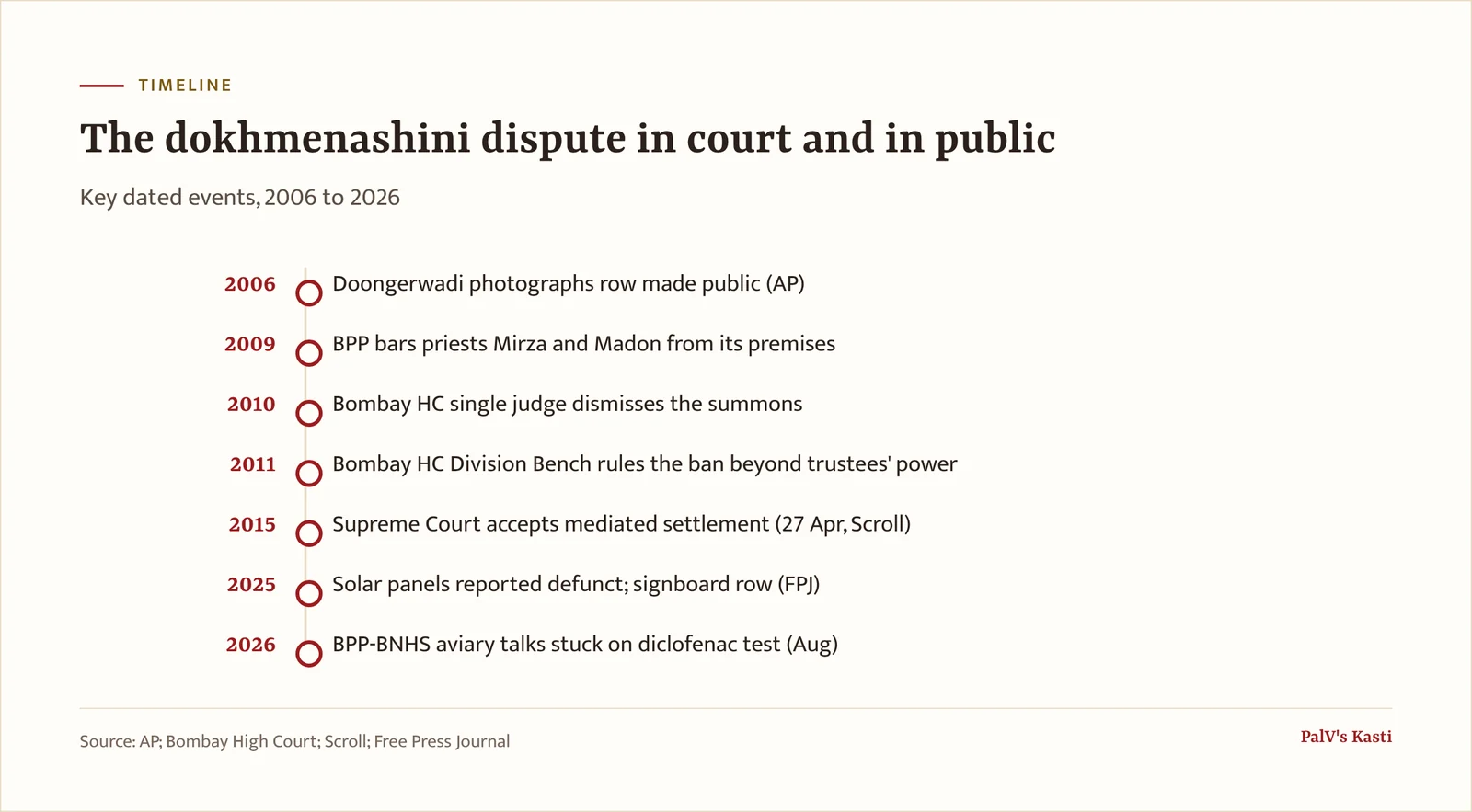
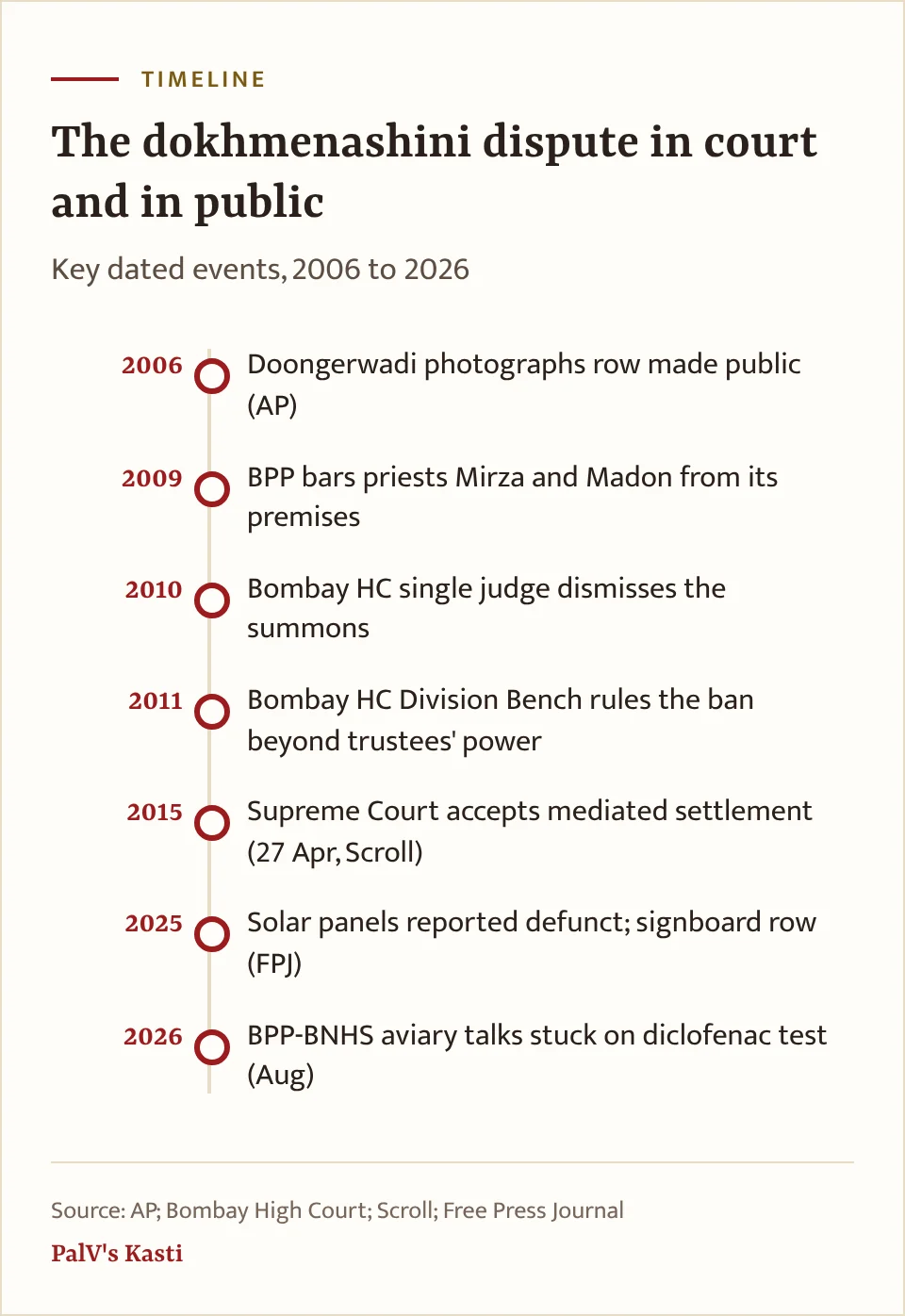
- 5 March 2010, Bombay High Court (single judge). In Jamsheed Kanga & Anr v Parsi Punchayet Funds & Properties (Originating Summons No. 1909 of 2009), Justice V.M. Kanade dismissed the summons, holding that the question needed evidence from both sides in a regular suit. Counsel for the plaintiffs had cited a 1985 High Priests' resolution said to accept burial or cremation. The court recorded the submission but did not rule on it, and we have not seen that resolution.
- 11 March 2011, Bombay High Court (Division Bench). In Appeal No. 256 of 2010, Justices D.Y. Chandrachud and Anoop V. Mohta allowed the appeal. They held that under the 1884 Deed of Trust the trustees cannot prevent any duly ordained Parsi Zoroastrian priest from performing rites at Doongerwadi and the two Agiaries, and that the ban on Mirza and Madon "was not within the power and authority of the trustees".
- 27 April 2015, Supreme Court. The BPP appealed in 2012. After nearly three years of mediation, Scroll reported, the court accepted a settlement between the trustees and Jamsheed Kanga and Homi Khusrokhan. All other priests may pray at the three BPP premises. Mirza and Madon may perform funeral rites there only for immediate family, after filing an affidavit with the BPP. The trustees keep "full power to regulate the performance of religious rites and ceremonies" there.
Opinion on the 2015 settlement split, as Scroll reported at the time. Mistree, then a BPP trustee, called it "a win-win situation for both sides". Kerssie Wadia, founder-trustee of the reformist Association for the Revival of Zoroastrianism, called it "a complete sell-out", saying it harmed the two priests at the centre of the case. Kanga and Khusrokhan said in a joint statement that the gain for every other priest, "for all time to come", outweighed the cost to a single individual.
This is general information, not legal advice; for a specific case, speak to a lawyer.
Where does the dokhmenashini debate stand in 2025 and 2026?
The latest reports describe no working aid in place of the vultures, and the BPP says the dakhmas function without one. In February 2025 the Free Press Journal reported that the solar panels at Doongerwadi were defunct. BPP chairman Viraf Mehta told the paper the equipment broke down just before the pandemic, and that the existing system is "functioning without any hiccups" without it. The argument over repairing them is covered in our piece on Solar concentrators at the Towers.

Suspicion runs both ways. In March 2025 the BPP removed the word "smashanbhoomi" from a new Doongerwadi signboard after orthodox members feared it signalled a crematorium, the Free Press Journal reported. One member suggested building a crematorium on the grounds. Another said that would let Doongerwadi "be sold to the builder lobby".
A plan to bring vultures back through an aviary is also stuck as of August 2026. Mehta told the Free Press Journal that talks with the Bombay Natural History Society were slow, and that the trust has no test, short of intrusive post-mortems, to tell which bodies carry diclofenac. "That's kind of where we are stuck on this," he said.
Frequently asked questions
Why are Parsis divided over the Tower of Silence?
Vultures have almost vanished from Mumbai, so the Doongerwadi dakhmas no longer work as they once did. Orthodox voices, including BPP trustees and high priests, say cremation and burial go against the faith and that the dakhmas still work. Reformists, such as former trustee Dinshaw Tamboly, say the system has collapsed and that cremated Parsis should not lose their prayers.
Can a Parsi priest pray for someone who was cremated?
Some priests do. Reformist priests have performed rites at the Worli crematorium prayer hall since it opened in August 2015. The BPP trustees told the Bombay High Court that the Athornan Mandal says no priest should, where a dokhma is available. The 2011 ruling and the 2015 Supreme Court settlement limit the BPP's power to bar priests from its premises.
What was the 2006 Doongerwadi photographs row?
In 2006 Dhun Baria (Open spells it Dhan), a Mumbai Parsi, secretly photographed inside the Doongerwadi grounds and handed out the images across the community, the Associated Press reported. She said "the dead have no dignity". BPP trustee Burjor Antia said she had committed a religious offence. The row brought the dispute into the open.
Are vultures coming back to Doongerwadi?
Not yet. In August 2026 BPP chairman Viraf Mehta told the Free Press Journal that aviary talks with the Bombay Natural History Society were slow. He said the trust has no test, short of intrusive post-mortems, to identify bodies carrying diclofenac, which causes kidney failure in vultures. That is where the plan is stuck.


