 PalV's Kasti
On this page
Whether dokhmenashini is sound by modern hygiene and environmental standards is still argued, and the evidence on both sides is thinner than the arguments. Its defenders, from J.J. Modi in 1922 to Ervad Dr Ramiyar Karanjia in 2017, describe it as sanitary and as the most ecological way to dispose of the body. Doctors on the reform side have called it a health hazard. In the sources we were able to check, we found no published study that measures pathogens, groundwater or air quality at a dakhma. What is well documented is that the vultures the system relied on collapsed across South Asia after the veterinary use of diclofenac, and that neighbours of Mumbai's Doongerwadi then complained of a foul smell.
For the scriptural reasons behind the practice, read Why dokhmenashini is ordained. For how a dakhma is used, see our Tower of Silence guide.
શહેરેવર રોજ
Shehrevar Roj, Tir Mah · 1396 Y.Z.
What was the original sanitary case for the Tower of Silence?
Parsi writers of the nineteenth and early twentieth centuries argued that the rules were sanitary at heart. J.J. Modi, in The Religious Ceremonies and Customs of the Parsees (1922), concluded that beneath all the funeral injunctions "lies the sanitary principle of segregation, prevention of contamination and infection". In his History of the Parsis (1884), Dosabhai Framji Karaka records how Nasarvanji Beramji, secretary to the Parsi Panchayet, answered the Oxford Sanskrit professor Monier Williams at Malabar Hill. The birds, Beramji said, work far faster than insects would on a buried body, and from a sanitary point of view nothing could be "more perfect than our plan". Modi repeats the argument about speed. Karaka also notes that Sir Richard Temple, then Governor of Bombay, visited the dakhma built at Navsari in 1878 and was much pleased with its sanitary precautions.
How was the dakhma designed to protect the ground?
Both Modi and Karaka describe the same drainage. Rain water that has passed over the remains runs through four underground drains into four wells, whose bottoms Modi says are covered with sand. Charcoal and sandstone placed at the drains filter the water before it enters the earth. Both writers tie this to the teaching that the earth must not be defiled. Neither gives measurements of how well the filters work, and we did not find a later study that tested them.
What changed when the vultures disappeared?
The science that matters most here is about birds. A 2004 paper in Nature by J.L. Oaks and colleagues tied the deaths of oriental white-backed vultures in Pakistan to residues of veterinary diclofenac, an anti-inflammatory drug given to livestock. Anne Rademacher, writing for the Rachel Carson Center in 2019, notes that by 2007 diclofenac toxicity was well established as the main cause of the crash across South Asia. She cites the Bombay Natural History Society: long-billed and slender-billed vulture populations had fallen by 97 percent. The ban on veterinary diclofenac, she adds, did not extend to human use, and the Free Press Journal noted in August 2026 that the drug is still used as a painkiller for people.
At Doongerwadi the effect was felt by the neighbours. Dinshaw Tamboly told Open magazine in February 2014 that when he became a Bombay Parsi Panchayat (BPP) trustee in the late 1990s, he learnt that people living nearby were complaining of a foul smell from the Towers. Coomi Kapoor, in her book The Tatas, Freddie Mercury & Other Bawas (excerpted by Scroll in July 2021), records the same complaints about odour from the wells. The birds' role, and the search for their return, is told in our guide to Vultures and the Tower of Silence.
Is the Tower of Silence a health hazard? Both sides
An Outlook report by Manu Joseph (dated 5 February 2022 on Outlook's website) set out the two positions. It reported that prominent doctors associated with the Disposal of the Dead with Dignity-Action Group (DDDAG), which wants Parsis to be allowed other methods such as cremation, Dr Rusi Soonawala and Farokh Udwadia among them, "insist that Dokhmenashini is a health hazard". The same report says the orthodox side dismisses this as a "ruse to get their way". Khojeste Mistree told Outlook that there is a disproportionate number of crows and kites, and that the scriptures do not say "only vultures" should consume the body.
Neither side, in the reporting we could read, points to a measured study at the site.
Did technical fixes solve the problem?
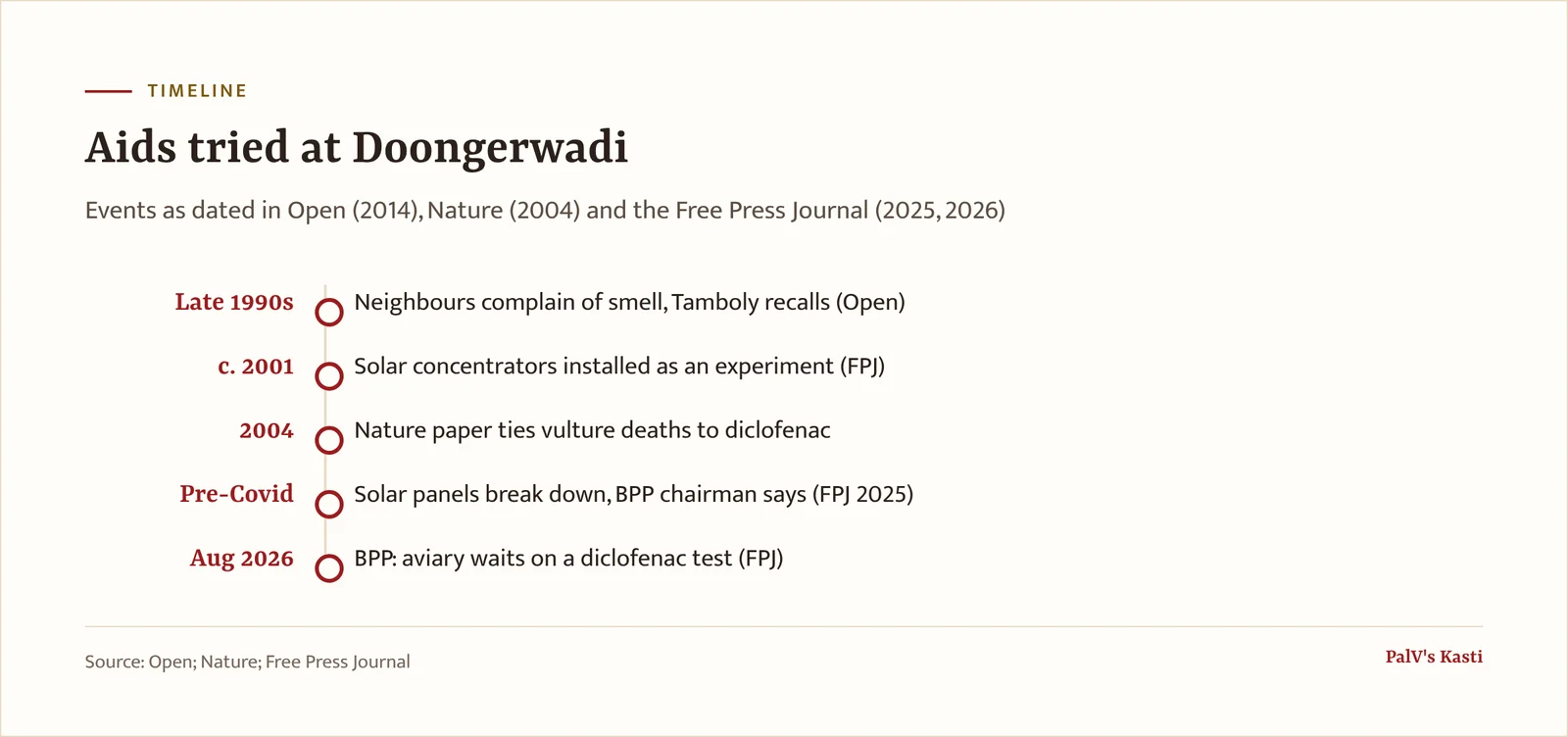
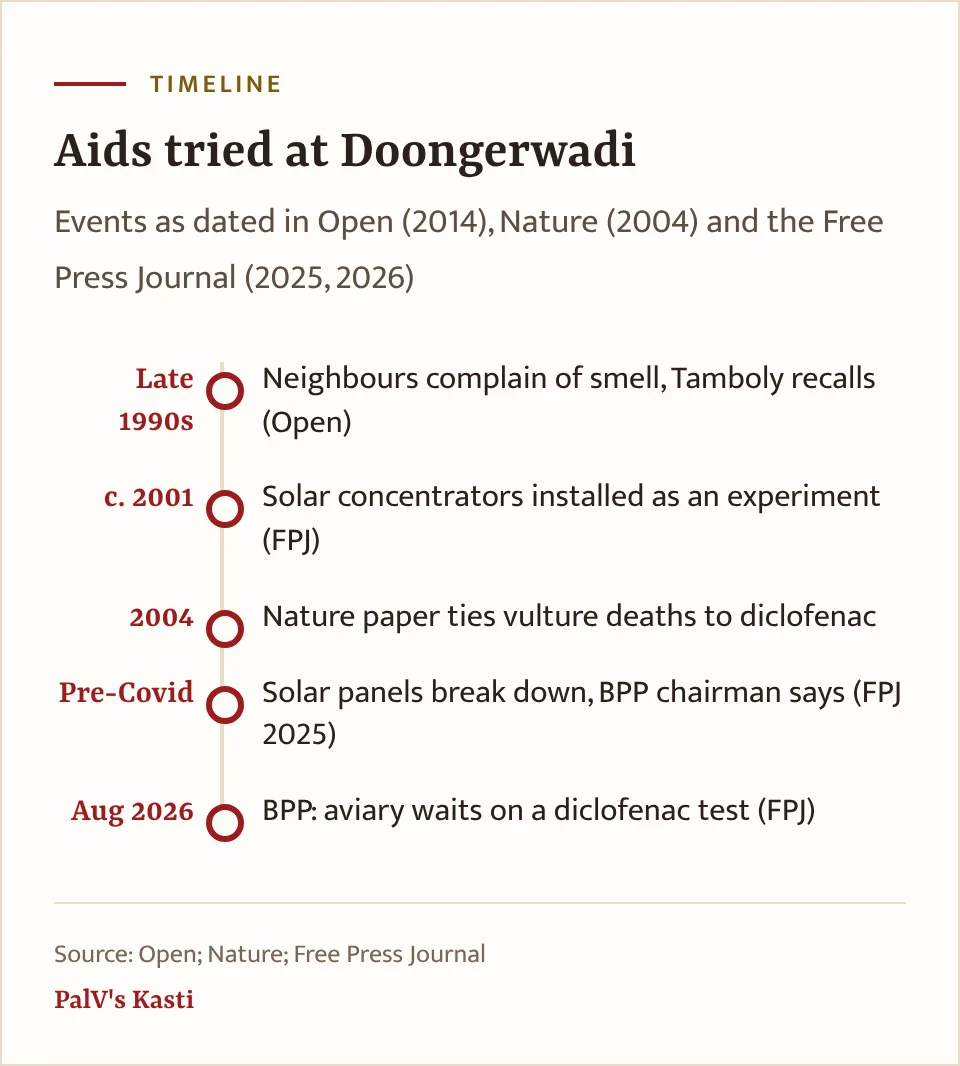
Not fully, on the record so far. Tamboly told Open in 2014 that the BPP once approved a part-herbal, part-chemical mixture to speed decomposition, and stopped it because it left sludge in the wells, where corpse bearers slipped. Solar concentrators, installed as an experiment around 2001 according to the Free Press Journal, were meant to dry the remains with focused sunlight. Rademacher judged the results insufficient. In February 2025 the same paper reported BPP chairman Viraf Mehta as saying the panels broke down just before the Covid pandemic and that the existing system was working without them, while a group of Parsis asked for them to be restored. In August 2026 Mehta told the paper that a planned vulture aviary was held up by one question: how to identify bodies that carry diclofenac.
Is dokhmenashini eco-friendly?
The orthodox answer is yes. Karanjia, writing in Jame Jamshed in 2017, called it "the most ecological and nature friendly way" of disposal. In another column he argued that cremation turns much of the body into small particles that take a long time to return to the elements, that burial takes years, and that even in its "marginally weakened form", with a body taking a few weeks to disintegrate, dokhmenashini remains the fastest. We found no measured comparison of the three methods.
The land itself is better described. Rademacher describes Doongerwadi as a 54-acre closed-canopy forest, with its temples, in the middle of South Mumbai. Its stewards invited her to help as they counted its plant and animal life, and she writes that the forest absorbs carbon dioxide, reduces pollution and noise, and lets rainwater soak in. This describes the land around the towers rather than the method itself. Doongerwadi is only one site, and our page on Parsi dakhma locations lists the others.
Practice varies between families and Agiaries; your family priest's guidance comes first.
Frequently asked questions
Is the Tower of Silence hygienic?
Its defenders say so. Modi in 1922 traced the funeral rules to a sanitary principle of segregation, and the dakhma filters rain water through sand and charcoal. Doctors quoted by Outlook call it a health hazard. In the sources we checked, no published study measures pathogens, groundwater or air at a dakhma, so neither claim rests on site data.
Is dokhmenashini eco-friendly?
Ervad Dr Ramiyar Karanjia calls it the most ecological way to dispose of the body, faster than cremation or burial in returning it to the elements. We found no measured comparison. Mumbai's Doongerwadi does preserve a 54-acre forest that, according to Anne Rademacher, absorbs carbon dioxide and lets rainwater soak in.
Why did the vultures disappear?
A 2004 study in Nature by Oaks and colleagues linked vulture deaths in Pakistan to residues of veterinary diclofenac in livestock carcasses. By 2007, writes Anne Rademacher, diclofenac was well established as the main cause of the South Asian crash. The veterinary ban did not cover people, and the drug is still used as a human painkiller.
Can crows and kites do the work of vultures?
Opinions differ. Khojeste Mistree told Outlook that crows and kites are present in disproportionate numbers and that scripture does not say only vultures should consume the body. Karanjia also names vultures, kites and crows as carrion birds. Parsiana editor Jehangir Patel, in the same Outlook report, said the system of the dakhma is not working.


