 PalV's Kasti

On this page
At Mumbai's Doongerwadi, vultures did the central work of dokhmenashini. After the prayers, the khandias carried the body into the dakhma by day and laid it on the stone platform, open to the sun. Vultures then cleared the flesh, which a description of a Bombay tower quoted by J.J. Modi in 1922 says took an hour or two. Once the sun had dried the bones, they were placed in the central well, where, the same account says, they slowly crumbled to dust. The Bombay Parsi Punchayet dates the first dakhma at Doongerwadi to 1672, and the system ran on sun and birds until India's vultures collapsed, a decline scientists trace to the 1990s.
શહેરેવર રોજ
Shehrevar Roj, Tir Mah · 1396 Y.Z.
How did the vultures and the dakhma work together at Doongerwadi?
Why birds of prey were part of the rite
Ervad Dr Ramiyar Karanjia lists four principles behind dokhmenashini: the body is placed away from where people live, on raised ground, under the rays of the sun, and open to birds of prey. Mary Boyce, writing in the Encyclopaedia Iranica in 1993, notes that dogs and birds belong to the good animal creation in Zoroastrian teaching, and that naming them as the excarnators is standard in the texts. The description of a Bombay tower that Modi quotes calls the vultures "nature's scavengers", and says they work far faster than insects would in a grave. Why the faith prescribes this method is set out in our guide to the Tower of Silence.
What happened at the dakhma
Modi quotes a description of a Bombay tower by Nusserwanjee Byramjee, the late secretary of the Parsi community's public charity funds and properties. In it, the paved stone platform is about three hundred feet round and laid out in three rows: the first for men, the second for women and the third for children. The Irish Times described the same order in 2001, with men in the outer circle and children in the innermost.
Only the khandias went in. The Irish Times reported in 2001 that relatives handed the body over to them at a gate short of the towers, and Open magazine reported in 2016 that no family member is allowed inside once the body has been taken in. Modi records that those walking in the procession kept at least thirty paces behind the bier.
Inside, Modi writes, the body was left partly uncovered so that the birds would see it, and he gives the reason as sanitary: the sooner it was consumed, the less it would decompose. Karanjia adds that a body may be laid in the dakhma only in daytime, because the sun's light is essential, and that this is called Khurshed Nagirashni, meaning "under the gaze of the sun". That, he writes, is why the Geh-sarna, the last prayers before the body is taken to the dakhma, must be held by day. After the vultures had done their work, the bones dried in the sun and were placed in the central well. Byramjee's account, as Modi quotes it, saw in this that rich and poor "meet together on one level of equality after death".
Practice varies between families and Agiaries; your family priest's guidance comes first.
How quickly did the vultures do their work?
Very quickly, by every account that predates the decline. The account Modi quotes gives an hour or two. AFP, describing the traditional system in 2016, wrote that the vultures took the flesh within an hour, before the bones dried in the sun. The 99% Invisible podcast said in a 2024 episode that the birds often needed only about 30 minutes, after which the khandias swept the bones into the well. That part of the episode draws on the memories of Aspi Firoze Gadiali, a khandia of more than four decades whom the reporter met in a small town a few hours north of Mumbai.
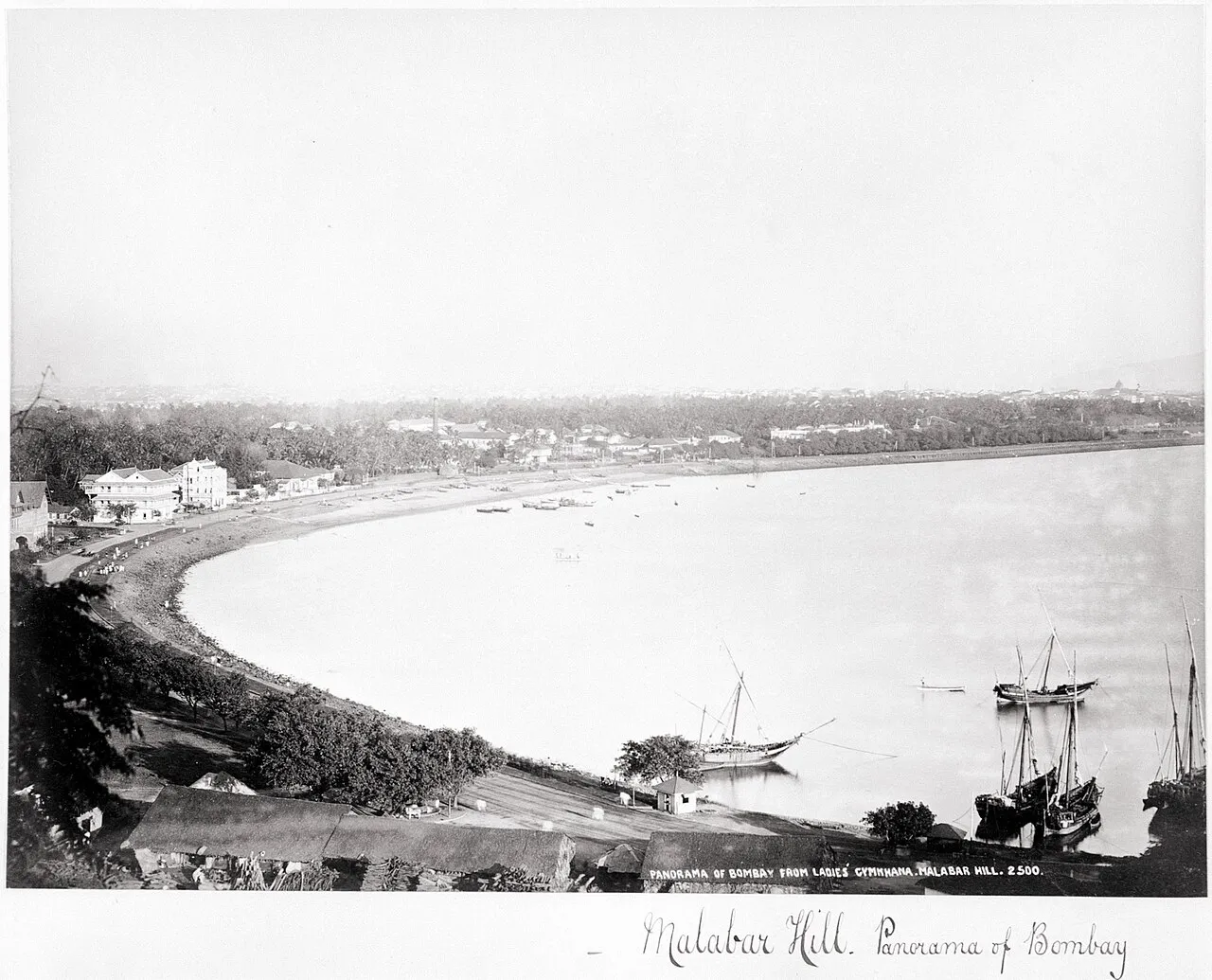
Families remember it the same way. Rashneh Pardiwala, who grew up minutes from Doongerwadi, told the same podcast that her mother called the Parsi method quick, clean and efficient. And Parsi Times reported in January 2024 that some forty to fifty years earlier, vultures were an easy sight around Malabar Hill.
How many vultures did Doongerwadi need?
We have found no historic count of the Doongerwadi vultures, and the estimates of how many were needed differ. In July 2001 The Irish Times quoted experts who said 100 to 120 birds were needed for the daily flow of bodies, against six-odd then left at the towers. In 2015 Dinshaw Rusi Mehta of the Bombay Parsi Punchayet (BPP) told Al Jazeera that 800 deaths a year needed at least 250 vultures.
How old are the dakhmas at Doongerwadi?
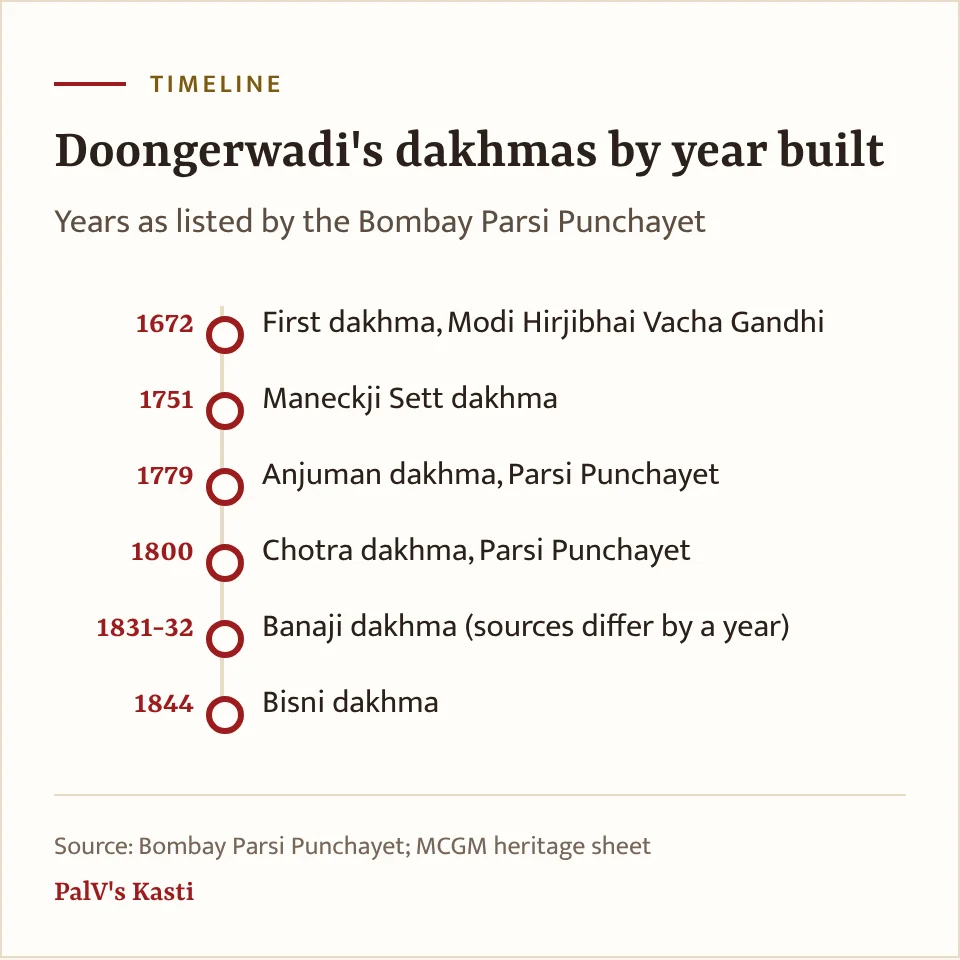
According to the BPP, the first dakhma at Doongerwadi was built in 1672 by Modi Hirjibhai Vacha Gandhi. The Municipal Corporation of Greater Mumbai's heritage sheet dates the grant of land at Malabar Hill to the same year, under Governor Gerald Aungier. The BPP lists the others as the Maneckji Sett dakhma (1751), the Anjuman dakhma (1779), the Chotra (1800), the Banaji (1832) and the Bisni (1844). For the Banaji tower the two sources differ by a year: the municipal sheet, citing a Bombay Samachar report, gives its consecration as 3 June 1831. The BPP's website, read in November 2026, says three dakhmas are in regular use.

The English name came later. Modi notes that the phrase "Tower of Silence" seems to have been first used by Robert Zavier Murphy, once Oriental Translator to the Government of Bombay.
When did the system stop working?
The vultures began to vanish across India in the 1990s, poisoned by the veterinary drug diclofenac. Asad Rahmani, then director of the Bombay Natural History Society, told Al Jazeera in 2015 that they had left the Tower of Silence nearly 30 to 35 years before. Without them, the dakhmas still rely on the sun, but NPR reported in 2012 that work vultures did in hours could now take weeks. Why the birds vanished and what is being done about it is covered in our hub on Vultures and the Tower of Silence.
Frequently asked questions
How long did vultures take at the Tower of Silence?
A description of a Bombay tower quoted by J.J. Modi in 1922 says an hour or two. AFP wrote in 2016 that the traditional system took about an hour, and the 99% Invisible podcast said in 2024 that the birds often needed only about 30 minutes. Without vultures, NPR reported in 2012, the same work can take weeks.
What happens to the bones in a dakhma?
Once the vultures had done their work, the bones were left to dry in the sun and then placed in the central well of the dakhma. The description of a Bombay tower that J.J. Modi quoted in 1922 says they gradually crumbled to dust there, and saw in this the rich and the poor becoming equal after death.
Why must the body be laid in the dakhma by day?
Ervad Dr Ramiyar Karanjia writes that the light of the sun is essential when the body is laid in the dakhma, a principle called Khurshed Nagirashni, "under the gaze of the sun". For that reason, he writes, the Geh-sarna prayers must be held in daytime. Practice varies, so families should follow their own priest's guidance.
Who goes inside the dakhma at Doongerwadi?
Only the khandias, the corpse bearers, carry the body inside. The Irish Times reported in 2001 that relatives hand the body over to them at a gate short of the towers, and Open magazine reported in 2016 that no family member is allowed inside once the body has been taken in.


