 PalV's Kasti
On this page
The Uthamna is the prayer ceremony held on the third day after a Parsi death, the day Ervad Dr. Ramiyar Karanjia describes as the soul's last in this material world. Priests recite the geh prayers, the Sarosh Yasht Hadokht and the Patet, the prayer of repentance, in the deceased's name, and a priest names the departed person in the Dhup prayer that asks for Sarosh Yazad's protection. Family and friends gather to sit with the bereaved. At the end, flowers are passed round, rose water is sprinkled on the hands of those present, and people quietly pledge a good deed or a charity in the deceased's memory. Karanjia describes two performances, one in the afternoon of the third day and one before dawn of the fourth.
શહેરેવર રોજ
Shehrevar Roj, Tir Mah · 1396 Y.Z.
What does the word Uthamna mean?
You will see it written Uthamna, Uthamnu and, in older English books, Oothamna. J.J. Modi, in "The Religious Ceremonies and Customs of the Parsees" (1922), traces it to the Gujarati verb uthvun, to get up or to depart, because on this day the soul rises, as it were, and leaves this world. The FEZANA glossary gives the same sense in reference to the soul. Karanjia, writing in Jame Jamshed in 2018, is less sure. He calls the derivation "not very clear" and suggests it may come from mourners rising from the floor mats used at the Geh Sarna.
When and where is the Uthamna held?
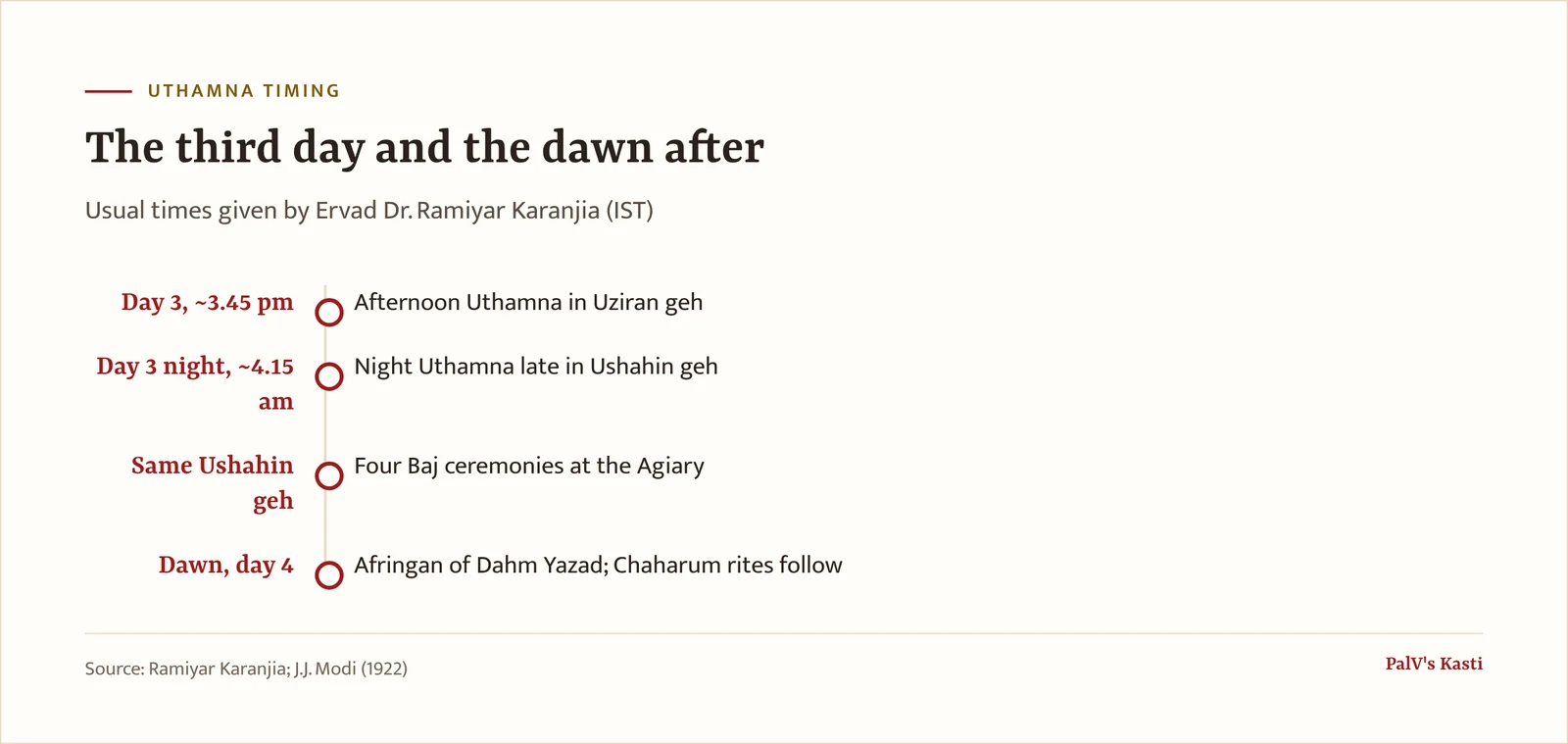
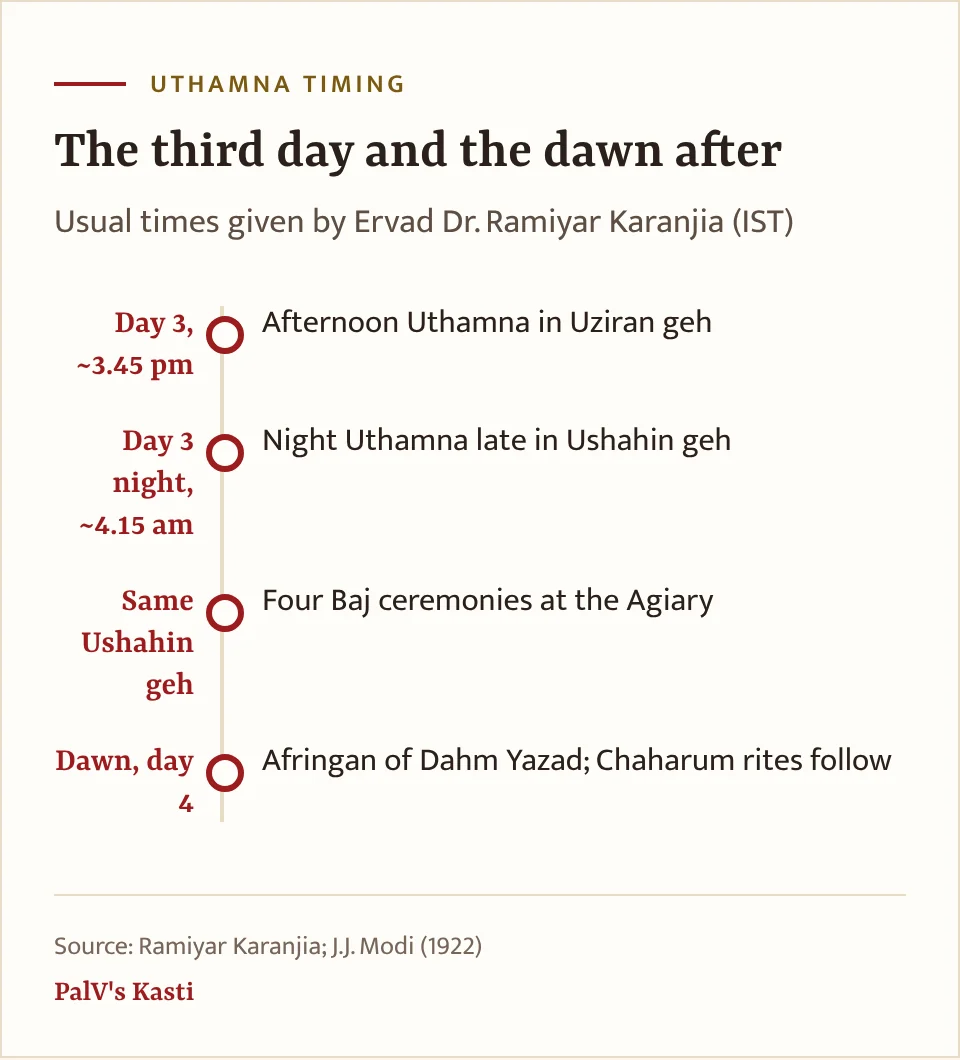
On the third day after death. Karanjia gives the usual pattern as two performances: one in the Uziran geh at about 3.45 pm (IST), and one towards the end of the Ushahin geh at about 4.15 am (IST), just before dawn of the fourth day. The FEZANA glossary likewise describes an afternoon and a midnight ceremony. Modi explains the pair. The proper moment, he writes, is the end of the third night, when the soul is held to depart, and the afternoon Uthamna exists so that friends and relations can attend. Of the two, he says, only one is necessary, especially the one at the end of the night. Karanjia calls the Uthamna a sort of condolence meeting, where friends and relatives come to console the family.
For the venue, Karanjia lists the Doongerwadi, an Agiary or Atash Behram, or any other ritually clean place. Modi named the home of the deceased if it could hold the gathering, a nearby fire temple, or another public place. An Uthamna can also be held in another town. After Ratan Tata's death, Parsi Times (19 October 2024) reported Uthamnas organised by the communities of Navsari, Jamshedpur and Nagpur.
Practice varies between families and Agiaries; your family priest's guidance comes first.
How is the afternoon Uthamna performed?
Modi (1922) and Karanjia (2018) describe the same order, with small differences in detail. Karanjia says five, seven or nine priests take part, usually an odd number, and that a Dasturji may join as a mark of respect for the deceased. The priests first perform the padyab-kusti.
- Standing and facing west, the priests recite the Khorshed and Meher Nyaesh twice. Modi explains that the first recital is each person's own daily duty and the second is said for the deceased. In his description the assembled mourners stand and pray with them.
- They recite the Doa Nam Setayashne and the namaskar of the four directions (Char dishano namaskar). Modi adds that those present then exchange the Hamazor.
- The priests spread a white cloth, set out the fire vase and the other implements, and sit in two rows facing each other.
- Seated, they recite the Uziran geh and the Sarosh Yasht Hadokht.
- The senior priest or Dasturji leads the Patet Ravan-ni and the others join in. Modi notes that the deceased's name is taken in its last section.
- Meanwhile one priest stands before the fire, with trays of flowers and rose water before him, and recites the Dhup prayer (Dhup-nirang, also called Dhoop sarna), naming the deceased.
- All recite the Doa Tandarosti, which Modi describes as a prayer for blessings on the surviving head of the family.
When the deceased was married, the family may choose a Jora nu Uthamnu, in which the spouse is also named and two priests recite the Dhup prayer. We explain that variant separately in Jora nu Uthamnu.
Practice varies between families and Agiaries; your family priest's guidance comes first.
How is the night Uthamna different?
Karanjia places it late in the Ushahin geh, shortly before the fourth day dawns, and notes that close family members and friends are generally the ones present. His lists for it include the Sarosh Baj, the Ushahin geh, the Sarosh Yasht Hadokht, a Nyaesh, the Doa Nam Setayashne, the Patet Ravan-ni, the Dhup prayer naming the deceased and the Doa Tandarosti.
Practice varies between families and Agiaries; your family priest's guidance comes first.
What happens with the flowers, rose water and pledges?
Once the prayers end, an attendant goes round with a tray of white flowers and rose petals and a rose-water sprinkler. Modi describes consecrated flowers being handed out and rose water sprinkled on the gathering. Karanjia describes people holding their hands over the tray while rose water is sprinkled on them. That is the moment to make a silent pledge: some charity, or prayers or a ceremony to be done in the deceased's memory. Karanjia adds that someone who cannot pledge anything may simply recite one Ashem Vohu for the departed then and there.
In earlier generations the pledges were spoken aloud. Modi records that a large part of the many lakhs of rupees Parsis gave to public charity was announced at these third-day gatherings, in the naiyat (memory) of the dead. He also describes the Sosh bhanavvi, in which an heir, usually the eldest son or a near relative, undertook before the senior priest to have set ceremonies done for the deceased. Karanjia writes that a religious heir (palak) was once appointed after the Uthamna if the deceased had no child. Why these pledges were thought to matter is the subject of our post on Uthamna significance.
Practice varies between families and Agiaries; your family priest's guidance comes first.
How should family and guests attend an Uthamna?
Karanjia's guidance in his question-and-answer pages on death and Dokhmenashini is short. Do the kusti after the change of geh (Modi's account also has the gathering perform the padyab-kusti as the Uziran geh begins). Bring a piece of sandalwood and lay it on the tray kept for it. Pray rather than talk: your own farajyat prayers, then prayers for the deceased such as the Sarosh Yasht Hadokht or the Patet Ravan-ni. He also notes that in recent years relatives and friends have taken to bringing flowers, often white, which the family arranges in vases placed on the carpet.
For the family, a few practical steps: confirm the place and the geh timing with your priest, and tell relatives who live away early, since the afternoon Uthamna is the one most people can reach.
Practice varies between families and Agiaries; your family priest's guidance comes first.
What comes after the Uthamna?
Later in the same Ushahin geh, four Baj ceremonies are performed at the Agiary. Modi and Karanjia both name them: for Rashnu and Ashtad, for Ram (Vay), for Ardafravash, with a set of new clothes (the Siav) consecrated alongside, and for Sarosh. At dawn of the fourth day an Afringan in honour of Dahm Yazad is recited, and the Chaharum (fourth-day) rites follow.
The full sequence of the first four days is set out in our guide to After-death prayers, and the funeral itself in Parsi death rituals.
Practice varies between families and Agiaries; your family priest's guidance comes first.
Frequently asked questions
On which day after death is the Uthamna held?
The Uthamna is held on the third day after death. Ervad Dr. Ramiyar Karanjia gives two usual times: the Uziran geh at about 3.45 pm IST, and late in the Ushahin geh at about 4.15 am IST, before dawn of the fourth day. J.J. Modi wrote that the pre-dawn one is the more essential of the two.
Can I attend an Uthamna if I am not a close relative?
Yes. Karanjia describes the Uthamna as a kind of condolence meeting where friends and relatives come to console the family, and Modi says the afternoon one exists so that friends can attend. Do your kusti after the geh changes, offer a piece of sandalwood, and pray quietly rather than chat.
What should I pledge when the rose water comes round?
Any good act you will actually do in the deceased's memory: a gift to charity, or prayers or a ceremony for the soul. Karanjia writes that the pledge is made silently, and that a person who cannot promise anything may recite a single Ashem Vohu for the departed at that moment instead.
Is Uthamnu the same as Uthamna?
Yes. Uthamnu, Uthamna and the older English spelling Oothamna all name the same third-day ceremony. Modi derives the word from the Gujarati uthvun, to get up or depart, referring to the soul leaving this world. Jora nu Uthamnu is the form of the ceremony in which a married person's spouse is also named.


