 PalV's Kasti
On this page
- Why did vultures disappear from the Towers of Silence?
- How far did India's vulture population fall?
- Has India banned diclofenac for animals?
- What does the loss of vultures mean for Parsi funerals?
- How did vultures work at Doongerwadi before the decline?
- Did losing the vultures affect people outside the Parsi community?
- Are vultures coming back to the Towers of Silence?
- Frequently asked questions
Vultures vanished from India's Towers of Silence because of diclofenac, an anti-inflammatory painkiller that Indian farmers began giving to their cattle in the early 1990s. Vultures that fed on treated carcasses died of kidney failure. Surveys by the Bombay Natural History Society (BNHS) in 2003 found the white-backed vulture down by more than 99% since the early 1990s. For Parsi funerals, the loss means that dokhmenashini, which relies on the sun and on birds of prey, now works far more slowly, with bodies taking weeks rather than hours. That has led to solar concentrators at Doongerwadi, talks on a vulture aviary there, and a move by some families to cremation. In August 2026 the BNHS director said the birds had left Mumbai.
શહેરેવર રોજ
Shehrevar Roj, Tir Mah · 1396 Y.Z.
Why did vultures disappear from the Towers of Silence?
The cause is diclofenac. In January 2004 Lindsay Oaks and colleagues of The Peregrine Fund showed in Nature that tissue from livestock given a standard veterinary dose shortly before death was lethal to captive vultures. Later that year a team led by Rhys Green of the RSPB and the University of Cambridge reported in the Journal of Applied Ecology that contamination of under 1% of carcasses was enough to explain the crash. Green called diclofenac "the main cause - possibly the only cause". A separate 2004 paper by Susanne Shultz and colleagues in the Proceedings of the Royal Society B reached the same conclusion for the whole subcontinent.
The towers were exposed to the drug in two ways. Birds could pick it up from dead cattle, and from the deceased themselves. Asad Rahmani, then director of the BNHS, told Al Jazeera in 2015 that diclofenac kills a vulture whether it comes "from a dead Parsi or from a dead cow". Parsi Times reported in January 2024 that vultures could easily be seen around Malabar Hill some forty to fifty years earlier, and that there had been almost no sightings in the past decade.
How far did India's vulture population fall?
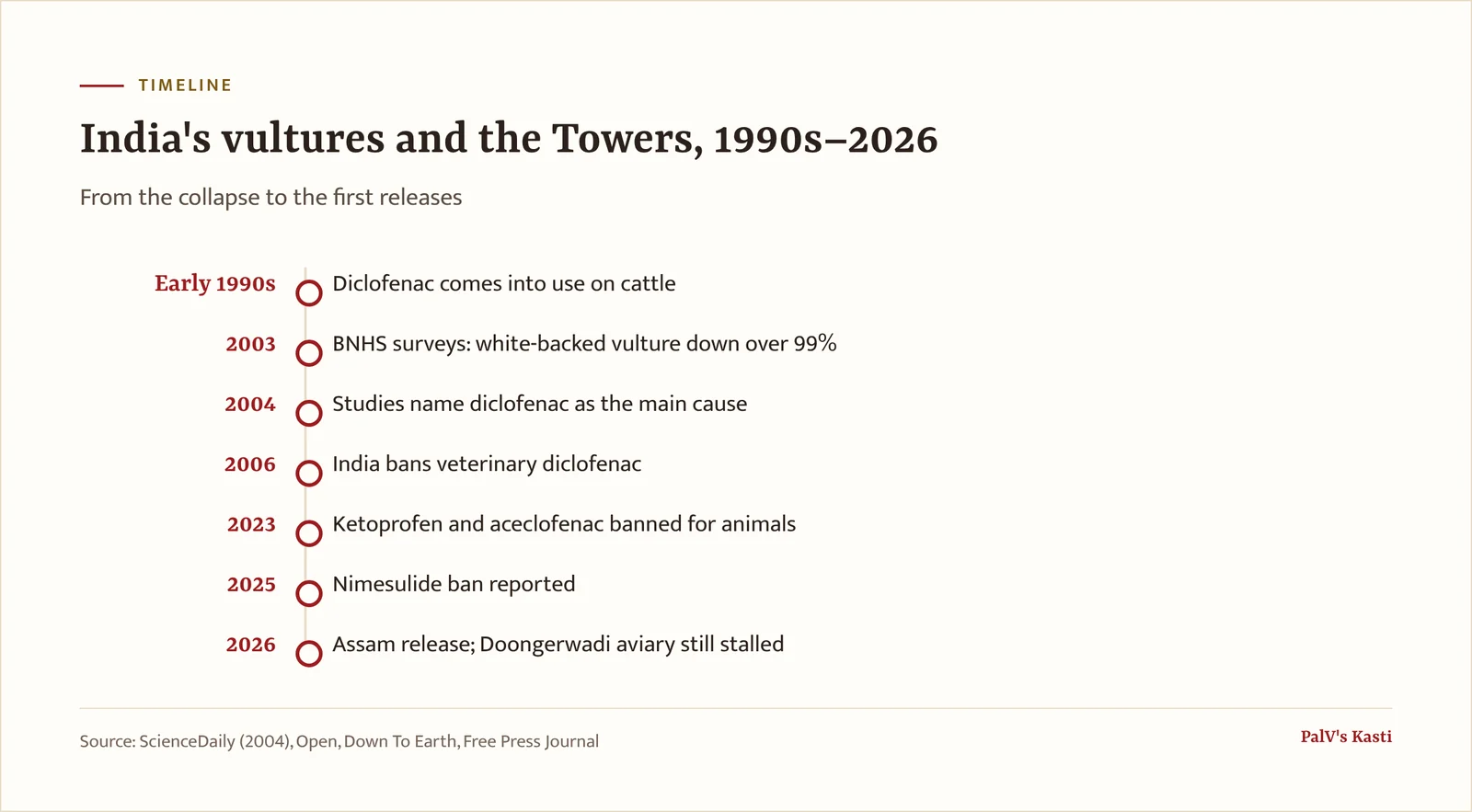
Very far, and very fast. A 2004 summary of the Journal of Applied Ecology study, published by ScienceDaily, gave the BNHS survey results of 2003: the oriental white-backed vulture down by more than 99% since the early 1990s, and the long-billed vulture down by more than 97%. Between 2000 and 2003 white-backed vultures were still falling by an average of 50% a year in India and Pakistan. By then the IUCN had listed the white-backed, long-billed and slender-billed vultures as Critically Endangered. Open magazine, writing in 2011, put the overall fall at 97 to 99% in less than ten years. In August 2026 the Free Press Journal said Gyps vultures had fallen by nearly 99% over two decades.

Has India banned diclofenac for animals?
Yes, for veterinary use. India banned veterinary diclofenac in 2006, as reported by Open in 2011, AFP in 2016 and the Free Press Journal in 2022. By a notification dated 31 July 2023, the Union Ministry of Health and Family Welfare also banned the manufacture, sale and distribution of ketoprofen and aceclofenac in animals, Down To Earth reported. The notification was issued under section 26A of the Drugs and Cosmetics Act, 1940. Vibhu Prakash of the BNHS told the magazine that aceclofenac is converted to diclofenac as soon as it is given to an animal. In January 2025 Down To Earth reported that nimesulide, another painkiller found to be lethal to vultures, had also been banned, with the curbs aimed at veterinary use. The Free Press Journal in August 2026 listed it among the now-banned drugs.
None of this covers people. The anthropologist Anne Rademacher noted in 2019 that the diclofenac ban was not applied to human use, so the drug remains widely available. For the Towers of Silence this matters directly, because a vulture can be poisoned by a body as well as by a carcass.
This is general information, not legal advice; for a specific case, speak to a lawyer.
What does the loss of vultures mean for Parsi funerals?
Ervad Dr Ramiyar Karanjia lists four principles behind dokhmenashini, and two of them are exposure to the rays of the sun and exposure to birds of prey. J.J. Modi's 1922 account of the Bombay towers describes the same pairing, with the body left uncovered so that the birds would find it and the bones then dried by the tropical sun. Khojeste Mistree described the method to NPR in 2012 in much the same terms.
Without vultures, the process is much slower. Karanjia told NPR that vultures are very quick, that it now works "a bit slowly", and that some people find this emotionally disturbing. NPR reported that what vultures did in hours could take weeks. Al Jazeera reported in 2015 that full decomposition could sometimes take eight weeks. On his own website Karanjia writes that the birds-of-prey principle has weakened over roughly the last two decades, but that the other three still work well and dokhmenashini remains effective.
The Bombay Parsi Punchayet (BPP) has tried to make up for the loss. BPP member Dinshaw Rusi Mehta told Al Jazeera in 2015 that 800 deaths a year needed at least 250 vultures, and that solar concentrators had been installed because there were none. Some families have chosen cremation instead. The prayer hall at the Worli crematorium opened in August 2015, and in January 2024 the Prayer Hall Trust estimated that 15 to 20% of Parsi funerals in Mumbai took place at crematoriums, the Free Press Journal reported. Outside Mumbai, Dastur Fardoon of Bengaluru told the Deccan Chronicle in 2016 that the city's tower was hardly used and that bodies there were simply exposed to the sun.
Practice varies between families and Agiaries; your family priest's guidance comes first.
How did vultures work at Doongerwadi before the decline?
Quickly. A description of a Bombay tower that J.J. Modi quoted in 1922 says the body was stripped by vultures within an hour or two. How the platforms, the khandias and the birds worked together is explained in Vultures at Doongerwadi, and what a dakhma is and how it is used is covered in our guide to the Tower of Silence.
Did losing the vultures affect people outside the Parsi community?
According to the economists Eyal Frank and Anant Sudarshan, yes. Their study, summarised by the Energy Policy Institute at the University of Chicago, estimates that the functional extinction of vultures raised human mortality in India by over 4%, because carcasses were no longer being cleared, and puts the damage at $69.4 billion a year. Open reported in 2011 that one estimate had India's dog population rising by about a third between 1992 and 2003, the decade of the vulture decline.
Are vultures coming back to the Towers of Silence?
Not yet. Captive breeding is producing birds for release elsewhere. Parsi Times reported in January 2024 that the BNHS had released ten long-billed vultures into Tadoba Tiger Reserve and Pench National Park and hoped to set up an aviary at Doongerwadi. On 8 August 2026 the Free Press Journal reported the release in Assam of five captive-bred slender-billed vultures and five white-rumped vultures by the Assam Forest Department and the BNHS.
Mumbai is harder. BNHS director Kishore Rithe told the Free Press Journal in August 2026 that the birds had left Mumbai, that Doongerwadi is surrounded by housing, and that they would not adopt the area without a permanent food supply. BPP chairman Viraf Mehta told the paper the next day that a donor had offered to pay for an aviary and a plot had been identified, but that the trust still needed a test, short of a post-mortem, to tell whether a body carries diclofenac. As of that report, the question was unresolved.
Frequently asked questions
What killed India's vultures?
Diclofenac, an anti-inflammatory drug given to cattle in India from the early 1990s. Vultures feeding on treated carcasses suffered kidney failure. Studies published in 2004 in Nature, the Journal of Applied Ecology and the Proceedings of the Royal Society B identified it as the main cause, and one found that contamination of under 1% of carcasses was enough.
When did vultures disappear from Doongerwadi?
BNHS director Asad Rahmani told Al Jazeera in 2015 that vultures had disappeared from the Tower of Silence nearly 30 to 35 years earlier. Parsi Times reported in January 2024 that they were easy to spot around Malabar Hill forty to fifty years before, with virtually no sightings in the decade before that report.
Is diclofenac still used in India?
Yes, for people. India banned veterinary diclofenac in 2006, and ketoprofen and aceclofenac for animal use in July 2023. Diclofenac is still a painkiller in human medicine, which is why the Bombay Parsi Punchayet said in August 2026 that it needs a way to identify bodies that carry it before any aviary can work.
How long does dokhmenashini take without vultures?
Much longer than before. A description quoted by J.J. Modi in 1922 says vultures cleared a body within an hour or two. NPR reported in 2012 that the same work could now take weeks, and Al Jazeera reported in 2015 that full decomposition sometimes took eight weeks. Solar concentrators were installed at Doongerwadi to help.
Are there plans to bring vultures back to the Tower of Silence?
Yes, but they have stalled. The BNHS proposed an aviary at Doongerwadi in 2024. In August 2026 BPP chairman Viraf Mehta said a donor and a plot were ready, but the trust still needed a test, short of a post-mortem, for diclofenac in bodies. No aviary had been built as of that report.


