 PalV's Kasti
On this page
Not yet, and nobody involved has said for certain that it can. The Bombay Parsi Punchayet (BPP) has looked at a vulture aviary for Doongerwadi since at least 2001, and every plan so far has stalled. The reasons have changed over 25 years: cost, the lack of long-term funding, how to design an enclosure the community will accept, and the painkiller diclofenac, which can be present in the body of the deceased and is lethal to vultures. In August 2026, BPP chairman Viraf Mehta told the Free Press Journal that a donor had offered to pay for an aviary and a plot had been identified, but the trust was stuck on how to identify bodies carrying diclofenac without an intrusive test. As of that report, no aviary had been built.
શહેરેવર રોજ
Shehrevar Roj, Tir Mah · 1396 Y.Z.
What would a vulture aviary at Doongerwadi actually do?
The idea is to keep vultures in a large netted enclosure, safe from the drugs that wiped out the wild birds, and let them do the work they once did at the dakhmas. On the 99% Invisible podcast in April 2024, this was described as Khojeste Mistree's mission: bring the birds back to the Parsi dead, but protect them inside an enclosure. Why the wild birds disappeared in the first place is covered in our hub on Vultures and the Tower of Silence, and how a dakhma works is explained in our guide to the Tower of Silence.
What has been tried since 2001?
2001: a British raptor expert and 90 wild vultures
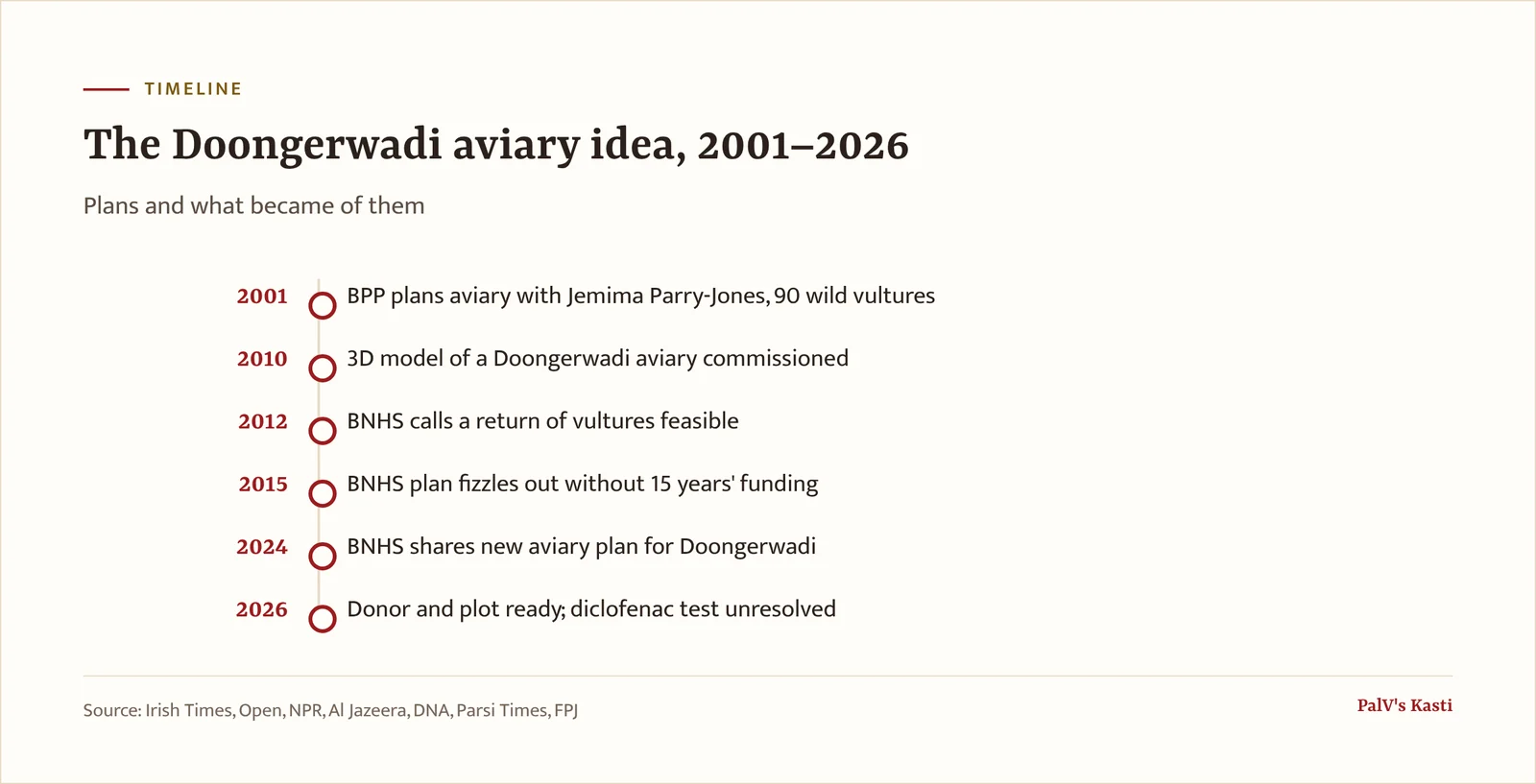
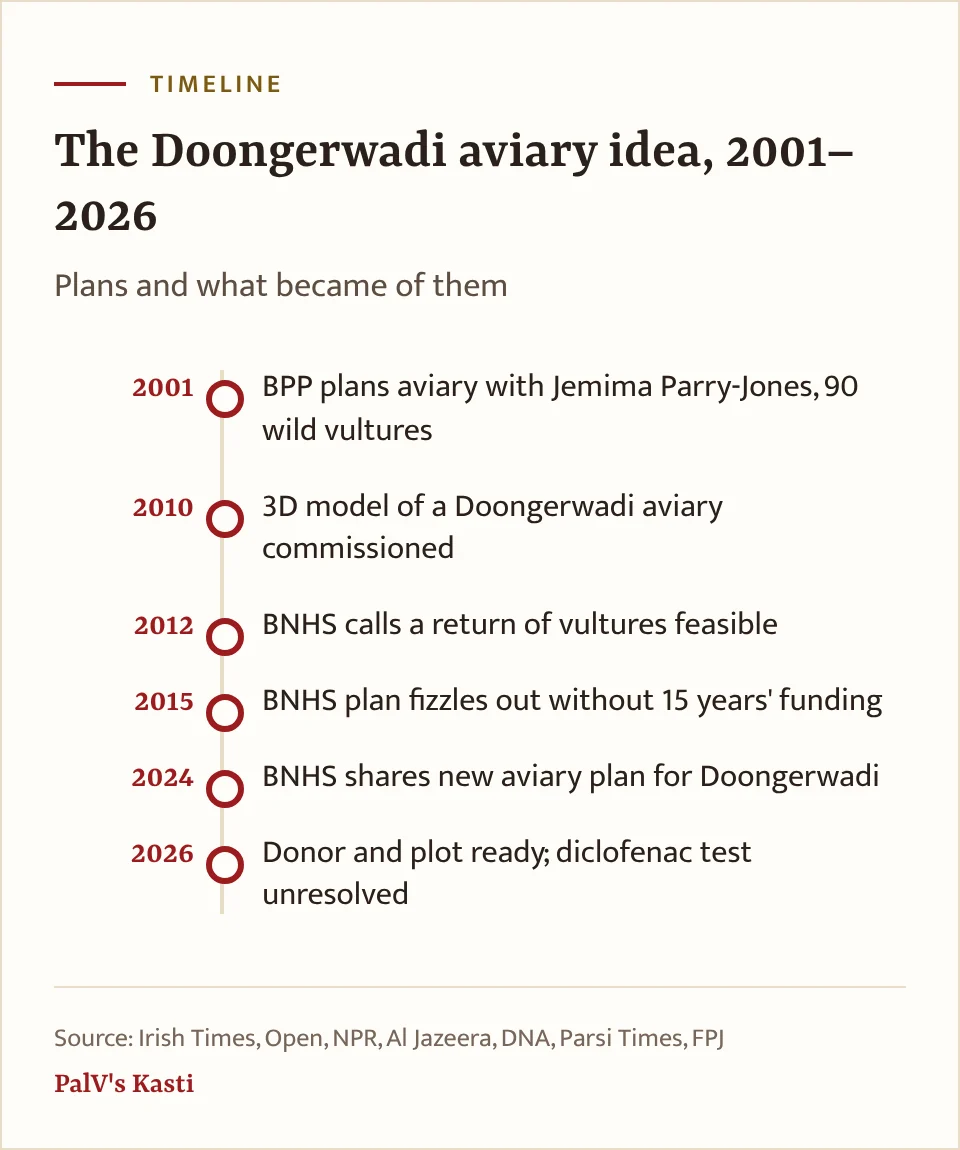
In July 2001 The Irish Times reported that the Punchayet had asked Jemima Parry-Jones of the National Birds of Prey Centre near Gloucester to set up an aviary on the premises. Trustee Rustom Tirandaz said the municipality had allowed it to start with 90 vultures captured from the wild, and that breeding them in captivity was meant to preserve the ritual. Open magazine reported in February 2014 that this plan was scrapped because the BPP thought the cost too high.
Up to 2010: Mistree's giant aviary and a 3D model
The 99% Invisible episode describes a later attempt led by Mistree, who asked Parry-Jones for advice. She told the podcast that the idea put to her was simply to put a big net over each tower and bring in some vultures, and that this could not work. She designed instead an aviary with the towers inside it, which she thought "would have worked possibly". Her conditions were demanding: extra meat to supplement the birds' food, probably goat, places for them to bathe, and an enclosure of enormous size that would be hard to clean. With no consensus on the plan, the podcast says, Mistree stood for the BPP and was elected a trustee in 2008, and in 2010 he had an architecture studio build a 3D model of an aviary at Doongerwadi.
2012 to 2015: a BNHS proposal and a stall
In 2012 Homi Khusrokhan, then president of the Bombay Natural History Society (BNHS), told NPR that bringing vultures back was "the first time it's really become feasible to do."
The BNHS version, as Open described it in 2014, was a main aviary in Sanjay Gandhi National Park with a smaller "satellite" aviary inside Doongerwadi, and vultures back at full strength by January 2014. It did not happen. In May 2015 Dr Vibhu Prakash of the BNHS told DNA that certain BPP trustees had asked for a proposal, but the main centre needed assured government funding for 15 years, which was not available, so the project fizzled out. A month earlier, BNHS director Asad Rahmani had told Al Jazeera that the society talked it over with Parsis, but "nothing came out of our discussion". Al Jazeera added that disagreements within the Punchayet had also stalled it.
At one point, 99% Invisible reports, 19 Parsi physicians signed a letter of concern about the aviary, because diclofenac was and still is given to people, especially at the end of life. Mistree's own verdict: "The aviary project died in natural death."
2024 to 2026: the idea returns
On 27 January 2024 Parsi Times reported that the BNHS had shared plans to bring vultures back to Doongerwadi through an aviary there, after it had released ten long-billed vultures into Tadoba Tiger Reserve and Pench National Park. BNHS president Praveen Pardeshi hoped the birds could settle into their old role once introduced, with other food provided when needed. The same report noted that controlling diclofenac in the bodies of the deceased would be difficult. In August 2026 the release of captive-bred vultures in Assam brought the subject up again, and that is where the current round of talks stands.
Why hasn't an aviary been built at Doongerwadi?
The sources point to five separate problems, and different people stress different ones.
- Diclofenac in the dead. The drug that killed the wild vultures is also a human painkiller. If a body carries it, captive birds that feed on it can die of kidney failure, as Viraf Mehta explained to FPJ in 2026.
- Design. BNHS director Kishore Rithe told FPJ in August 2026 that he had been told an enclosure over the towers is not acceptable to the community, and that a separate enclosure would mean bringing bodies to the cages, which may not fit religious practice.
- The neighbourhood. Rithe also said the birds have left Mumbai and Doongerwadi is ringed by housing, so they would not adopt the site without permanent food and less human movement.
- Money. Cost ended the 2001 plan (Open, 2014), and the lack of 15 years of government funding ended the BNHS plan (DNA, 2015).
- Disease. Dr Homi Dhalla of the World Zarathushti Cultural Foundation told FPJ in February 2025 that a huge aviary is "a risky proposition because of concerns about avian diseases".
Where do the vulture aviary plans stand in 2026?
On 8 August 2026 the Free Press Journal reported that five captive-bred slender-billed vultures and five white-rumped vultures had been released in Assam by the state forest department and the BNHS, at the Jatayu Soft Release Centre in Tewaripal, Biswanath. FPJ called it the first known release of captive-bred slender-billed vultures into the wild anywhere. The news revived calls in Mumbai to bring the birds back to Doongerwadi.
The next day FPJ published an interview with Viraf Mehta. He said talks with the BNHS had been slow, that a donor had stepped up to pay for an aviary and a plot had been found, and that the open questions were practical. How do you draw vultures to one dokhma so that it can be enclosed? How do you tell, after death, whether a body has diclofenac in it, when no family wants a post-mortem? He said the whole board was unanimous on what it wants to do, but called these "teething issues" that had to be resolved first. In FPJ's report of the day before, BPP trustee Adil Malia said: "We are positive that we can arrive at a solution."
So, as of August 2026: a donor and a plot, no agreed design, no non-intrusive diclofenac test, and no aviary.
Who supports an aviary, and who has doubts?
Support has come from the BPP itself at different times, from Tirandaz in 2001 to Mehta and Malia in 2026. In 2015 Al Jazeera reported that four of the seven trustees held that the "sky burial" is the only religious method for a Parsi body and that aviaries should be installed, while the others wanted modern technology. Speaking to FPJ in August 2026, Dr Viraf Kapadia, a Nepean Sea Road resident, put the orthodox view this way: "the orthodox feel that Dokhmenashini will not work without vultures."
Doubts come from several directions. The physicians' letter worried about diclofenac. Dhalla worried about disease. And Mistree, who championed the aviary for years, told 99% Invisible in 2024 that he now sees the vultures as secondary to the system: "The most important is the sun." Families thinking about the wider choices, including cremation, may find our piece on the Zoroastrian green funeral useful, and for how writers have reflected on the empty skies, see our Towers of Silence personal essay post.
Practice varies between families and Agiaries; your family priest's guidance comes first.
Frequently asked questions
Are there any vultures at Doongerwadi today?
Very few, if any. Parsi Times reported in January 2024 that vultures were once easy to spot around Malabar Hill but there had been virtually no sightings over the previous decade. In August 2026 BNHS director Kishore Rithe told the Free Press Journal that the birds have left Mumbai altogether.
Who would build and run a vulture aviary at Doongerwadi?
The Bombay Parsi Punchayet, which manages Doongerwadi, has been discussing it with the Bombay Natural History Society. In August 2026 BPP chairman Viraf Mehta told the Free Press Journal that a donor had offered to pay for the aviary and a plot had been identified. No construction had been announced as of that report.
Why is diclofenac such a problem for an aviary?
Diclofenac is the veterinary drug blamed for India's vulture collapse, and it is also prescribed to people as a painkiller. Captive birds feeding on a body that carries it can suffer kidney failure. The BPP said in 2026 it needs a non-intrusive way to identify such bodies, because families do not want post-mortems.
Could a net simply be put over the Towers of Silence?
Raptor expert Jemima Parry-Jones told 99% Invisible in 2024 that a net over each tower alone would not work, and she designed a much larger aviary instead. In 2026 BNHS director Kishore Rithe said he had been told that an enclosure over the towers is not acceptable to the community.
Have captive-bred vultures been released anywhere in India?
Yes. Parsi Times reported in January 2024 that the BNHS had released ten long-billed vultures into Tadoba Tiger Reserve and Pench National Park. In August 2026 the Free Press Journal reported the release of captive-bred slender-billed and white-rumped vultures in Assam, which revived Parsi calls for their return to Doongerwadi.


