PalV's Kasti
On this page
Homaji was a Parsi of Bharuch (Broach) who was hanged in Bombay in 1783, at the height of the quarrel between Kadmi and Shahenshahi Parsis over the calendar. He was accused of kicking a pregnant woman and causing her to miscarry. Dosabhai Framji Karaka's History of the Parsis (1884) records that he was tried in Bombay, convicted of murder and sentenced to death. Parsi Times writers Noshir Dadrawala and Khushroo P. Mehta tell it as a story of innocence: in their accounts the charge was false and he was condemned on false testimony. Dadrawala draws the lesson that the community should stop fighting itself and stop falsely accusing those who think differently.
અસપંદામેદ રોજ
Asfandarmad Roj, Tir Mah · 1396 Y.Z.
Who was Homaji?
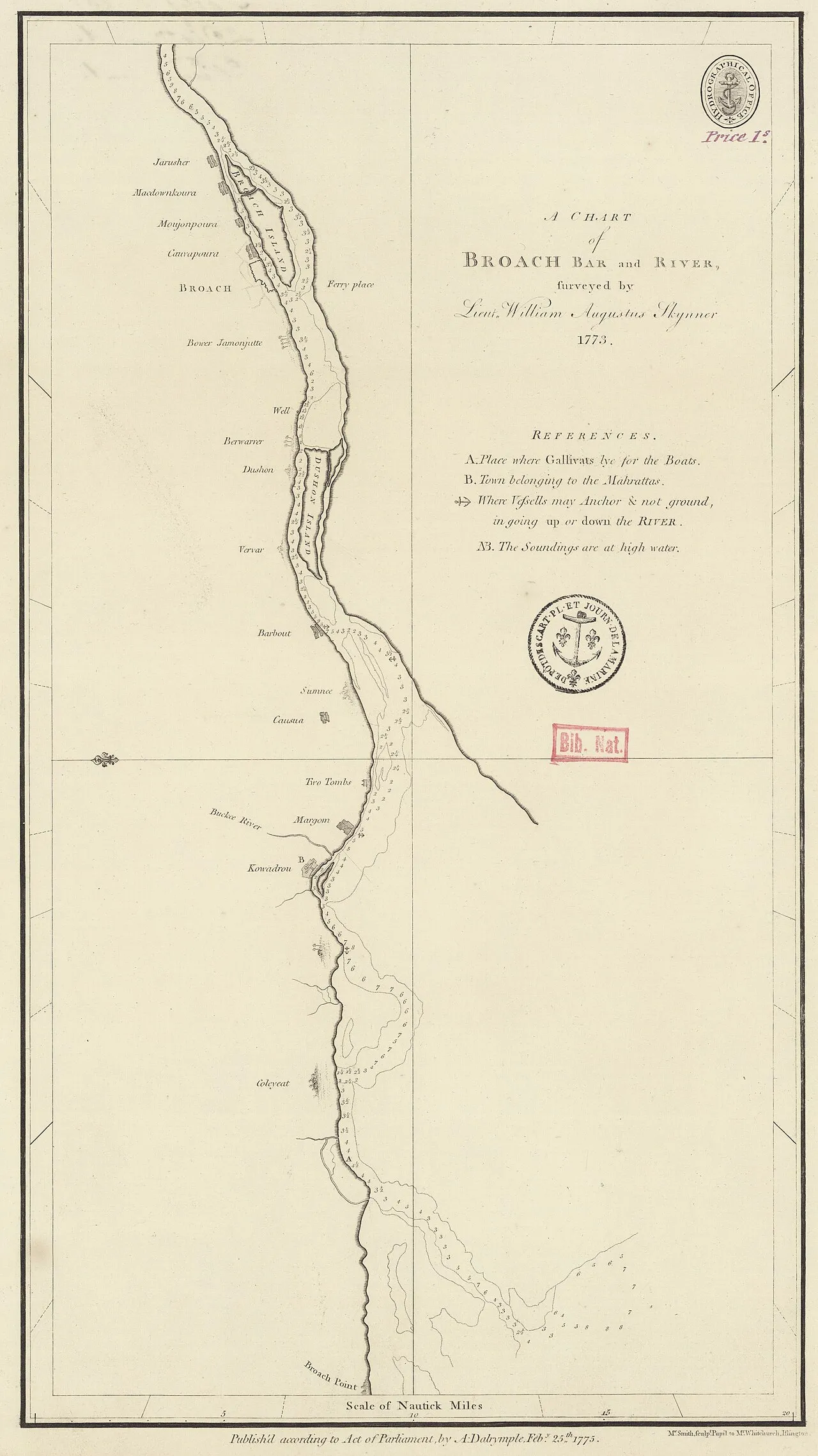
The older books name him Homaji Jamshedji. Karaka uses that form, and J.J. Modi writes "Homajee Jamshedji" in his 1922 Religious Ceremonies and Customs of the Parsees. Dadrawala calls him Homa, son of Jamshed Zaahiaa, and describes the father as a weaver of Bharuch and a well-known poet. Mehta's 2016 Parsi Times piece adds that the father was a prominent citizen of the town.
None of the accounts we could open says more about the man himself. What survives is the story of his trial and death, and the remembrance that grew from it.
What was the Kabiseh controversy behind his death?
Kabiseh (Karaka spells it Kabisa) means intercalation: adding days to keep a calendar in step with the sun. Karaka explains that the Parsi year has 365 days, and that the ancient Persians are reported to have added a whole month once every 120 years to keep it in line with the solar year. At some point the Parsis of India and the Zoroastrians of Iran ended up one month apart.
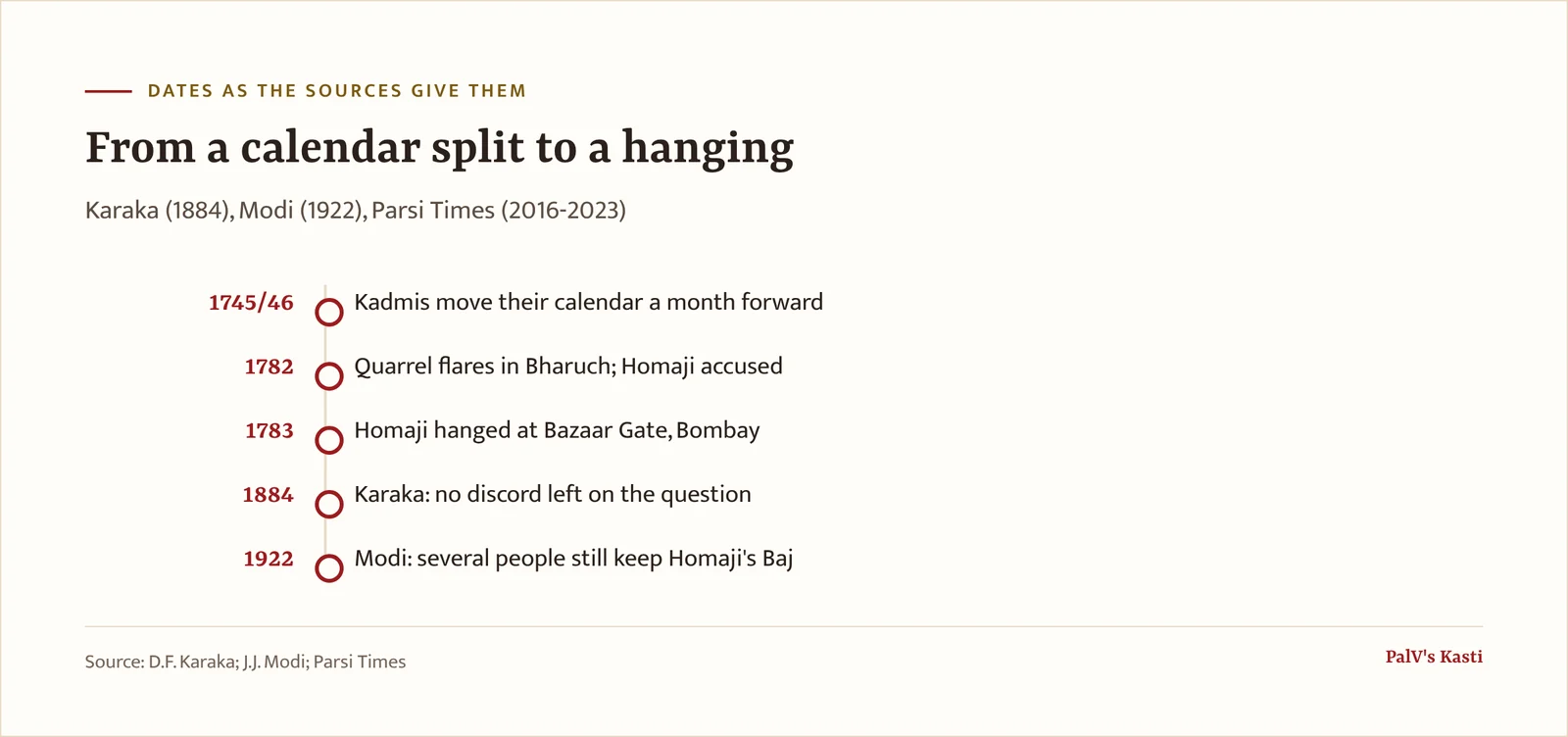
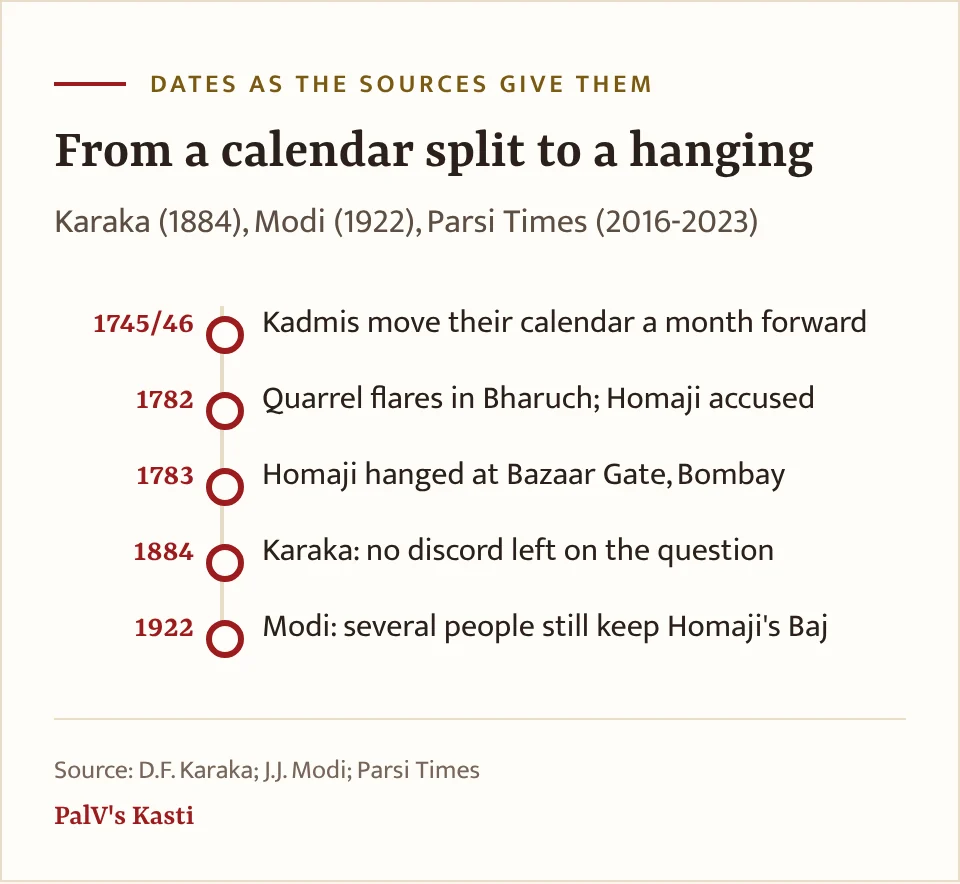
When a group in Gujarat moved their calendar one month forward to match Iran, they took the name Kadmi. Those who kept the old reckoning became the Shahenshahis. The two sources give slightly different dates for the change. Dadrawala puts it in 1745. Karaka gives the year of Yazdegard 1114, which he equates with 1746, and credits an Irani named Jamshid and a few priests with bringing in the Iranian date at Surat.
For decades the quarrel was bitter. Dadrawala writes that the two groups rioted in Parsi mohallas and that marriage between them was long treated as taboo. Karaka, writing of 1782 and 1783, says the Parsis of Broach "had recourse to violence rather than to argument". Our Dae Mah guide covers the month in which Homaji's death is remembered.
What was Homaji accused of, and how was he tried?
The accusation itself is the same in every account we read. Homaji was said to have kicked a pregnant woman, causing her to miscarry. Dadrawala and Mehta place this in Bharuch in 1782. Dadrawala adds that the woman was a Kadmi and Homaji a Shahenshahi.
On the trial, the sources differ in detail:
- Karaka (1884): Homaji was sent to Bombay and tried in the Mayor's Court, which then handled some of the work later done by the High Court. He was convicted of murder and sentenced to death. Others involved were jailed or fined, and Karaka says the fines came to Rs 3,900 and were paid by the Kadmis.
- Dadrawala and Mehta (Parsi Times, 2016 to 2023): he was tried first before the Nawab of Bharuch and then before the British court in Bombay. He pleaded innocent. Both writers say a false testimony was given against him and that the sentence rested on it. Dadrawala identifies the witness as a Kadmi.
- Modi (1922): he was hanged by the British Government "for the murder of a Parsee lady", in a dispute that grew out of the Kabiseh question and that ended in her death.
When and where was Homaji hanged?
Dadrawala and Mehta both write that Homaji was hanged at the corner of Bazaar Gate in the Fort area of Bombay, on Roj Govad of Mah Dae in 1152 YZ, which they give as 1783 AD. Modi also gives 1783. Karaka places the affair in 1782-83 without naming the day. Roj Govad of Mah Dae is kept as his death anniversary, Homaji ni Baj, and Modi records in 1922 that several people still had his Baj recited on that anniversary.
Practice varies between families and Agiaries; your family priest's guidance comes first.
What did Homaji say before he was hanged?
Here the story passes from the court record into community tradition, and the Parsi Times writers tell it as such. According to Dadrawala, Homaji declared before his death that he was innocent and that the sentence was unjust. Dadrawala adds that Homaji foretold that his false accuser would be found dead on the fourth day after his death, the Chahrum, and promised his blessings to everyone who remembered him for his innocence.
The tradition has more than one ending. In one version that Dadrawala reports, the woman who accused him was found dead at home on the Chahrum. In another, it was the witness who had testified falsely. Mehta's 2016 account says both of them died on that day. Karaka and Modi say nothing about a prophecy.
Dadrawala writes that, over the centuries, devout Parsis have invoked Homaji's blessings against long litigation and false charges. Why he is called the patron of the harassed, and where he is remembered, is covered in our piece on Homaji, patron of harassed souls.
Was Homaji innocent?
The sources do not agree, and we do not take a side. Karaka reports the conviction without comment on guilt. Modi, writing in 1922, notes that many people considered Homaji innocent and a saintly person, and that his Baj was still being kept about 139 years after his death. Dadrawala and Mehta state plainly that he was falsely accused. No record of the Mayor's Court case is available online, so this post sets out each account as its author gave it.
What lessons does the story of Homaji teach?
The clearest statement of a lesson comes from Noshir Dadrawala, in Parsi Times columns of May 2020 and June 2023. For him the story shows how pointless the community's internal fights can be. He observes that few young Parsis today know or care whether someone is Kadmi or Shahenshahi, and that people pray with equal devotion at Kadmi and Shahenshahi Atash Behrams in Mumbai and Surat. Yet the same question once led to riots and to a man's death.
Dadrawala then turns to the arguments of his own day: orthodox against liberal, and disputes over vegetarianism, over burial or cremation, and over intermarried Parsis visiting fire temples. His suggestion is that Homaji ni Baj be a day to resolve against infighting and against falsely accusing those who think, speak or act differently, whether traditional or liberal. That is his reading, offered as a columnist.
Karaka, writing a century after the hanging, makes a related point from history. By 1884, he says, there was "an entire absence of discord" between Shahenshahis and Kadmis on the calendar question, although the two still kept different dates. A quarrel that once cost a life had gone quiet by his time.
Frequently asked questions
Who was Homaji?
Homaji, named Homaji Jamshedji in Karaka's 1884 history and Homajee Jamshedji by J.J. Modi, was a Parsi of Bharuch. Parsi Times writer Noshir Dadrawala calls him Homa, son of Jamshed Zaahiaa, a weaver and poet. He was hanged in Bombay in 1783 during the Kadmi and Shahenshahi calendar dispute.
What was the Kabiseh controversy?
The Kabiseh controversy was the eighteenth-century quarrel over intercalation, the adding of a month to the calendar. A group of Parsis moved their calendar a month forward to match Iran and became the Kadmis, while the rest stayed Shahenshahi. Dadrawala dates the change to 1745. Karaka gives 1746.
What was Homaji accused of?
Homaji was accused of kicking a pregnant woman and causing a miscarriage, in Bharuch around 1782. Karaka writes that he was tried in the Mayor's Court in Bombay and convicted of murder. Modi describes the charge as the murder of a Parsi woman. Parsi Times writers say the accusation was false.
Where was Homaji hanged?
Noshir Dadrawala and Khushroo P. Mehta, both writing in Parsi Times, say Homaji was hanged at the corner of Bazaar Gate in the Fort area of Bombay. They date it to Roj Govad of Mah Dae, 1152 YZ, which they give as 1783. J.J. Modi's 1922 book also gives the year as 1783.
What lesson does Homaji's story teach?
Noshir Dadrawala, writing in Parsi Times in 2020 and 2023, reads the story as a warning against infighting. A calendar quarrel that now hardly matters once cost a man his life. He suggests Homaji ni Baj as a day to resolve against falsely accusing fellow Parsis who think or act differently.