PalV's Kasti
On this page
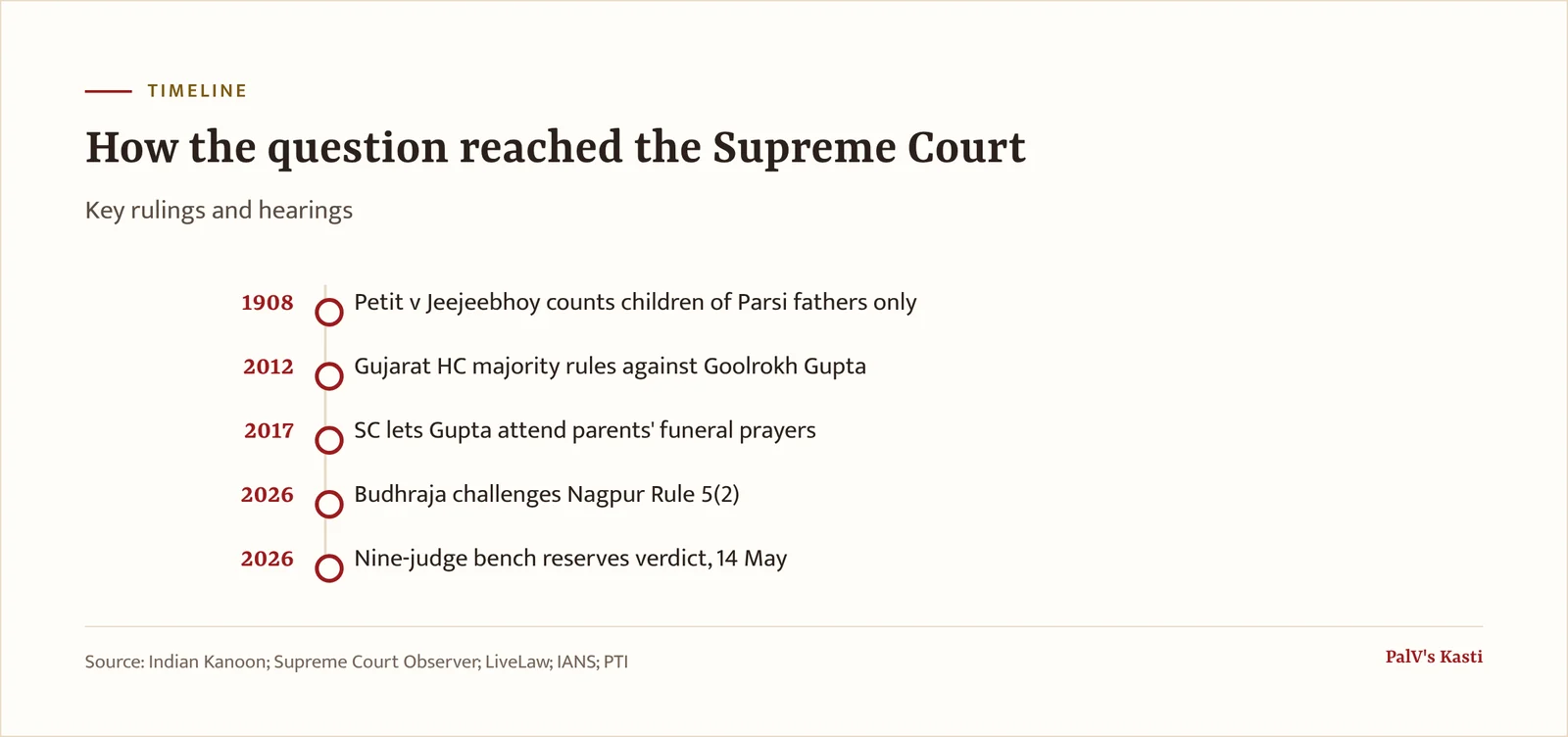
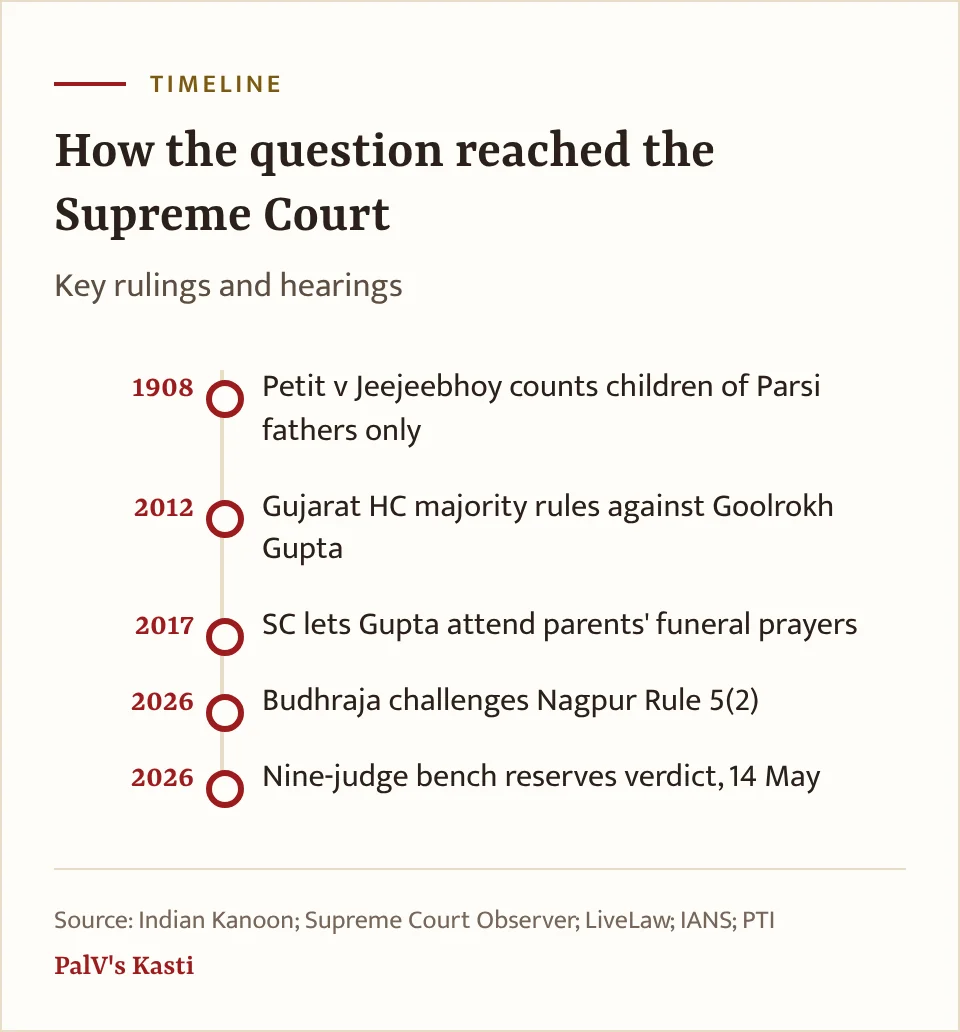
The restrictions trace back to two legal readings. The Bombay High Court's 1908 Petit judgment counted the children of Parsi fathers by non-Parsi mothers as Parsis, with no matching line for mothers. And in 2012 the Gujarat High Court's majority presumed that a Parsi woman who marries out takes her husband's religious status. Under rules such as the Nagpur Parsi Panchayat's, a man who marries out keeps his Agiary access and his children are accepted, while a woman who does so can be kept out, and her children with her. Whether this rests on doctrine or on trust rules is the dispute. The question is before a nine-judge bench of the Supreme Court and is pending as of 16 November 2026.
અસપંદામેદ રોજ
Asfandarmad Roj, Tir Mah · 1396 Y.Z.
What restrictions do intermarried Parsi women face?
Dina Budhraja, born to Parsi Zoroastrian parents, married a Hindu man under the Special Marriage Act, 1954 in 2009 and did not convert, the Indian Express reported on 26 March 2026. When her grandmother was ill in 2024, she wrote to the Nagpur Parsi Panchayat in advance, asking to attend the funeral prayers inside the Agiary. Her petition, as ThePrint reported on 24 March 2026, says the managing committee replied that she was "not permitted to enter the agiary" and could sit outside on the veranda. She held the funeral ceremony at her mother's house, and a month after the death the panchayat told her not to represent herself as Parsi at all, the Indian Express reported. Her counsel told the Supreme Court on 25 May 2026 that Nagpur has only one Agiary and the nearest other fire temple is in Indore, around 400 km away, LiveLaw reported.
In Valsad, the local Parsi trust barred Goolrokh Gupta, who had married a Hindu man, from its institutions, including her parents' last rites when the time came, the Supreme Court Observer records. On 14 December 2017 the Supreme Court recorded an agreed interim arrangement letting her attend her parents' funeral prayers (the Paidust) and the four days of ceremonies after death.
Older reports describe wider exclusion. Outlook reported on 21 April 2003 that such women had in the past been barred from the Tower of Silence for their last rites and were also kept out of Parsi hospitals and sanatoriums. We have found no current source on hospital admission, so treat that as a 2003 report only.
Do Parsi men who marry out face the same rules?
Not under Nagpur's rules, which put the difference in writing. Rule 5(2) of the panchayat's constitution, as quoted in the petition, says that any Parsi or Irani Zoroastrian woman who takes a non-Parsi husband and has children by him will not be accepted as a Parsi, and nor will "her children". The petition says Rule 5(3) leaves a Parsi man who marries a non-Parsi woman with his identity and his Agiary access, and his children are accepted. Noshir Dadrawala told the Hindustan Times in February 2018 that no such rule applies to the children of men who marry out, provided the child's Navjote has been performed. How courts have treated the children of women who marry out is covered in Children of intermarried women.
Is the rule the same at every Agiary and Anjuman?
No. The Indian Express noted in March 2026 that practice is not uniform across panchayats. The Budhraja petition says panchayats in Kolkata and Delhi have allowed women married under the Special Marriage Act into the Agiary, and our guide Can Parsis marry non-Parsis quotes the Delhi Parsi Anjuman's rule. In 2018 the campaigner Vispy Wadia told the Hindustan Times that such women are often "at the mercy of trusts' whims", and that the Calcutta Anjuman had been "very liberal in admitting women". On 5 May 2026, Senior Advocate Darius Khambata told the Supreme Court that the Bombay Parsi trust had passed a resolution in 1991 to allow women's entry, LiveLaw reported. We have not seen the resolution itself.
Why are intermarried women treated differently from men?
Each side gives a different answer, set out here in its own words.
The 1908 definition and descent through the father
The legal starting point is the Bombay High Court's judgment of 27 November 1908 in Petit v Jeejeebhoy, reported at (1909) ILR 33 Bom 509 and 11 Bom LR 85. For the purpose of the community's trust funds, Justice Davar included among Parsis the "children of Parsi fathers by alien mothers" who had been properly admitted into the religion. There was no matching line for the children of Parsi mothers. Davar traced the fathers' exception to Parsi men working far from home in Gujarat's interior who had children with local women and had a priest perform their Navjote.
Dadrawala, in Parsi Times on 28 October 2017, called the resulting gap "mainly historical and not necessarily doctrinal", noting that a century ago it was largely men who married outside. A 2018 Oxford Human Rights Hub post by Priyanka Sunjay said the trusts that bar such women rely on a century-old case reading "Parsi" through a "patrilineal prism". The older cases are traced in our article on Half-Parsis.
The Gujarat High Court's reasoning in 2012
In Goolrokh M. Gupta v Burjor Pardiwala (Special Civil Application No. 449 of 2010, decided 23 March 2012), the majority held that a Parsi woman who married a non-Parsi under the Special Marriage Act is presumed to take her husband's religious status unless a court declares otherwise, DNA reported. Justice Akil Kureshi dissented: "Professing one's religion is a matter of faith." The Oxford post called the majority view an application of "the archaic doctrine of coverture", under which a wife's identity merges with her husband's.
What traditionalist priests and trusts say
Some traditionalist priests oppose marrying out by anyone, men included. Dastur Firoze Kotwal, described as one of the religion's eight high priests, told the Christian Science Monitor in 1998 that the scriptures outlaw all intermarriages. Outlook reported in April 2003 that six high priests had published a resolution calling such marriages irreligious and barring their children, citing the Vendidad. Outlook noted that it reached even children with Parsi fathers. Ervad Marzban Hathiram wrote on Frashogard on 13 October 2016 that interfaith unions are strictly discouraged whatever the person's sex: "The rules apply equally to both."
Trusts also defend their right to decide. Parsi Times reported on 4 November 2023 that the Bombay Parsi Punchayet had declared a Nagpur child of a Hindu father and Parsi mother would not be recognised as Parsi, "in keeping with the law". In the Supreme Court, Senior Advocate Gopal Subramanium, for the respondents in the Gupta case, argued that "Article 26 is not simply about management", Verdictum reported on 22 April 2026.
What reformist priests and campaigners say
Dasturji Khurshed Dastoor, the Udvada head priest, criticised admitting the children of men who marry out but not those of women, Asian Voice reported in January 2016. In 2018 he told the Hindustan Times that a woman married under the Special Marriage Act has "all the rights to continue her religion", adding: "This particular board stopped it, not the community." Dadrawala wrote in 2017 that the texts discouraging inter-faith unions nowhere allow men to marry out and not women. On 6 May 2026, asked by Justice B.V. Nagarathna whether excluding these women was a matter of religion at all, Khambata answered "No", arguing that no doctrine excludes women when intermarried men are still let in, the Supreme Court Observer reported. Wadia told ThePrint in 2023: "there's religious othering of women." The texts each side relies on are in Scripture on mixed marriages.
Practice varies between families and Agiaries; your family priest's guidance comes first.
What has the Supreme Court said so far?
Only remarks from the bench, not a ruling. On 5 May 2026, LiveLaw reported Justice Nagarathna saying that "marriage as a basis for classification is discriminatory against women". The nine-judge Constitution Bench hearing the Sabarimala reference, which includes Parsi women's entry to fire temples after an interfaith marriage, reserved its verdict on 14 May 2026, IANS and the Deccan Chronicle reported. LiveLaw's page on the reference, checked on 16 November 2026, shows no verdict. Budhraja's petition (W.P.(C) No. 381/2026) was held over on 30 May 2026 to await that judgment, PTI reported. Both are pending as of 16 November 2026.
This is general information, not legal advice; for a specific case, speak to a lawyer.
Frequently asked questions
Can a Parsi woman married to a non-Parsi enter a fire temple?
It depends on the trust that runs the Agiary. Nagpur's panchayat told Dina Budhraja in 2024 that she could not enter and could sit on the veranda. Her petition says panchayats in Delhi and Kolkata let such women in. Whether a trust may exclude her is before the Supreme Court, pending as of 16 November 2026.
Why are Parsi men who marry out treated differently?
The Bombay High Court's 1908 Petit judgment counted children of Parsi fathers by non-Parsi mothers, once admitted to the religion, as Parsis, with no such line for mothers. Trusts that bar these women rely on that reading, a 2018 Oxford Human Rights Hub post said. Noshir Dadrawala calls the gap mainly historical.
Can a Muslim man marry a Zoroastrian woman in India?
Yes, under the Special Marriage Act, 1954, which lets any two persons who meet its conditions marry without either converting. The Parsi Marriage and Divorce Act, 1936 covers only marriages between Parsis. After such a marriage, whether the local trust still treats the woman as a Parsi varies, and that question is pending before the Supreme Court.
Do all Parsi trusts bar women who marry out?
No. Each trust or Anjuman sets its own rules. The Nagpur Parsi Panchayat's Rule 5(2) excludes such women and their children, while Dina Budhraja's petition says panchayats in Delhi and Kolkata admit them to the Agiary. In 2018 Vispy Wadia told the Hindustan Times the Calcutta Anjuman had been very liberal in admitting women.