PalV's Kasti

On this page
- Is there one official priestly view on interfaith marriage?
- What do traditionalist priests say about these marriages and Navjotes?
- What do reform-minded priests say and do?
- What do high priests tell families who come to them?
- Can a trust stop a priest from performing these ceremonies?
- Are priests still divided in 2026?
- What should a family planning a mixed wedding or Navjote do?
- Frequently asked questions
Parsi priests do not speak with one voice on interfaith marriage, and no single authority decides for all of them. At one end, Ervad Marzban Hathiram has written that he will not attend the Navjote of a child with one non-Parsi parent, and that a priest who performs one commits a grave sin. At the other, priests such as Framroze Mirza and Khushroo Madon have conducted mixed weddings and these Navjotes for years, and Indian high priests have spoken both ways. In law, the Parsi Marriage and Divorce Act, 1936 defines "marriage" as a marriage between Parsis (section 2(6)) and requires the Ashirvad ceremony by a priest (section 3(1)(b)), so a mixed couple's legal marriage takes place under another law, such as the Special Marriage Act, 1954 (section 4). In practice, what happens depends on which priest a family asks and which trust runs the Agiary or hall. Each position below is given in its own speaker's words, with dates.
અસપંદામેદ રોજ
Asfandarmad Roj, Tir Mah · 1396 Y.Z.
Is there one official priestly view on interfaith marriage?
No. Encyclopaedia Iranica's entry on conversion in modern times (Pargol Saati, 1993) says modern Zoroastrian opinion clusters around reformist and traditionalist tendencies. It adds that "some moderates" on the traditionalist side accept the spouses and children of mixed marriages, while the strictest refuse to accept even Zoroastrians who marry out. The same entry notes that even within one community, a person may reject the ruling of a council or a high priest.
The nearest thing to a collective ruling came in 2003, when six high priests passed a resolution calling marriages outside the community irreligious; our main guide, Can Parsis marry non-Parsis, covers it. Even then, the same report in Outlook (21 April 2003) recorded an exception. Less than a decade earlier, five high priests, some of whom signed the 2003 resolution, had agreed to the Navjote of Neville Wadia in his eighties. Dastur Firoze Kotwal told Outlook: "That was an exception. He had Parsi blood."
What do traditionalist priests say about these marriages and Navjotes?
Ervad Marzban Hathiram, who described himself in 2013 as a priest with nearly 25 years of practice, set out the strict view in a post on the Frashogard site on 13 October 2016, written as a reply to a friend. A friend married to a non-Parsi had invited him to her daughter's Navjote, and he declined. He wrote that he would stay away even if the child were his own. His reason was that nobody can be "initiated" into Zoroastrianism: in his words, "One is born into the faith." To invest such a child with Sudreh and Kusti, he wrote, is "a grave spiritual sin", and for a priest to perform it is a sin "beyond any redemption".
In an earlier Frashogard post (June 2013) Hathiram said marriages and Navjotes performed by "rogue" priests for parents he described as of "indeterminate genealogy" have "no spiritual validity". Iranica describes the same strict position as the traditionalist view: in it, "only a child born of Zoroastrian parents" is a Zoroastrian by birth.
Practice varies between families and Agiaries; your family priest's guidance comes first.
What do reform-minded priests say and do?
Some priests have openly performed these ceremonies. In 2003 Outlook reported that Framroze Mirza was placing advertisements saying he was willing to conduct mixed marriages. "This is hypocrisy," he told the magazine, adding that the high priests "themselves have blessed" such marriages and Navjotes in the past.
Khushroo Madon, who had served at the J.D. Agiary in Colaba for two decades, gave his reason to The Better India in December 2017: the Gathas of Zarathushtra, he said, say "non-Parsis can follow our religion". Scroll reported in 2015 that for the previous 15 years Mirza and Madon had been unpopular with orthodox Parsis for conducting inter-religious marriages, for the Navjotes of children with non-Parsi fathers, and for funeral prayers for Parsis who chose cremation or burial.
In North America, Dr Kersey Antia, in The Argument for Acceptance in Zoroastrianism (2015), quotes Dr Lovji Cama telling the Third World Zoroastrian Conference in Bombay in 1978 that "the liberal priests have no objection" to the Navjotes of children of mixed marriages, whichever parent is Zoroastrian. In a separate paper written with Dilshed Antia, he notes that "some liberal priests in North America" initiate such children. Antia also writes that, in his talks with visiting high priests from India, one of them advised a priest to perform the Navjote of a non-Zoroastrian spouse first, before the couple's wedding.
Practice varies between families and Agiaries; your family priest's guidance comes first.
What do high priests tell families who come to them?
Not every high priest takes the line of the 2003 resolution. At the Udwada, Gujarat, one of the holiest Zoroastrian fire temples.">Iranshah Udvada Utsav in January 2016, the Udvada head priest, Dasturji Khurshed Dastoor, described parents who had come to him in tears because an only daughter was marrying outside. His answer, as Asian Voice reported it: "Is the boy nice? Is she happy? Then go ahead."
Dastoor told the Hindustan Times in February 2018 that a Parsi woman who marries a non-Parsi under the Special Marriage Act "has all the rights to continue her religion". Of the Valsad Parsi Anjuman's board of trustees, which had barred Goolrokh Gupta, he said: "This particular board stopped it, not the community." At the level of a single wedding, the archaeologist Kurush Dalal told Outlook in 2003 that a priest at his own wedding to a Bengali college friend said he hoped to see the couple again at their child's Navjote.
Can a trust stop a priest from performing these ceremonies?
The Bombay High Court said a trust could not do so on the terms the Bombay Parsi Punchayet tried in 2009. That year the BPP's trustees barred Mirza and Madon from two south Mumbai Agiaries and Doongerwadi, Scroll reported. In Jamsheed Kanga & Anr v. Parsi Panchayat Funds and Properties & Ors (Appeal No. 256 of 2010, judgment of 11 March 2011), a bench of Justices D.Y. Chandrachud and Anoop V. Mohta held that the ban lay outside "the power and authority" that the 1884 trust deed gives the trustees. Our main guide and Excommunication for marrying out cover the case.
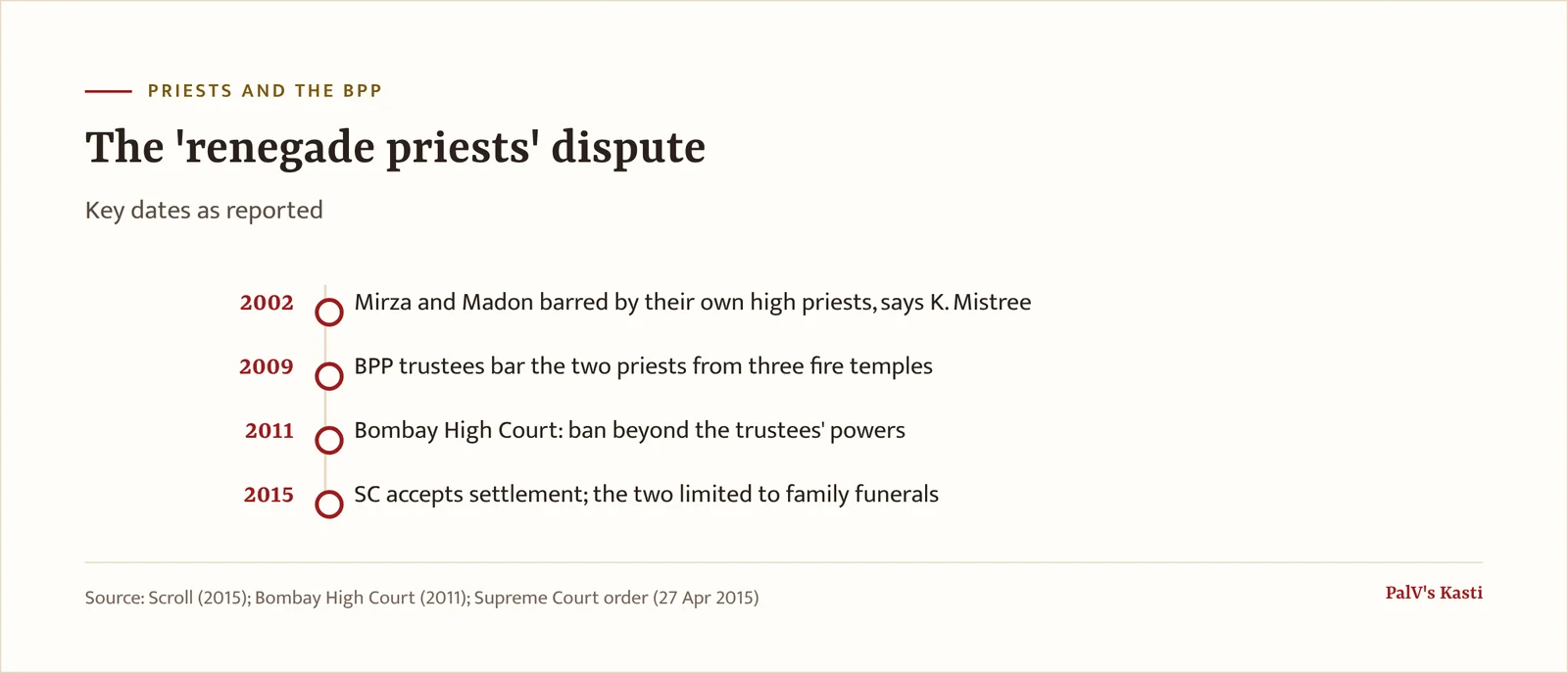
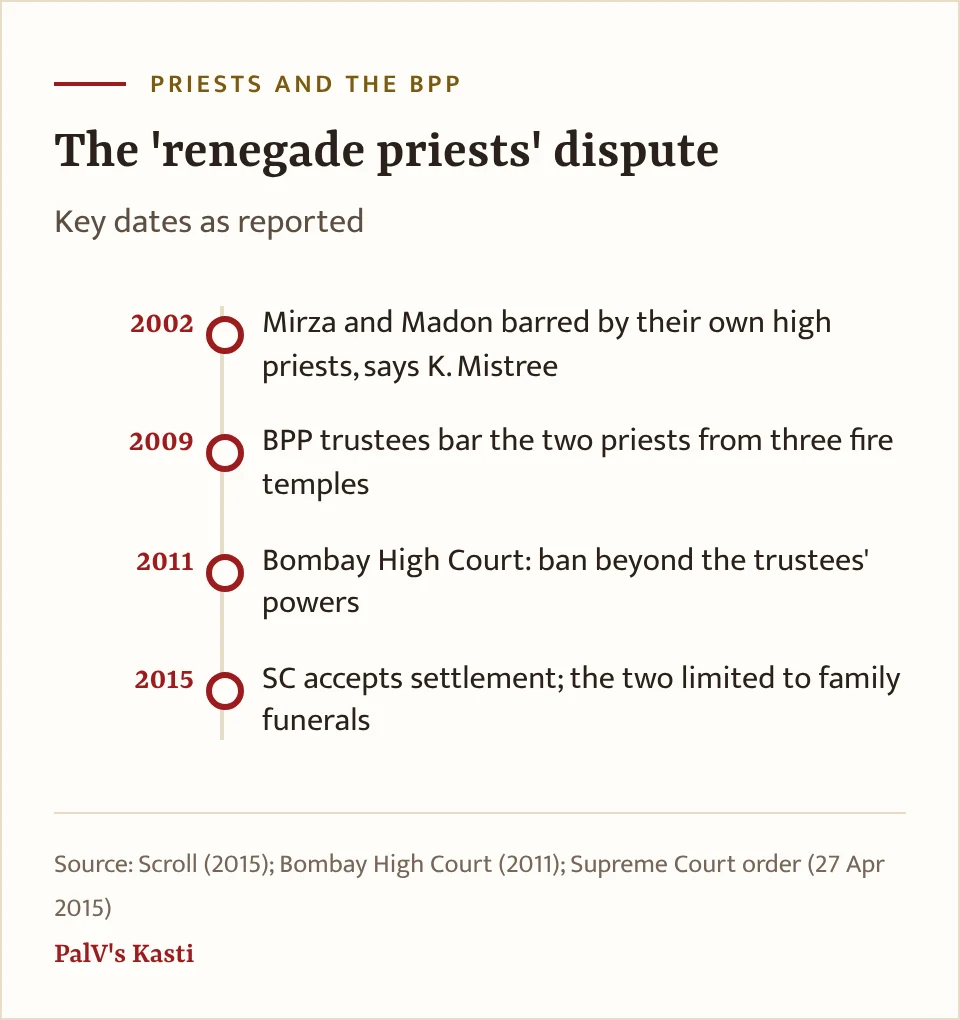
The BPP appealed. In Parsi Panchayat Funds & Properties & Ors v. Jamsheed Kanga & Anr (SLP (C) No. 9732 of 2011), the Supreme Court's order of 27 April 2015 (Justices Ranjan Gogoi and N.V. Ramana) records that the parties had settled in a mediation before retired Justice Sujata Manohar, makes the terms of settlement part of the order and lets the appeals be withdrawn. The order also rejects an application by Ervad Khushroo Madon and Ervad Framroze Mirza to intervene, since they had not been parties at any stage. The order does not set out the terms. According to Scroll (30 April 2015), the trustees cannot limit any Parsi Zoroastrian's right to choose a priest for ceremonies in those three places, but Mirza and Madon may pray there only for funeral rites of their immediate family, and only after filing an affidavit with the BPP. BPP trustee Khojeste Mistree told Scroll that the BPP had acted because the two priests had "already been banned" by their own high priests in 2002. Kerssie Wadia of the Association for the Revival of Zoroastrianism called the settlement "a complete sell-out".
This is general information, not legal advice; for a specific case, speak to a lawyer.
Are priests still divided in 2026?
The question was still live this year. On 6 June 2026 the Free Press Journal reported that Yezdi Hodiwalla, a Bandra resident, had written an open letter to the high priest of the Iranshah at Udvada, Vada Dasturji Tehemton Burjor Mirza. The letter urged him to withdraw from a webinar by the London-based Ba Humata Foundation that would discuss "progressive views on marriage and faith", and it questioned the eligibility of the webinar's chair. Hodiwalla pointed to priests who had earlier declined Ba Humata invitations. The Dasturji denied any link with the event, telling the paper the letter-writer had been "misinformed", that he was not taking part and that he had not been invited.
What should a family planning a mixed wedding or Navjote do?
Start early, and ask direct questions.
- Sort out the legal marriage first. As set out above, a Parsi and a non-Parsi cannot marry under the 1936 Act; our main guide explains the options.
- Ask your family priest plainly whether he will say prayers at the wedding or perform the child's Navjote. Positions differ widely, so don't assume.
- Check the rules of the Agiary, baug or hall you have in mind, because trusts set their own. Our piece on Mixed marriage challenges describes what families have faced.
- For the history of how children of mixed marriages have been treated, see Half-Parsis.
Practice varies between families and Agiaries; your family priest's guidance comes first.
This is general information, not legal advice; for a specific case, speak to a lawyer.
Frequently asked questions
Will a Parsi priest perform an interfaith wedding?
Some priests have, and others refuse. The Parsi Marriage and Divorce Act, 1936 covers marriages between Parsis solemnised by Ashirvad, so a mixed couple marries under another law such as the Special Marriage Act, 1954. Priests such as Framroze Mirza have openly offered prayers for mixed couples, while traditionalists like Ervad Marzban Hathiram oppose such unions.
Will a priest perform the Navjote of a child with one non-Parsi parent?
It depends on the priest. Ervad Marzban Hathiram wrote in 2016 that such a Navjote is "a grave spiritual sin". Khushroo Madon and Framroze Mirza performed them, Scroll reported in 2015, and Kersey Antia records liberal priests in North America who do. Ask your family priest directly before fixing a date.
Did the high priests ban marriages outside the community?
Outlook reported on 21 April 2003 that six high priests had resolved that marrying outside the community is irreligious, and that the offspring of such marriages were excluded from the faith. Outlook added that Dastur Firoze Kotwal later spoke of it as a guideline rather than a fatwa.
Can the Bombay Parsi Punchayet ban a priest for these ceremonies?
In 2011 the Bombay High Court held the BPP trustees' 2009 ban on priests Framroze Mirza and Khushroo Madon beyond their powers. The Supreme Court made a mediated settlement part of its order of 27 April 2015. Under it, Scroll reported, other priests stay free to serve, but those two may perform only their immediate family's funeral rites there.