PalV's Kasti
On this page
- Can the non-Parsi spouse go into the fire temple with the family?
- Is it harder when the Parsi partner is the woman?
- What happens when someone in the family dies?
- Will a priest perform our children's Navjote?
- Who teaches the children the prayers?
- Will relatives come to the wedding?
- Where do some intermarried families go instead?
- Frequently asked questions
The practical challenges that Parsis in mixed marriages have described on record cluster around the family's religious occasions. A non-Parsi husband or wife may have to wait outside the Agiary while the rest of the family goes in. A Parsi woman who married out may be told she cannot pray inside for a relative's funeral. Parents have struggled to find a priest for their children's Navjote, and some worry that relatives will stay away from the wedding. How much of this a family meets depends on the city, the trust that runs the Agiary, and whether the Parsi partner is the husband or the wife. Below we set out what intermarried Parsis and their families have told reporters, each named and dated, without taking a side.
અસપંદામેદ રોજ
Asfandarmad Roj, Tir Mah · 1396 Y.Z.
Can the non-Parsi spouse go into the fire temple with the family?
In the cases reported, often not. Vispy Wadia, whom the Press Trust of India described as a reformist, told PTI in December 2017 that when a Parsi man marries out, his children may enter the fire temple but his wife may not. The non-Parsi spouse, he said, is "made to wait outside". Wadia added that it has a big psychological impact on children when they see their mother kept out.

The Better India, writing about the same issue on 26 December 2017, made the point that the rules are not the same everywhere: "Some fire temples deny entry; some do not." Smita Godrej Crishna, whose husband is Christian, put the contrast to the Hindustan Times in February 2018: in Iran he can enter a fire temple, "In India, he can't."
Practice varies between families and Agiaries; your family priest's guidance comes first.
Is it harder when the Parsi partner is the woman?
The people quoted in these reports say it is. Khursheed Narang, who had married a Hindu man 40 years earlier, told the Pulitzer Center in December 2014 that she could not always take her children inside temples because some priests would not let her in. "This problem doesn't exist for men who marry out," she said.
The rules that trusts write can make the difference sharper. When Dina Budhraja, who married a Hindu man under the Special Marriage Act in 2009, wrote to the Nagpur Parsi Panchayat in advance of her ailing grandmother's death asking to attend the prayers in its Agiary, its managing committee replied that she was "not permitted to enter the agiary" and would have to sit on the veranda outside, ThePrint reported on 24 March 2026. The Panchayat's position rests on its Rule 5(2), which the Indian Express quoted on 26 March 2026: a Parsi or Irani Zoroastrian woman who marries a non-Parsi man and has children by him, and her children, "will not be accepted as Parsi/Irani Zarthostis". Wadia summed up the position of such women to the Hindustan Times in 2018: they are "often at the mercy of trusts' whims". Other trusts, such as Delhi's, have different rules, which our main guide, Can Parsis marry non-Parsis, compares.
Practice varies between families and Agiaries; your family priest's guidance comes first.
What happens when someone in the family dies?
Budhraja's grandmother died in September 2024. Without permission to pray inside the Agiary, Budhraja "had no option" but to hold the funeral ceremony at her mother's home, ThePrint reported. According to the Indian Express (26 March 2026), a month after the death the Panchayat wrote to her telling her not to represent herself as a Parsi at all.
ThePrint reported that she went to the Supreme Court partly because she feared being kept out of her own mother's funeral prayers in future. In an earlier case, Goolrokh M. Gupta v. Burjor Pardiwala, a five-judge Supreme Court bench passed an interim order in December 2017 that let Gupta attend her parents' last rites, ThePrint reported. Gupta's case was later tagged to the nine-judge Sabarimala reference, which reserved its verdict on 14 May 2026, and on 30 May 2026 the court deferred Budhraja's plea until that ruling, PTI reported. Both were pending as of 16 November 2026, when LiveLaw's page on the reference listed no verdict. Our main guide follows the court status.
Practice varies between families and Agiaries; your family priest's guidance comes first.
Will a priest perform our children's Navjote?
Some parents have found it hard. Narang told the Pulitzer Center that when her children decided they wanted to be initiated, she struggled to find a priest willing to do it. In 2003 Jamshed Mehta, a salesman married to a Christian, told Outlook that his sons had not yet had their Navjote: "What if the priests refuse to conduct it?"
Even a Navjote that goes ahead can be questioned afterwards. The Indian Express reported that Budhraja arranged a Navjote for her son in 2023 and that the Nagpur Panchayat's managing committee objected to it in public and spread messages about it on social media.
Priests themselves are divided on these ceremonies, as our piece on the Priest's view of interfaith marriage sets out. Whether the child is then counted as a Parsi is a separate question, covered in Children of intermarried women.
Practice varies between families and Agiaries; your family priest's guidance comes first.
Who teaches the children the prayers?
Sometimes the non-Parsi parent does it. Aruna Jehangir, a Sindhi married to a Parsi, told Outlook in 2003 that her husband was travelling when her three daughters' Navjote came near, so she learnt the Parsi prayers herself in order to teach them to the girls.
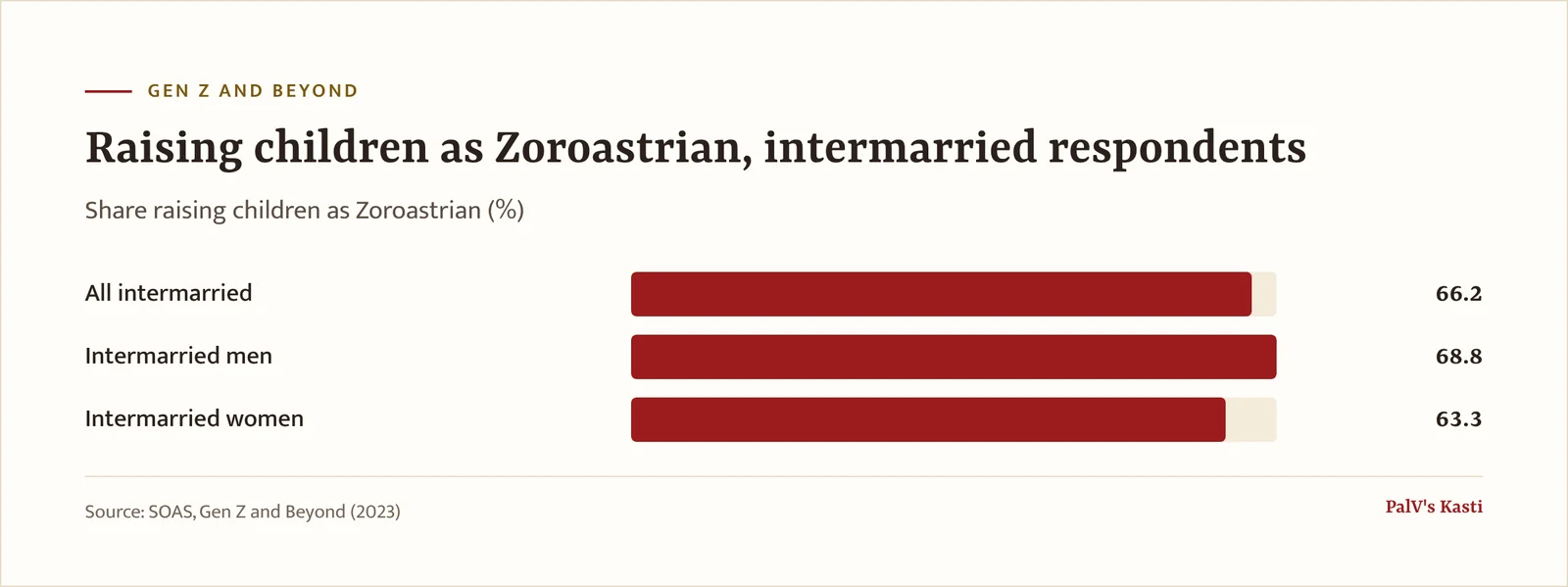

Not every intermarried family raises its children in the faith. SOAS's 2023 survey "Gen Z and Beyond" (Nazneen Engineer, Sarah Stewart and Joe Turtle; 5,003 respondents) found that 66.2% of respondents with a non-Zoroastrian partner were raising their children as Zoroastrian, and 33.8% were not or did not intend to. Intermarried women were slightly less likely to do so than intermarried men (63.3% against 68.8%). Among respondents married within the community, the share not raising their children as Zoroastrian was 4.7%. The authors add that reasons other than intermarriage could lie behind the figure.
Exclusion can also put children off. Goolrokh Gupta told the Hindustan Times in 2018 that her daughter had wanted a Navjote as a child but dropped the idea after watching her mother's fight. The girl, Gupta said, was put off by having to "beg for admission".
Will relatives come to the wedding?
Karishma Patel, a 32-year-old in New York, told NY City Lens in February 2015 that her aunts and uncles in India might not attend if she married outside the faith. "If I married a non, I don't know if they would come to my wedding," she said (by "a non", NY City Lens explained, she meant a non-Zoroastrian), and added: "I hope they would." Farah Minwalla, 25, said her parents had been "pretty hands off" but would "strongly prefer me to marry within the faith."
Our main guide covers how the law treats a mixed couple's marriage. If the family also wants prayers said, talk to a priest well before fixing the date.
Where do some intermarried families go instead?
Some have built their own place of worship. On 26 December 2017 PTI reported that more than 100 Parsis had inaugurated a fire temple in Kondhwa, Pune, under the banner of the Association for Revival of Zoroastrianism. PTI said it recognises the children of Parsis who marry outside and allows non-Parsis in. The two reports differ on the cost: PTI gave Rs 2.2 crore and The Better India Rs 2.5 crore.
The Better India reported at the opening that the temple would perform the Navjotes of children of mixed marriages, solemnise marriages and perform funeral rituals. Wadia told PTI the aim was a place where anyone could come in "with their heads held high". These details are as reported in December 2017; check with the temple for its arrangements today. The wider history of how children of mixed marriages have been treated is in our earlier article on Half-Parsis.
Practice varies between families and Agiaries; your family priest's guidance comes first.
Frequently asked questions
Can a non-Parsi husband or wife enter a fire temple?
Often not, in the cases reported. Vispy Wadia told PTI in 2017 that a non-Parsi spouse "is made to wait outside the temple", even when a Parsi man's children go in. The Better India noted that rules differ, with some fire temples denying entry and some not. PTI reported that a reformist temple opened in Pune in 2017 admits non-Parsis.
Can a Parsi woman married to a non-Parsi attend funeral prayers in an Agiary?
It depends on the trust. The Nagpur Parsi Panchayat told Dina Budhraja she would have to sit outside on the veranda, so after her grandmother died in 2024 the funeral ceremony was held at her mother's home, ThePrint reported. Delhi's Anjuman has different rules. Her Supreme Court plea was pending as of 16 November 2026.
Can the children of a mixed marriage have a Navjote?
Some families have found it hard. Khursheed Narang told the Pulitzer Center in 2014 that she struggled to find a willing priest. A Navjote done is not always accepted: the Nagpur Panchayat publicly objected to the Navjote Dina Budhraja arranged for her son in 2023, the Indian Express reported.
Do intermarried Parsis raise their children as Zoroastrians?
Most do, according to SOAS's 2023 survey "Gen Z and Beyond". Of respondents with a non-Zoroastrian partner, 66.2% were raising their children as Zoroastrian and 33.8% were not or did not plan to. Intermarried women were slightly less likely to than intermarried men, at 63.3% against 68.8%.