PalV's Kasti
On this page
- When was the Iran League founded, and by whom?
- Why did Bombay's Parsis want a link with Iran's Zoroastrians?
- What did the Iran League do for Zoroastrians in Iran?
- What was the Iran League Quarterly?
- How did the Iran League change after the 1930s?
- Does the Iran League in Mumbai still exist?
- Frequently asked questions
The Iran League is a Parsi organisation founded in Bombay in 1922 to rebuild ties between the Parsis of India and Iran, and especially to help the Zoroastrians still living there. Encyclopaedia Iranica dates its founding to 10 September 1922 and names Sir Hormasji C. D. Adenwala as its first president, with Dinshah J. Irani as co-founder. Through the 1920s and 1930s it supported schools and welfare work in Yazd, Kerman and Tehran, backed Persian translations of the Avesta, guided Parsi travellers to Iran and published the bilingual Iran League Quarterly. Its office still works today from Fort, Mumbai, on a much smaller scale.
અસપંદામેદ રોજ
Asfandarmad Roj, Tir Mah · 1396 Y.Z.
When was the Iran League founded, and by whom?
Every source we checked puts the founding in Bombay in 1922. Encyclopaedia Iranica's entry on the League, written by Kaikhusroo M. JamaspAsa, gives the exact day as 10 September 1922 and describes the founders as prominent Parsis. Sir Hormasji (also spelt Hormusji) C. D. Adenwala was the first president.
The second name that comes up again and again is Dinshah J. Irani (1881 to 1938). A separate Iranica entry by the historian Afshin Marashi calls him a co-founder and co-president, and describes him as the League's president in 1924. Four years before the League, in 1918, he had also co-founded the Iranian Zoroastrian Anjoman in Bombay. Speaking at the League's office in June 2026, the historian Dinyar Patel told Mumbai Mirror that the League "was founded by Hormusji Adenwalla and Dinshaw Irani in 1922".
Why did Bombay's Parsis want a link with Iran's Zoroastrians?
Iranica quotes the League's purpose as "reviving and strengthening cultural and other ties", linking India's Parsis with Iran. Marashi's entry on Dinshah Irani is more specific. He writes that the League set out to improve conditions for the Zoroastrians of Kerman and Yazd, and to help Iranian Zoroastrians who had newly arrived in Bombay to settle there.
Dinyar Patel's study in the journal Modern Asian Studies (published online in 2020) describes the same starting point. In his account, the League was first meant to assist fellow Zoroastrians in Iran, and soon widened its aims to Indo-Iranian cultural and economic relations as a whole. In the 2026 Mumbai Mirror report, Patel added a personal reason. Many founding members, he said, descended from recent Zoroastrian migrants from Iran, people for whom Iran was "their homeland" and not an idea. Mumbai Mirror notes that these newer arrivals, the Iranis, had settled in Bombay and Pune. Their story, and the wider history of the community that stayed behind, is told in our guide to Zoroastrianism in Iran.
Patel also stressed that the League did not work only within the community. He told Mumbai Mirror the founders wanted "a people-to-people bridge" between Bombay and Tehran, open to people of any religion, at a time when India and Iran had no formal diplomatic ties.
What did the Iran League do for Zoroastrians in Iran?
Schools, hospitals and orphanages
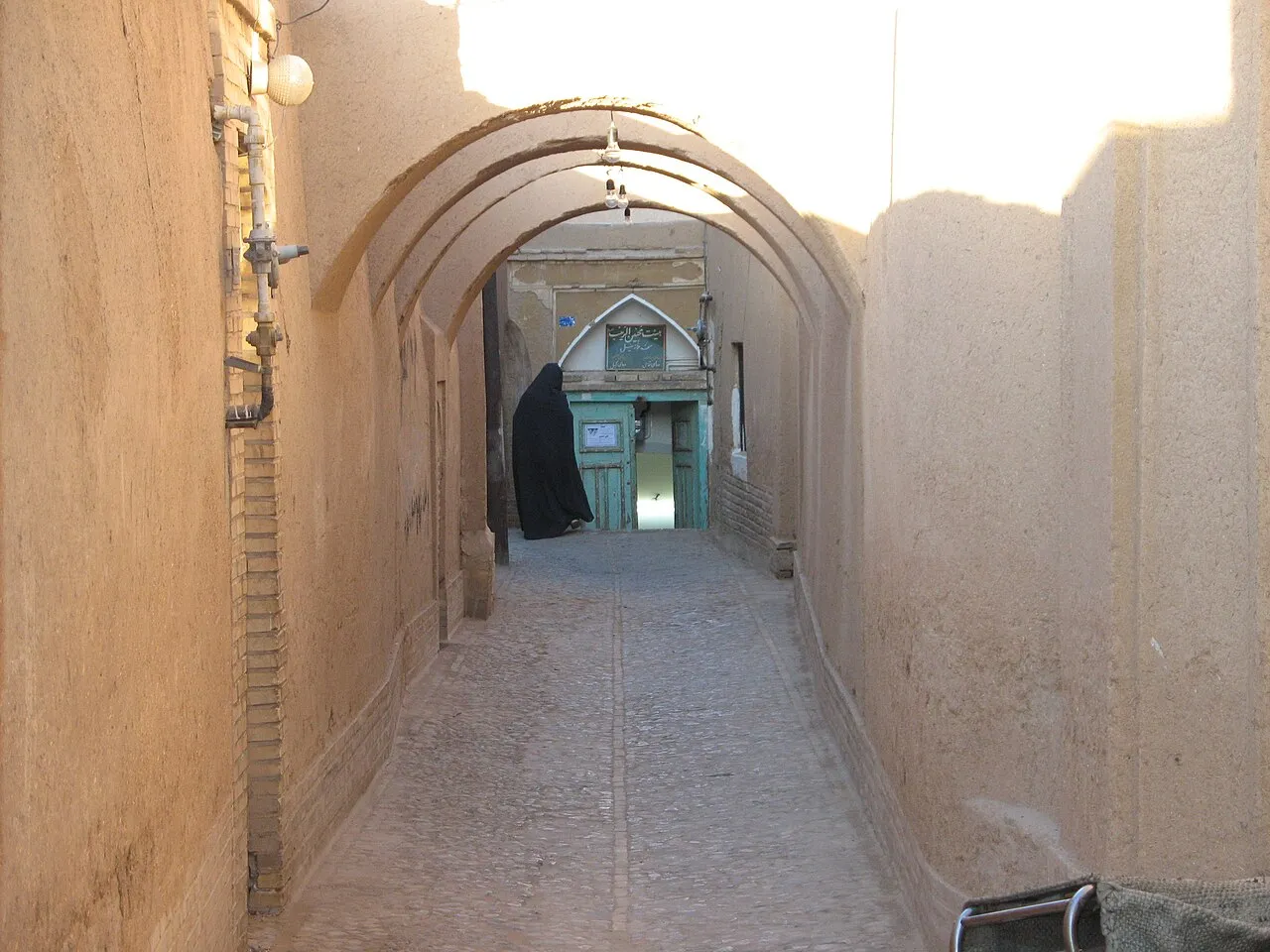
In a 2020 interview with Ajam Media Collective, Marashi described the philanthropy of Bombay's Parsi organisations, the Iran League among them, as "building schools, hospitals, and orphanages in Kerman, Yazd, and Tehran". Iranica records one project by name. A League body called the Iranian Women's Education Fund Committee helped build a high school for girls in Tehran.
Books and Persian translations of the Avesta
Much of the League's best-documented work is in print. As president in 1924, Dinshah Irani invited the Iranian scholar Ebrahim Pour-Davoud to Bombay, and according to Iranica the League paid for his three-year stay in India. Pour-Davoud then translated the Avesta into modern Persian. Iranica lists the Avesta volumes the League published: the Gathas in 1927, two volumes of Yashts in 1928 and 1930, a Khorde Avesta in 1931 and a first Yasna volume in 1938. Marashi says these translations made the Zoroastrian texts knowable to modern Iranians.
Iranica also records that the League sent some 330 books on the Zoroastrian religion to the Majles (parliament) library and to the Iranian Zoroastrian Anjoman in Tehran.
Contact with Iran's rulers
Iranica notes a run of official contacts in the 1920s. In November 1924 Ahmad Shah Qajar landed in Bombay on his way to Europe, and the League, with other Bombay bodies, gave him a formal address in a silver casket. The League was represented at Reza Shah's coronation on 25 April 1926. The entry also says the League, with help from Dasturs and scholars, helped draw up the solar calendar that Iran's Majles passed on 31 March 1925, and took a leading part in putting up a statue of the poet Ferdowsi in Tehran.
Help for Parsi travellers
Back in Bombay, Iranica says, the League held lectures on Iranian affairs and free Persian conversation classes, and assisted people wishing to visit Iran. The Mumbai Mirror report describes it acting as a guide for visitors, arranging travel and offering language lessons. Patel told the audience that some early Parsi travellers packed tinned food from London before setting off.
What was the Iran League Quarterly?
The League's journal began, according to Iranica, as a monthly Bulletin in March 1928 and became the quarterly Iran League Quarterly in 1930. The Ideas of India database calls it "the official organ of the Iran League, Bombay" and lists volumes 1 to 22, covering 1930 to 1950. Six issues from 1931 to 1940 can be read online through that database. Marashi describes it as a bilingual English and Persian journal, and the Ajam interview reproduces a steamship advertisement for journeys to Iran taken from its pages.
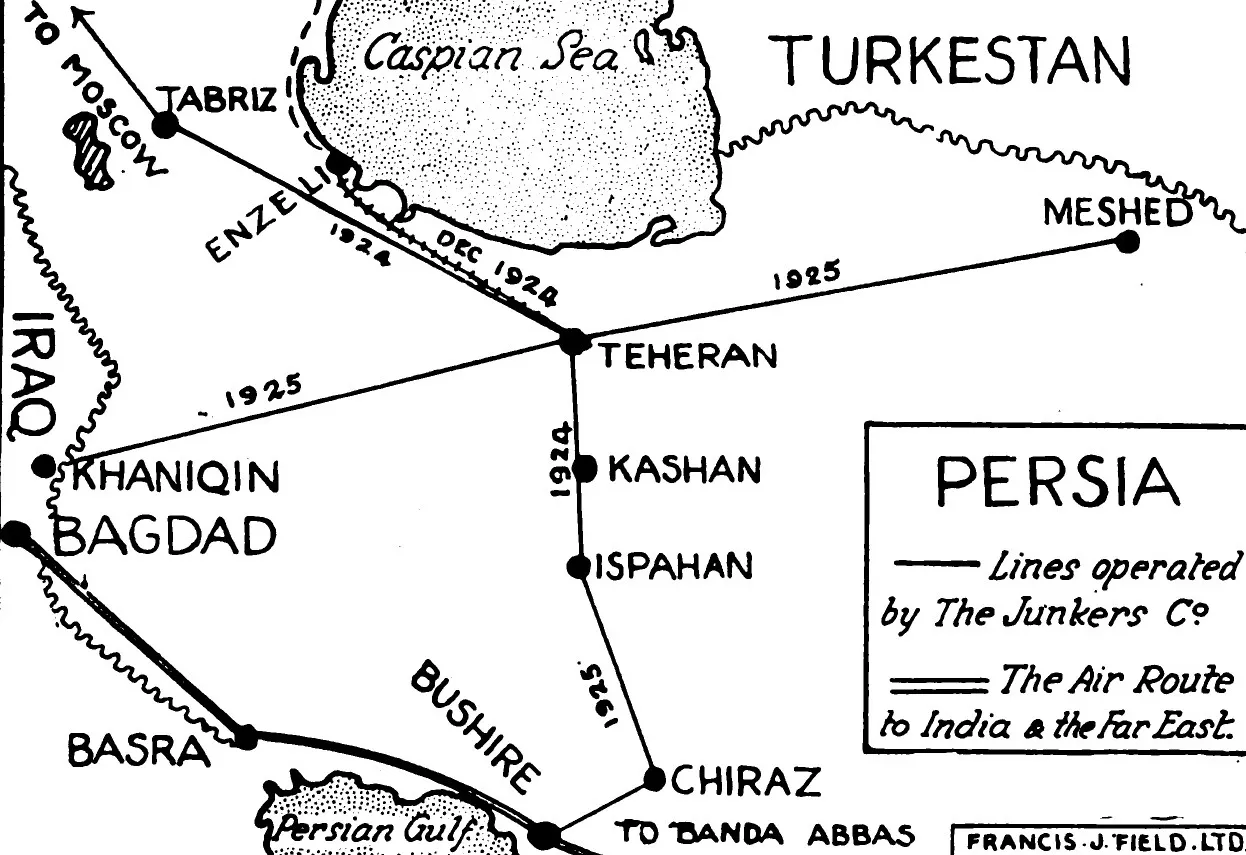
Iranica, last updated in 2012, says the Quarterly was discontinued for lack of funds. Old issues are still kept at the League's office, and what else that collection holds is covered in our post on the Iran League Library.
How did the Iran League change after the 1930s?
Historians read the League's later years in political terms. Patel's Modern Asian Studies article argues that by the 1930s Parsi enthusiasm for Reza Shah's Iran also reflected worry about Indian nationalist politics, and that some Parsis even argued the community should "return" to Iran. We look at that idea separately in Parsi resettlement in Iran proposal. Mumbai Mirror reports that the League's wider hope of ever closer cultural, educational and commercial ties also faded; in his 2026 talk Patel said, "Those hopes were dashed by 1940."
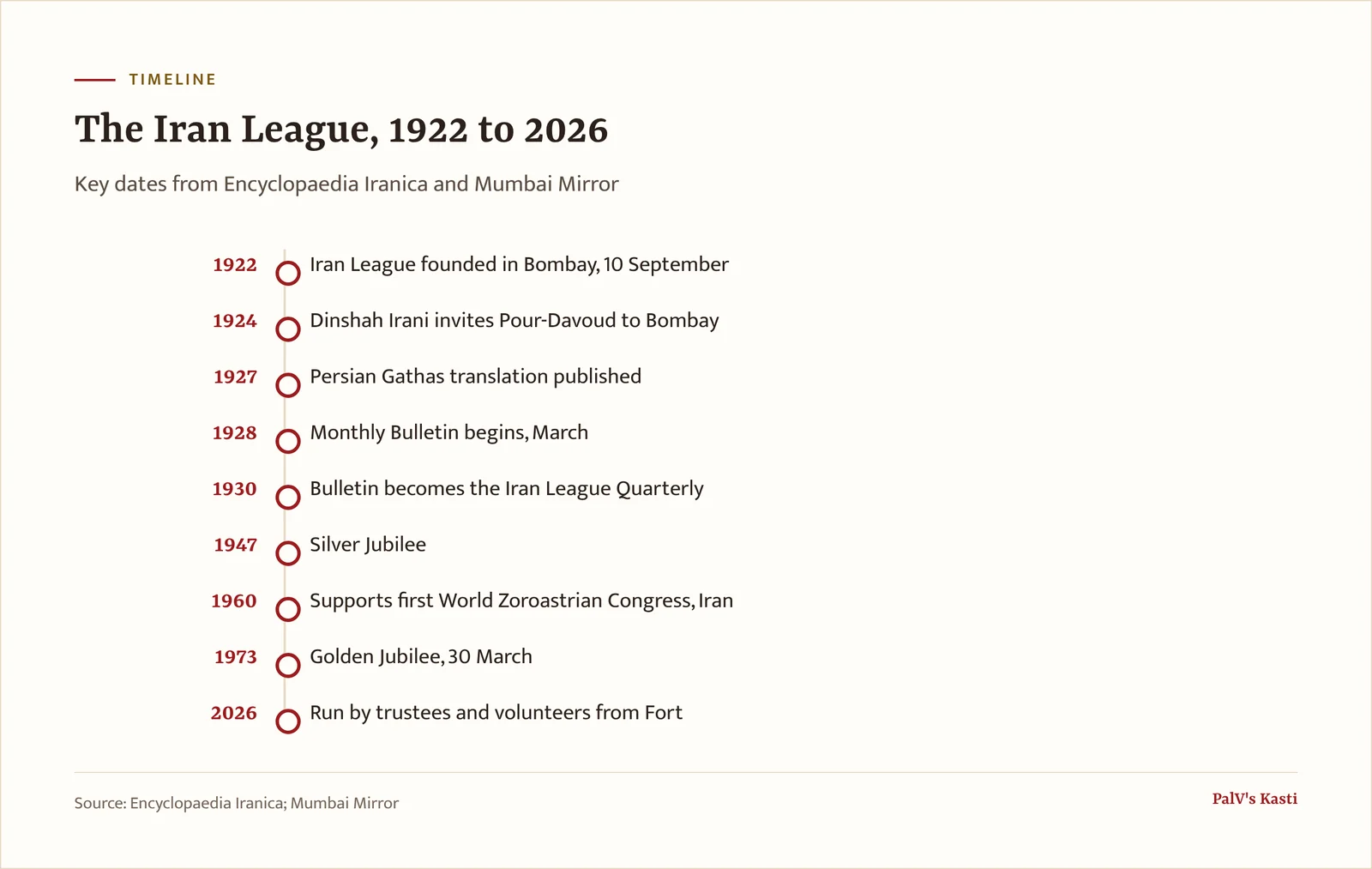
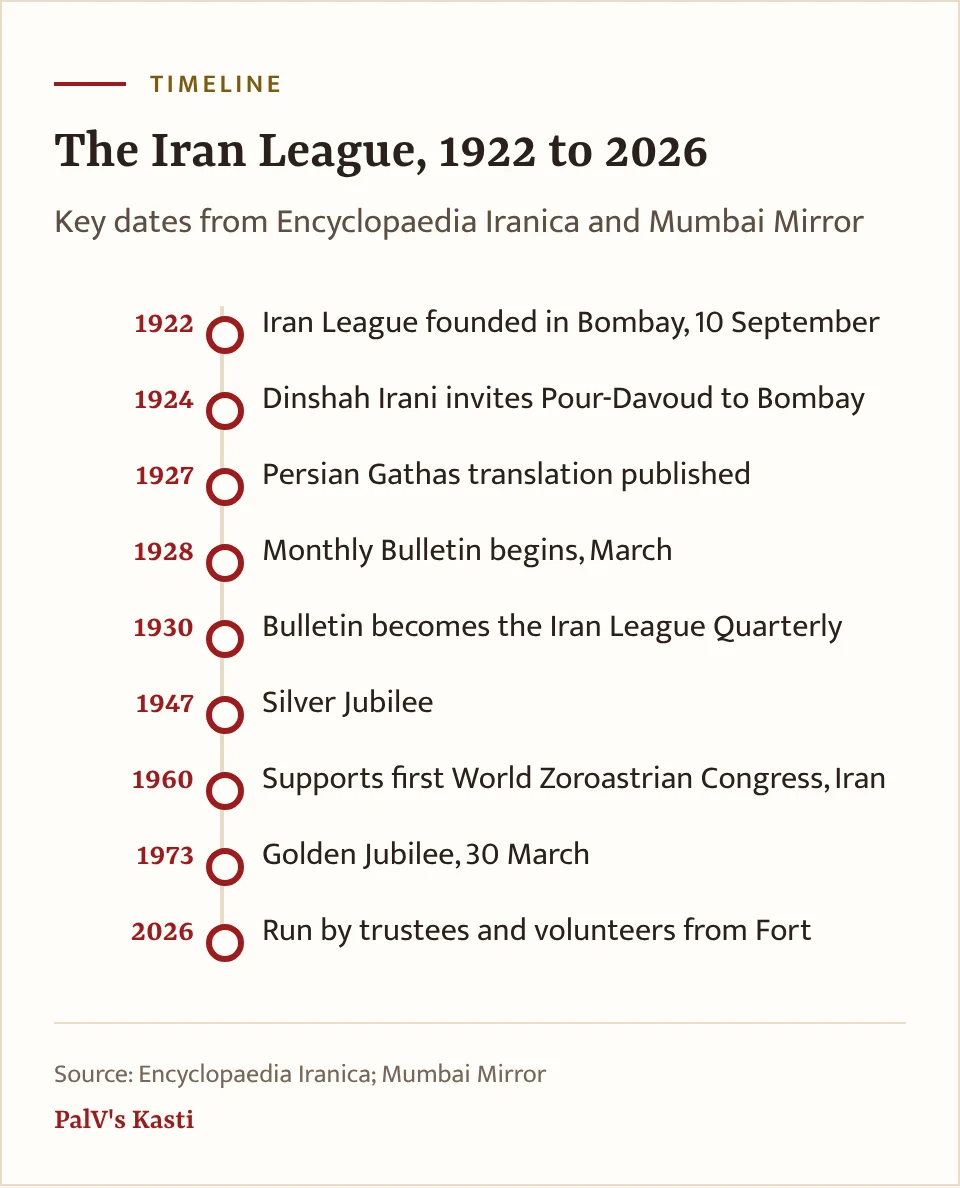
The League carried on all the same. Iranica records that it supported the first World Zoroastrian Congress, held in Iran in 1960, and held its Silver Jubilee in 1947 and Golden Jubilee celebrations on 30 March 1973. By the time that entry was last updated in 2012, its work had narrowed to annual essay and speech competitions for Parsi school pupils.
Does the Iran League in Mumbai still exist?
Yes. A Mumbai Mirror report by Tasneem Patanwala, published on 14 June 2026, places the League's office on the second floor of Navsari Building on D. N. Road in Fort. The report says the League no longer has a formal membership base, though membership remains open, and that a handful of trustees and volunteers keep it going. Most activities are arranged by email.
According to the same report, its work now centres on preserving and digitising its archives, holding lectures and running competitions. Trophies for Gujarati recitation and Avesta prayer competitions stand on the office shelves next to old copies of the Quarterly. Dr Kerman Daruwalla, project coordinator of the TISS-Parzor Academic Programme, has spent a year cataloguing the collection as a volunteer and told the paper it documents "decades of cultural and trade exchange between India and Iran."
We have not found an official website for the League. For visits or access to the collection, the 2026 report is the most recent public description we have, so check with the office before you go.
Frequently asked questions
What is the Iran League?
The Iran League is a Parsi body founded in Bombay in 1922 to rebuild cultural and other ties between India's Parsis and Iran. In its early decades it supported Zoroastrian schools and welfare in Iran, backed Persian Avesta translations, helped Parsi travellers and published the Iran League Quarterly. Its office is in Fort, Mumbai.
Who founded the Iran League, and when?
Encyclopaedia Iranica dates the founding to 10 September 1922 in Bombay. Sir Hormasji C. D. Adenwala was the first president. Dinshah J. Irani, who had co-founded the Iranian Zoroastrian Anjoman in 1918, was co-founder and co-president, and was president in 1924. The historian Dinyar Patel names the same two founders.
What did the Iran League do for Iran's Zoroastrians?
Historian Afshin Marashi describes Bombay Parsi groups, the Iran League among them, as building schools, hospitals and orphanages in Kerman, Yazd and Tehran. Iranica adds a girls' high school in Tehran, about 330 Zoroastrian books sent to two Tehran collections, and the League's support for Ebrahim Pour-Davoud's Persian translations of the Avesta between 1927 and 1938.
What is the Iran League Quarterly?
The Iran League Quarterly was the League's official journal, published in English and Persian. Iranica says it began as a monthly Bulletin in March 1928 and turned quarterly in 1930. The Ideas of India database lists volumes 1 to 22 for 1930 to 1950. Iranica, last updated in 2012, says it was discontinued for lack of funds.
Is the Iran League still active in Mumbai?
Yes, on a small scale. A Mumbai Mirror report from June 2026 says a few trustees and volunteers run it from the second floor of Navsari Building, D. N. Road, Fort. It holds lectures and competitions and is digitising its archive. It has no formal membership base, though membership is open.