 PalV's Kasti
On this page
- Who started the Irani cafes of Karachi?
- How many Irani cafes did Karachi have, and where were they?
- Which Irani cafes in Karachi have closed?
- Which Irani cafes in Karachi still survive?
- What is chullu kabab, and what did Karachi's Irani cafes serve?
- Why were Karachi's Irani cafes known for politics and poetry?
- Why are Irani cafes closing in Karachi?
- Frequently asked questions
Karachi's Irani cafes were opened by migrants from Iran in the early twentieth century, Zoroastrians first and later Bahais and Muslims. Many Iranis bound for Bombay settled in Karachi instead. By the 1970s the city had more than a hundred Irani restaurants, according to both Dawn and Vice. When the journalist Asif Noorani wrote about them for Dawn in 2016, he found hardly ten left. The names that still turn up in recent reporting are Khairabad Tea Shop on I.I. Chundrigar Road, the neighbouring Pehlvi Restaurant and Café Durakhshan in Saddar, and Chullu Kabab Sistani, which took over the old Café Subhani.
શહેરેવર રોજ
Shehrevar Roj, Tir Mah · 1396 Y.Z.
Who started the Irani cafes of Karachi?
Noorani's Dawn essay opens with one man. Sometime in the 1920s Rustom Aspandiar Bahmani, a Zoroastrian from Yazd, rode by mule to Zahidan, took a slow train to Quetta and a faster one to Karachi, then sailed six days to Bombay. Like other Zoroastrians of his generation, he made his mark in the restaurant business. But plenty of Iranis, Noorani writes, never went on to Bombay and stayed in Karachi.
On who came first, the two main accounts agree. Noorani says the Zoroastrians were followed into the trade by Bahais and then Muslims. Rida Bilgrami, reporting for Vice in 2018, says the early Karachi cafes were set up mostly by Zoroastrian settlers. Later owners reflect the second and third waves: Khairabad's family is Muslim with roots in Yazd, Vice reports, and Dawn names a Bahai as the proprietor of Café Gloria.
The Bombay side of the same migration is covered in our guide to the Irani cafes of Mumbai.
How many Irani cafes did Karachi have, and where were they?
More than a hundred at the peak in the 1970s. Dawn and Vice both give that figure.
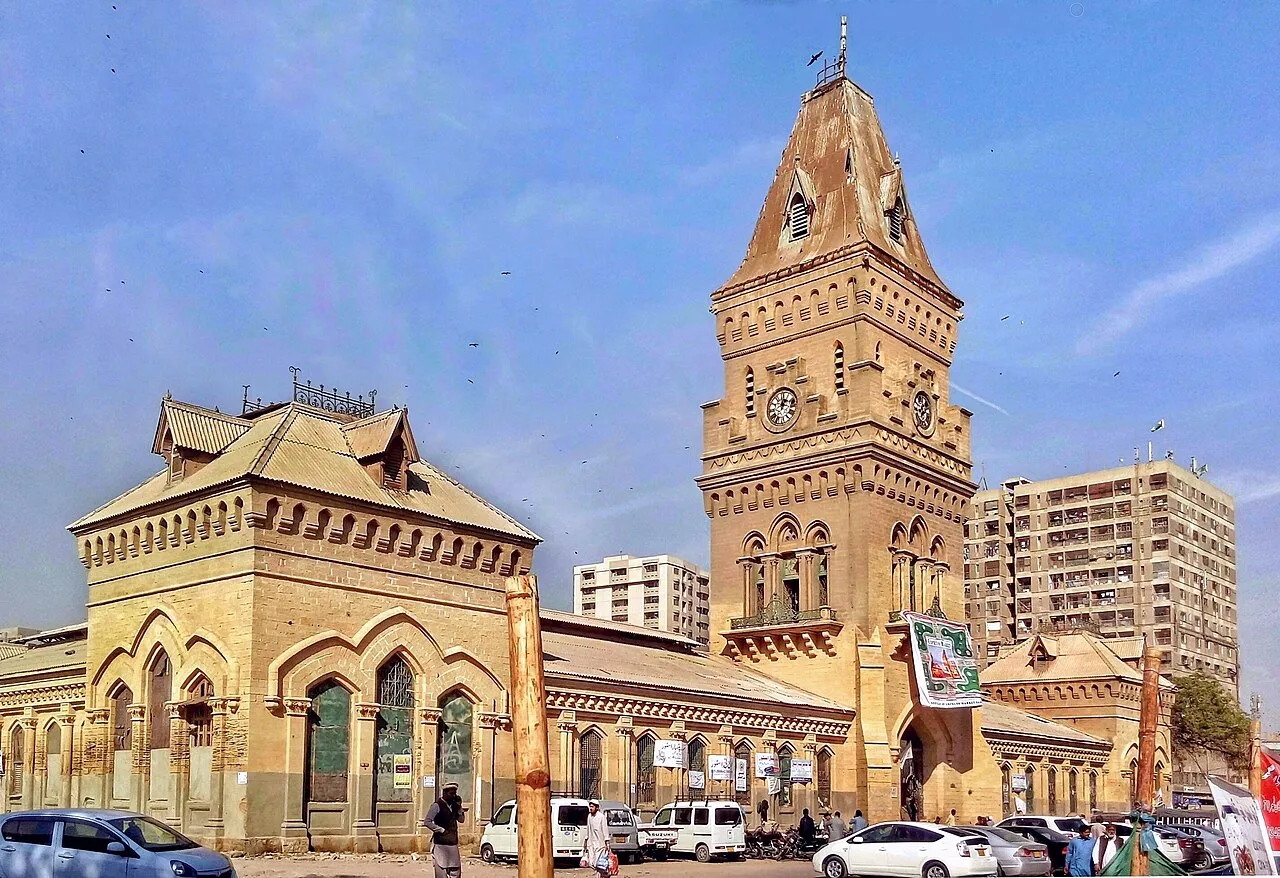
Noorani fills in the map. People called them Irani hotels, most carried "Café" before their names, and four stood close together in Saddar alone. They clustered in the old commercial districts and middle-class neighbourhoods. Few opened in the newer parts of the city after Independence. Café Liberty and an unnamed one in Nursery market, PECHS, were exceptions, and Defence Housing Authority and North Nazimabad never had one at all.
The layout followed the Bombay pattern. Almost every Irani restaurant took a street corner open on two sides, Noorani notes, in Mumbai and Pune as much as Karachi.
Which Irani cafes in Karachi have closed?
Most of them. Here are some from Noorani's 2016 roll call, with a 2013 Express Tribune report on Café Liberty:
- Eastern Coffee House, once the India Coffee House run by the India Coffee Board, later taken over by an Irani. Writers and student leaders, among them the Marxist Ali Mukhtar Rizvi, spent afternoons there.
- Café Victoria, opposite Hotel Metropole, remembered for its Mahi Kabab.
- Café Victory, near the Dawn offices, where journalists came for beef steak at lunch.
- Café Yasmeen near the Police Head Office, the most recent closure when Noorani wrote.
- Café Liberty on Tariq Road, a garment showroom by 2013, according to the Express Tribune.
Two names outlived their buildings. The Tariq Road and Allama Iqbal Road crossing is still called Café Liberty, and the area by Fleet Club goes by Lucky Star, Noorani writes, after restaurants that shut years ago.
Which Irani cafes in Karachi still survive?
Four names come up in the latest reporting we found. Only Khairabad has a 2025 report. The others were last described in 2018, so check before you travel.
Khairabad Tea Shop
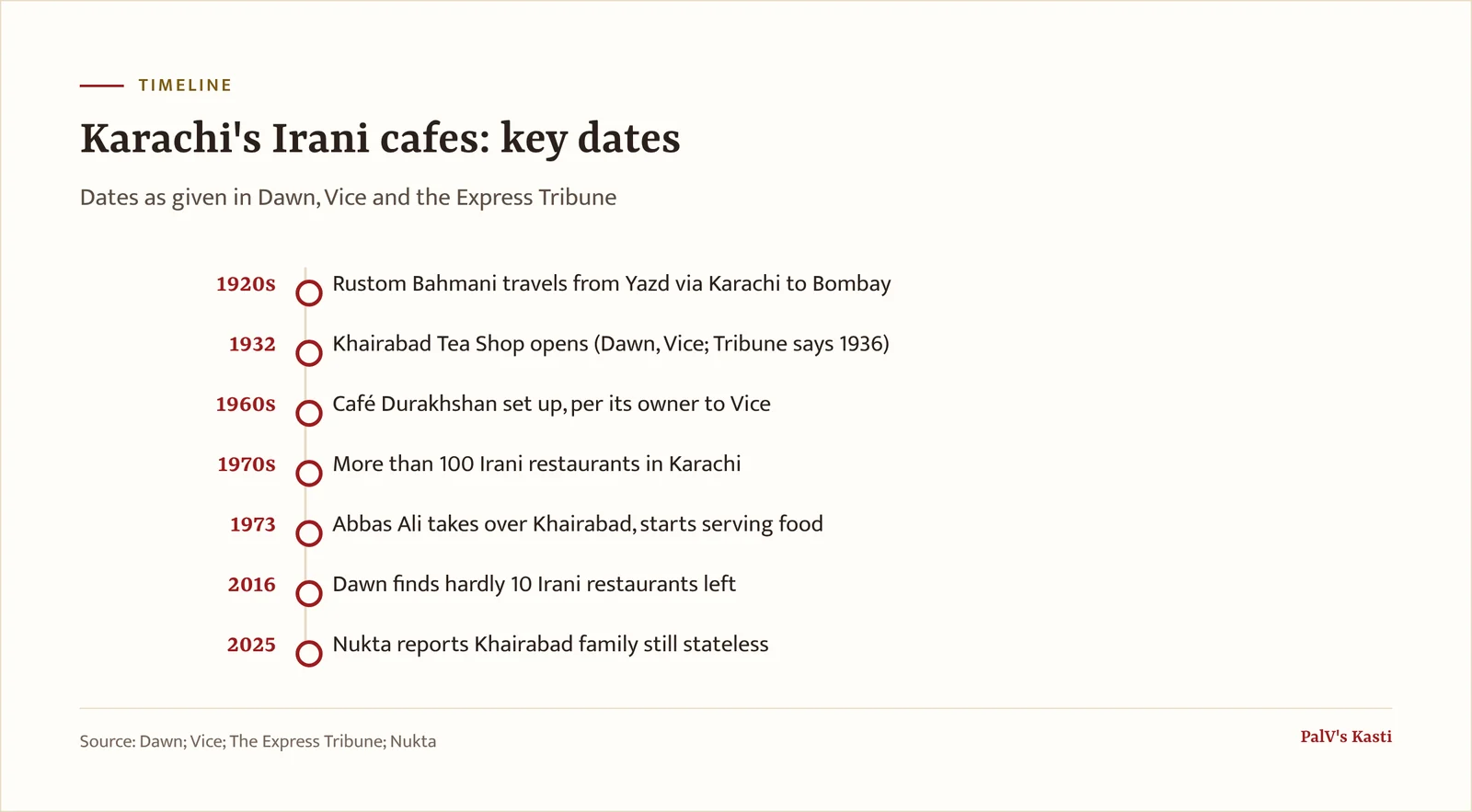
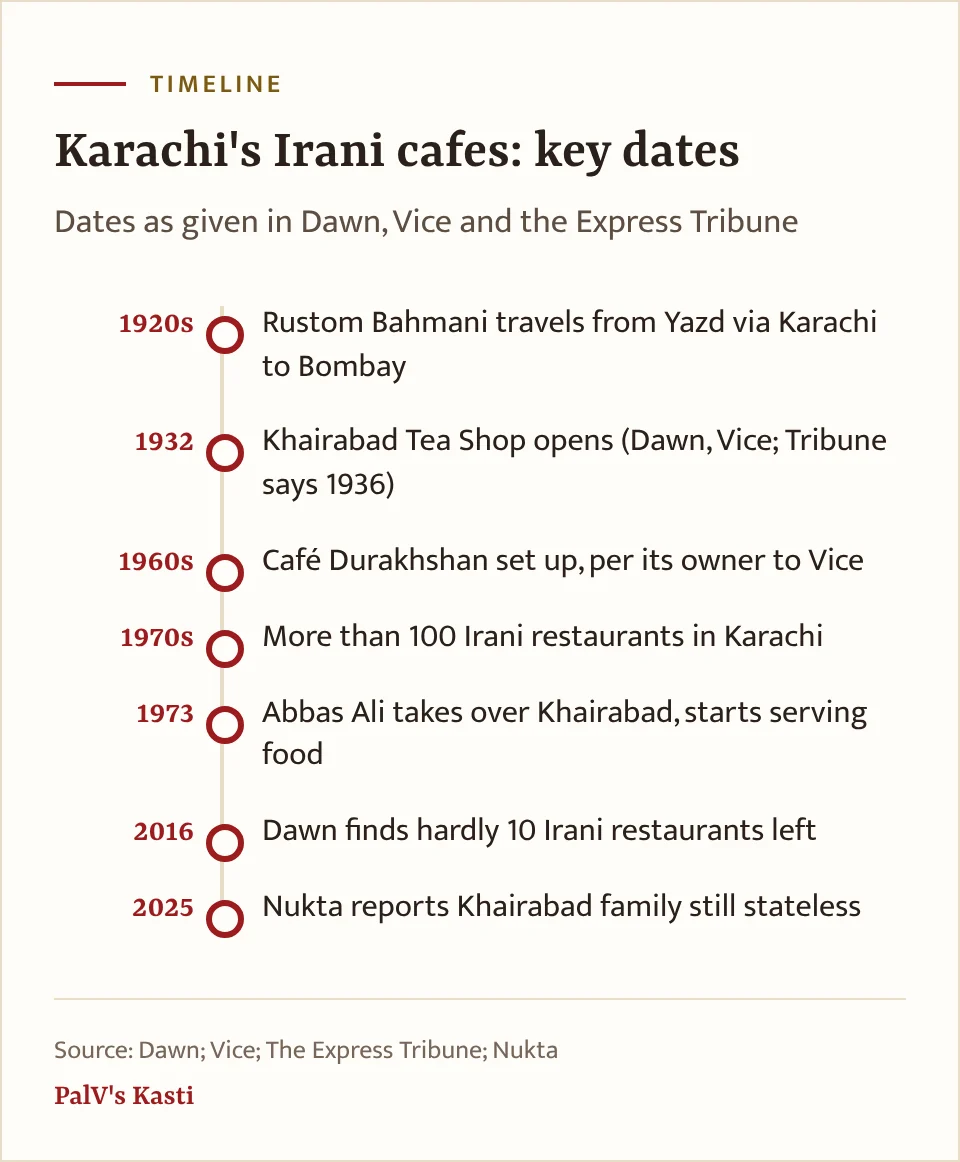
Khairabad stands at the edge of I.I. Chundrigar Road, the road Vice calls the Fleet Street of Karachi, and journalists were still regulars when the Express Tribune visited in 2013. Haji Abbas Ali told Vice his grandfather stopped in Karachi on a business trip in 1932, stayed, and opened a small tea shop named after the family's village in Iran. Dawn also gives 1932. The Express Tribune, quoting the owner in 2013, gave 1936. Abbas Ali took over in 1973 and began serving food. In September 2025 Nukta reported that the family, in Pakistan for generations, still has no Pakistani citizenship.
Pehlvi Restaurant and Café Durakhshan
They stand side by side at the corner of M.A. Jinnah Road and Zebunnisa Street. Pehlvi was named after Mohammad Reza Shah Pahlavi and swapped its old look for a modern café fit-out around 2008, the Express Tribune reported. Dawn found it still kept a small stall pouring tea from chainaks, small metal teapots. Durakhshan, which Vice found still had its bentwood chairs and ornate staircase, feels older. Its best seller in 2016 was the Spicy Pulao.
The sources disagree on Durakhshan's history. Noorani heard that the two were once a single restaurant split between siblings, though the owners would not discuss it. Its owner Mohammed Mehdi told Vice that a Parsi man set Durakhshan up in the 1960s and that he bought it from him. We could not settle which account is right.
Chullu Kabab Sistani
This is the old Café Subhani near Fleet Club, which closed a year or two before Noorani's article. Local owners refurbished it and reopened it as Chullu Kabab Sistani, Dawn reported. Its manager told Vice in 2018 that the owner comes from Sistan in Iran and that the restaurant has run since 1960. That date rests on his word alone.
What is chullu kabab, and what did Karachi's Irani cafes serve?
Chullu kabab was Café Subhani's famous dish: an Iranian kabab on a bed of buttered rice, in Noorani's description. The version Vice ate at Chullu Kabab Sistani came with steamed white and saffron rice, grilled tomatoes, beef kababs and chicken cubes, and a slab of butter melting over the top.

Khairabad still listed chullo mahi, rice with grilled fish, in 2018 (mahi is Persian for fish). By 2013, the Express Tribune wrote, sulaimani chai, bun maska and kabab koobideh had given way to fizzy drinks and fast food. Owners told Vice they had added Pakistani and Indo-Chinese dishes to stay in business. Parsi home cooking across the border is a different story, told in our post on Pakistani Parsi cuisine.
Why were Karachi's Irani cafes known for politics and poetry?
Because they let people sit. Many Karachi eateries hung a notice banning political talk, the Express Tribune observed in 2013, but the Irani cafes were where poets, journalists and student activists argued for hours over one cup of tea. Ahmed Shah, then president of the Karachi Arts Council, told the paper that Faiz Ahmed Faiz, Josh Malihabadi and Ibn-e-Insha used to gather at such places. Khairabad's Abbas Ali put it to Vice simply: where else would a newspaper editor eat beside a vendor?
Why are Irani cafes closing in Karachi?
The owners gave the clearest answers. Abbas Ahmed of Café Durakhshan told Dawn that tastes had moved to fast food, nihari, biryani and barbecue, and that with profits down an owner was better off selling up and putting the money in a fixed deposit. Abbas Ali of Khairabad told Vice there is no new migration from Iran, that gas and food prices keep rising, and that his children are unlikely to carry on. Mohammed Mehdi said the original owners' children had sold up and moved to Canada and the USA, and he feared that in 15 to 20 years even the few left might go. At Chullu Kabab Sistani the manager blamed rents and said Pakistanis find Persian food too mild.

The survivors changed to last. The marble-topped tables went because they took too much space, Ahmed said, but the bentwood chairs and big mirrors stayed.
Frequently asked questions
How many Irani cafes are left in Karachi?
Dawn's Asif Noorani wrote in 2016 that hardly ten of Karachi's Irani restaurants remained, down from more than a hundred in the 1970s. Vice in 2018 said only a handful survived. The names that recur are Khairabad Tea Shop, Pehlvi Restaurant, Café Durakhshan and Chullu Kabab Sistani. We found no full count published after 2018.
What is the oldest Irani cafe in Karachi?
Of the cafes still open, Khairabad Tea Shop has the earliest stated date. Dawn and Vice both say Abbas Ali's grandfather opened it in 1932, while the Express Tribune quoted the owner in 2013 as saying 1936. Khairabad stands on I.I. Chundrigar Road, and Nukta reported in 2025 that the same family still runs it.
Who started the Irani cafes in Karachi?
Iranian migrants did, in the early twentieth century. Dawn's account says Zoroastrians came first, followed by Bahais and then Muslims, and that many Iranis settled in Karachi instead of moving on to Bombay. Vice's 2018 report also says the early Karachi cafes were mostly set up by Zoroastrian settlers.
What is chullu kabab?
Chullu kabab is an Iranian kabab served over buttered rice, the speciality of Karachi's old Café Subhani. Its successor, Chullu Kabab Sistani, serves a version with white and saffron rice, grilled tomatoes, beef kababs, chicken pieces and a slab of butter melting on top, as Vice described it in 2018.
Are any Karachi Irani cafes still owned by Zoroastrians?
Very few, by the owners' own account. Mohammed Mehdi of Café Durakhshan told Vice in 2018 that very few remaining Irani cafes are still owned by Parsis, and that the original owners' children had sold and emigrated. Khairabad's family is Muslim, and Chullu Kabab Sistani's owner comes from Sistan in Iran, according to its manager.


