 PalV's Kasti

On this page
- What is Pakistani Parsi cuisine?
- Are there Parsis in Pakistan, and how many?
- How did Karachi's Parsi kitchens develop the cuisine?
- Are there Pakistani Zoroastrian (Parsi) recipes in print?
- Is Pakistani Parsi food different from Indian Parsi food?
- Where can you eat Parsi food in Karachi?
- Will Pakistani Parsi cooking survive?
- Frequently asked questions
Pakistani Parsi cuisine is the Parsi food of Pakistan's small Zoroastrian community, cooked almost entirely in Karachi. It is the same family of dishes Parsis cook in India: dhansak with caramelised brown rice, sali murghi, patra ni machhi, ravo. The Express Tribune, writing about Karachi-born cookbook author Niloufer Mavalvala's book, traced its recipes to two roots, Persia and India. Karachi's Parsi kitchens kept the food going through street-corner tea stores that sold dhansak, compound-by-compound gahambar feasts, a community recipe book and television cooking. Today they keep it alive through home cooks who sell to the wider city. The community is now very small. The 2023 census counted 2,348 Parsis in the whole country.
શહેરેવર રોજ
Shehrevar Roj, Tir Mah · 1396 Y.Z.
What is Pakistani Parsi cuisine?
It is home cooking first. When Pakistani newspapers write about Parsi food, they name the same short list. The Express Tribune, in a 2016 piece on Mavalvala's book The Art of Parsi Cooking, named dhansak chawal, sali murghi (chicken topped with potato straws) and ravo (a semolina pudding). Arab News, visiting a Karachi kitchen in 2025, opened on patra ni machhi, fish wrapped in banana leaf with green chutney.
The same Tribune piece explains why the food tastes the way it does. In its summary of Mavalvala's book, recipes with nuts, dried fruit and sweetness came from Persia, while ginger, garlic, chillies and spice are the Indian side.
Which dish goes with which occasion, from Navroz lunch to a Navjote, is a subject of its own. We cover it in our guide to Pakistani Parsi dishes.
Are there Parsis in Pakistan, and how many?
Yes, but very few, and the counts disagree. Two Pakistani outlets, The Express Tribune and Arab News, both report that Pakistan's 2023 census recorded 2,348 Parsis. The Tribune adds an estimate of about 5,000 Parsis at independence in 1947.
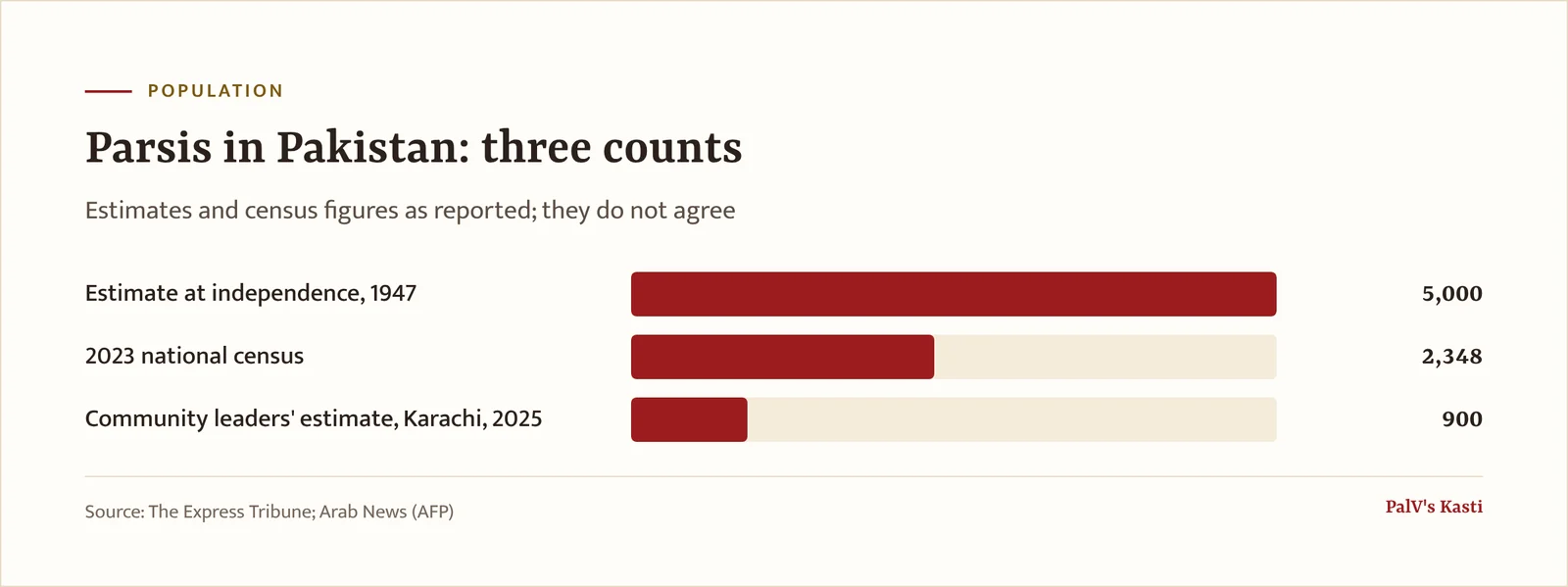
Community leaders give different numbers. Speaking to AFP in 2025, hotelier Dinshaw Behram Avari said the community had once numbered as many as 15,000 to 20,000. The same report put today's figure at around 900 in Karachi, plus a few dozen elsewhere in Pakistan. We can't reconcile the census figure with the community's own estimate, so we give both.
What everyone agrees on is that this is a Karachi story. Arab News reports that the city now has only two main Parsi colonies. For the wider history of the community there, read our piece on the Parsis of Karachi.
How did Karachi's Parsi kitchens develop the cuisine?
A port city and its dhansak
Writing in Dawn in 2014, Bisma Tirmizi tied dhansak's popularity to the late 19th century and the fast growth of Bombay and Karachi. In her account, immigrants from Iran set up small tea stores on street corners. They fed working men tea, biscuits, omelettes and dhansak. Dawn's Asif Noorani, writing about Karachi's Irani restaurants in 2016, named Zoroastrians from Iran among their owners. He quoted one tea-shop owner who counted close to a hundred such restaurants in the 1950s and 60s and fewer than ten by then. Their food is a separate thread, which we follow in Irani cafes of Karachi.
Gahambars and the long community table
Gahambars are seasonal community feasts, and the Tribune reported in 2026 that Karachi's Parsis still host them. Dilaira Dubash described the Karachi version in the Tribune in 2012. Each Parsi residential compound holds its own gahambar and invites the residents of the others. A jashan led by priests comes first in the evening. Then comes a three-course meal, with papeta ma gosht (meat with potatoes) and dhansak chawal on the menu.
The same article records how the feast had changed by 2012. Women used to gather to cook. Now caterers do it. Banana leaves have given way to cardboard sheets covered with butter paper, and dessert is often ice cream. Dawn's 2011 description of a Parsi feast gives the order of service on the banana leaf: chutneys and pickles, then papeta ma gosh with hot chapatis, then dhansak, then Parsi custard.
Practice varies between families and Agiaries; your family priest's guidance comes first.
Recipe books, television and a Sunday lunch
Karachi wrote its recipes down. In 2016 Mavalvala told the Tribune that the city's effort began about 25 years earlier with Manna of the Angels, a book of family recipes donated by Karachi's own people. The same article named Karachi television chef Zarnak Sidhwa among those promoting the cuisine. A 2026 Tribune profile calls her the country's "dessert queen". The 2016 piece also said the Karachi Parsi Institute ran a popular Sunday lunch. Its weekly menu went out by email, and people outside the community ordered too. We have no newer report on that lunch.
Not every cook used a book. Gulnar Cowasjee told Arab News she learned by watching her grandmother, who added masalas by hand without measuring.
Are there Pakistani Zoroastrian (Parsi) recipes in print?
Yes, a few. FEZANA's 2012 cookbook Eat, Live, Pray, planned as a free download, collected 72 recipes from readers in seven countries, Pakistan among them. Farishta Murzban Dinshaw, who put the book together, holds a master's degree in institutional food management from the University of Karachi. Two recipes carry Pakistani names:
- Gajar mewa nu achaar, a carrot and raisin pickle also called lagan nu achaar or wedding pickle, from the late Khorshed Sidhwa of Pakistan, sent in by her daughter-in-law Anahita Sidhwa.
- Kuku-ye-sabzi, a baked herb and egg dish the book calls a savoury herb cake and places on the Navroz table, from the late Katayun Felfeli of Pakistan, sent in by her daughter Mitra Irani.
Is Pakistani Parsi food different from Indian Parsi food?
We found no source that documents a recipe-level difference. The dishes Karachi's cooks name, such as dhansak chawal, sali murghi and ravo, are the ones the Tribune credits with putting Zoroastrian cooking as a whole on the world's food map. It does not present them as Pakistani specialities.
The difference is the setting. In Karachi, Parsi food survives in a very small community, and much of it is now eaten by non-Parsis. Cowasjee told Geo News that most of her customers are Muslim, and Geo called patra ni machhi the dish they ask for most. We'd rather say "no documented difference" than invent one.
Where can you eat Parsi food in Karachi?
Mostly from home kitchens, not restaurants. The best-reported is Ghar Se, which Gulnar Cowasjee started from her home during the COVID-19 pandemic and launched on social media. Geo News placed her kitchen in Cyrus Colony; Arab News wrote of her home in Karachi's Parsi Colony. When Geo asked why the city had no Parsi restaurant, Cowasjee said one had existed, run by Pervaiz and Mahzarin Tarapore, and it closed after the owners left Pakistan. Check current menus directly before you plan around any of these.
Will Pakistani Parsi cooking survive?
Its own cooks are not sure. Cowasjee remembered tables of 25 to 28 people and told Arab News that now there isn't even a table of two. Her daughter Myra, a lawyer, said she has Parsi food perhaps once a fortnight, though her colleagues now order from her mother. Sidhwa, speaking in 2026, put it more hopefully: "We are preserving as much as we can."
Frequently asked questions
Are there Parsis in Pakistan?
Yes. A small Parsi Zoroastrian community lives in Pakistan, almost all of it in Karachi, where Arab News reports there are now two main Parsi colonies. The Express Tribune says about 5,000 Parsis lived in Pakistan at independence in 1947. Many younger Parsis have since moved to Canada, Australia, Britain and the United States.
How many Parsis live in Pakistan?
Pakistan's 2023 census recorded 2,348 Parsis, as reported by The Express Tribune and Arab News. Community leaders quoted by AFP in 2025 gave a lower figure: around 900 in Karachi and a few dozen elsewhere. Dinshaw Behram Avari told AFP the community had once numbered between 15,000 and 20,000 people.
Where can you eat Parsi food in Karachi?
Mainly from home cooks. Gulnar Cowasjee's Ghar Se, launched on social media during the COVID-19 pandemic, cooks Parsi food to order, and most of her customers are Muslim. In 2016 the Karachi Parsi Institute ran a popular Sunday lunch with a weekly emailed menu. A Parsi restaurant run by the Tarapore family has closed.
Is Pakistani Parsi food different from Indian Parsi food?
No published source we found shows a recipe-level difference. Karachi cooks name the cuisine's best-known dishes: dhansak with brown rice, sali murghi, patra ni machhi and ravo, none of them described as Pakistani inventions. The real difference is circumstance. Karachi's community is tiny, and much of its Parsi food is now cooked for non-Parsi customers.
What is Manna of the Angels?
Manna of the Angels is a Karachi Parsi recipe book made from family recipes donated by people of the city. Cookbook author Niloufer Mavalvala told The Express Tribune in 2016 that it appeared about 25 years earlier, and called it the start of Karachi's effort to record and share Parsi cooking.


