 PalV's Kasti
On this page
Khandias are the Parsi community's professional pall-bearers. The word comes from khandh, the shoulder, and that is the work: they carry the iron bier of the deceased on their shoulders towards the dokhma. J.J. Modi's 1922 account and later priestly guides name a second group, the nasesalars, who place the body on the bier and carry it inside the dokhma. In Mumbai the khandias work at Doongerwadi, the Bombay Parsi Punchayet's estate at Gibbs Road, Malabar Hill. The BPP's own page says the deceased is carried on the shoulder by the khandias up to the Fravandian Gate. Writing in Open magazine in July 2015, Lhendup G. Bhutia reported that over the years the division of work between the two groups had blurred.
અસપંદામેદ રોજ
Asfandarmad Roj, Tir Mah · 1396 Y.Z.
Who are the khandias?
J.J. Modi, in The Religious Ceremonies and Customs of the Parsees (1922), explains the name as those who carry the body on their khandh, that is, on their shoulders. Mary Boyce gives the same meaning in her Encyclopaedia Iranica entry on the disposal of the dead (1993), where the Parsi term khāndia is glossed as "one who shoulders (the bier)". The older Avestan word for a corpse bearer, Boyce notes, is nasu-kaša.
Khandias are paid staff, not relatives of the deceased. Modi recorded that Bombay, as the headquarters of the Parsis, had a paid staff of about 50 professional bearers of both kinds in his day. In small towns, he wrote, the same people did both jobs. In the smallest places there were no paid bearers at all, and relations and friends of the deceased did the work.
What is a nasesalar, and how is it different from a khandia?
A nasesalar (also written nassasalar, nusessalar or nasā-sālār) is the corpse bearer who handles the body itself. Modi describes the nassasalars as the men who come to the house and place the deceased on the bier, and the khandias as those whose business is to carry that bier on their shoulders from the house to the Tower. At the Tower, Modi writes, the nassasalars take charge of the body again and carry it inside.

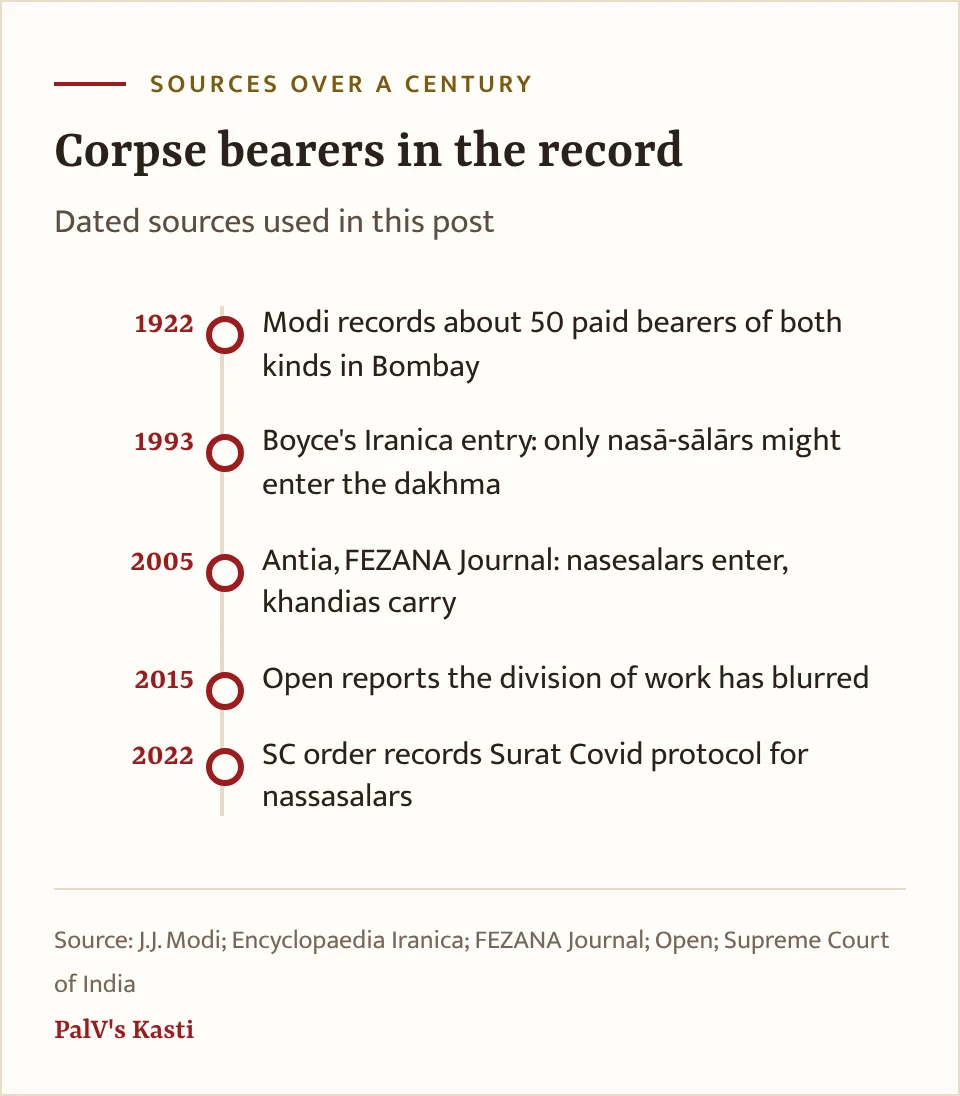
Kersey H. Antia's guide to funeral ceremonies, published in the FEZANA Journal in winter 2005, draws the same line. In his account the nasesalars take part in the funeral rituals, lay the deceased on the gehan (the iron bier) and carry it inside the dokhma, while the khandias carry it from the house to the area near the dokhma. Boyce adds that the nasā-sālārs had charge of the disposal, that only they might enter the dakhma, and that they were usually two in number.
Practice varies between families and Agiaries; your family priest's guidance comes first.
What do khandias do at Doongerwadi today?
The Bombay Parsi Punchayet's Doongerwadi page, as we read it on 16 November 2026, sets out the order of the funeral. Two mobeds recite the Geh Sarna prayers. The khandias then carry the deceased on their shoulders, followed by those two mobeds and then by the mourners attending the Pydast. They stop at the Fravandian Gate, where the bier is set on the last salutation slab and the family bids its final farewell. A last sagdid is performed there, and the pall-bearers then take the body on to the dokhma assigned for it. For what happens inside, see our page on the Tower of Silence.
The same page says Doongerwadi's own staff number over 100, and that a shift system is in use for the khandias, the bungli kamdars and the supervisors. The page carries no date, so read this as the BPP's description of its staff as of November 2026.
Open's 2015 report adds what the khandias themselves said at the time. By their count, around three bodies reached Doongerwadi each day, and many of them lived with their families in quarters inside the estate. How recruitment and pay have changed is covered in our post on the decline of the khandia profession.
Professional bearers work outside Mumbai too. During the Covid-19 pandemic, the Supreme Court's order of 4 February 2022 in The Surat Parsi Panchayat Board v Union of India (Civil Appeal No. 1067 of 2022) recorded a protocol for Surat. Under it, Covid victims would be handled only by the nassasalars employed by the Panchayats, wearing PPE kits, and normally two of them would carry the bier to a dokhma set aside for those deaths.
What rules of purity do corpse bearers follow?
The priestly and academic sources we checked agree on the rules below. Each rests on the Zoroastrian teaching about nasu, the pollution of death, which our Nasu page explains.
Never alone: bearers work in pairs
Modi writes that there must be at least two bearers even for an infant whom one person could carry, citing Vendidad III.14, and that a heavier body is carried by four, six, eight or another even number. Boyce cites the same verse as forbidding anyone to carry a body alone. Both Modi and Antia record that the bearers, like the priests, hold a paiwand, a cloth joining each pair.
Boyce also notes that the Pahlavi Vidēvdād allowed women to be corpse bearers, a woman with a man or two women together, but that within living memory only men have done the work, apart from local customs for small children. We found no second source on this point.
An iron bier, never wood
Both Modi and Antia say the bier, the gehan, is made of iron. Modi's reason is that wood is porous and could carry and spread infection. Antia gives the same explanation: unlike wood, iron does not pass infection on.
The Bareshnum purification
Modi wrote in 1922 that the people going through the Bareshnum purification were by then mostly the professional corpse bearers, who took it before joining the work and again on leaving it. Antia says both kinds of bearer keep strict rules of hygiene and purity and stay apart from others until they have completed a Bareshnum of nine nights.
Practice varies between families and Agiaries; your family priest's guidance comes first.
How are khandias regarded in the community?
This is a sensitive question, and the published views differ. Open's July 2015 feature described the khandias as having become "the 'untouchables' of an otherwise casteless community", and recorded khandias' own accounts of relatives keeping their distance.
Bakhtiar K. Dadabhoy, reviewing Cyrus Mistry's novel for Outlook (the review is dated 5 February 2022 on Outlook's website), took a different view. He wrote that the khandias' low ritual position comes from handling the dead, that this pollution "can be removed" by purificatory rites, that Parsis have no castes or sub-castes, and that there are no restrictions on eating together. In his reading, the khandias' low position today has more to do with poverty and anonymity than with ritual. Boyce, writing on the older practice, notes that bearers who had no direct contact with the body were not thought to be seriously polluted.
The novel Dadabhoy was reviewing, set in pre-Independence India and narrated by a priest's son who becomes a khandia, has its own page: Chronicle of a Corpse Bearer.
How many khandias are there now?
We could not find a published, dated headcount of khandias from the BPP or a 2024 to 2026 news report. The figures on record are Modi's "about 50" bearers of both kinds in 1922 Bombay and the BPP's undated statement that Doongerwadi's whole staff, of which khandias are one part, is over 100. Figures quoted elsewhere could not be traced to an original source, so we have left them out.
Frequently asked questions
Who are khandias?
Khandias are professional Parsi pall-bearers who carry the iron bier of the deceased on their shoulders towards the dokhma. The name comes from khandh, the shoulder. In Mumbai they work at the Bombay Parsi Punchayet's Doongerwadi estate, where the BPP's website says a shift system is used for them.
What is a nasesalar?
A nasesalar, also spelt nassasalar or nusessalar, is the corpse bearer who handles the body itself. According to J.J. Modi and Kersey Antia, nasesalars place the deceased on the iron bier and carry it inside the dokhma. Mary Boyce's Iranica entry says only they might enter the dokhma, and that they were usually two.
What do Parsi corpse bearers do?
They carry the deceased to the dokhma, always in pairs joined by a paiwand. At Doongerwadi, the BPP says khandias carry the bier on their shoulders to the Fravandian Gate for the family's last farewell, after which the pall-bearers take the body on to the dokhma. Modi, Antia and Boyce say the nasesalars carry it inside.
Why must corpse bearers always work in pairs?
Modi and Boyce both cite Vendidad III.14, which forbids carrying a body alone. Modi writes that even an infant must be carried by at least two bearers, and a heavier body by an even number such as four or six. Modi and Antia both note that each pair holds a paiwand, as the priests do.
Have women ever been corpse bearers?
Mary Boyce, in Encyclopaedia Iranica, writes that the Pahlavi Vidēvdād allowed women to be corpse bearers, either a woman with a man or two women together. She adds that within living memory only men have done the work, apart from local customs for small children. We found no second source, so we give it as Boyce's account.


