 PalV's Kasti
On this page
- Is there a fixed Navroz thali?
- What does a Navroz thali look like, course by course?
- What is served first on Navroz morning?
- What goes on the plate at Navroz lunch?
- Which sweets close the Navroz meal?
- Is dhansak part of a Navroz thali?
- What do Mumbai restaurants serve on a Navroz menu?
- How was a festive Parsi meal served on banana leaves?
- Frequently asked questions
A Parsi Navroz thali has no fixed list, but the published accounts we read agree on its shape. The day opens with something sweet: sagan ni sev with mithu dahi, or a bowl of ravo. Lunch is built on plain dar and rice with a prawn or fish patio. Then comes a fish course such as patra ni machhi, a chicken or mutton dish like sali boti or farcha, and a pulao. A sweet finishes it, most often lagan nu custard, with falooda as the other favourite. Most of our sources leave dhansak off the table, though a few menus include it.
શહેરેવર રોજ
Shehrevar Roj, Tir Mah · 1396 Y.Z.
Is there a fixed Navroz thali?
No. None of the family accounts, newspaper features or cookbooks we read sets out a fixed home Navroz thali, and none gives a set number of dishes. What they do give is a repeated pattern of dishes, eaten in a fairly steady order, and that pattern is what we have laid out course by course below.
Who cooks also changes from house to house. A 2019 Deccan Chronicle feature reported that the New Year lunch is usually ordered from a Parsi caterer, and Nawaz Modi Singhania told the paper her family's lunch, for about 35 to 40 people, comes from the family caterer. For the festival itself, its prayers and its two dates, see our guide to Parsi New Year (Navroz).
What does a Navroz thali look like, course by course?
This table pulls together the dishes that at least two of our sources name for the day. It's a guide to the common pattern, not a rule.
| Course | Dishes named for Navroz | Notes |
|---|---|---|
| Sweet start (morning) | Sagan ni sev with mithu dahi; ravo | The first dish of the day |
| Morning savoury | Akoori | Scrambled eggs served on toast |
| Base of lunch | Mori dar with plain rice, prawn or fish patio | Mori means without salt |
| Fish | Patra ni machhi; saas ni machhi | Patra ni machhi is usually pomfret |
| Chicken or mutton | Sali boti or sali gosht; chicken farcha; jardaloo chicken | Sali are crisp fried potato straws |
| Rice | Mutton pulao, berry pulao, saffron pulao | Berry pulao is the one named most |
| Sweet | Lagan nu custard; falooda; mawa ni boi | Mawa ni boi is a fish-shaped sweet |
Our main guide to Parsi New Year food explains why each of these dishes belongs to the day. To cook them, our Parsi New Year recipes take you through the menu step by step.
What is served first on Navroz morning?
Something sweet comes first. Delzeen Watcha Mistry told the Deccan Chronicle that her family starts the New Year with something sweet, and The Better India and NewsMeter both name sweet sev with sweet dahi as the breakfast. NewsMeter's Beyniaz Edulji calls sev the first breakfast dish on any auspicious day.

Ravo is the other common opener. Freny Bharda told Goya that her family's day begins with it: semolina simmered slowly in milk and finished with nuts and raisins. In Secunderabad, former Ranji cricketer Noshir Mehta told The Hans India in 2016 that the afternoon meal follows on from the morning ravo of suji, milk and sugar topped with dry fruits.
Two more items sit at the edge of the morning. Outlook India's 2018 Navroz feature says Parsis begin the day with akoori, and The Better India also lists akoori among the day's dishes. Food writer Meher Mirza, writing in Saveur, describes her own Navroz morning as malai pao: the cream from the top of heavy milk, scooped up with white bakery bread.
What goes on the plate at Navroz lunch?
Dar, rice and patio
NewsMeter describes the Navroz lunch as yellow lentils with steamed white rice. Mirza writes that lunch at her home never changes: rice and butter-yellow mori dar, topped with garlic fried crisp, with prawn or fish patio, sharp with vinegar and chilli, as the classic partner. FEZANA's cookbook Eat, Live, Pray (2012) gives the same pairing. It explains that mori means without salt, and says the dar served over white rice, with prawn or fish patio alongside, makes dhun dar.
The fish course
Patra ni machhi is the fish most sources name. Slurrp describes it as fish, usually pomfret, coated in a coconut, coriander and green chilli chutney, then wrapped in banana leaf and steamed. For Ashoo Saam Chinoy, speaking to the Deccan Chronicle, the New Year isn't complete without it. Saas ni machhi appears on chef Rukshana Billimoria's list in Outlook India and on the caterer menu quoted in the Deccan Chronicle piece.
Chicken and mutton
Sali boti or sali gosht, mutton under a heap of crisp potato straws, is the meat dish named most often: by Chinoy, NewsMeter, Billimoria and The Better India. Slurrp calls chicken farcha, dipped in egg and crumbs and deep-fried, a mainstay at the Navroz table. Jardaloo chicken, cooked with dried apricots, is on Billimoria's list, and chef Anahita Dhondy told the Deccan Chronicle her family's version is sweet, sour and tangy.
The pulao
A pulao usually follows. Billimoria names mutton pulao and berry pulao, Freny Bharda's family lunch is often berry palao, and The Better India lists saffron pulao. Singhania told the Deccan Chronicle that chicken pulao dal is her favourite of the day.
Which sweets close the Navroz meal?
Lagan nu custard is the dessert named most. Outlook India describes it as baked from full-fat milk, eggs, sugar, green cardamom and nutmeg, NewsMeter calls it a baked custard for auspicious occasions, and it appears on two of the Mumbai restaurant menus in the Free Press Journal's 2026 round-up.
Falooda is the other favourite, though it doesn't always come at the end of lunch. Freny Bharda's family drinks it when they return home from prayers at the temple, to cool down after the afternoon sun. Mawa ni boi, a fish-shaped sweet, is on Billimoria's list and in Mirza's account of the festive table.
Is dhansak part of a Navroz thali?
Usually not. Chinoy told the Deccan Chronicle her family doesn't cook dhansak on auspicious occasions because it is eaten on the fourth day after a death, and Slurrp gives the same reason. Saveur puts it plainly: never on Navroz. Yet The Better India lists dhansak among the dishes prepared on the day, the caterer menu in the Deccan Chronicle includes mutton dhansak, The Hans India reported dhansak at the 2016 Secunderabad New Year lunch, and two Mumbai restaurant menus in the Free Press Journal's 2026 round-up carry it. Our guide to Parsi New Year food goes into the reasons.
Practice varies between families and Agiaries; your family priest's guidance comes first.
What do Mumbai restaurants serve on a Navroz menu?
Restaurant menus follow the home pattern closely. In its August 2026 round-up, the Free Press Journal listed the Sir Ratan Tata Institute serving pulao dar, mutton, prawns, patra ni machhi and lagan custard, prepared by community cooks. The Bayview at Hotel Marine Plaza listed murgi na farcha, saas ni machhi, lagan sara stew and chicken berry pulao, with Parsi brown sevaiya, malido and ravo pudding for sweets. These menus change every year, so treat them as a snapshot.
How was a festive Parsi meal served on banana leaves?
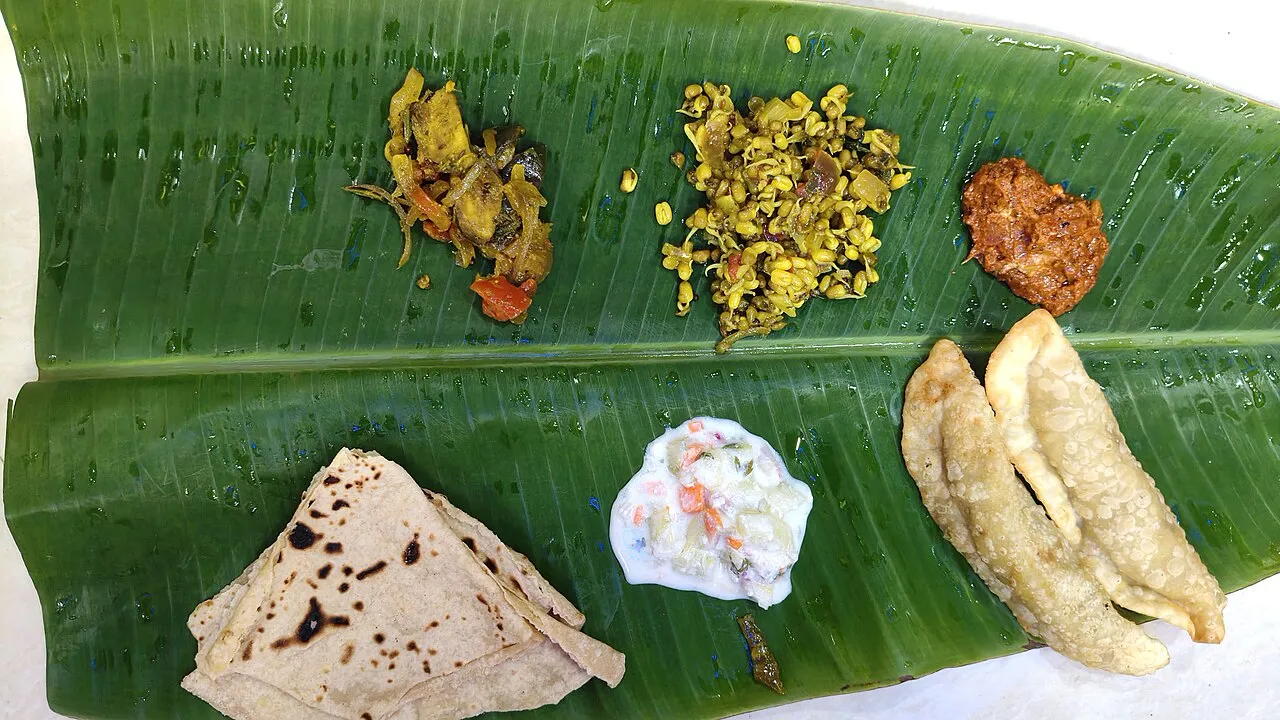
For large feasts, the plate was a banana leaf. FEZANA's cookbook describes the Parsi wedding feast, the lagan nu bhonu, as six to eight courses, served in India on banana leaves. Side dishes and condiments went on the top part of the leaf, and the main courses and rice on the lower part. When guests had finished, they folded the ends of the leaf, which told the servers to clear it. FEZANA is describing weddings here, not Navroz lunches, but it's the closest published guide we found to how a course-by-course Parsi meal is set out.
Frequently asked questions
What is in a Parsi Navroz thali?
A Parsi Navroz thali usually starts with sweet sev and mithu dahi, or ravo, in the morning. Lunch is mori dar and rice with a prawn or fish patio, then patra ni machhi, sali boti or chicken farcha, and a pulao. Lagan nu custard or falooda is the usual sweet. None of our sources gives a fixed list.
What is served at a Navroz lunch?
Navroz lunch is built on yellow dar and white rice with a prawn or fish patio. Families then add a fish dish such as patra ni machhi, a meat dish such as sali boti, sali gosht or farcha, a mutton or berry pulao, and a sweet. A 2019 Deccan Chronicle feature says it is usually ordered from a Parsi caterer.
What sweet do Parsis eat first on Navroz?
NewsMeter and The Better India both name sweet sev with sweetened dahi as the Navroz breakfast. Saveur describes the sev as vermicelli fragrant with cardamom and nutmeg, and the dahi as gently sweetened yoghurt. Ravo, semolina cooked slowly in milk and topped with nuts and raisins, is the other common choice, according to cook Freny Bharda speaking to Goya.
How was a Parsi feast served on a banana leaf?
FEZANA's cookbook Eat, Live, Pray says the Parsi wedding feast in India was served on banana leaves, in six to eight courses. Side dishes and condiments went on the top part of the leaf, and main courses and rice on the lower part. Guests folded the ends of the leaf when they had finished, telling the servers to clear it.


