 PalV's Kasti
On this page
Parsi New Year food follows a clear shape. The morning opens with something sweet: sagan ni sev (sweet vermicelli), mithu dahi (sweetened yoghurt) or ravo (semolina cooked in milk). Lunch is the big meal, built on plain yellow dal and white rice with a sharp prawn or fish patio, then patra ni machhi, salli boti or sali gosht, chicken farcha and a pulao. Falooda, ravo or lagan nu custard close it. A sweet start is meant to set a sweet year. Rice, which FEZANA's community cookbook says was once too costly for every day, marks the occasion. And dhansak is usually left off because many families link it with mourning. Below we go through each part of the day, with who says what.
શહેરેવર રોજ
Shehrevar Roj, Tir Mah · 1396 Y.Z.
When is Parsi New Year, and is the food the same in March and August?
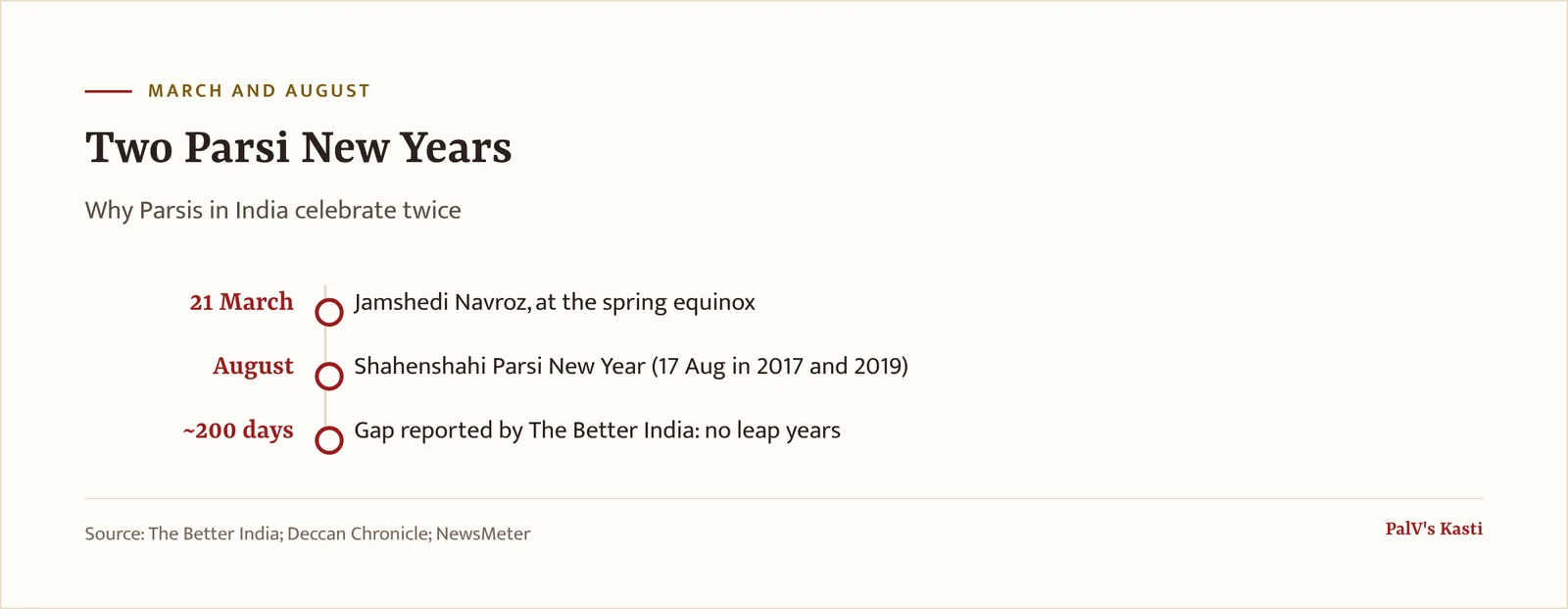
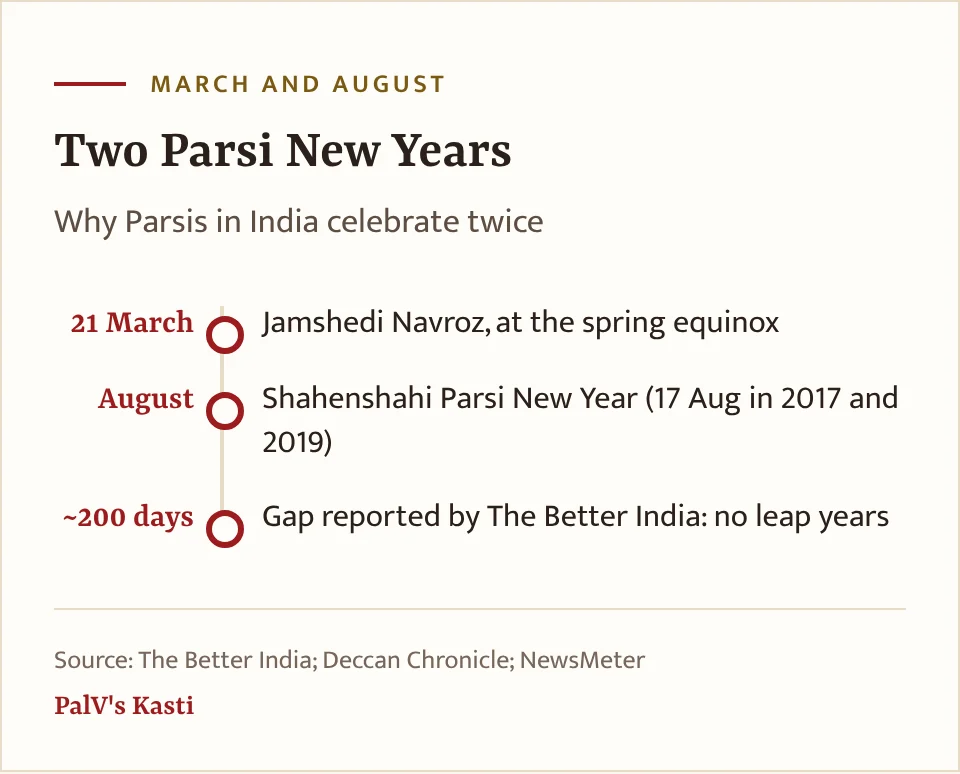
Parsis in India mark two new years. Jamshedi Navroz falls on 21 March, at the spring equinox, the same day Iran celebrates Nowruz. The Parsi New Year of the Shahenshahi calendar comes in August. The Better India explains the gap: the Shahenshahi calendar followed in India has no leap years, so its New Year is observed about 200 days after the rest of the world marks Nowruz. It fell on 17 August in 2017, according to The Better India, and again on 17 August in 2019, according to the Deccan Chronicle.
The food writers we read describe the same kind of festive menu for both days. One difference shows up in Navroz accounts from March: falooda. In My Bombay Kitchen, Niloufer Ichaporia King writes that falooda is meant to be eaten on 21 March, Navroz. The Iranian side of the March festival, with its haft-seen table and herbed rice with fish, is a separate tradition, covered in our piece on Nowruz foods and symbolism. For the festival itself, see our guide to Parsi New Year (Navroz).
Why do Parsis start the New Year with something sweet?
The first food of the day is sweet so that the year will be sweet too. Freny Bharda, speaking to Goya in 2017, said her family eats ravo first thing "to start the year on a sweet note". Delzeen Watcha Mistry told the Deccan Chronicle in 2019 that the day begins with sagan ni sev, mithu dahi or ravo. NewsMeter called sev the first breakfast dish on any auspicious day, eaten with sweetened yoghurt.
- Sagan ni sev: brown, sweet vermicelli, scented with cardamom and nutmeg in Meher Mirza's description for Saveur.
- Mithu dahi: milk boiled down, sweetened and set as curd. FEZANA's cookbook notes that mithoo dahi and sev are served on auspicious days such as navjotes, and Slurrp reports that spoonfuls are fed to children before exams for luck.
- Ravo: semolina cooked slowly in milk and ghee or butter, finished with fried nuts and raisins. Chef Rukshana Billimoria told Outlook India that ravo is "absolutely mandatory" in her house. Our explainer on Parsi ravo covers the dish in full.
- Malai pao and mawa ni boi: Mirza also lists the cream skimmed off rich milk, scooped up with white bakery bread, and mawa ni boi, a fish-shaped khoya sweet that Saveur and Homegrown both tie to sweetness and blessings for the coming year.
Sweetness also runs through the best-known Parsi origin story. Goya and Homegrown both retell the Sanjan story: King Jadi Rana answered the newly landed Zoroastrians with a vessel full to the brim with milk, and their priest stirred sugar into it. In Homegrown's telling, the sugar showed that his people would sweeten the society without overpowering it. The versions differ on detail (in Goya the king sends the vessel and a pinch of sugar goes in, in Homegrown he shows it and a spoonful goes in), and Homegrown calls the story an oral tradition, not recorded history.
Practice varies between families and Agiaries; your family priest's guidance comes first.
What do Parsis eat for Navroz lunch?
Lunch is the big gathering of the day. Slurrp describes a lavish feast once prayers are over and guests have arrived. Nawaz Modi Singhania told the Deccan Chronicle she hosts a lunch for about 35 to 40 friends of the family, with food from the family caterer, and Delzeen Watcha Mistry told the same paper that lunch is usually ordered from a Parsi caterer. The dishes below are the ones that come up again and again in the accounts we checked. Our Navroz Parsi thali lays the meal out course by course, and step-by-step methods are in Parsi New Year recipes.
Dar chawal with patio
The base is plain toor dal, tempered with cumin and topped with fried garlic, served over white rice. Saveur calls it butter-yellow mori dar, and NewsMeter says Navroz lunch rests on yellow lentils and steamed rice. On the side goes a prawn or fish patio, a sweet-sour seafood dish cooked with vinegar and jaggery. FEZANA's cookbook Eat, Live, Pray explains two of the names. "Mori" means without salt. And "dhun" comes from a Sanskrit word for wealth: rice once cost more than wheat rotli, so it was kept for special days, and dal with rice became "dhun dar".
Patra ni machhi
Pomfret coated in a green chutney of coconut, coriander and green chilli, wrapped in banana leaf and steamed. Ashoo Saam Chinoy told the Deccan Chronicle that the New Year is incomplete without it, and Slurrp lists it among the Navroz dishes, as part of most Parsi celebrations along with weddings and navjotes.
Salli boti, sali gosht, farcha and jardaloo chicken
Mutton or chicken topped with salli, crisp fried potato straws, is the meat course in several accounts. NewsMeter calls sali gosh very popular, Slurrp says Navroz is a great excuse to make salli chicken, and Chinoy names sali gosht alongside patra ni machhi as essential. Chicken farcha, pieces dipped in egg and crumbs and deep-fried, is a fixture of the Navroz table in Slurrp's account. Billimoria in Outlook and chef Anahita Dhondy in the Deccan Chronicle both mention jardaloo chicken, cooked with dried apricots, which Dhondy describes as "sweet, sour and tangy".
Pulao
A pulao often joins or replaces plain rice. Freny Bharda's lunch is "usually berry palao, or sali boti". Billimoria cooks mutton pulao and berry pulao, Singhania's favourite is chicken pulao dal, and The Better India's list includes saffron pulao.
Something sweet to finish
Dessert brings the sweetness back. Lagan nu custard, a baked custard served on auspicious occasions according to NewsMeter, also appears in Outlook India's Navroz round-up. Falooda, rose syrup and milk over soaked basil seeds and noodles, is the drink Bharda's family has on returning from prayers. Our Navroz falooda post has the method.
Why is dhansak not eaten on Navroz?
Dhansak, the best-known Parsi dish, is usually kept off the New Year table because many families cook it after a death. Chinoy told the Deccan Chronicle that dhansak is not made for happy occasions and is eaten on the fourth day after a death. Slurrp gives the same reason: Navroz marks a fresh start, and a mourning dish does not belong on it. Saveur's Meher Mirza puts it in four words: "But never on Navroze."
Not every source agrees. The Better India's 2017 list of dishes "specially prepared" on the day includes dhansak, and The Hans India reported that the Secunderabad community's 2016 New Year meal included patra ni machhi and dhansak. So the custom is widely followed rather than universal.
Practice varies between families and Agiaries; your family priest's guidance comes first.
How does food fit into the rest of the day?
The meals sit around prayer. Billimoria described a morning bath, new clothes and a visit to the fire temple, where her family offers flowers, milk, fruit and sandalwood, and The Better India lists the same four offerings. Singhania goes to the Atash Behram for prayers and has sagan done at home. The evening is for a Parsi natak or the community club: Outlook, Saveur and the Deccan Chronicle all mention a play, and The Hans India describes Secunderabad families heading to the Zoroastrian Club. Some households add small customs of their own. Bharda's family cuts a watermelon together "to keep illness away in the New Year".
Practice varies between families and Agiaries; your family priest's guidance comes first.
Frequently asked questions
What do Parsis eat on Navroz?
Parsis begin Navroz with a sweet breakfast of sagan ni sev, mithu dahi or ravo. Lunch is plain yellow dal and rice with prawn or fish patio, followed by patra ni machhi, salli boti or sali gosht, chicken farcha and a pulao. Falooda, ravo or lagan nu custard are the usual sweets to end the meal.
Why is dhansak not eaten on Navroz?
Many Parsi families cook dhansak on the fourth day after a death, so it is treated as a mourning dish and kept off happy occasions. Slurrp and a cook quoted in the Deccan Chronicle give this reason, and Saveur says it is never served on Navroze. A few reports do list it at New Year meals.
Why do Parsis start the New Year with something sweet?
Families eat a sweet dish first so the year ahead begins on a sweet note, in the words of cook Freny Bharda speaking to Goya. Sagan ni sev with mithu dahi, or ravo, is the usual choice. The same sweet pairing of sev and dahi is served on other auspicious days such as navjotes, according to FEZANA's community cookbook.
What is mori dar?
Mori dar is plain toor dal cooked with turmeric, tempered with cumin and finished with fried garlic, made without salt according to FEZANA's community cookbook. Served over white rice it becomes dhun dar, from a word for wealth. Prawn or fish patio is its classic partner on Navroz and other happy days.
Is Jamshedi Navroz food different from the August Parsi New Year?
The accounts we read describe a similar festive menu on both days: sweet breakfast, dar chawal with patio, fish, meat and a pulao. The main March addition is falooda, which Niloufer Ichaporia King says is meant for 21 March. Iranian Nowruz dishes such as herbed rice with fish belong to a separate tradition.


