 PalV's Kasti
On this page
Old Poona's Parsi food, as far as the written record lets us see it, was Parsi home cooking carried into the Camp. Dorabjee & Sons opened in 1878 and served the only food its founder knew how to make: Parsi food, which today means dhansak, salli boti, farcha, akuri and lagan nu custard on its menu. Poona-born writer Farrukh Dhondy remembers dhan dar machhi for birthdays, dhansak for Sunday family gatherings, and batasa, bhakra and gor keri nu achaar kept in glazed jars. In the 20th century, Irani cafes and Camp's bakeries added bun maska, Irani chai and Shrewsbury biscuits. What we couldn't find is any source describing a separate "Poona style" of Parsi cooking, so this post sticks to what is recorded.
શહેરેવર રોજ
Shehrevar Roj, Tir Mah · 1396 Y.Z.
What did Parsi families in old Poona cook at home?
The clearest first-hand picture comes from Farrukh Dhondy, the UK-based writer born in Poona, in a 2022 essay for Outlook. He names dhan dar machhi as a birthday special: plain white rice, a simple tempered dal, and fish rubbed with red chilli, turmeric and salt, then fried. Dhansak, the browned rice served with a meaty dal of cooked-down vegetables, was for family gatherings on a Sunday. Dhansak and pulao, he writes, make up the basic Parsi meal.
His grandmother's store cupboard matters just as much. She kept jeera-flecked batasa and bhakra in glazed china jars. Once a year she spent several days making gor keri nu achaar, the sweet mango relish somewhere between chutney and pickle, together with the other Parsi women of the neighbourhood. And eggs went on top of most things, from potatoes to okra to mince.
One caution. Dhondy's essay doesn't name the town where his grandmother's kitchen stood. We know he was born in Poona, and an Outlook review of Dorabjee & Sons notes that many of his short stories are set in the lanes around Sarbatwala Chowk in Camp. Read his list as the food of a Poona-born Parsi childhood, not as a recipe register for the city.
How did Parsi home cooking reach Poona's Camp restaurants?
Through one family, mainly. Darius Dorabjee told The Indian Express in 2018 that his great-grandfather Sorabjee Dorabjee started the business in 1878, when the Cantonment's only eating place was an Italian restaurant and bar closed to Indians. A bun-maska and chai stall came first. Customers asked for a restaurant, and because the founder knew only Parsi cooking and had no hired cooks, Parsi food is what the restaurant served. Outlook India gives the same 1878 date.
The arrangement stayed close to a home kitchen. The family bought a house across the road so the women could grind masalas and sift rice there, while the men cooked in the restaurant. According to the 2018 report, the food was still cooked on chulhas, and a family member still added the masalas.
What was on a 1940s Poona Parsi menu?
In 2018 the restaurant displayed its old menus from the 1940s to the 1970s at the entrance. On the 1940s card, mutton chilly fry cost two annas; in 2018 it cost Rs 250. The Indian Express report adds that chicken dishes then cost twice as much as mutton, which was the "poor man's food" of the time. The 2018 menu ran from pulao and biryani to dhansak, salli boti, farcha, akuri on toast and lagan nu custard, with Ardeshir raspberry soda to drink. For the restaurant's own story, read our Dorabjee & Sons history.
Why is Sunday dhansak linked with Poona?
Two separate accounts put dhansak on Sunday. Dhondy's essay ties it to Sunday family gatherings at home. Anvar Alikhan's 2022 review in Outlook says Dorabjee's Sunday dhansak "has become an institution of Poona". Neither source explains how the habit started, so we won't guess.
How did Irani cafes and Camp bakeries shape the Poona tea table?
Sifra Lentin of Gateway House writes that Irani migrants of the late 19th and early 20th centuries, many of them leaving the drought-hit provinces of Yazd and Kerman, were drawn to British India and especially to Bombay and Poona, where Iranian Zoroastrians had already settled. A 2018 report in The Citizen says many of Pune's Parsi-Irani cafes are in the Old Camp area. Most open around 6 am and take only cash, and the menu is built around bun maska, broon maska and Irani chai. By that report, Diamond Queen and Goodluck Cafe both date from 1935. Our guide to the Irani cafes of Pune covers them one by one.

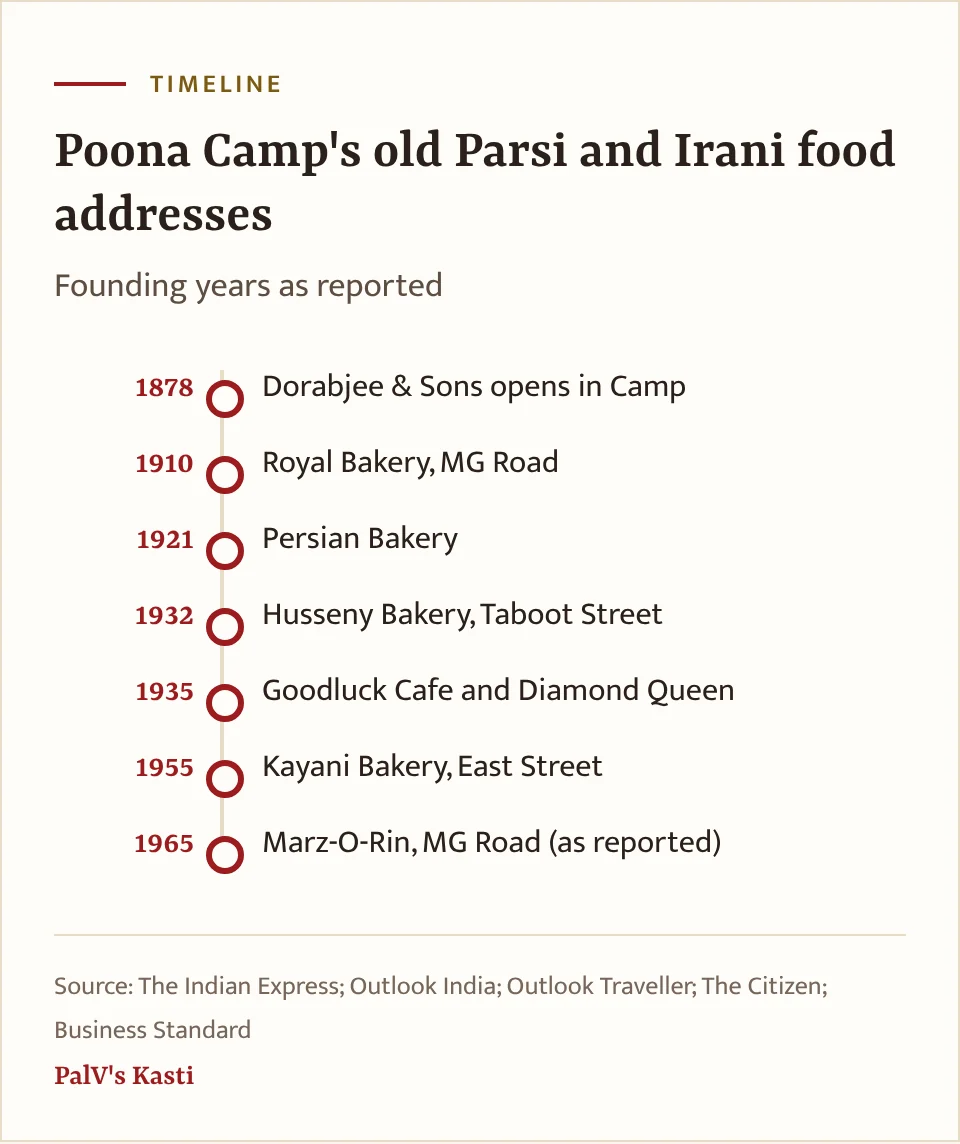
The bakeries sit alongside. Outlook Traveller's round-up of Camp's old bakeries gives these founding years, each from that one article:
- Royal Bakery, MG Road, 1910. It started out selling peti pav to British officers.
- Persian Bakery, 1921, known for Bombay khari and nankhatai.
- Husseny Bakery, Taboot Street, 1932, for brun pav and Irani naan.
- Kayani Bakery, 1955, the home of Shrewsbury biscuits and mawa cake. Business Standard gives the same year.
- Marz-O-Rin, MG Road. The article dates it to 1965 but also calls it a year younger than Kayani, so treat that date as unsettled.
A 2020 Better India feature on the batasa, built around Parsi cookbook author Niloufer Mavalvala, counts Pune with Surat and Navsari as a stronghold of the biscuit. It's the same biscuit Dhondy's grandmother kept in her jars.
Was there a separate Poona style of Parsi cooking?
We looked and found no source that says so. None of the Poona accounts we read presents dhansak, salli boti, farcha, akuri or lagan nu custard as a local speciality, and Dhondy calls dhansak and pulao the basic Parsi meal. What the Poona sources do show is setting: a Cantonment where a Parsi family's kitchen became a public restaurant, Irani cafes and old bakeries close together in Camp around Sarbatwala Chowk, East Street and MG Road, and a town counted among the batasa's strongholds.
Frequently asked questions
What is the oldest Parsi restaurant in Pune?
Dorabjee & Sons in Camp is the oldest we found on record. The Indian Express and Outlook India both date it to 1878, when Sorabjee Dorabjee turned a bun-maska and chai stall into a restaurant. In 2018 the founding family's fourth generation was running it, serving Parsi dishes such as dhansak, salli boti, farcha and lagan nu custard.
What Parsi food did old Poona families eat on Sundays?
Dhansak. Poona-born writer Farrukh Dhondy recalls dhansak, browned rice with a meaty lentil and vegetable dal, as the dish for Sunday family gatherings. A 2022 Outlook review separately calls the Sunday dhansak at Dorabjee & Sons in Camp an institution of Poona. Neither source explains when the Sunday habit began.
Why is Pune Camp linked to Parsi and Irani food?
The places on record sit in Camp, the old Cantonment. Dorabjee & Sons opened there in 1878, many Parsi-Irani cafes are in the Old Camp area, and Kayani Bakery, Marz-O-Rin and Cafe Yezdan are nearby. Gateway House notes that Iranian Zoroastrians had already settled in Poona when later Irani migrants arrived.
Which old bakeries are in Pune Camp?
Outlook Traveller's list names Royal Bakery (1910), Persian Bakery (1921), Husseny Bakery (1932), Kayani Bakery (1955) and Marz-O-Rin. They are known for brun pav, Bombay khari, nankhatai, Shrewsbury biscuits and mawa cake. Most of these founding years come from that single article, so treat them as that magazine's account.
Is Poona Parsi food different from Bombay Parsi food?
We found no written source describing a distinct Poona style. None of the Poona accounts we read treats dhansak, salli boti, farcha or lagan nu custard as a local speciality. What stands out in the record is place: a small Cantonment where a Parsi restaurant, Irani cafes and old bakeries clustered in a few streets of Camp.


