 PalV's Kasti
On this page
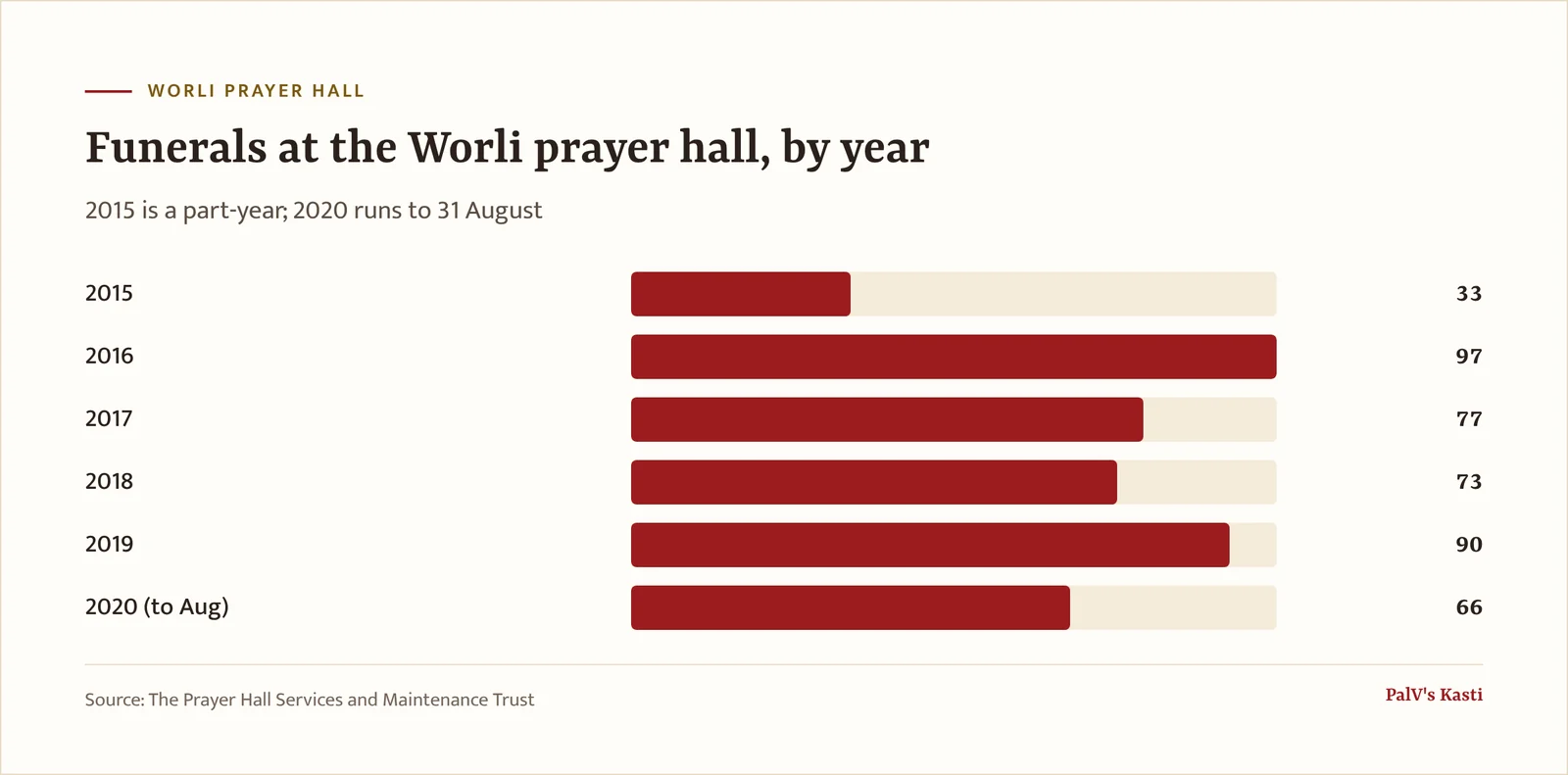
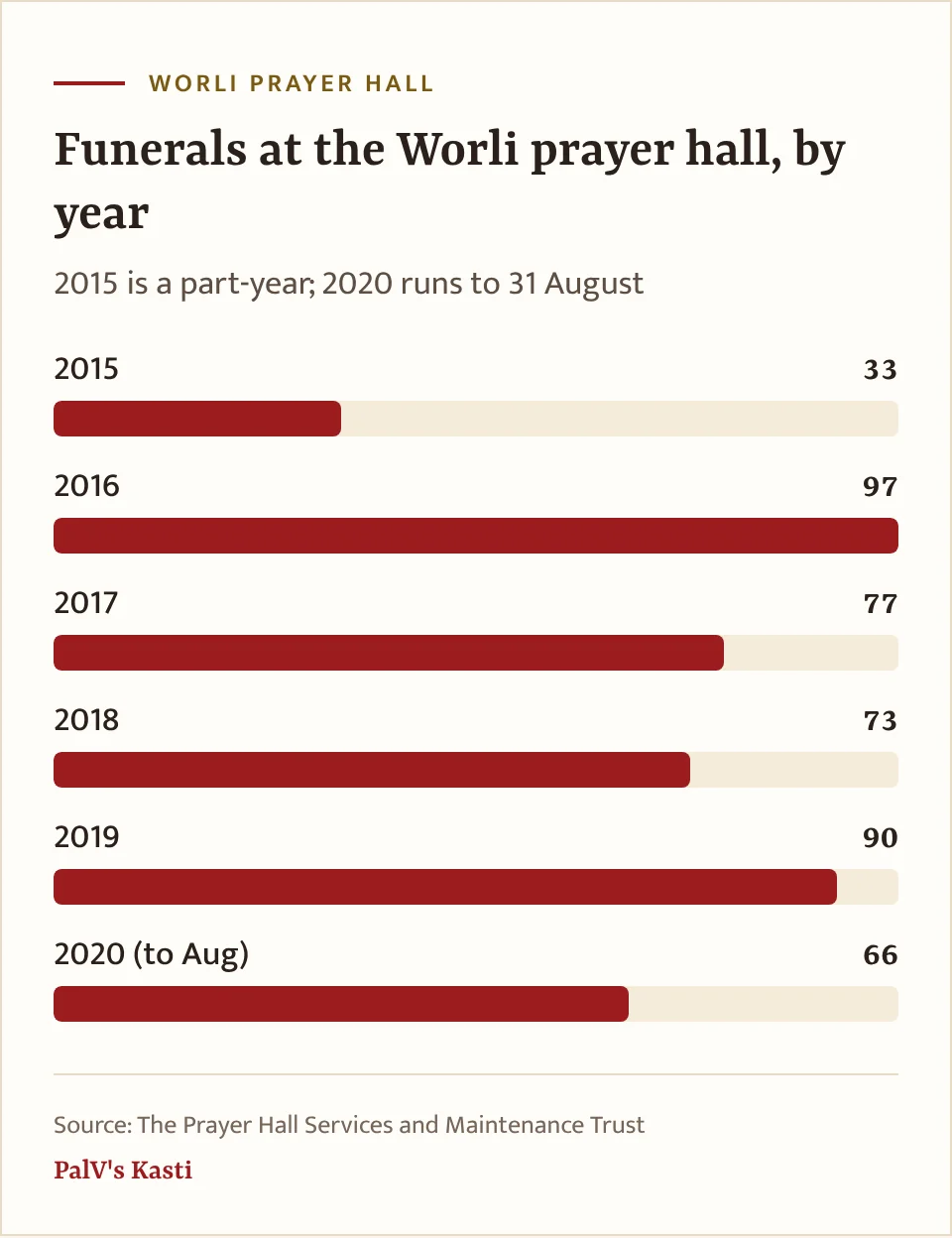
Nobody publishes one official count of Parsi cremation in Mumbai. The best figures come from the Prayer Hall Trust, which runs the prayer hall at the Worli municipal crematorium. It recorded 33 funerals there in 2015 (its first part-year), 97 in 2016, 77 in 2017, 73 in 2018, 90 in 2019 and 66 in the first eight months of 2020. Published estimates of cremation's share of all Parsi funerals in the city run from "just over 10%" to "15-20%", depending on who is counting. The larger change is in how families mourn. Since the hall opened in 2015, Parsis who choose cremation have had a settled place for the four days of prayers, which the bunglis at Doongerwadi had refused them. For the wider background, see our guide to Parsi cremation.
શહેરેવર રોજ
Shehrevar Roj, Tir Mah · 1396 Y.Z.
How many Parsis are cremated in Mumbai each year?
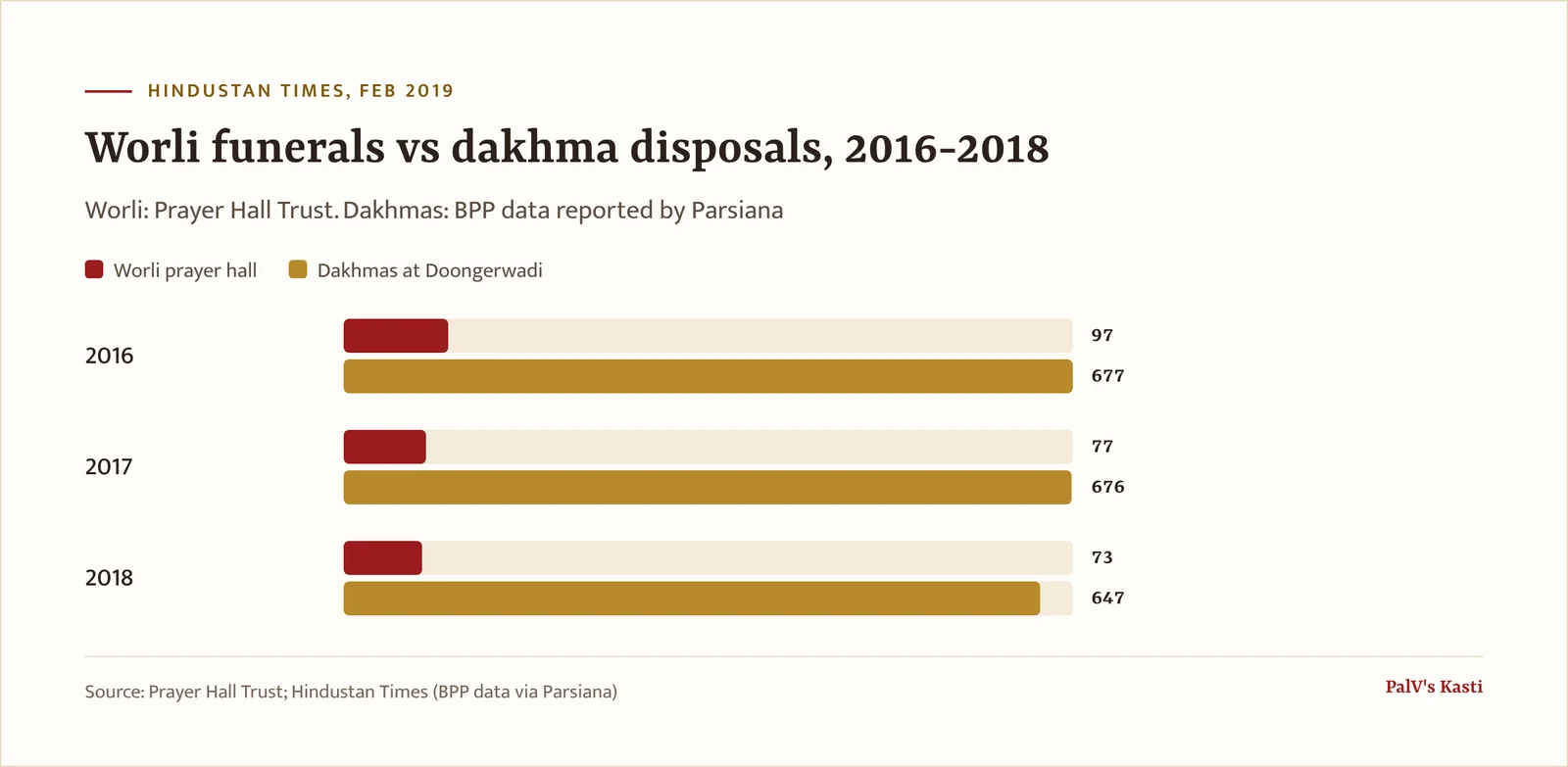
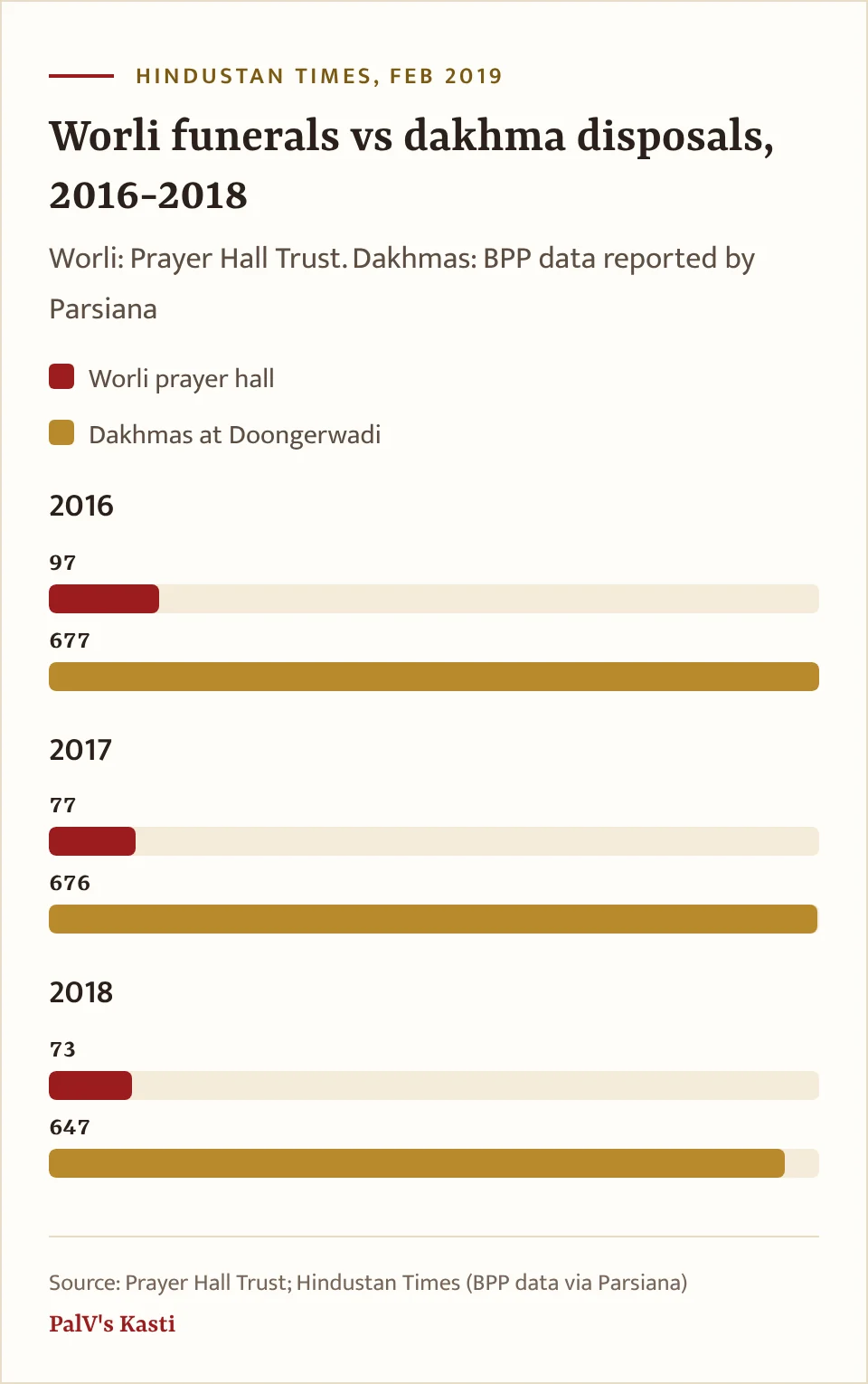
The only year-by-year series we found is a one-page table the Prayer Hall Trust put on its website, dated 31 August 2020. It counts funerals whose prayers were held at the Worli hall: 33 in 2015, 97 in 2016, 77 in 2017, 73 in 2018, 90 in 2019 and 66 in 2020 up to the end of August. That makes 436 in just under five years. The Hindustan Times reported the same 2016, 2017 and 2018 numbers in February 2019, under a headline that described only 247 cremations in three years.
Nothing newer has been published by year. When the Free Press Journal marked the hall's eighth anniversary in January 2024, it quoted the 2015, 2019 and 2020 figures and gave none for later years. The same report quoted Dinshaw Tamboly, a former Bombay Parsi Punchayet (BPP) trustee who is now a member of the Prayer Hall Trust, as saying the community holds about 650 funerals a year in Mumbai, of which 100 to 120 are cremations.
Read the Worli figures for what they are. They count families who used the hall, not every Parsi cremated in the city. The Trust's rules let families hold the four-day prayers at Worli even when the cremation took place somewhere else. Tamboly also told the Free Press Journal in April 2024 that cremations were held at other places before the hall existed.
What share of Parsi funerals in Mumbai are cremations?
The published estimates do not agree, so here they are side by side, each with its source and date:
- June 2016, AFP: Parsiana editor Jehangir Patel put cremations at around 15% of funerals in a Mumbai community estimated at 45,000, up from 6% before the hall opened.
- February 2019, Hindustan Times: using BPP data reported by Parsiana, the paper gave about 677 bodies taken to the dakhmas in 2016, 676 in 2017 and 647 in 2018, and 720 deaths in the community in 2018. Patel put the cremation share at about 6% before the hall and around 12% in the three years since.
- January 2024, Free Press Journal: an estimated 7-8% before the hall, and a Prayer Hall Trust estimate of 15-20% now.
- April 2024, Free Press Journal: Patel said "just over 10%" of funerals were done in non-traditional ways, and that there was still reluctance to choose cremation.
Our calculation from the 2018 numbers: 73 Worli funerals out of 720 deaths is about 10%. Tamboly's 2024 figure of 100 to 120 out of 650 works out to roughly 15% to 18%. Much of the gap comes from what is counted (the Worli hall alone or every crematorium) and which years.
Wishes are another matter. Open magazine reported in February 2014 that a Parsiana survey from December 2013 found 28% of respondents wanted to be cremated. On the other side, the orthodox scholar Khojeste Mistree told AFP in 2016 that a "massive majority" still favoured the traditional way, and that from a religious point of view cremation was wrong.
Did cremations rise after the Worli prayer hall opened in 2015?
The Free Press Journal wrote in January 2024 that the number of Parsis opting for cremation had nearly doubled since the hall opened. In the same article Patel was more cautious. He said the number cremated may not have gone up, but life had improved for the families who chose it, because getting a hall or a priest for the prayers was no longer a problem.
The monthly pattern is uneven. Framroze Mirza, then the priest in charge of services at the hall, told the paper that some months bring eight to 10 funerals and others only one or two. He also described a spike during Covid, when the bodies of those who died of the disease were not allowed into the dakhmas. The Trust's own table fits that account: June and July 2020 each show 15 funerals, a monthly figure reached only twice before in the series.
How has cremation changed Parsi funeral patterns in Mumbai?
A fixed place for the four-day prayers
Before 2015, a family that chose cremation could not hold the after-death prayers in the Doongerwadi bunglis. Journalist Coomi Kapoor, in her history of the Parsis, writes that the BPP took this line on the advice of Dastur Firoze Kotwal. In April 2024 Tamboly told the Free Press Journal that the high priests had refused to allow prayers at the Tower of Silence halls for those who were cremated, and "we had no choice but to set up a prayer hall". Patel called the old situation "a nightmare" for those families.
Families choosing which prayers to hold
The Trust's 2020 table splits its 436 funerals into 374 with the full four days of prayers and 62 with the Paidast only. So most families who used the hall kept the whole four-day sequence. Our post on the Parsi cremation process explains what those prayers are and when they are said.
Practice varies between families and Agiaries; your family priest's guidance comes first.
Mourners of every faith sitting together
At Doongerwadi, only Zoroastrians may enter the prayer halls, as the Free Press Journal noted in October 2024. Patel told the paper earlier that year that at Worli, non-Zoroastrian friends and relatives are not made to sit separately. Open magazine reported in 2016 that a cremation lets the family stay with the body until the end, and that some community members cite this access as a consideration in their choice.
Well-known Parsis cremated at Worli
The Free Press Journal reported three prominent cremations at Worli. Cyrus Mistry, former chairman of Tata Sons, was cremated there in 2022. Minoo Shroff, a former BPP chairman, followed in April 2024, and Tamboly said this could be the first time a member of the BPP's board had been cremated. Ratan Tata's last rites were held there on 10 October 2024. Homi Khusrokhan, a Prayer Hall Trust trustee who led the arrangements, told the paper he did not know of any request from Tata about cremation. Patel said it would have been embarrassing if dignitaries had been turned away.
Do most Mumbai Parsis still choose Doongerwadi?
Yes, on every published count. Even the highest estimate, the Trust's 15-20%, means that at least eight in 10 Parsi funerals in Mumbai are not cremations (our calculation). The Trust itself does not campaign for cremation. In a 2016 Parsi Times interview Tamboly said it was not the Trust's policy to recommend the hall to anyone, and called it a personal choice for individuals and families. Whether Doongerwadi should have its own crematorium is a separate argument, which we cover in the Doongerwadi crematorium debate. For the traditional system itself, see our page on the Tower of Silence.
Frequently asked questions
How many Parsis are cremated in Mumbai?
The Prayer Hall Trust counted 436 funerals at its Worli hall between 2015 and 31 August 2020, with a high of 97 in 2016. In January 2024 Dinshaw Tamboly of the Trust told the Free Press Journal that 100 to 120 of Mumbai's roughly 650 Parsi funerals a year were cremations.
Where is the Parsi crematorium in Mumbai?
The prayer hall used by Parsi families who choose cremation is at the Worli municipal crematorium, and it opened in 2015. Dinshaw Tamboly of the Prayer Hall Trust has said that Parsi cremations took place at other crematoriums before the hall existed, and the Trust's rules let families hold the prayers at Worli after a cremation elsewhere.
Was Ratan Tata cremated?
Yes. The Free Press Journal reported that Ratan Tata's last rites were held at the Worli municipal crematorium on 10 October 2024, after the public paid their respects at the NCPA lawns. Homi Khusrokhan, a Prayer Hall Trust trustee who led the arrangements, told the paper he did not know of any request from Tata about cremation.
Why do the published cremation figures disagree?
They measure different things. The Worli table counts only funerals whose prayers were held at that hall. Other estimates try to cover every crematorium, refer to different years, or are the judgement of a community editor rather than a count. Current shares run from just over 10% to 15-20%, and no year-wise figures after August 2020 have been made public.
Did Parsi cremations in Mumbai rise during Covid?
Framroze Mirza, the priest then in charge at the Worli hall, told the Free Press Journal in January 2024 that cremations spiked during Covid, when bodies of those who died of the disease were not allowed into the dakhmas. The Trust's table shows 15 funerals in each of June and July 2020.


