 PalV's Kasti
On this page
- What are the Parsi rules on intermarriage and conversion?
- Where do the rules come from? The 1908 Parsi Panchayat case
- How common is intermarriage among Parsis now?
- Would accepting the children of intermarriage slow the decline?
- What do traditionalists say in the purity vs survival debate?
- What do reformists say?
- What are the courts deciding?
- What does drive the decline, according to the research?
- Frequently asked questions
Not by much, according to the one peer-reviewed projection that tested the question. As demographers Zubin Shroff and Marcia Castro describe the rules, Parsis in India do not take converts, and the children of a Parsi woman who marries a non-Parsi are not counted as Parsi, while the children of a Parsi man who marries out are. Writing in Demographic Research in 2011, they projected Mumbai's Parsi population from 2001 to 2051. At 2001 fertility, accepting every child of intermarriage gave 20,535 Parsis in 2051, against 20,122 under the current rules. Their conclusion: intermarriage "is not the principal driver" of the decline, and the main factor is very low fertility. Whether the rules should change is a separate argument, which the authors call deeply divisive. A nine-judge Supreme Court bench heard the women's side of it and reserved its verdict on 14 May 2026.
શહેરેવર રોજ
Shehrevar Roj, Tir Mah · 1396 Y.Z.
What are the Parsi rules on intermarriage and conversion?
Shroff and Castro describe the Parsis of India as endogamous and non-proselytising, a community that has traditionally refused to convert people of other faiths. They add that a Parsi father is a necessary legal condition for a newborn to count as Parsi. Malini Karkal, writing in Demography India in 1975, makes the same point about conversion: the Parsis who settled in India, she writes, admitted no convert to their religion.
The rule falls differently on men and women. As Shroff and Castro set it out, a Parsi man who marries a non-Parsi woman has children who are considered Parsi, though his wife is not. A Parsi woman who marries a non-Parsi man has children who are not considered Parsi. She herself stays a member of the community "by law, but not by custom, according to orthodox Parsis", a line the authors take from the legal historian Mitra Sharafi.
In daily life this decides who may enter community spaces. AFP reported in December 2013 that the children of a Parsi woman who marries a non-Zoroastrian are barred from Mumbai's fire temples and the Towers of Silence. Some local bodies write the rule down. Rule 5(2) of the Nagpur Parsi Panchayat, quoted by The Indian Express in March 2026, says a Parsi or Irani Zoroastrian woman who marries a non-Parsi man and has children with him will not be accepted, nor will those children.
Practice varies between families and Agiaries; your family priest's guidance comes first.
Where do the rules come from? The 1908 Parsi Panchayat case
Sharafi writes that the Bombay High Court's judgment of 27 November 1908 in Petit v. Jeejeebhoy, informally called the Parsi Panchayat case, is generally taken to stand for keeping converts out of the community. It began with a marriage. Suzanne Brière, a Frenchwoman, married into the Tata family and went through the Navjote just before the wedding. Sharafi dates the marriage to 1903, while ThePrint, in a 2023 report, gives 1902.

Justices Dinshaw Davar and Frank Beaman ruled against Mrs Tata's side. Sharafi is careful about what they did and did not decide. They did not declare conversion itself impermissible. They held that juddins, non-Parsis, were excluded from the benefit of Parsi trusts, the legal instrument that governs Zoroastrian religious properties and funds. Davar's judgment, she writes, set up "Parsi" as an ethnic category and "Zoroastrian" as a religious one. Beaman's view was that the community had become a caste, which a person could only enter by being born into it.
The judgment itself records that the trustees defending the suit counted, as an exception, the children of Parsi fathers by non-Parsi mothers. The case's reach is still disputed. Sharafi notes a running debate over whether the judges' remarks on conversion were obiter dicta, of no value as precedent, because the would-be converts were not parties to the suit.
How common is intermarriage among Parsis now?
Far more common than two generations ago. Karkal worked from Parsi Panchayat marriage records for Greater Bombay. In 1950 to 1959, 9,422 Parsis married there and 1.5% of them took a partner from outside the community. In 1960 to 1969 the share was 3.7%.
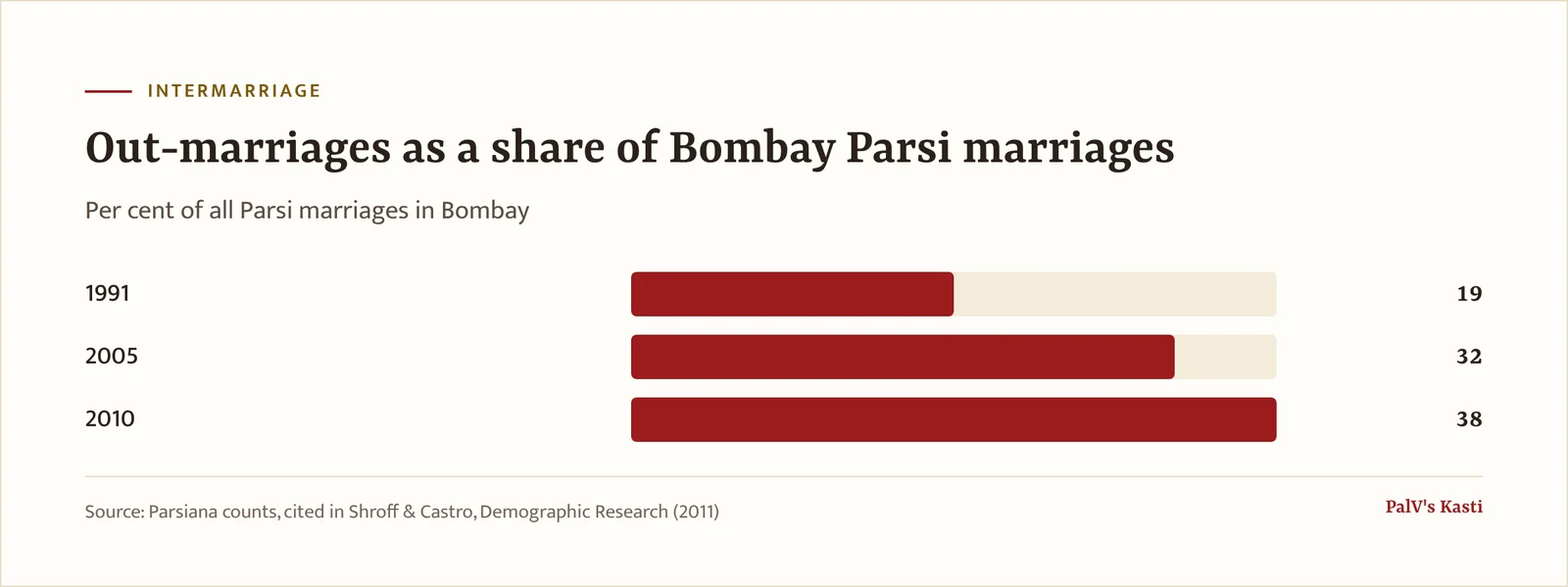
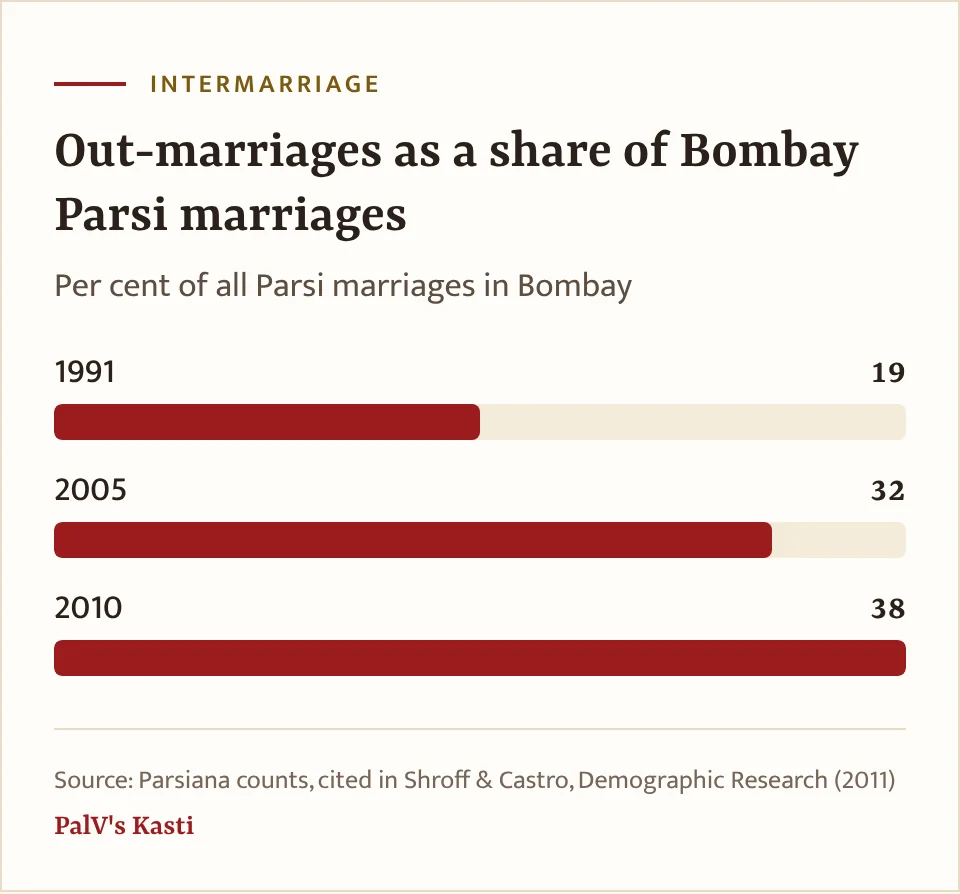
Later figures use a different measure, the share of all Parsi marriages rather than of people marrying. Shroff and Castro cite Parsiana's counts: marriages outside the community were 19% of all Parsi marriages in Bombay in 1991, 32% in 2005 and 38% in 2010. ThePrint reported in August 2023 that Parsiana's data put the figure close to 50 per cent, and quoted Bombay Parsi Punchayet trustee Viraf Mehta saying almost half of Mumbai's Parsi marriages are now interfaith because young Parsis can't meet eligible Parsis.
Would accepting the children of intermarriage slow the decline?
Only slightly, unless more children are born. Shroff and Castro started from Mumbai's 46,557 Parsis in the 2001 Census and ran the population forward to 2051, treating the community as closed to migration. They tested three acceptance rules against three fertility levels. A total fertility rate (TFR) of 0.89 was the level they observed for 2001.
| Fertility assumption | Current rules | Accept all children of intermarriage | Accept no children of intermarriage |
|---|---|---|---|
| 2001 level (TFR 0.89) | 20,122 | 20,535 | 19,136 |
| Doubled (TFR 1.78) | 31,756 | 32,911 | 29,036 |
| Trebled (TFR 2.67) | 47,116 | 49,344 | 41,913 |
The authors explain the small gap at today's fertility plainly. With so few births, there are very few children to bring into the fold or keep out of it. Accepting the children of Parsi women who married out, instead of excluding them as the current rule does, adds about 400 people by 2051 at 2001 fertility. That grows to 1,155 if fertility doubles and 2,228 if it trebles. They also tried doubling the rate of out-marriage, and it barely moved the trend, because non-Parsi wives having Parsi children with Parsi husbands more than offset the Parsi women marrying out.
Two cautions come with these numbers. The model is for Mumbai only, starts from 2001 data, and borrows the marriage ages of women marrying within the community for women marrying out, because Parsiana's counts had no ages. And it is one study. We found no second peer-reviewed projection to set beside it.
What do traditionalists say in the purity vs survival debate?
AFP, covering the World Zoroastrian Congress in Mumbai in December 2013, reported that traditionalists see the rules as essential to preserving an identity that combines religion and ethnicity. Khojeste Mistree, described by AFP as a Punchayet trustee, warned that if members marry out, the community's ethnicity "is going to disappear" within four generations. He called them the rules of a religious club, which members have every right to leave.
A Bombay Parsi Punchayet trustee, unnamed in ThePrint's 2023 report, put the distinction this way: "Everyone may embrace the faith, but everyone cannot become a Parsi." The same report noted that when author Prochy N. Mehta petitioned the Calcutta High Court in 2017 after her grandchildren, whose father is not Parsi, were refused entry to the city's fire temple, the Federation of Parsi Zoroastrian Anjumans of India, an umbrella of 69 Anjumans, intervened to keep non-Parsis out. ThePrint also reported a TISS study by Dr Lata Narayan, published in 2017, in which only 4.4 per cent of 761 respondents said the children of Parsi women who have had their Navjote should count as members of the community.
What do reformists say?
Shroff and Castro describe socially liberal Parsis as seeing intermarriage as inevitable and believing that accepting the children would help stem the decline considerably. Jehangir Patel, editor of Parsiana, told AFP in 2013 that the rules are "basically politics of apartheid", discrimination on the basis of race and sex.
Vispy Wadia, president of the Association of Intermarried Parsis, told ThePrint in 2023 that women who marry out no longer face social ostracism but do face religious othering. "By saving the so-called purity, we're sacrificing our religion," he said. ThePrint added that Parsiana criticised the preference for racial purity over survival in a 2019 editorial.
What are the courts deciding?
Two Supreme Court matters bear on the women's side of the rule. Neither had been decided in the latest reports we could open.
Goolrokh Gupta v. Burjor Pardiwala
Born Parsi, Goolrokh Gupta wed a Hindu man under the Special Marriage Act, 1954, and went on practising her faith. The Supreme Court Observer's case page records that the Parsi trust in Valsad barred her from Parsi institutions, and that the Gujarat High Court, by 2:1, dismissed her petition, mainly on the ground that a Parsi woman marrying a non-Parsi under that Act ceases to be Parsi unless a competent court declares she still practises Zoroastrianism. Her special leave petition (SLP (C) 18889/2012) went to a Constitution Bench. At a hearing on 7 December 2017, Chief Justice Dipak Misra observed, as Scroll reported, that "only a woman can choose to curtail her own identity". That was a remark from the bench, not a judgment.
LiveLaw reported that her petition was later tagged with the Sabarimala reference before a nine-judge bench. At the hearing on 5 May 2026, her counsel Darius Khambata argued that the bar falls only on women and that practice is not uniform, saying several Anjumans permit intermarried women to enter. Justice B.V. Nagarathna remarked that the practice looked prima facie like excommunication based on gender. These were oral remarks, not a ruling. LiveLaw reported on 14 May 2026 that the bench had reserved its verdict. We found no judgment reported since, so the case is pending as of 14 May 2026.
Dina Budhraja and the Nagpur Parsi Panchayat
According to The Indian Express on 26 March 2026, Dina Budhraja married a Hindu man under the Special Marriage Act in 2009 without converting, and in 2024 was refused entry to an Agiary for her grandmother's funeral prayers under Rule 5(2). A bench of Chief Justice Surya Kant and Justices Joymalya Bagchi and Vipul M. Pancholi issued notice to the Nagpur Parsi Panchayat and the Union Government. Her petition argues the rule fails the equality, liberty and religious-freedom guarantees of Articles 14, 21 and 25. It cites the Bombay High Court's 2011 ruling in Jamshed Kanga v. Parsi Panchayat Funds that excommunication has no place in Zoroastrian doctrine, and points out, as the Express reported, that the Parsi panchayats of Delhi and Kolkata do not treat women who marry out as having lost their identity. The matter was pending as of 26 March 2026.
This is general information, not legal advice; for a specific case, speak to a lawyer.
What does drive the decline, according to the research?
Fertility, in Shroff and Castro's analysis. They found the main factor behind the fall to be the community's very low fertility, a TFR of only 0.89 in 2001. Even an immediate doubling would leave Mumbai's 2051 population 30 to 40% smaller than in 2001. They suggest the community move its argument away from intermarriage and toward subsidies for raising children, support for working women and housing for young couples.
Why so few children are born is the subject of our page on the Parsi birth rate. What an ageing community needs today is covered in Elderly Parsis care, and the latest counts are on our Parsi population in India page. Families living abroad meet these questions in other settings, which we look at in the Zoroastrian diaspora.
Frequently asked questions
Are the children of a Parsi mother and a non-Parsi father Parsi?
Under the traditional rule, no. Demographers Shroff and Castro report that the children of a Parsi woman who marries a non-Parsi man are not considered Parsi, while those of a Parsi man who marries out are. A 2026 petition reported by The Indian Express says the Delhi and Kolkata panchayats do not treat such women as having lost their identity.
Would accepting those children stop the Parsi decline?
Not on its own, according to a 2011 study in Demographic Research. At 2001 fertility, accepting the children of Parsi women who married out, instead of excluding them as now, would leave Mumbai with about 400 more Parsis in 2051. The gap grows only if fertility rises, reaching 2,228 people if it trebles.
What did the 1908 Parsi Panchayat case decide?
On 27 November 1908 the Bombay High Court ruled against the side of Suzanne Brière, a Frenchwoman who had her Navjote before marrying into the Tata family. Legal historian Mitra Sharafi writes that the judges did not ban conversion outright but held that non-Parsis could not benefit from Parsi trusts.
What is the Goolrokh Gupta case?
Goolrokh Gupta, born Parsi, married a Hindu under the Special Marriage Act and was barred by the Valsad Parsi trust. The Gujarat High Court held, 2:1, that she ceased to be Parsi unless a court declared she still practised the faith. A nine-judge Supreme Court bench heard her appeal and reserved its verdict on 14 May 2026.
Do Parsis in India accept converts?
Traditionally, no. Shroff and Castro describe an endogamous community that has refused to convert people of other faiths, and Karkal wrote in 1975 that Parsis in India admitted no convert. A Bombay Parsi Punchayet trustee told ThePrint in 2023 that anyone may embrace the faith but not everyone can become a Parsi.


