 PalV's Kasti
On this page
- What is the Parsi fertility rate today?
- What do Parsi demographics show about births and deaths?
- When did the Parsi birth rate start falling?
- Why do Parsis marry so late?
- How many Parsis never marry?
- Do married Parsi couples choose small families?
- Are Parsis infertile, or is cousin marriage to blame?
- How is India trying to raise Parsi births?
- Does marrying outside the community explain the low birth rate?
- Frequently asked questions
The Parsi birth rate is low mainly because Parsis marry late, a large share never marry, and married couples usually stop at one child or none. Biology is not the main cause. Harvard researchers Zubin Shroff and Marcia Castro worked out a total fertility rate (TFR, the average number of children a woman has over her lifetime) of 0.89 for Mumbai's Parsis in 2001. A population needs about 2.1 to replace itself. Their 2011 study in the journal Demographic Research names this very low fertility as the main driver of the community's decline. The fall is old. It began around the end of the nineteenth century, when Parsi girls started going to school in large numbers, and fertility has kept falling for more than a hundred years since.
For how many Parsis live in India today and where, see our guide to the Parsi population in India.
અસપંદામેદ રોજ
Asfandarmad Roj, Tir Mah · 1396 Y.Z.
What is the Parsi fertility rate today?
Every estimate we found since 1999 is below one child per woman. Shroff and Castro report 0.94 for Parsis in Bombay in 1999, from a 2008 study by Unisa and colleagues, and University of Delhi statisticians Ranjita Pandey and Neena Yadav give the same 0.94. Shroff and Castro's own figure for Mumbai in 2001 is 0.89.
Two figures from 2013 are lower still. Shernaz Cama of the Parzor Foundation gave Business Standard a TFR of 0.88 that October. The Canadian Medical Association Journal (CMAJ) reported in 2014 that a September 2013 Ministry of Minority Affairs report put it at 0.8 children per woman.
On the 2001 figure, the average Parsi woman in Mumbai has well under half the 2.1 children needed for replacement (0.89 is about 42% of 2.1, our calculation). None of these is a Census figure; each is a researcher's or report's own estimate, for slightly different years and places.
What do Parsi demographics show about births and deaths?
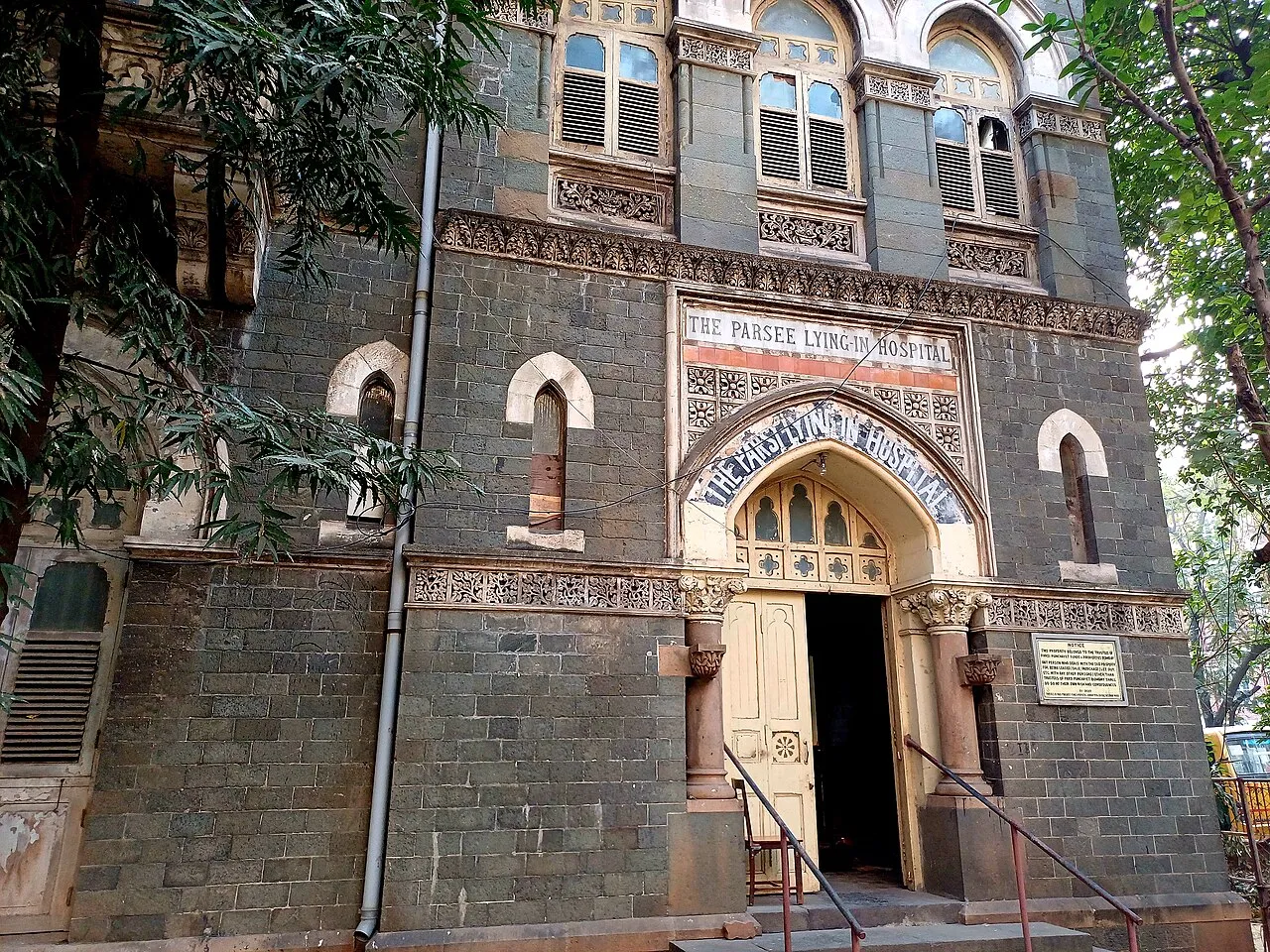
Parsi deaths have outnumbered births every single year since 1955. Both Shroff and Castro and Pandey and Yadav report this, citing J. Hinnells's 2005 study of the Zoroastrian diaspora. A table from that book, reproduced by Pandey and Yadav, gives 276 births against 928 deaths for 1999.
Later yearly figures are estimates from journalists and community workers, not an official register, and they do not all describe the same place:
| Who gave the figure | Where and when | Births | Deaths |
|---|---|---|---|
| Business Standard (its own report) | October 2013 | 200 a year | 850 a year |
| Shernaz Cama, Parzor Foundation | CMAJ, 2014 | Around 200 a year in Bombay | Over 800 a year |
| Pearl Mistry, Jiyo Parsi coordinator | AFP, November 2017 | One baby for every four deaths | |
| Jehangir Patel, editor of Parsiana | ThePrint, August 2023 | 150 a year | 600 a year |
| Mumbai municipal data, in a presentation by Dinshaw Tamboly, chairman of WZO Trust Funds | Free Press Journal, May 2026 | 210 in 2010 | 933 in 2010 |
Fewer births are not the whole story of shrinking numbers. Shroff and Castro also list emigration to Britain, the United States, Canada and Australia as a possible contributor, and we look at where those families settled in our piece on the Zoroastrian diaspora.
When did the Parsi birth rate start falling?
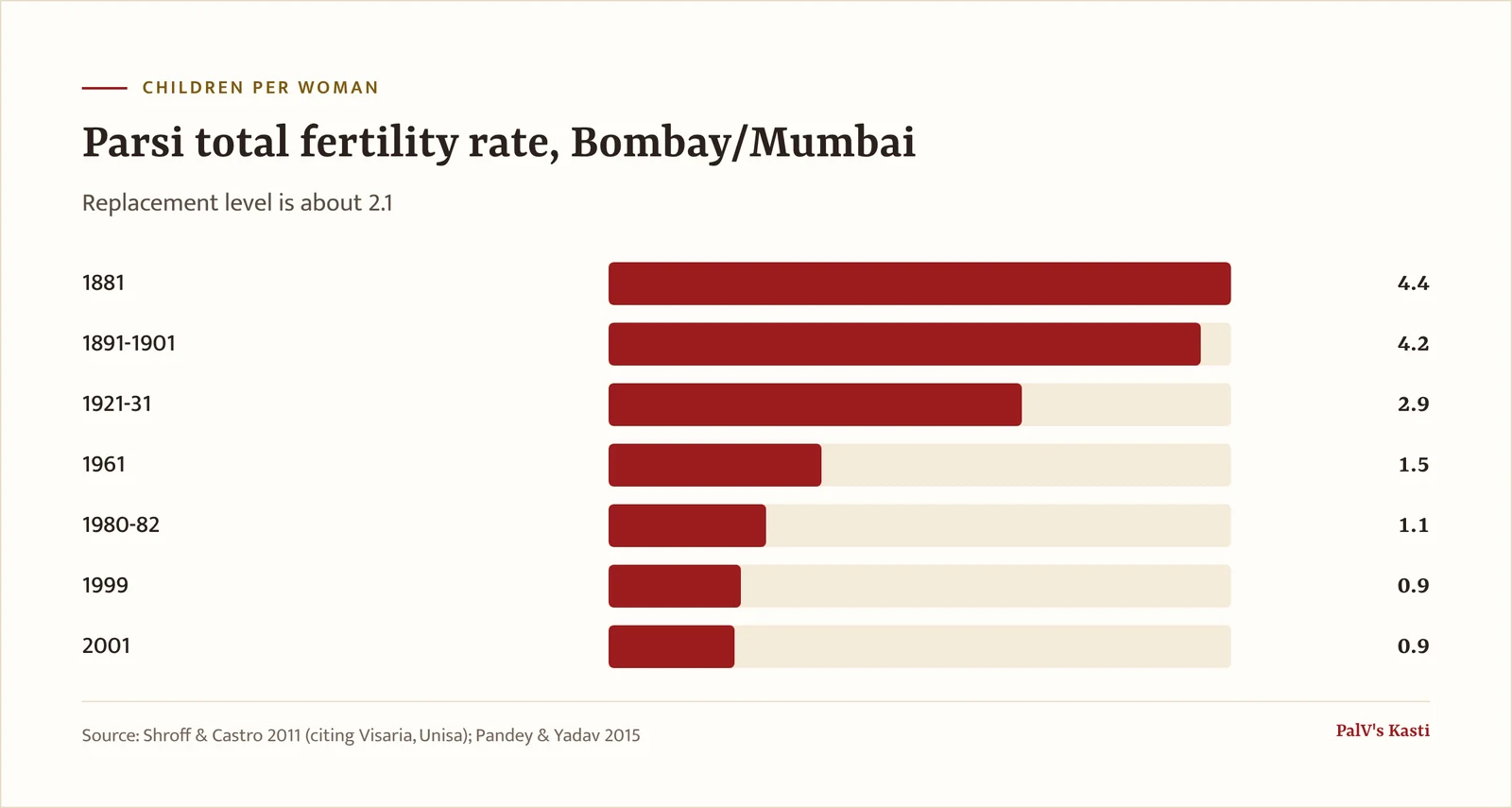
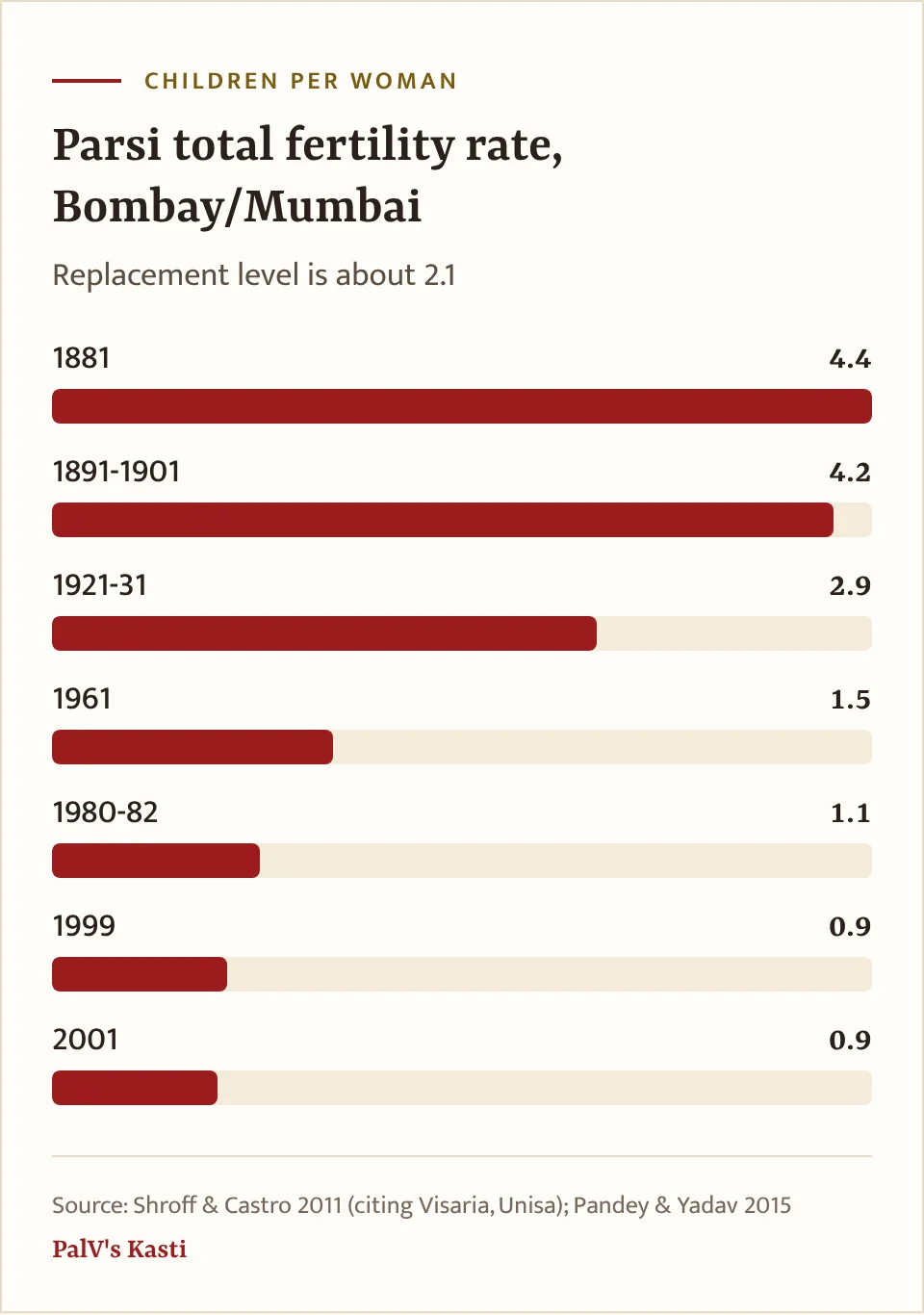
Parsi fertility started falling around the end of the nineteenth century, long before Independence. Shroff and Castro, drawing on L. Visaria's 1974 study, give a TFR of 4.41 for Bombay's Parsis in 1881, 4.2 for 1891 to 1901, and 2.93 for 1921 to 1931. Visaria found that 1961 to 1970 was the first period when Parsi fertility dropped below replacement level. Pandey and Yadav put the TFR for Greater Mumbai's Parsis at 1.51 in 1961 and 1.12 in 1980 to 1982.
Why then? Shroff and Castro, summarising P. Axelrod's 1990 research, tie the first drop to the quick spread of girls' education in the community after 1870. The school rolls make the point. In 1860, of 635 girls enrolled in Bombay's schools and colleges, 485 were Parsi, at a time when Parsis made up less than a tenth of the city.
Education changed household budgets too. By the early twentieth century, Western schooling had brought a wish for a Western standard of living, which raised what families spent. And as more Parsi women went out to work, couples wanted fewer children. That is Axelrod's reading, again as Shroff and Castro report it.
Why do Parsis marry so late?
Parsi women have married at about 26 or 27 and men at about 31 for over sixty years. Shroff and Castro give average ages of 26.5 for women and 31.4 for men in 1962, and say marriage age has stayed near that level since. A 1999 Tata Institute of Social Sciences (TISS) survey of Greater Mumbai, as reported by Pandey and Yadav, found 26.8 for women and 30.6 for men. The 2013 ministry report gave 27 and 31, figures that CMAJ and Business Standard both carried.
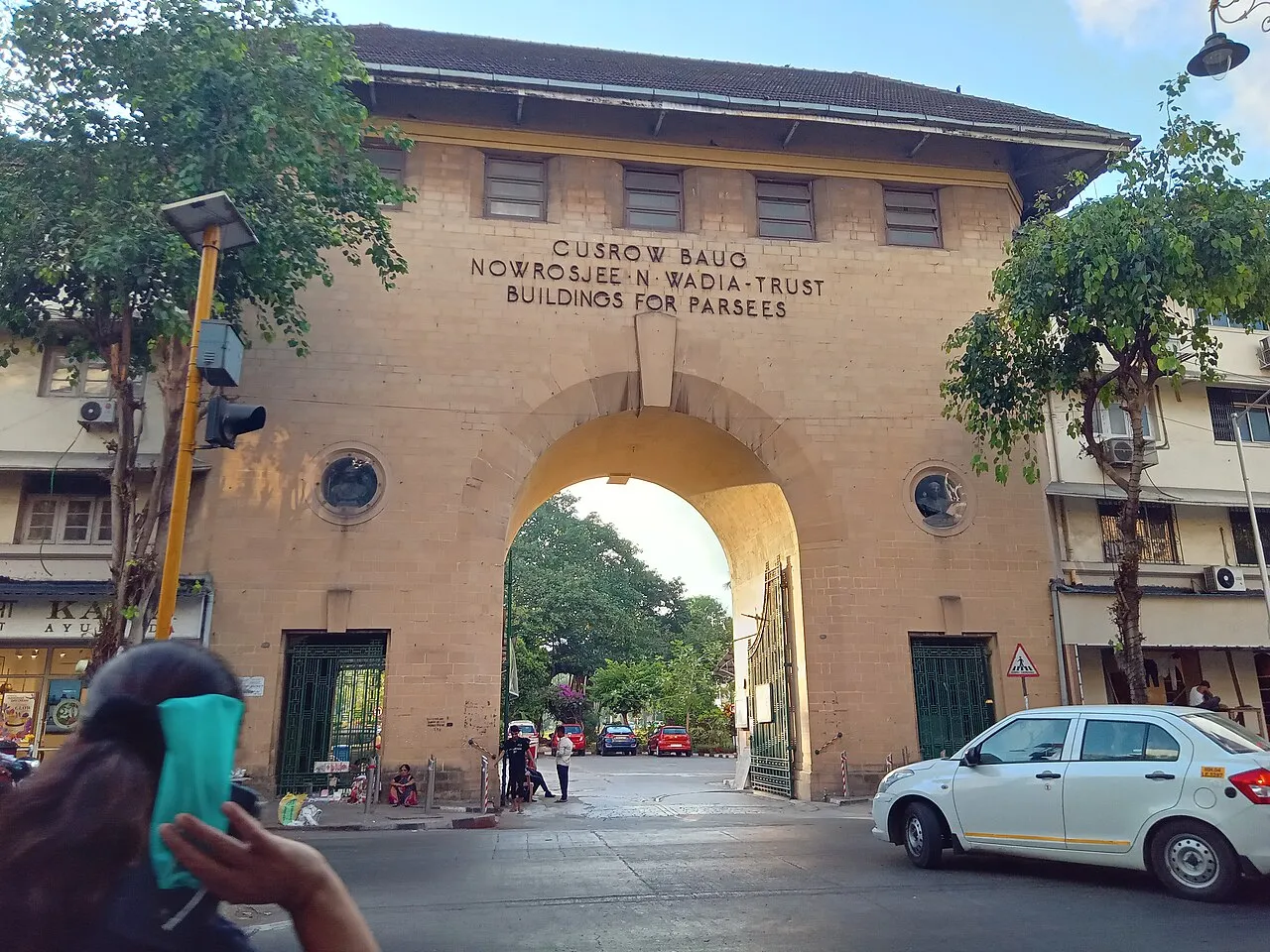
It was not always so. In 1890 most Parsi women married between 16 and 20, and by the 1940s the preferred age had moved to 25 to 29, according to the studies Shroff and Castro review. The reasons researchers and community workers give are mostly about money and space:
- Income, as men see it. Low income is the reason Parsi men most often give for not marrying. In a 1991 study by Cabinetmaker, cited by Shroff and Castro, 400 of 1,000 never-married men and 150 of 1,000 never-married women named it. Axelrod read this as income measured against the community's own high place in Bombay society, not poverty.
- Housing. Shroff and Castro write that flats in the south of the city, where most Parsis live, are priced beyond all but the wealthy. Almost 90% of Parsis in Cabinetmaker's study believed a married couple should have a home of its own.
- Choosing one's own partner. Arranged marriages fell from 67% for Parsis born before 1906 to 31% for those born between 1946 and 1950, according to Axelrod. Shroff and Castro add that the community's small size and limited contact among young Parsis make partners hard to find, which pushes marriage later.
- Elders and costs. Business Standard reported in 2013 that young Parsis find education and housing costs hard to ignore, and that caring for elderly relatives and busy working lives push couples to put off children. In 2023 Cama told ThePrint that a young Parsi couple has, on average, eight dependents.
How many Parsis never marry?
Roughly a third, on the recent estimates we found. The share of women still unmarried at the end of their child-bearing years rose from under 1% in 1881 to 17% in 1971, Shroff and Castro report from Visaria's work. A 1999 survey that TISS carried out for the Bombay Parsi Panchayat (BPP) found that 30% of Parsi women stayed unmarried all their lives. In 2023 Cama told ThePrint that around 36% of Parsis never marry.
Dinyar Patel, then a researcher of Parsi history at Harvard, put it bluntly to Open magazine in December 2014: most Parsis, he said, were not aware that non-marriage and late marriage were the really significant reasons for the decline.
Do married Parsi couples choose small families?
Yes, and on purpose. Pandey and Yadav note that Parsis report wide use of birth control, that most give spacing children as their reason, and that the gap between a first and second birth averages 3.62 years. CMAJ reported in 2014 that few Parsis have more than one child.
Business Standard summed up the research in 2013: the habit of not marrying, or marrying late and having one child or none, had shaped Parsi fertility more deeply than the religious rules on intermarriage. Cama told CMAJ that there is no peer or family pressure on Parsis to have more children, and called the community "extremely Westernized and individualistic".
Community trusts have tried small nudges. The BPP's website lists monthly child assistance of Rs 3,000 for a second child born in April 2010 or later, and Rs 5,000 for a third child born in January 2012 or later.
Are Parsis infertile, or is cousin marriage to blame?
The research does not support either idea as the main cause. Axelrod tested the old belief that cousin marriages, common among Parsis, lower fertility. He found the reverse: after allowing for how long couples had been married, cousin marriages produced more children on average. The time from wedding to first baby was no longer than in comparable wealthy Indian communities. Shroff and Castro conclude that social factors explain the decline. Pandey and Yadav report Dr Anahita Pandole, a fertility specialist with the BPP programme, as saying sub-fecundity is not endemic in the community.
Infertility is part of the picture all the same. In 2012 The Tribune quoted Ministry of Minority Affairs sources calling infertility the biggest cause of the dwindling numbers, while the same report summarised Dinyar Patel's research as finding the causes social and behavioural, with late marriage and non-marriage feeding infertility. Tamboly's May 2026 presentation, as Free Press Journal reported it, listed infertility among the major contributors, alongside late marriage and high rates of non-marriage.
How is India trying to raise Parsi births?
Through the Jiyo Parsi scheme, which the Ministry of Minority Affairs launched in 2013-14 to arrest the decline. Its medical component helps couples pay for treatment of infertility, pregnancy complications and complications in new-borns, and a December 2025 government reply counted 232 babies born under the scheme between 2020-21 and 2024-25. In August 2026 Minister Kiren Rijiju told the Rajya Sabha that 534 births had been reported since 2014-15, IANS reported. How that help works for a couple is covered in our article on Parsi fertility clinics.
Does marrying outside the community explain the low birth rate?
Not on its own: Shroff and Castro's projections for Mumbai found that accepting the children of intermarriage would barely slow the decline while fertility stays this low, and we set out each side of that question in the Purity vs survival debate.
Frequently asked questions
What is the total fertility rate of Parsis?
Every recent estimate is below one child per woman. Shroff and Castro calculated 0.89 for Mumbai's Parsis in 2001, and report 0.94 for Bombay in 1999. A 2013 Ministry of Minority Affairs report, as reported by CMAJ, gave 0.8. A population needs a total fertility rate of about 2.1 to replace itself.
Are Parsis infertile?
Research does not show widespread infertility. Axelrod's 1990 study found cousin marriages produced more children, not fewer, and that the gap between marriage and first birth was normal. Fertility specialist Dr Anahita Pandole has said sub-fecundity is not endemic. Infertility does affect some couples, and the government's Jiyo Parsi scheme helps pay for their treatment.
How many Parsi babies are born each year?
We found no official yearly count, only estimates. Shernaz Cama told CMAJ in 2014 that about 200 Parsi children are born in Bombay each year against over 800 deaths. Mumbai municipal data presented by Dinshaw Tamboly in 2026 showed 210 births and 933 deaths in 2010. Parsiana editor Jehangir Patel told ThePrint in 2023 the figures were 150 and 600.
Has the Jiyo Parsi scheme raised the Parsi birth rate?
It has added births, but no source we found has measured a new fertility rate. The government counted 232 babies born under the scheme between 2020-21 and 2024-25, and Minister Kiren Rijiju told the Rajya Sabha in August 2026 that 534 births had been reported since 2014-15. Community estimates since then still show deaths far ahead of births.


