PalV's Kasti
On this page
- Why have plans to grow Parsi numbers been needed?
- What did the government propose before Jiyo Parsi?
- What is the Jiyo Parsi scheme?
- Does the Bombay Parsi Punchayet pay couples to have children?
- What has been tried on treatment, housing and matchmaking?
- What do demographers say would actually work?
- Would accepting children of Parsi women who marry out help?
- Have these plans made a difference?
- Frequently asked questions
The plans proposed to grow the Parsi population fall into five groups: paying for fertility treatment, giving couples money to raise a second or third child, finding flats for young couples, helping single Parsis meet, and accepting the children of Parsi women who marry outside the community. The first four have been tried by the Bombay Parsi Punchayet (BPP), the Surat Parsi Punchayet and the Centre's Jiyo Parsi scheme, launched in 2013-14. The fifth is still argued over. Demographers Zubin Shroff and Marcia Castro, then at the Harvard School of Public Health, set the bar in 2011: in their projections for Mumbai, even doubled fertility leaves the community 30-40% smaller in 2051 than in 2001, and only a trebling brings growth.
શહેરેવર રોજ
Shehrevar Roj, Tir Mah · 1396 Y.Z.
Why have plans to grow Parsi numbers been needed?
The census keeps counting fewer Parsis. The Ministry of Minority Affairs told the Rajya Sabha in March 2022 that the count fell from 69,601 in Census 2001 to 57,264 in Census 2011. We go through the full count, state by state, in our guide to the Parsi population in India, and the census-by-census fall since 1941 in Parsi population trend.
Shroff and Castro name low fertility as the main driver, putting the total fertility rate of Mumbai's Parsis at 0.89 children per woman in 2001. Shernaz Cama, a Delhi University professor, told Business Standard in 2013 that a rate of 2.1 is needed for a stable population, so 0.89 is well under half of it. What that has meant for the city is covered in Mumbai's shrinking Parsi community.
What did the government propose before Jiyo Parsi?
Fertility treatment came first. In a Lok Sabha answer of 19 August 2010, the Ministry of Minority Affairs described a proposed scheme to pay for infertility treatment, including medicines, for young Parsi couples. By May 2012 the idea had a price. The Tribune reported that Minister Salman Khurshid had taken a scheme to the Planning Commission and hoped to see it in the 12th Plan, and that the poet Keki Daruwala, a former minorities commission member, had sought approval for about Rs 20 crore to fund treatment at clinics run by Parsis.
What is the Jiyo Parsi scheme?
Jiyo Parsi is the Centre's scheme to reverse the fall in Parsi numbers, launched in 2013-14, according to a Lok Sabha answer of July 2014 and a PIB release of 24 July 2024. It has three parts: Medical Assistance pays for treatment, Advocacy covers counselling and publicity, and Health of the Community helps couples with childcare and the care of dependent elderly relatives.
The 2014 answer said the scheme ran with help from the Parzor Foundation and the BPP. Revised guidelines followed on 29 February 2024, announced by Minister Smriti Irani, Free Press Journal reported: state governments now run it with local anjumans and fire temples, and money goes straight into beneficiaries' bank accounts. A PIB release of 3 February 2026 adds two online portals for applications, opened in August 2024 and October 2025.
How many babies has Jiyo Parsi helped bring?
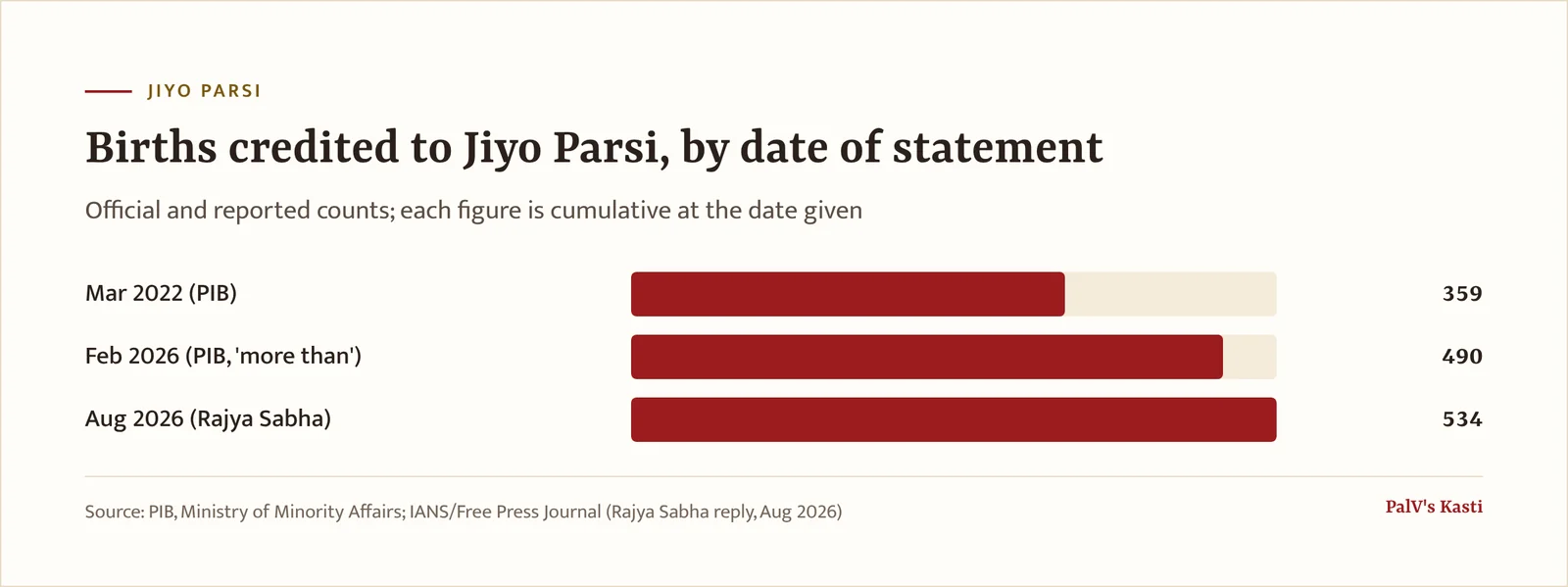
The count depends on the date. The ministry gave 359 births in March 2022 and "more than 490" in February 2026. In August 2026 Minister Kiren Rijiju told the Rajya Sabha that 534 births had been recorded since 2014-15 and that Rs 37.43 crore had been spent, as reported by IANS and Free Press Journal. Pearl Mistry of the Parzor Foundation, which ran the programme until 2022-23, told Free Press Journal that 428 babies had been born under it by then.
Does the Bombay Parsi Punchayet pay couples to have children?
Yes, though the reported amounts differ from year to year. Business Standard wrote in October 2013 that the BPP gave couples Rs 3,000 on having a second child and Rs 5,000 for a third. ThePrint reported in August 2023 that the BPP was paying around Rs 4,000 a month towards raising a second child and Rs 5,000 for a third, and that the Surat Parsi Punchayet gave around Rs 3,500 a month to couples with a second child. In March 2024 BPP chairman Viraf Mehta told Free Press Journal that the trust pays monthly stipends to couples with a second or third child, without giving a figure. For the amount today, ask the Punchayet concerned.
What has been tried on treatment, housing and matchmaking?

Community-funded fertility treatment
Community efforts on treatment predate the government scheme. In 2012 Khojeste Mistree, then a member of the BPP, told The Telegraph about a project that sent young couples to a doctor chosen as a fertility expert, and said 232 babies had been born through it. Business Standard reported in 2013 that an earlier BPP initiative for infertile couples had led to 222 pregnancies. The two reports count different things, so the figures can't be added or compared.
Flats for young couples
Business Standard reported in 2013 that the BPP tried to house newly married couples on low incomes. In 2024 Viraf Mehta told Free Press Journal that the BPP had cleared its waiting list, so a young couple wanting to start a family could be allotted a flat within three to six months, and that bigger flats were being looked at. Cama had suggested in 2013, in Business Standard, building colonies in other parts of Mumbai and in Gujarat.
Matrimonial meets
Turnout at matchmaking events has been thin. According to Business Standard, turnout at the BPP's monthly matrimonial meets fell from 90 at the start of 2013 to 36 at a later meet, only six of them women. Organiser Zarin Havewala said the meets had led to 11 marriages by then.
What do demographers say would actually work?
Shroff and Castro argue that only a large rise in fertility can stop the decline. They suggest child-rearing subsidies, support for working mothers and housing for young couples, paid for by both the community and the state.
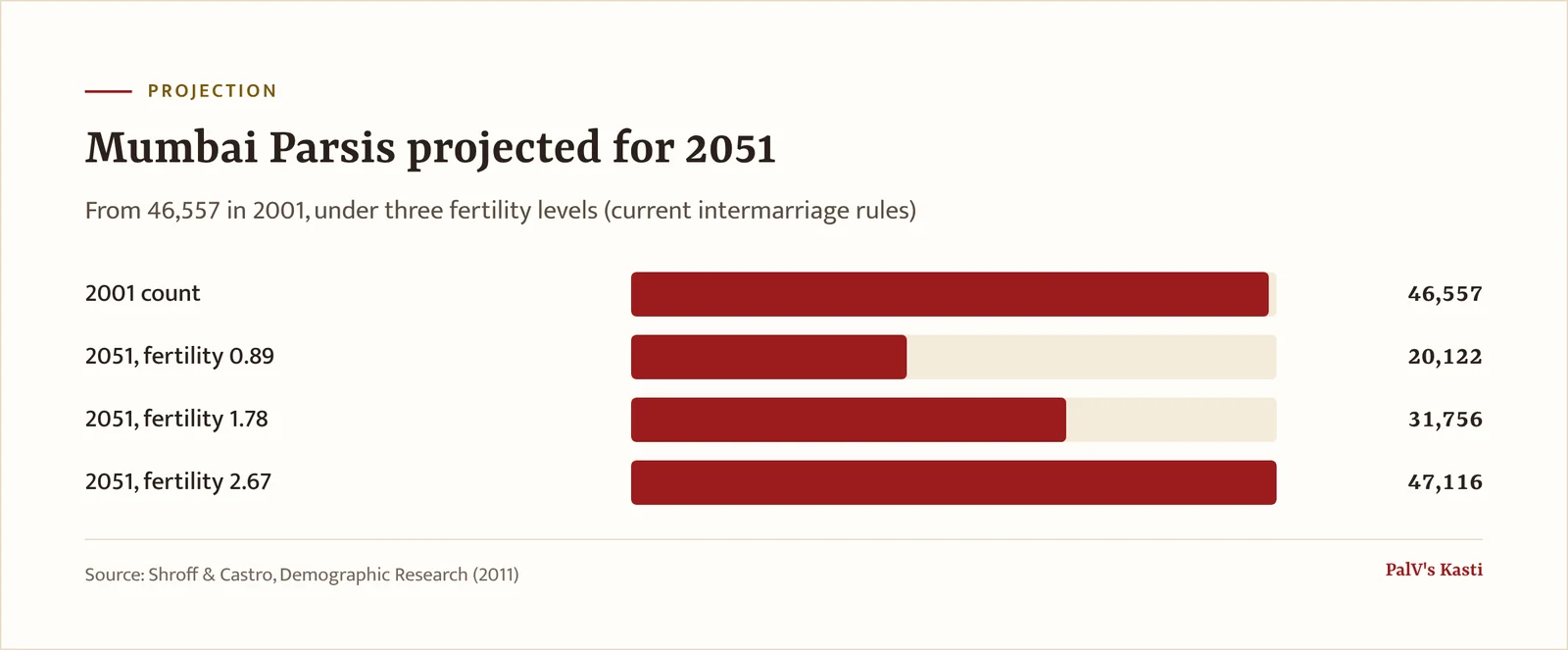
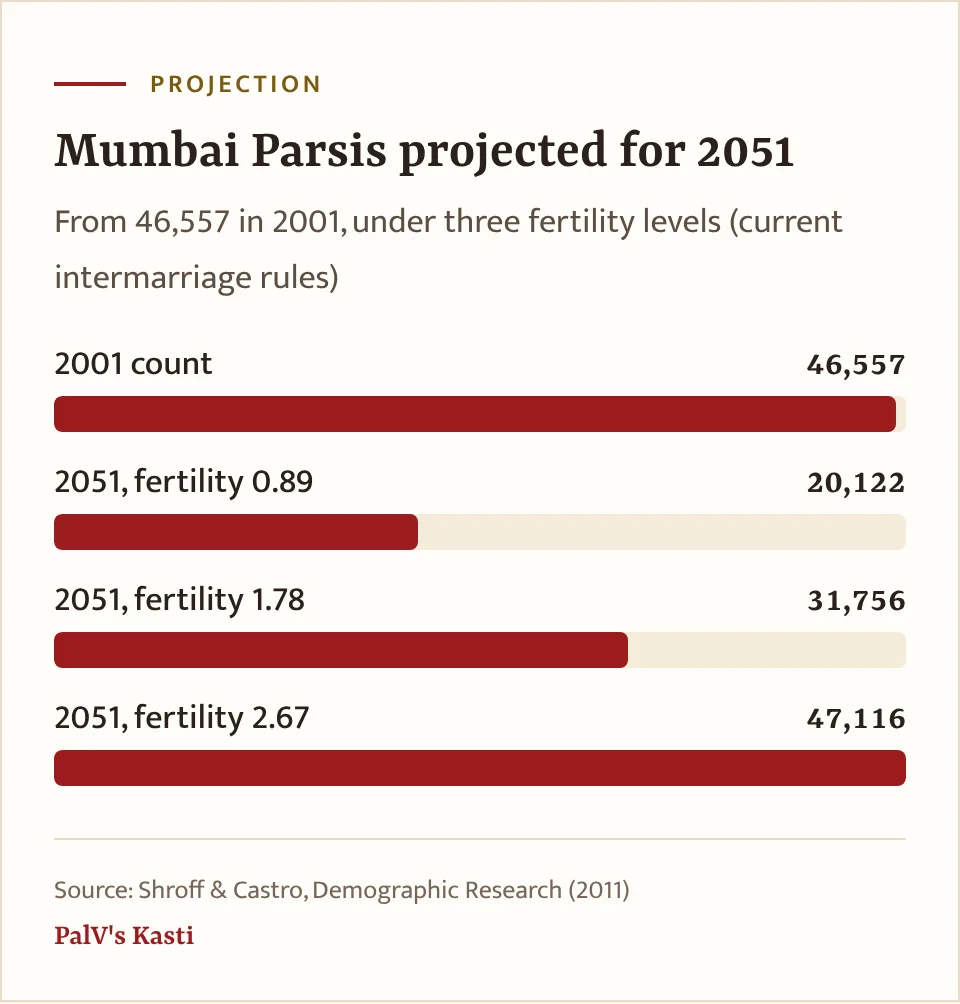
They also show how high the bar is. Their projections start from the 46,557 Parsis counted in Mumbai in 2001. If fertility stays at 0.89, Mumbai has about 20,122 Parsis in 2051. If it doubles, about 31,756. Only if it trebles, to 2.67, does the community grow slightly, to 47,116 by 2051. They point to Sweden, where they credit cash incentives, day-care allowances and supportive workplaces with helping raise fertility from 1.6 to 2.02 between 1983 and 1989, and note that a lasting rise of that size (about 25%) would still be far too small for Parsis.
Would accepting children of Parsi women who marry out help?
This proposal is about who counts as Parsi. Under the community's rule, as Shroff and Castro describe it, a child needs a Parsi father to be considered Parsi, so the children of a Parsi woman and a non-Parsi man are not counted. ThePrint, reporting in August 2023, described the same rule: a Parsi man who marries a non-Parsi can have children who enter the fire temple, while the children of Parsi women who marry non-Parsis are not accepted into the fold.
The numbers are smaller than the argument. Shroff and Castro estimate that, at 2001 fertility, accepting these children would leave Mumbai with only about 400 more Parsis in 2051. The gain grows if fertility rises: about 1,155 more with doubled fertility and about 2,228 more with trebled fertility.
Whether the community should accept these children is argued strongly on both sides; we set out each side in its own words in our separate post on the purity vs survival debate.
Practice varies between families and Agiaries; your family priest's guidance comes first.
Have these plans made a difference?
The people involved don't agree. Rijiju told the Rajya Sabha in August 2026 that independent third-party evaluations had found Jiyo Parsi successful, according to Free Press Journal. Jehangir Patel, editor of Parsiana, told the same paper in 2024 that "around 400 births is too little to revive the community." Pearl Mistry said in 2026 that such programmes take decades and need a change in mindset. The scheme's 2014 advertising campaign also drew angry criticism from Parsis, Scroll reported in November 2014.
Frequently asked questions
What is being done to increase the Parsi population?
The Centre's Jiyo Parsi scheme, launched in 2013-14, pays for fertility treatment, counselling and childcare and elderly care. The Bombay Parsi Punchayet pays monthly stipends for second and third children and, its chairman said in 2024, can house young couples within three to six months. The Surat Parsi Punchayet also pays couples a second-child stipend, ThePrint reported in 2023.
How many babies have been born under Jiyo Parsi?
Minority Affairs Minister Kiren Rijiju told the Rajya Sabha in August 2026 that 534 births had been recorded since 2014-15, with Rs 37.43 crore spent on the scheme. Earlier official counts were lower: 359 in March 2022 and more than 490 in February 2026. Figures rise as the scheme continues, so check the date of any number you see quoted.
Does the BPP pay Parsi couples for a second child?
Yes. Business Standard reported in 2013 that the Bombay Parsi Punchayet gave Rs 3,000 for a second child and Rs 5,000 for a third. ThePrint reported in 2023 around Rs 4,000 a month for a second child and Rs 5,000 for a third. BPP chairman Viraf Mehta confirmed monthly stipends in 2024 but gave no amount.
Would accepting children of intermarried Parsi women stop the decline?
Not on its own, according to the 2011 study by Shroff and Castro. At 2001 fertility, accepting these children would add only about 400 people to Mumbai's Parsi population by 2051. The gain rises to about 2,228 if fertility trebled. The question remains contested within the community, and your family priest's guidance comes first.
Can the Parsi population grow again?
Only with a very large rise in births, on the 2011 projections by Shroff and Castro. At 2001 fertility, Mumbai's Parsis fall from 46,557 to about 20,122 by 2051. Doubled fertility still leaves the city 30-40% smaller. Only a trebling, to about 2.67 children per woman, brings slight growth, to about 47,116.