PalV's Kasti
On this page
- How many Parsis did each census count from 1941 to 2011?
- How much has the Parsi population fallen since 1941, decade by decade?
- Did Partition reduce the Parsi count?
- Why is the 1981 Parsi census figure not directly comparable?
- Has the share of Parsis in Maharashtra and Gujarat changed since 1971?
- Did anyone predict this Parsi population trend?
- When will there be a newer Parsi census figure?
- Frequently asked questions
The Census of India counted 114,890 Parsis in 1941, the highest figure in the census series. Census 2011, the latest published count, found 57,264. That is a fall of 57,626 people, or 50.2% by our calculation, so the community is now almost exactly half its 1941 size. The counts in between were 111,791 (1951), 100,772 (1961), 91,266 (1971), 71,630 (1981), 76,382 (1991) and 69,601 (2001). Two cautions apply when reading this Parsi population trend. The 1941 figure covers undivided India, including areas that went to Pakistan. And the 1981 figure was counted on a different basis, so the small rise to 1991 is not a like-for-like gain.
શહેરેવર રોજ
Shehrevar Roj, Tir Mah · 1396 Y.Z.
How many Parsis did each census count from 1941 to 2011?
Each count above, except 1961, comes from a census table or an official statement that we opened ourselves. The 1941 total appears in Table XIII of the 1941 census tables for India. The 1951 figure of 1,11,791 was given to the Lok Sabha in a written reply in December 2016, as reported by PTI. The 1971, 1981 and 1991 figures come from the religion papers of those censuses, and 2001 and 2011 from the C-01 appendix tables, where the community is listed as "Parsi/Zoroastrian" (2001) and "Parsi/Zorastrian" (2011, spelt that way in the table).
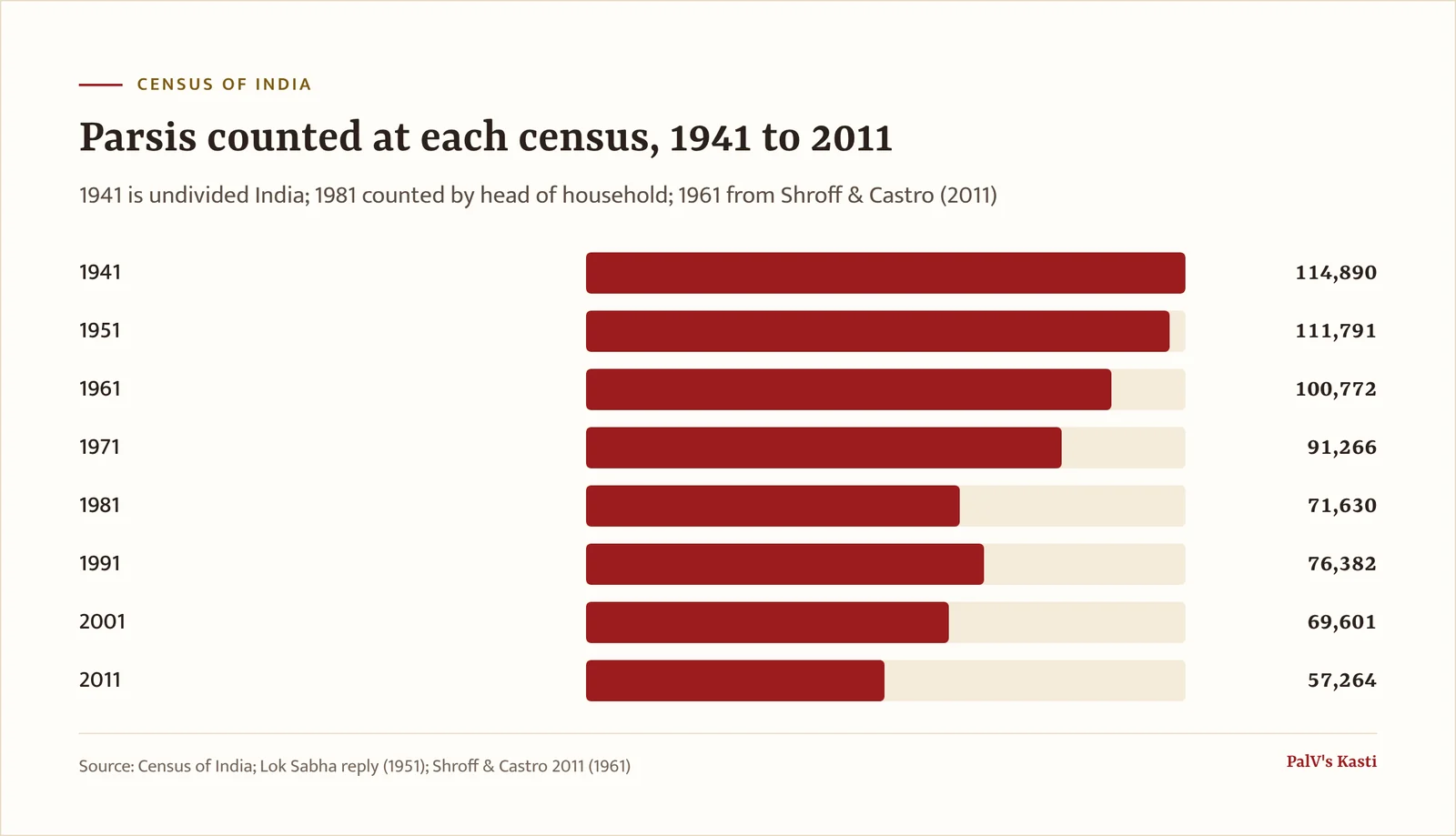
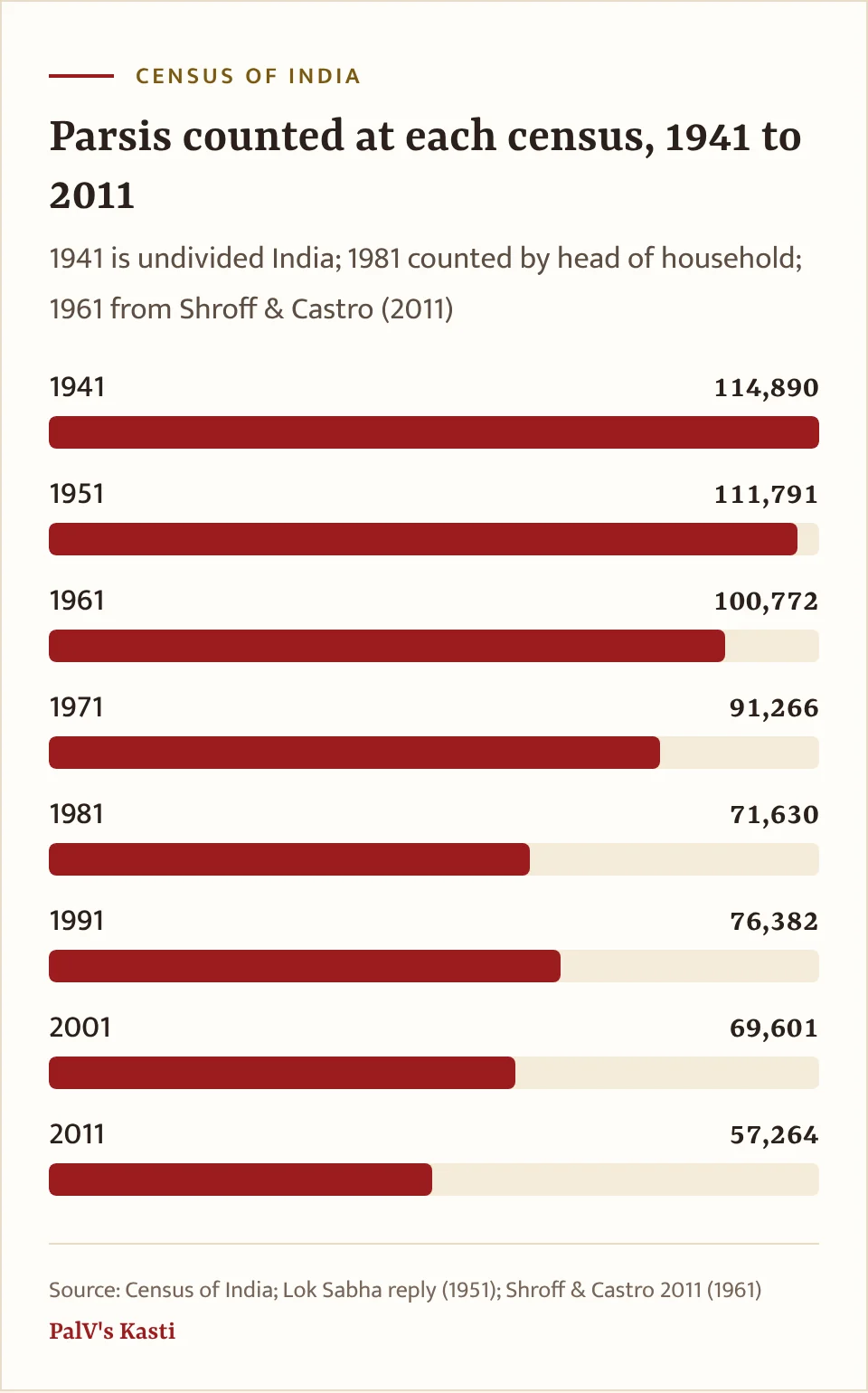
We could not open the 1961 religion table. The 1961 figure of 100,772 is the one given by demographers Zubin Shroff and Marcia Castro in their 2011 paper in the journal Demographic Research, whose table draws on Kulke's 1974 study of the Parsis and on Registrar General of India data.
Not every source agrees on 1941. Speaking at a National Commission for Minorities event in Mumbai in May 2026, Dinshaw Tamboly, chairman of WZO Trust Funds, put the 1941 peak at 114,791, according to the Free Press Journal. The 1941 census table reads 114,890, and that is the figure we use.
How much has the Parsi population fallen since 1941, decade by decade?
The fall was not even. It was small across the 1940s, steady through the 1950s and 1960s, then much sharper in the 1970s. The 2000s brought the second-largest drop of the whole period.
| Census period | Change (people) | Change (%) |
|---|---|---|
| 1941 to 1951 | −3,099 | −2.7% |
| 1951 to 1961 | −11,019 | −9.9% |
| 1961 to 1971 | −9,506 | −9.4% |
| 1971 to 1981 | −19,636 | −21.5% |
| 1981 to 1991 | +4,752 | +6.6% |
| 1991 to 2001 | −6,781 | −8.9% |
| 2001 to 2011 | −12,337 | −17.7% |
Changes and percentages in the table are our calculation from the census figures. The 1941 to 1951 row crosses the Partition boundary change, and the 1971 to 1991 rows cross the 1981 change of method, so those three rows need the cautions explained below.
The cleanest comparison is the last two decades, which avoid both problems. The rate of fall roughly doubled between them, from 8.9% in 1991 to 2001 to 17.7% in 2001 to 2011. Measured from 1971, the earliest post-Independence census table we opened, the fall to 2011 is 34,002 people, or 37.3% by our calculation.
Did Partition reduce the Parsi count?
Partly, on paper. The 1941 census covered undivided India, and its tables include provinces such as Sind and Baluchistan that became part of Pakistan. Shroff and Castro note that census figures from 1951 onwards exclude the areas that became Pakistan. They also write that about 5,000 Parsis were lost to Pakistan at Partition. So part of the 3,099 gap between 1941 and 1951 reflects a change in the country being counted, not only a change in the community.
Inside India, people also moved. Shroff and Castro cite Kulke's finding that between 1941 and 1951 the rise in the Parsi population of Bombay matched the fall in other parts of India. In 1941 the census already counted 86,270 Parsis in Bombay Province, the largest figure for any province in that table.
Why is the 1981 Parsi census figure not directly comparable?
The 1981 religion figures were counted by household, not by person. The 1981 census paper on religion says its data are based on the religion of the head of the household, while the earlier figures were based on each individual's own return, and it asks readers to bear this in mind when comparing. The 1991 religion paper repeats the point: its figures, like those of 1961 and 1971, are based on the religion of the individual, while 1981's were based on the head of the household.
There are two smaller boundary notes as well. The 1981 count excludes Assam, where the census could not be held, and the 1991 count excludes Jammu and Kashmir. The census flags both in its tables.
So the 71,630 of 1981 and the 76,382 of 1991 rest on different methods, and the census papers do not say how much of the apparent rise comes from that change. What we can say is that 1991 is still 14,884 below the 1971 count of 91,266, and both of those were counted person by person.
Has the share of Parsis in Maharashtra and Gujarat changed since 1971?
Hardly at all. At every census from 1971 to 2011, Maharashtra held roughly 78% to 79% of India's Parsis and Gujarat about 16% to 17%. The decline ran at a similar pace in both states: by our calculation Maharashtra's Parsi count fell 37.9% between 1971 and 2011 and Gujarat's fell 35.7%.
| Census | All India | Maharashtra | Share | Gujarat | Share |
|---|---|---|---|---|---|
| 1971 | 91,266 | 72,266 | 79.2% | 15,131 | 16.6% |
| 1981 | 71,630 | 56,866 | 79.4% | 11,732 | 16.4% |
| 1991 | 76,382 | 60,501 | 79.2% | 12,924 | 16.9% |
| 2001 | 69,601 | 54,739 | 78.6% | 11,594 | 16.7% |
| 2011 | 57,264 | 44,854 | 78.3% | 9,727 | 17.0% |
Shares are our calculation, and the 1981 row uses the household-basis count. For the full 2011 state-by-state picture and the towns where Parsis live today, see our guide to the Parsi population in India.
Did anyone predict this Parsi population trend?
Yes, as early as 1948. Shroff and Castro describe a projection by the demographer C. Chandra Sekar, published that year, which correctly foresaw a decline after 1951. Assuming no migration and the fertility seen in 1941, he projected about 89,000 Parsis for 2001. The 2001 census counted 69,601. Shroff and Castro call his forecast remarkably accurate once emigration to the West, marriage outside the community and the loss to Pakistan are allowed for.
The latest public projection is Tamboly's. At the May 2026 event he said that if the present trend continues, India's Parsi population could fall below 10,000 by 2101, the Free Press Journal reported. That is his projection, not a census figure.
When will there be a newer Parsi census figure?
Not yet. The 2011 count of 57,264 is still the latest published figure, and the Free Press Journal wrote in May 2026 that the next national census was expected later that year or in 2027. Until it appears, any figure after 2011 is an estimate.
Meanwhile, the Ministry of Minority Affairs runs the Jiyo Parsi scheme to contain the decline, as it told the Rajya Sabha in March 2022. We cover the scheme and other proposals in Plans to grow Parsi numbers, and the medical side in Parsi fertility clinics. Emigration abroad, which Shroff and Castro say may also have played a part, is the subject of our piece on the Zoroastrian diaspora.
Frequently asked questions
How many Parsis were there in India in 1941?
The Census of India 1941 counted 114,890 Parsis in undivided India, which then included areas that later became Pakistan. Bombay Province alone had 86,270. Not every figure quoted agrees: WZO Trust Funds chairman Dinshaw Tamboly gave 114,791 in May 2026, the Free Press Journal reported. The census table itself reads 114,890.
When did the Parsi population peak?
At the 1941 census. The all-India count rose at every census from 1881 to 1941, according to the series published by Shroff and Castro, and has been lower at every census since, apart from the 1981 to 1991 step. The same study shows Bombay's Parsi count rising until 1961 before it too began to fall.
How much has the Parsi population fallen since 1941?
From 114,890 in 1941 to 57,264 in 2011, a fall of 57,626 people or 50.2% by our calculation. Because 1941 covered undivided India, a stricter comparison starts at 1971, when the count was 91,266. From 1971 to 2011 the fall was 34,002 people, or 37.3% by our calculation.
Why did the Parsi population rise between 1981 and 1991?
The census papers do not give an exact answer, but they flag a change of method. The 1981 census grouped people by the religion of the head of the household, while 1971 and 1991 recorded each person's own religion. The census asks readers to bear this in mind. The 1991 figure of 76,382 is still well below 1971's 91,266.
Did Partition reduce the Parsi census count?
Partly. The 1941 census covered undivided India, while figures from 1951 onwards leave out the areas that became Pakistan, as Shroff and Castro note. They put the number of Parsis lost to Pakistan at Partition at about 5,000. So the 3,099 fall between 1941 and 1951 is not purely a change within the community.