PalV's Kasti
On this page
- What percentage of India is Parsi?
- How does the census count Parsis?
- How did the Parsi count change between 2001 and 2011?
- Are there more Parsi women than men?
- How urban are Parsis, and where do most of them live?
- When were the Census 2011 Parsi figures released?
- Why do different sources quote different Parsi figures?
- Is there a newer count than Census 2011?
- Frequently asked questions
Census 2011 counted 57,264 Parsis in India, 28,115 men and 29,149 women. The country's total that year was 1,210,854,977, so the Parsi percentage in India was about 0.0047%, or roughly one Parsi for every 21,145 Indians (our calculation). Ten years earlier, Census 2001 had counted 69,601. That is 12,337 fewer people, a drop of 17.7% in one decade, while the national total in the census religion tables grew by 17.7% (again our calculation). The 2011 table also shows a community that is nearly all urban, has more women than men, and lives mostly in Maharashtra. As of May 2026, no newer census count had been published.
શહેરેવર રોજ
Shehrevar Roj, Tir Mah · 1396 Y.Z.
What percentage of India is Parsi?
In Census 2011, Parsis were 0.0047% of India's population. We divided the census count of 57,264 by India's total of 1,210,854,977 to get that figure. Put differently, there were about 47 Parsis per million people.
The share was bigger in 2001. That census counted 69,601 Parsis in a national total of 1,028,610,328 in its religion table, which works out to 0.0068% (again our calculation).
| Census | Parsis counted | India's total (census religion table) | Parsi share (our calculation) |
|---|---|---|---|
| 2001 | 69,601 | 1,028,610,328 | 0.0068% |
| 2011 | 57,264 | 1,210,854,977 | 0.0047% |
How does the census count Parsis?
You won't find Parsis in the main Census 2011 religion table. That table, called C-01, has named columns for six religions only: Hindu, Muslim, Christian, Sikh, Buddhist and Jain. Everyone else goes into one of two leftover columns, "Other religions and persuasions" or "Religion not stated".
Parsis sit inside "Other religions and persuasions". Their own number appears in a separate sheet, the C-01 Appendix, which breaks that group into named communities. For each community it gives persons, males and females, split into total, rural and urban, for India and for each state. It has no ages, no marital status and no district rows for Parsis, so the 2011 data can't tell you how many Parsis live in Mumbai or how old they are.
What does the "Parsi/Zorastrian" label mean?
That is simply the label the census uses for the community. The 2011 appendix spells it "Parsi/Zorastrian", without the second "o". The 2001 appendix spelt it "Parsi/Zoroastrian". In both years it is one combined row, so the census gives no separate figure for Parsis and for other Zoroastrians living in India.
How did the Parsi count change between 2001 and 2011?
Every line of the table went down. Women fell slightly faster than men, and the small rural group shrank fastest of all.
| Measure | Census 2001 | Census 2011 | Change | % change (our calculation) |
|---|---|---|---|---|
| All Parsis | 69,601 | 57,264 | −12,337 | −17.7% |
| Men | 33,949 | 28,115 | −5,834 | −17.2% |
| Women | 35,652 | 29,149 | −6,503 | −18.2% |
| Urban | 66,912 | 55,306 | −11,606 | −17.3% |
| Rural | 2,689 | 1,958 | −731 | −27.2% |
The rest of the country went the other way. Over the same ten years the national total in the census religion tables rose from 1,028,610,328 to 1,210,854,977, a gain of 17.7% by our arithmetic. The Parsi figure moved by the same percentage in the opposite direction.
A census table records the size of a fall, not the reasons behind it. We go through the causes in our article on Parsi population decline. Which customs are under pressure as numbers fall is the subject of Fading Parsi traditions.
Are there more Parsi women than men?
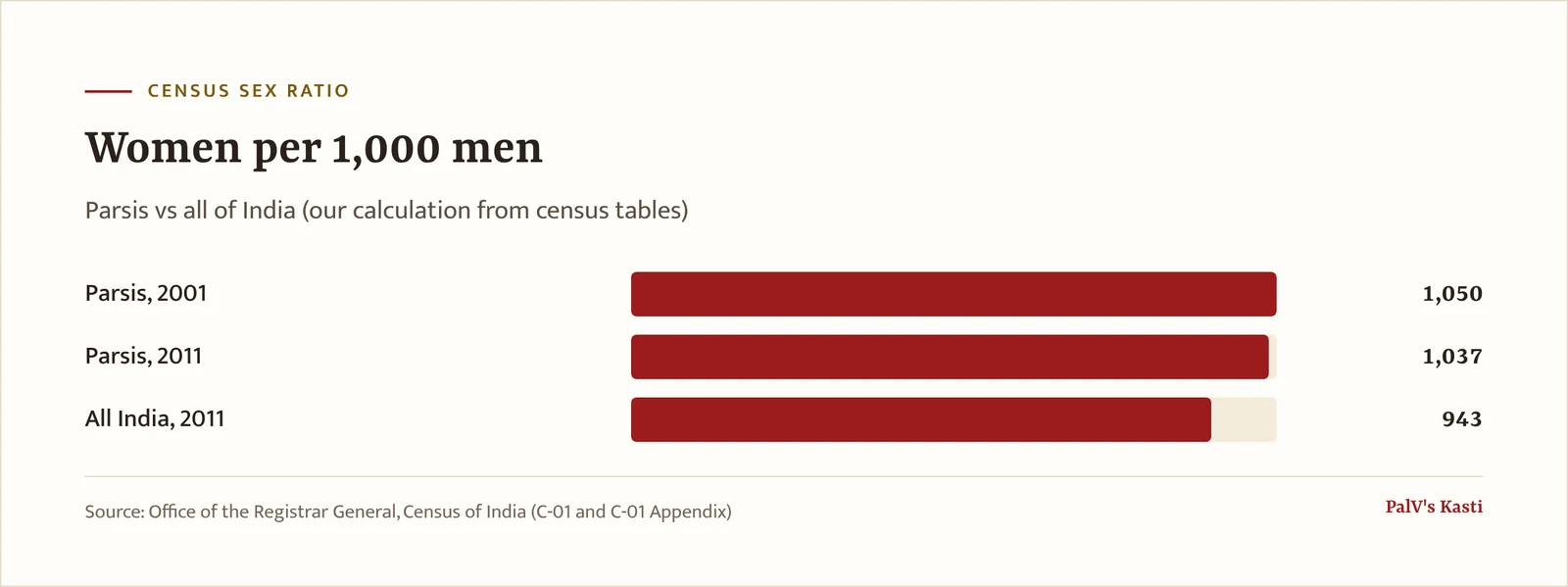
Yes. Census 2011 found 29,149 Parsi women and 28,115 Parsi men, about 1,037 women for every 1,000 men. India overall had roughly 943 women per 1,000 men that year (587,584,719 women and 623,270,258 men). In 2001 the Parsi ratio was even higher, at about 1,050. All three ratios are our calculation from the census tables.
How urban are Parsis, and where do most of them live?
In 2011, 55,306 of the 57,264 Parsis counted lived in urban areas and just 1,958 in villages. That is 96.6% urban, up from 96.1% in 2001.
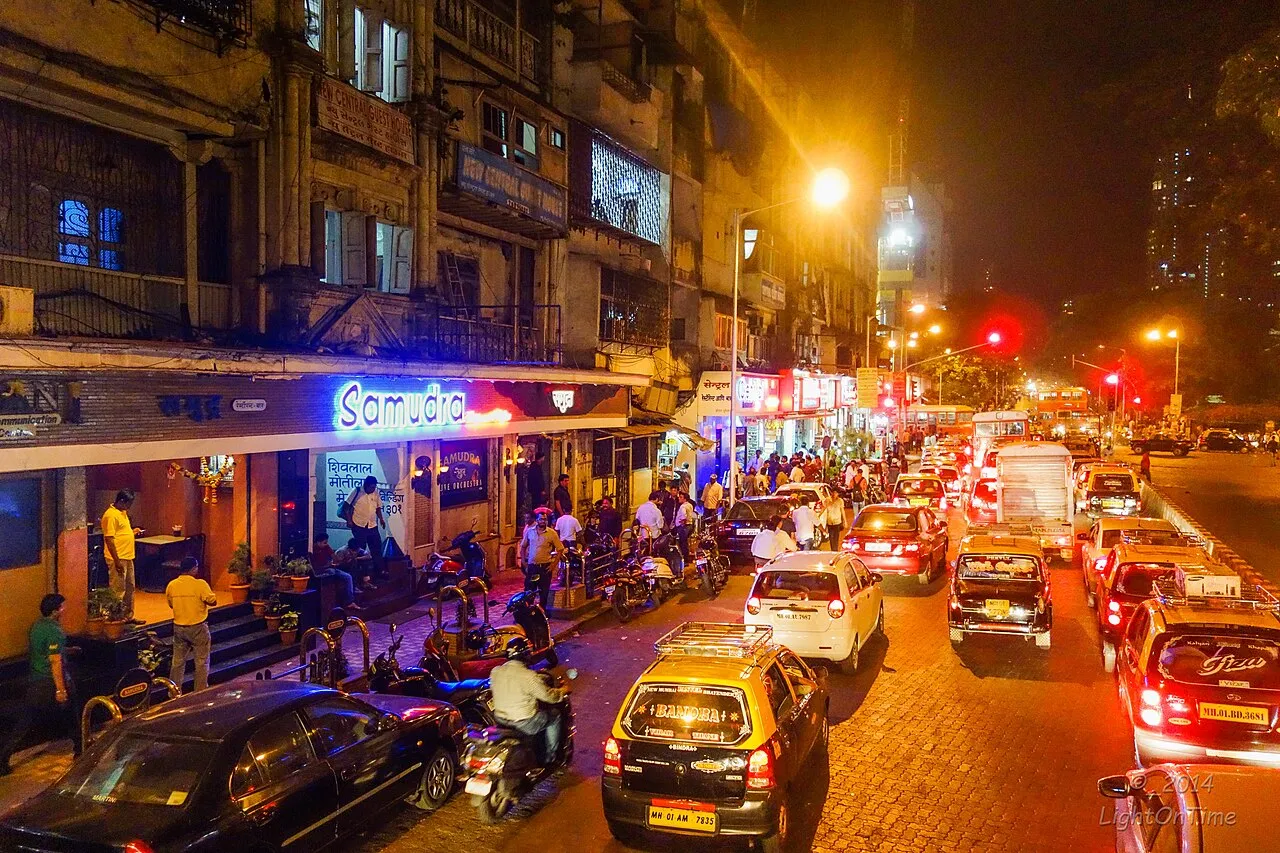
Maharashtra alone had 44,854 Parsis, which is 78.3% of the national count, and Gujarat had 9,727. Between them the two states held about 95% of India's Parsis. The Maharashtra figure was 54,739 in 2001, so the state lost 18.1% of its Parsis in the decade, a little more than the national fall. These shares and changes are our calculation from the census appendix. For the full state-by-state breakdown, see our guide to the Parsi population in India.
For Parsis and other Zoroastrians living outside India, see our piece on the Zoroastrian diaspora.
When were the Census 2011 Parsi figures released?
Not quickly. The census was taken in 2011, but in a written Lok Sabha answer on 6 May 2015 the Ministry of Minority Affairs said religion-wise data of Census 2011 "have not yet been released". The figures reached the papers in July 2016. The Hindustan Times of 26 July 2016 described the Parsi count as "a little over 57,000" and gave Maharashtra's figure of 44,854, citing census data released that Monday.
Since then the number has been repeated in Parliament several times. In December 2016, PTI reported that Minister of State for Home Hansraj Ahir gave 57,264 in a written Lok Sabha reply. A Press Information Bureau note of 21 March 2022, from the Ministry of Minority Affairs, records the same fall, from 69,601 in 2001 to 57,264 in 2011. And in December 2024, according to All India Radio News, Minority Affairs Minister Kiren Rijiju told the Rajya Sabha that the count stood at "57 thousand in the 2011 Census".
Why do different sources quote different Parsi figures?
Mostly rounding, and one misprint. The Hindustan Times in 2016 wrote "around 69,000" for 2001 and "a little over 57,000" for 2011, and gave the decade's fall as 18% where the exact census figures give 17.7%. Kiren Rijiju's 2024 reply, as reported by All India Radio, also rounded the 2011 count to 57 thousand. The odd one out is a 2015 Lok Sabha answer, which printed the 2001 count as 69,001 instead of 69,601.
The census appendix itself gives 69,601 for 2001 and 57,264 for 2011, and the 2022 Press Information Bureau note uses the same two figures.
Is there a newer count than Census 2011?
Not as of May 2026, our latest source. The Free Press Journal's report of 10 May 2026, on a presentation by Dinshaw Tamboly, chairman of the WZO Trust Funds, at a National Commission for Minorities event in Mumbai, still gave 57,264 as the 2011 figure, and said the next national census was expected later that year or in 2027. Until its religion tables are published, every current Parsi number you see is either the 2011 count or an estimate.
Frequently asked questions
What is the Parsi percentage in India?
Parsis made up about 0.0047% of India's population in Census 2011, by our calculation. The census counted 57,264 Parsis out of 1,210,854,977 people, roughly one in every 21,145. In Census 2001 the share was about 0.0068%, with 69,601 Parsis. As of May 2026, no newer census figure had been published.
How many Parsis were counted in Census 2011?
Census 2011 counted 57,264 Parsis in India: 28,115 men and 29,149 women. The figure comes from the C-01 Appendix table, where the community is listed as "Parsi/Zorastrian" under "Other religions and persuasions". It was 12,337 fewer than the 69,601 counted in 2001, a fall of 17.7%.
Which state has the most Parsis?
Maharashtra. Census 2011 counted 44,854 Parsis there, about 78.3% of the national total by our calculation. Gujarat came second with 9,727. Together the two states held about 95% of all Parsis in India, also our calculation. Maharashtra's Parsi count had been 54,739 in Census 2001, so it fell by about 18% in ten years.
Why does the census say "Parsi/Zorastrian"?
It is the census label for the community's row in the C-01 Appendix, a table that breaks down the "Other religions and persuasions" group. The 2011 table spells it "Parsi/Zorastrian" and the 2001 table "Parsi/Zoroastrian". Parsis and other Zoroastrians in India are counted together in that single row in both years.
When will the next Parsi census figure come?
Not before the next national census reports its religion tables. In May 2026 the Free Press Journal reported that the census was expected later in 2026 or in 2027. Census 2011 religion data took about five years to appear, reaching newspapers in July 2016, so a new Parsi figure may take time after counting ends.