PalV's Kasti
On this page
- How fast is the Parsi population falling?
- Is low fertility the main reason for the Parsi decline?
- Why do so many Parsis marry late, or not at all?
- Why do Parsi deaths outnumber births?
- Does marrying out cause the Parsi population decline?
- Do Parsis emigrate, and does that shrink the count?
- Are Parsis going extinct?
- Frequently asked questions
The Parsi population is declining mainly because too few children are born. Demographers Zubin Shroff and Marcia Castro recorded a total fertility rate of 0.89 among Mumbai's Parsis in 2001, well under one child per woman. Late marriage, a large share of Parsis who never marry, an old age profile in which deaths far outnumber births, and emigration all add to it. The community rule that children of Parsi women who marry out are not counted as Parsi costs a few more people, but the same study found it is not the main cause. The census shows the result: 69,601 Parsis in India in 2001 and 57,264 in 2011.
ખોરદોદ રોજ
Khordad Roj, Tir Mah · 1396 Y.Z.
How fast is the Parsi population falling?
The census count fell by 12,337 people between 2001 and 2011, a drop of 17.7% in one decade (our calculation from the Census figures). The Ministry of Minority Affairs gave the same two numbers, 69,601 and 57,264, in a reply to the Rajya Sabha published by PIB on 21 March 2022.
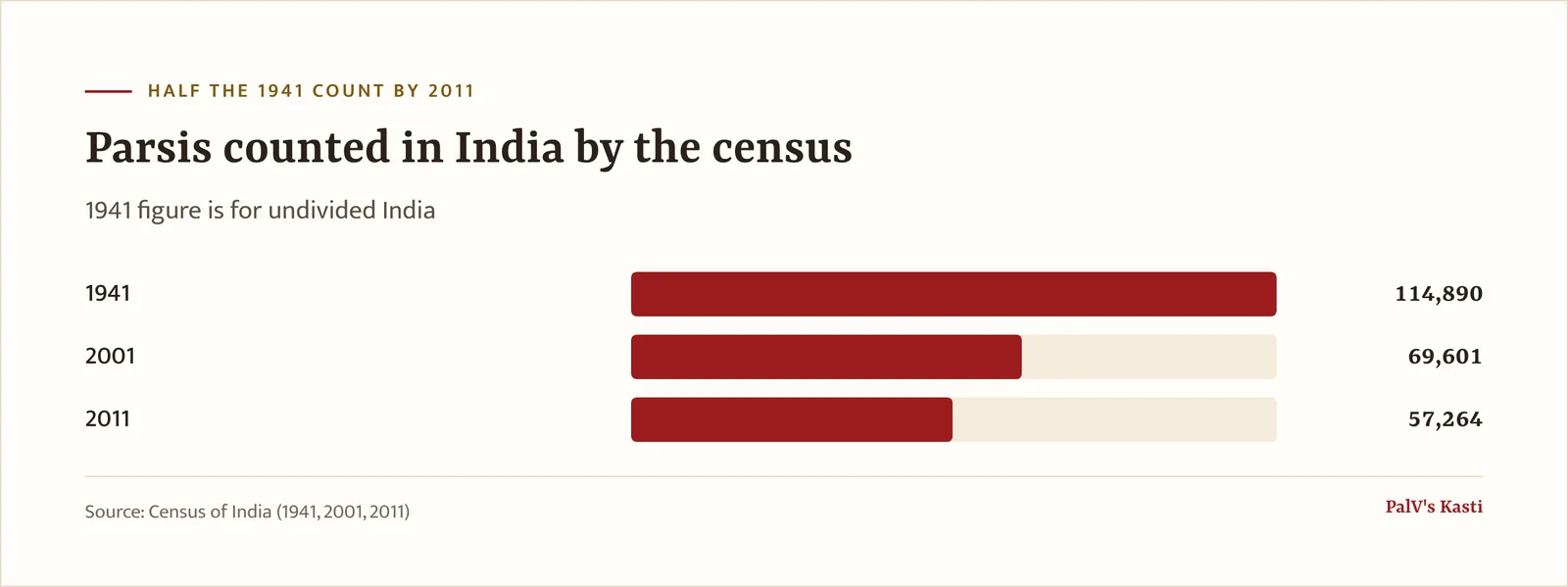
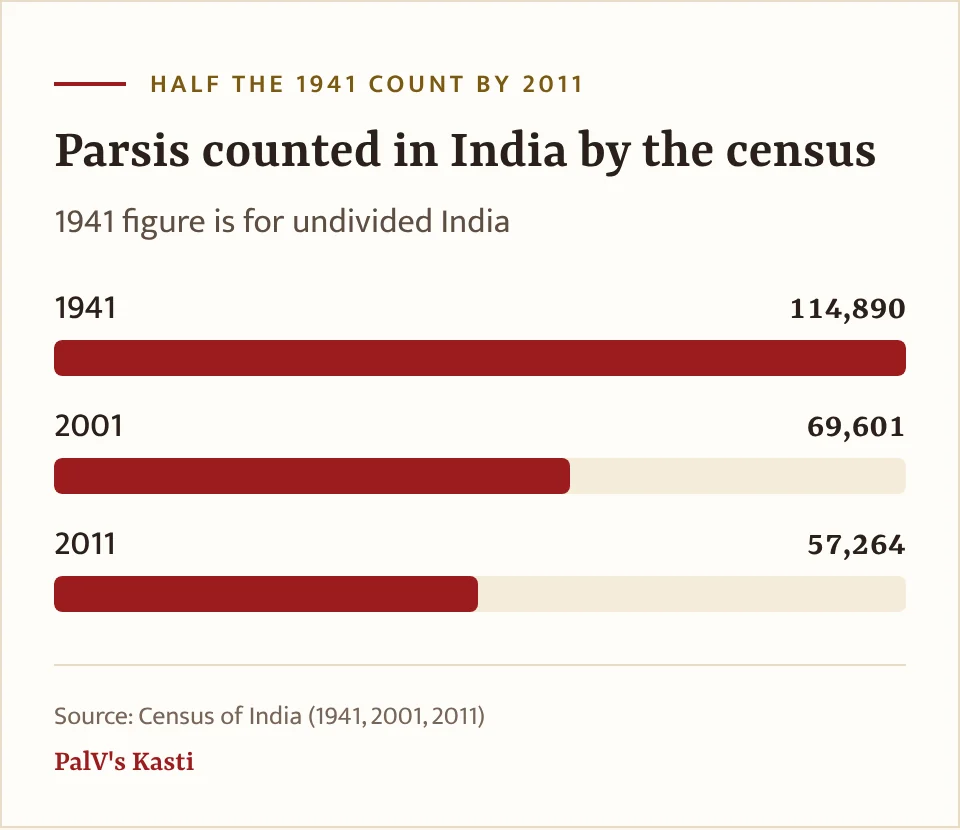
The fall is older than that. The 1941 Census table for undivided India counted 114,890 Parsees, so the 2011 figure is a little under half the 1941 one (our calculation). In the words of Shroff and Castro's 2011 paper in the journal Demographic Research, the community saw "a steady increase until 1941" and a sharp, sustained decline after it. In Bombay the turning point came later, in 1961.
For the state-by-state count, see our page on the Parsi population in India, and for what the 2011 count showed, the Parsi Census 2011 figures. This page stays with the reasons.
Is low fertility the main reason for the Parsi decline?
Yes, according to the most detailed study we found. Shroff and Castro conclude that the main factor is "the abysmally low fertility of the community", which they measured at a total fertility rate of 0.89 in Mumbai in 2001. That is far below the level at which each generation replaces the one before it, a line Bombay Parsis first fell under in 1961-70, according to the same paper.
Other sources agree on the scale. A 2014 report in the Canadian Medical Association Journal (CMAJ), citing a government scheme document, put Parsi fertility at 0.8 children per woman. The Free Press Journal, reporting on the revised Jiyo Parsi guidelines in March 2024, gave it as "between 1 and 0.8".
This is a long trend, not a recent one. Shroff and Castro, drawing on earlier studies, note that fertility among Bombay Parsis had been falling for over a century and that deaths had exceeded births in every year since 1955. Why so few children are born is a question of its own, which our post on the Parsi birth rate takes up.
Why do so many Parsis marry late, or not at all?
Shroff and Castro list women never marrying or marrying late among the social factors behind low fertility. They report an average marriage age in 1962 of 26.5 for women and 31.4 for men, and say it has stayed near that level since. The scheme document cited by CMAJ gave 27 and 31.
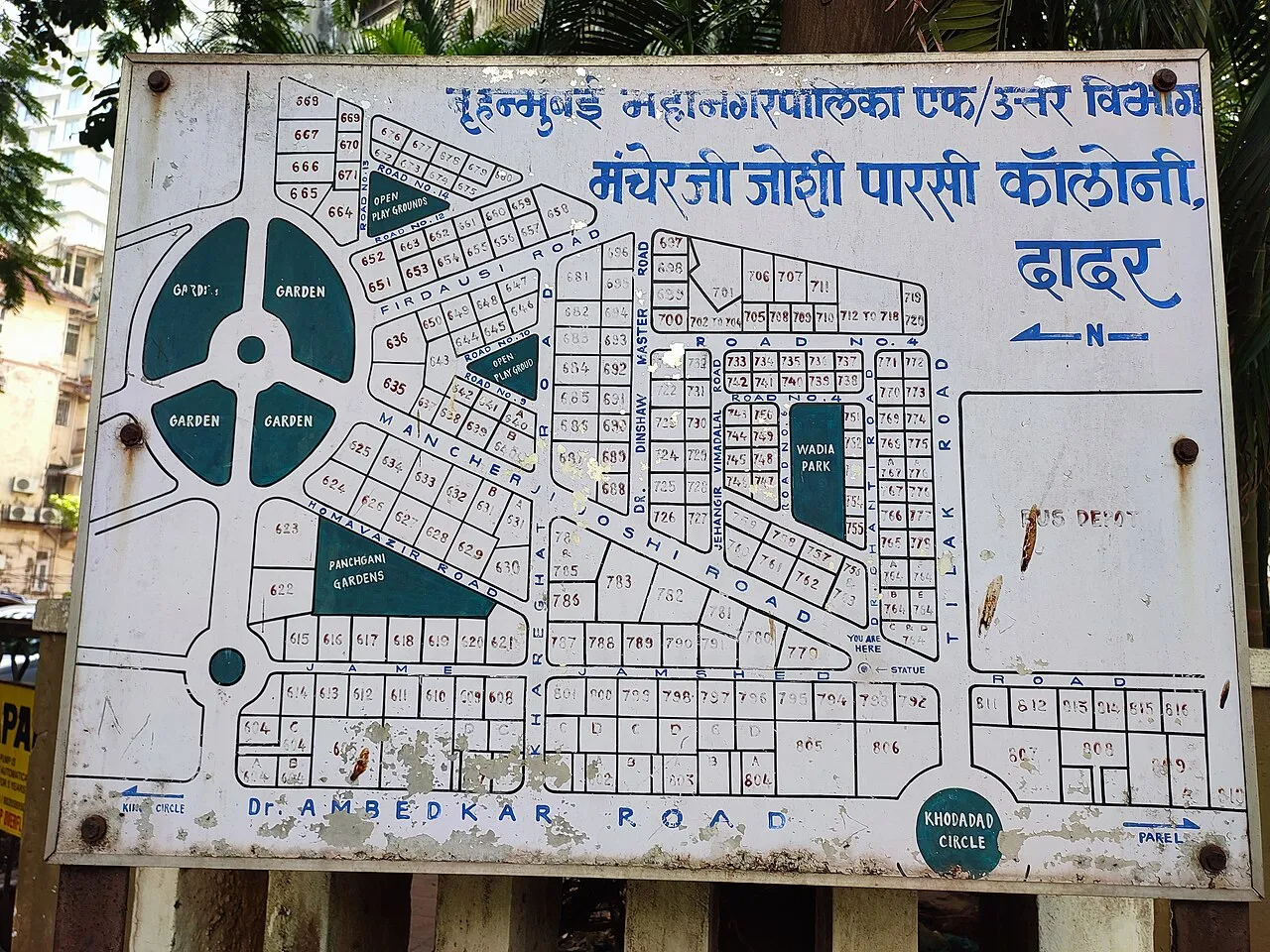
A large share never marry. The same paper cites a 1999 Tata Institute of Social Sciences survey for the Bombay Parsi Punchayet which found that 30% of Parsi women stayed unmarried all their lives. CMAJ's source said 30% of Parsis remain single. Shernaz Cama of the Parzor Foundation put the share who never marry at around 36%, according to ThePrint in August 2023.
Two reasons come up again and again in the research:
- Money, as measured against status. Parsi men who stayed single most often gave low income as the reason, which the researchers read as income low relative to what they felt a Parsi household should look like.
- Housing. Shroff and Castro call the lack of a home of one's own a "widely cited reason for not marrying". South Mumbai flats went beyond the reach of all but the wealthy, and Parsis tend to want a home of their own rather than live in an extended family.
Cama also told CMAJ that Parsis are "extremely Westernized and individualistic" and often put off children for their careers.
Why do Parsi deaths outnumber births?
Because the community is old. In Mumbai in 2001, Shroff and Castro found nearly a quarter of Parsis over 65 and under 13% below 15. The CMAJ report gave 31% of Parsis over 60.
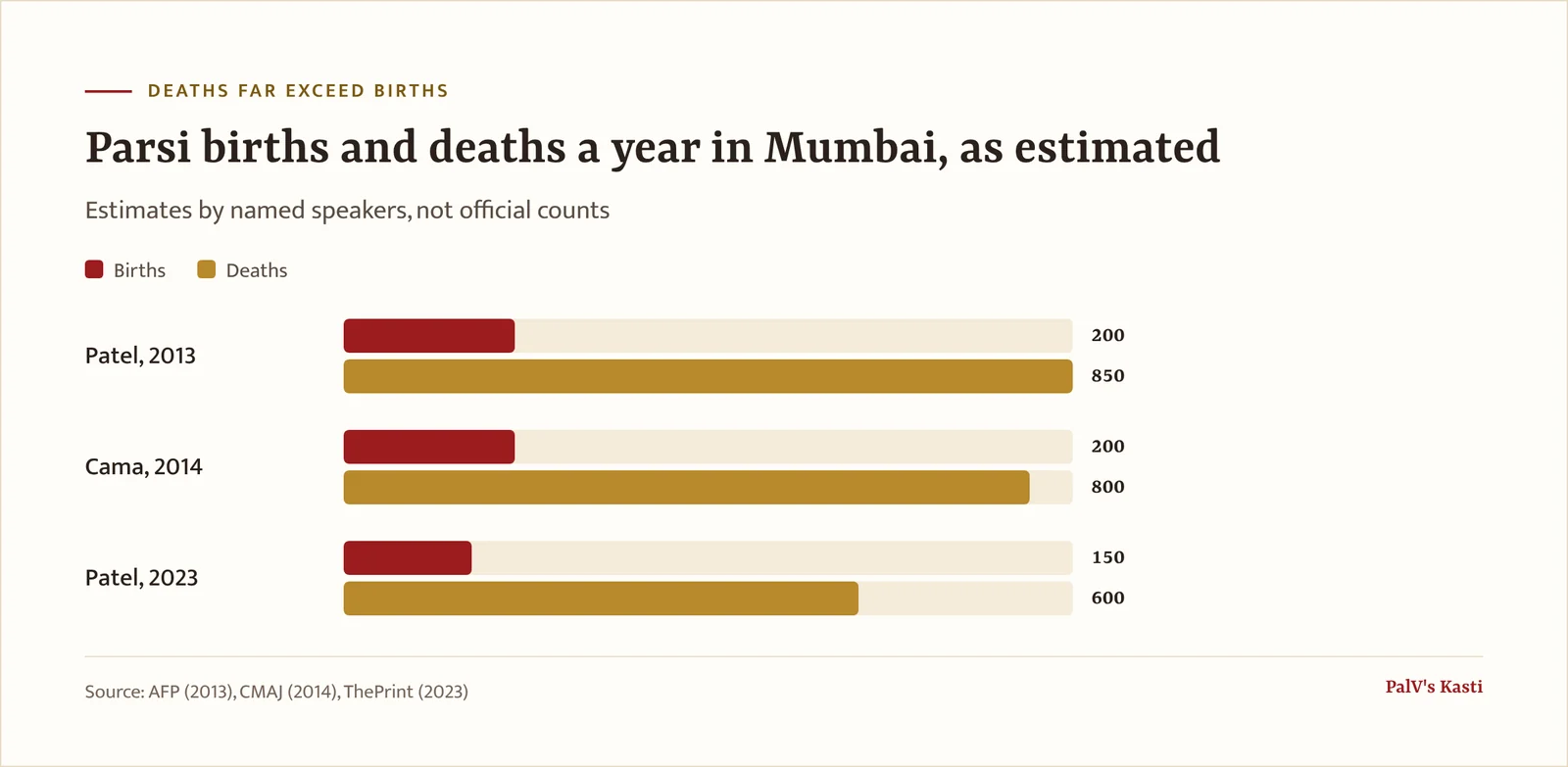
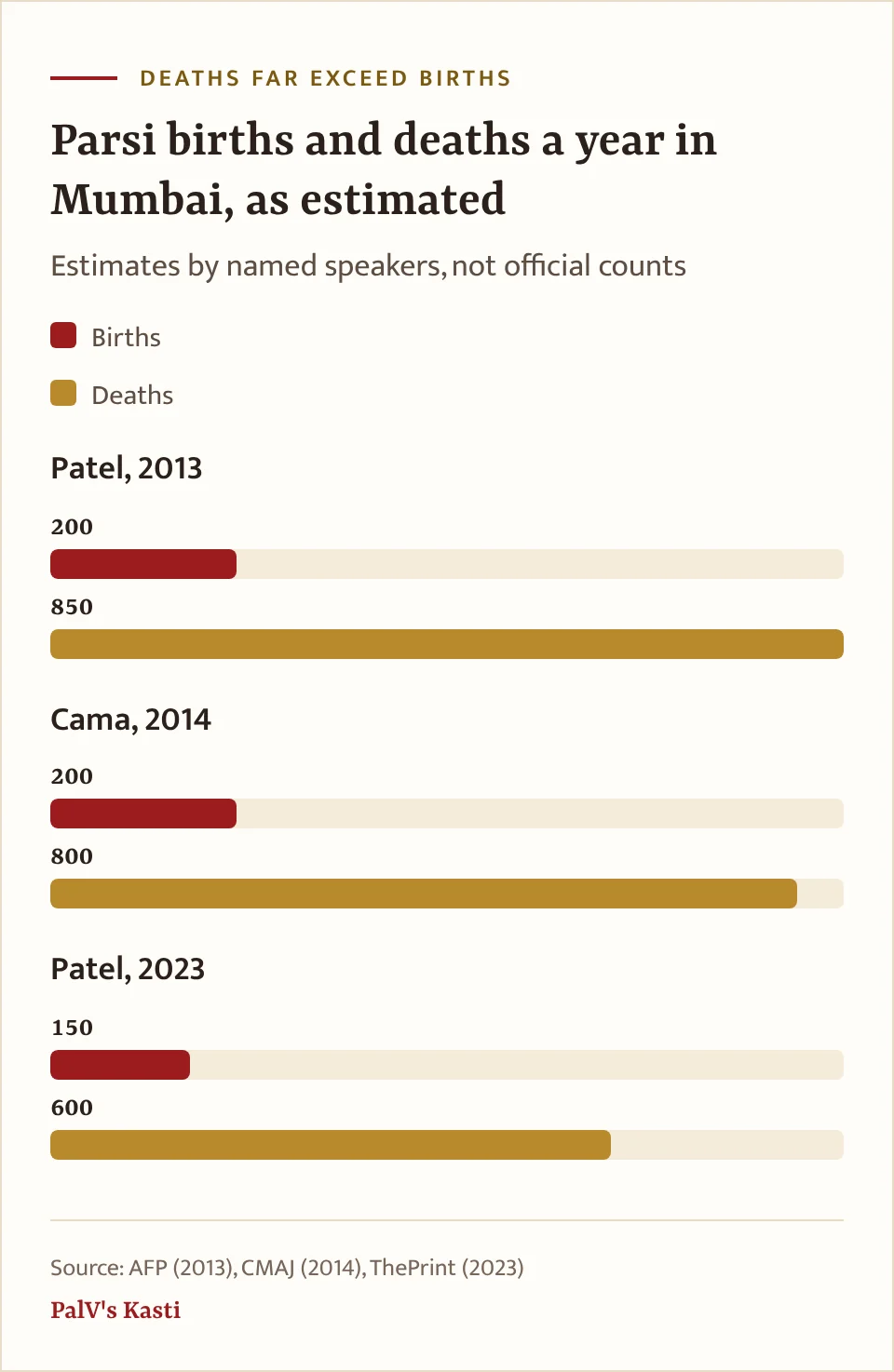
The estimates of births and deaths in Mumbai differ by speaker and year, so we give each one as said:
- Jehangir Patel, editor of Parsiana, told AFP in December 2013 that Mumbai sees about 850 Parsi deaths and roughly 200 births a year.
- Shernaz Cama told CMAJ in 2014 that around 200 Parsi children are born in Bombay while more than 800 Parsis die each year.
- Patel's figure in ThePrint in 2023 was 600 deaths for every 150 births.
- FEZANA's 2012 demographic compilation reported, for Mumbai, deaths rising from 303 per 100 births in 1992 to 741 per 100 births in 2011.
We found no official all-India count of Parsi births and deaths. All of these are Mumbai figures.
Does marrying out cause the Parsi population decline?
It plays a part, but a small one by the numbers. First, the rule itself. Shroff and Castro describe the Parsis as a community that does not convert others and that requires a Parsi father for a newborn to be considered Parsi. AFP, reporting in November 2017, wrote that a man who marries outside the community still has his children considered Parsi, while the children of women who marry out are barred from places of worship.
Marriage outside the community has grown. Shroff and Castro, citing Parsiana, give 19% of Bombay Parsi marriages in 1991, 32% by 2005 and 38% by 2010. FEZANA, also citing Parsiana, gives 20.5% in 1992 and 38.9% in 2011.
Yet the study's projections show the rule is not what drives the fall. If current trends hold, Mumbai's Parsis would go from 46,557 in 2001 to 20,122 in 2051. Counting every child of intermarriage would leave 20,535. In the authors' words, "intermarriage is not the principal driver" of the decline. Fertility is.
Whether the rule should change is argued with feeling inside the community, and our post on the purity vs survival debate sets out both sides in their own words.
Practice varies between families and Agiaries; your family priest's guidance comes first.
Do Parsis emigrate, and does that shrink the count?
Emigration is a real factor, though nobody has measured its size. Shroff and Castro say emigration, especially to Britain, the United States, Canada and more recently Australia, may also have contributed, and add that there is no data on how many Parsis leave Mumbai each year. Viraf Mehta, chairman of the Bombay Parsi Punchayet, told the Free Press Journal in March 2024 that the young generation has been moving abroad, particularly to North America, Australia and New Zealand.
Partition also took a one-time share off the Indian count. Shroff and Castro estimate that about 5,000 Parsis were lost to Pakistan, and from 1951 the census no longer covered those areas. For where Zoroastrians live outside India today, see the Zoroastrian diaspora.
Are Parsis going extinct?
No source we found puts a date on it, but the projections point steadily down. At an event under the National Commission for Minorities in Mumbai in May 2026, Dinshaw Tamboly, chairman of the WZO Trust Funds, presented the community's demographic picture. The Free Press Journal, reporting it on 10 May 2026, wrote that if the present trend continues the Parsi population in India could fall below 10,000 by 2101. The causes listed there were late marriages, marriages outside the community, falling birth rates, many unmarried people and infertility.
Some voices are bleaker. Jehangir Patel told AFP in 2013 that "it's going down and down and it's eventually going to disappear", and in 2024 told the Free Press Journal that reversing the decline was impossible. The Ministry of Minority Affairs runs the Jiyo Parsi scheme to contain the decline; AFP reported that it began in 2013. The plans to grow Parsi numbers have a post of their own. When the Free Press Journal reported in May 2026, the 2011 figure of 57,264 was still the latest count, and the next census was expected later that year or in 2027.
Frequently asked questions
Why is the Parsi population declining?
Mainly because very few children are born. Mumbai's Parsis had a total fertility rate of 0.89 in 2001, well under one child per woman. Late marriage, many who never marry, an old age profile and emigration add to the fall. India counted 69,601 Parsis in 2001 and 57,264 in 2011.
Why did Zoroastrianism decline in India?
In India the census counts the faith's followers under a Parsi label, and that count has fallen since the 1941 Census counted 114,890. Demographers blame very low fertility, late and fewer marriages, an ageing community where deaths outnumber births, and emigration. The 2011 Census counted 57,264 Parsis, a little under half the 1941 figure.
Does marrying outside the community cause the decline?
Only a little. A 2011 Demographic Research study projected Mumbai's Parsis at 20,122 in 2051 under current rules and 20,535 if every child of intermarriage were counted. Its authors concluded that intermarriage is not the principal driver of the decline. Very low fertility is the main cause.
How many Parsis are born and die in Mumbai each year?
Estimates vary by year and speaker. Parsiana editor Jehangir Patel told AFP in 2013 of about 850 deaths and 200 births a year, and ThePrint in 2023 of 600 deaths for every 150 births. Shernaz Cama told CMAJ in 2014 of around 200 births and over 800 deaths. No official yearly count is published.
How many members does Zoroastrianism have?
In India, the 2011 Census counted 57,264 people under the label "Parsi/Zorastrian" (the table's own spelling), the latest official figure. That figure covers India only. Zoroastrians also live in other countries, and our page on Zoroastrian population by country brings those figures together with their sources.