 PalV's Kasti
On this page
- Why do some Parsis need an alternative to the Tower of Silence?
- What does Zoroastrian teaching say about cremation and burial?
- Where are Mumbai Parsis cremated, and what is the Worli prayer hall?
- How many Parsis now choose cremation?
- Are prayers said for a Parsi who is cremated?
- What do Zoroastrians in North America choose?
- Do the rites before the funeral change?
- Frequently asked questions
Where a Tower of Silence cannot be used, a Parsi family's alternatives are cremation and burial. In Mumbai, where most funerals still go to Doongerwadi, a growing minority of families choose cremation, and since August 2015 a prayer hall for Parsi-Zoroastrian rites at the Worli municipal crematorium has given them a place for the prayers that follow. In North America, where there is no dakhma, Zoroastrian guidance written there treats cremation as the usual choice and burial as the less preferred one. Neither option has the blessing of the high priests. A passage reproduced in J.J. Modi's 1922 book on Parsi ceremonies states that the religion forbids both burying and burning the dead, and the question of whether priests may pray for a Parsi who is cremated has gone as far as the Bombay High Court.
અસપંદામેદ રોજ
Asfandarmad Roj, Tir Mah · 1396 Y.Z.
Why do some Parsis need an alternative to the Tower of Silence?
Dokhmenashini, the exposure of the body in a dakhma to the sun and carrion birds, is the method the priestly sources prescribe. Our guide to what Parsis do with dead bodies explains the reasons behind it, and our page on the Tower of Silence covers the structure itself. The sources we read point to these reasons for looking elsewhere.
- No dakhma nearby. Dastur Kersey Antia, writing in the FEZANA Journal in winter 2005, listed the choices open to Zoroastrians in North America as burial, cremation, or sending the body to India for dokhmenashini.
- Fewer vultures. The Free Press Journal reported in April 2024 that the near-extinction of India's vultures was one reason the traditional system had become less effective.
- Covid-19. According to the Free Press Journal in January 2024, the bodies of people who died of the disease were not allowed into the Tower of Silence in Mumbai, and cremations spiked.
What does Zoroastrian teaching say about cremation and burial?
The priestly sources agree that dokhmenashini is the ideal. They differ on how serious the alternatives are.
In The Religious Ceremonies and Customs of the Parsees (1922), the priest-scholar J.J. Modi reproduces an account explaining that earth, fire and water are held sacred, so the religion enjoins that a body is not to be buried, burnt or put into seas and rivers. Ervad Dr Ramiyar Karanjia writes on his website that dokhmenashini alone reunites the body's semi-spiritual parts with air and sunlight, and that any other method, whether chosen or forced by circumstance, slows the progress of the soul.
Dastur Kersey Antia takes a more practical line. In his 2005 commentary for FEZANA he agrees that dokhmenashini is the only method that pollutes no element of nature. He then argues that burial pollutes the earth and can contaminate nearby water, and he calls cremation "the second best alternative for us". Where burial is the only option, he advises surrounding the grave with cement-concrete blocks on all sides, as is done in Iran.
The high priests in Mumbai have held the stricter view. Open magazine reported in February 2014 that they had strictly forbidden both cremation and burial. In her history of the Parsis, excerpted by Scroll in July 2021, Coomi Kapoor writes that Dastur Firoze Kotwal called acceptance of cremation "a strike at the very foundation of our religion".
Practice varies between families and Agiaries; your family priest's guidance comes first.
Where are Mumbai Parsis cremated, and what is the Worli prayer hall?
Mumbai's prayer hall for Parsis who are cremated stands at the municipal crematorium in Worli. The Free Press Journal reported in January 2024 that it opened in August 2015, that the A H Wadia Trust gave a founding grant of Rs 1.5 crore, and that priest Framroze Mirza, helped by two other priests, was then in charge of its religious services.
Why was it needed? Dinshaw Tamboly, a member of the Prayer Hall Trust and a former Bombay Parsi Punchayet (BPP) trustee, told the paper in April 2024 that Parsis had been cremated before, but there were "no facilities" for the prayers held after a funeral. The January 2024 report added that the BPP had once discussed allowing cremation at Doongerwadi, and that the clergy and orthodox members opposed it, so it was dropped.
Well-known Parsis have since chosen Worli. In April 2024 the Free Press Journal reported the cremation of economist and philanthropist Minoo Shroff, the first former BPP chairman in the trust's recorded history to be cremated rather than taken to the Tower of Silence. In October 2024 it reported that Ratan Tata's last rites were held at the Worli municipal crematorium.
How many Parsis now choose cremation?
No official count is published. These are the Prayer Hall Trust's estimates as reported by the Free Press Journal in January and April 2024.
- Of the roughly 650 Parsi-Zoroastrian funerals in Mumbai each year, 100 to 120 were cremations, Tamboly said.
- Before the prayer hall opened, an estimated 7-8% of Parsi funerals in Mumbai were cremations. The trust now puts it at 15-20%.
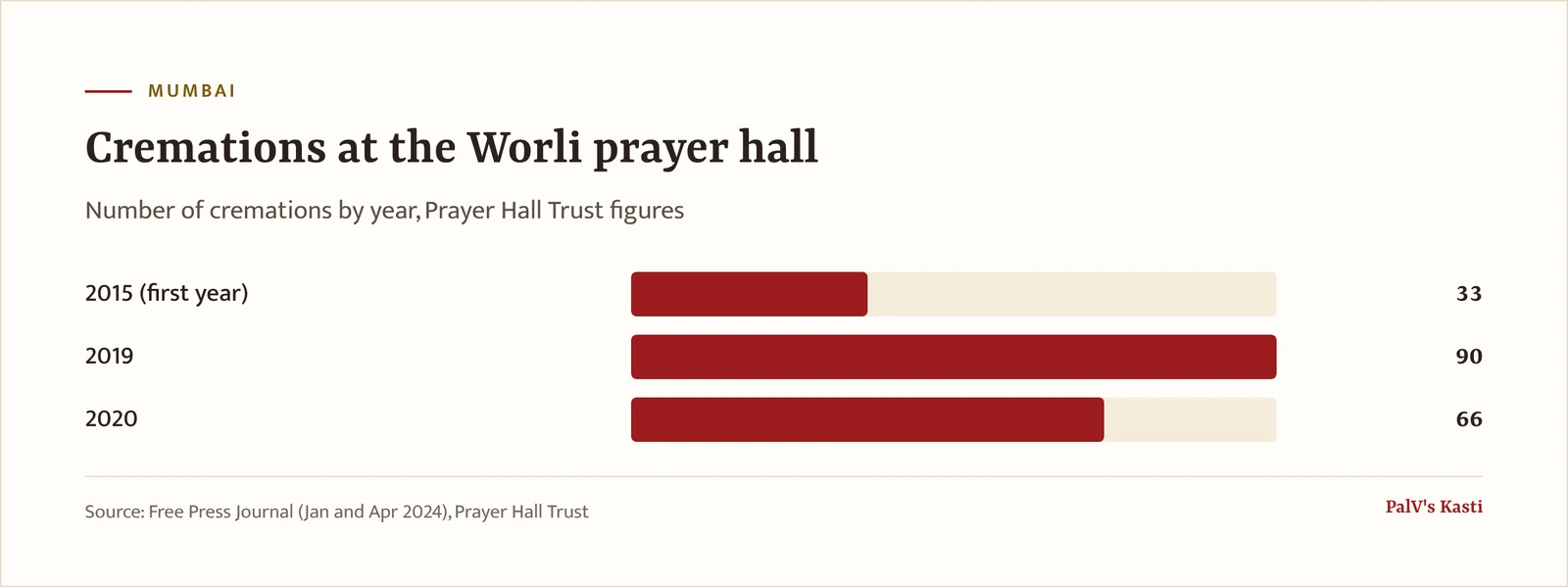
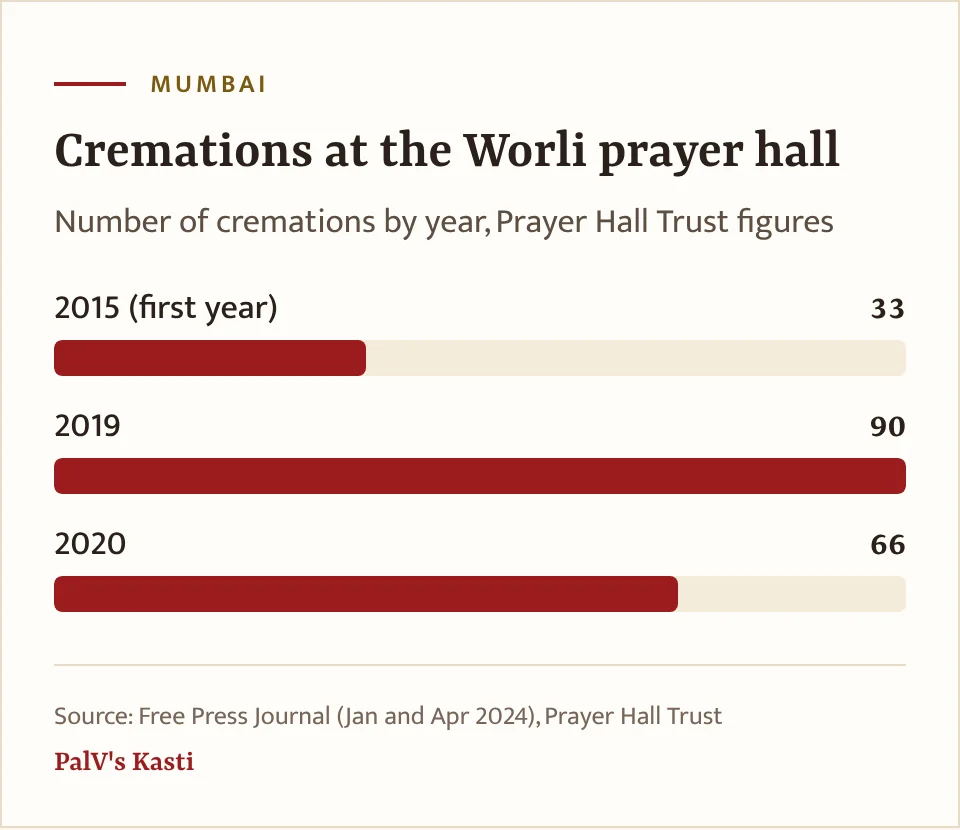
- Cremations at the Worli hall went from 33 in 2015 to 90 in 2019, and were 66 in 2020.
A lower figure comes from Jehangir Patel, editor of Parsiana, who told the same paper in April 2024 that "just over 10%" of funerals were now done in non-traditional ways, and that there was still reluctance to choose cremation.
Are prayers said for a Parsi who is cremated?
This is the most contested part of the question, and the answer depends on whom you ask.
At Doongerwadi, the BPP did not allow its bunglis (prayer halls) to be used for families whose dead were to be cremated. Kapoor writes that this was on Dastur Kotwal's advice, and the Free Press Journal reported in April 2024 that the high priests had refused to allow prayers there for those who were cremated. On 9 June 2009 the BPP trustees resolved to bar two priests, Framroze Mirza and Khushroo Madon, from Doongerwadi, the Godavara Agiary in Fort and the Agiary at Godrej Baug. The High Court judgment records three ceremonies the trustees called irreligious, the first being prayers for the dead who were cremated.
On 11 March 2011, in Jamsheed Kanga & Anr v Parsi Panchayat Funds and Properties & Ors (Appeal No. 256 of 2010), a Bombay High Court bench of Justices D.Y. Chandrachud and Anoop V. Mohta held that the ban was not within the trustees' power under the trust deed, and directed them to withdraw all notices and instructions enforcing it. Open reported in February 2014 that the BPP had appealed to the Supreme Court, which had appointed a mediator. Kapoor, writing in 2021, says the Supreme Court was reluctant to rule on a religious matter and that neither side was satisfied with the mediator's final order. We could not find the text or date of that order.
In North America, the guide by Firoze Jungalwala and Farhad Panthaki describes priests saying the final Kusti prayers and Sarosh Baj at the crematorium.
Practice varies between families and Agiaries; your family priest's guidance comes first.
What do Zoroastrians in North America choose?
Jungalwala and Panthaki state that in North America cremation is the preferred mode, that burial is considered to contaminate the earth and so is deemed undesirable, and that it is customary to return the ashes to nature.
The FEZANA guide to funeral ceremonies by Dastur Antia, compiled by Roshan Rivetna (2005), sets out the practical choices. After cremation, the ashes may be handed to relatives in an urn, buried in a family or community plot, or scattered in a garden where local rules allow. For burial, it suggests asking for a cement-lined box to avoid polluting earth and water. It also mentions a few cases of loved ones being sent to Iran for burial at a Zoroastrian aramgah.
Practice varies between families and Agiaries; your family priest's guidance comes first.
Do the rites before the funeral change?
The FEZANA guide allows the body to go from home straight to the crematorium or cemetery if a place is available there for the Gehsarna prayers; our guide to the rituals before the funeral covers the earlier rites, and the full sequence is in our guide to Parsi death rituals. Whatever a family chooses, speak to your family priest early.
Frequently asked questions
Do Parsis bury their dead?
Not as a rule. An account reproduced in J.J. Modi's 1922 book states that the religion forbids burial so that the earth is not polluted. Some Zoroastrians in North America do bury their dead, and the FEZANA guide of 2005 suggests a cement-lined box to limit pollution of earth and water.
Can a Parsi be cremated?
Yes, though the high priests have opposed it. In Mumbai, a prayer hall for Parsi-Zoroastrian rites at the Worli municipal crematorium has been open since 2015. Dastur Kersey Antia called cremation the second-best option after dokhmenashini. Your family priest can advise on what your Agiary allows.
What is the Worli prayer hall?
It is a hall at the municipal crematorium in Worli, Mumbai, opened in August 2015 so that families who choose cremation have a place for the prayers that follow the funeral. The A H Wadia Trust gave the founding grant, and in January 2024 priest Framroze Mirza led its services with two other priests.
Are prayers allowed for cremated Parsis?
It depends on the place and the priest. The BPP did not allow its Doongerwadi bunglis to be used for those to be cremated, and in 2009 it barred two priests who prayed for them. The Bombay High Court held that ban beyond the trustees' power in March 2011. Prayers are held at the Worli prayer hall.
How many Parsis choose cremation?
There is no official figure. In 2024 the Prayer Hall Trust estimated that 15-20% of Mumbai's Parsi funerals now end in cremation, up from 7-8% before 2015, or 100 to 120 of about 650 funerals a year. Parsiana editor Jehangir Patel put the share of non-traditional funerals at just over 10%.


