 PalV's Kasti
On this page
- What should the family do when death is near?
- What are the first practical steps after a death in Mumbai?
- What are Sachkar and Sagdid?
- What happens at the funeral?
- What if there is no Tower of Silence?
- What happens over the next three days and nights?
- How long do Parsi death rituals last?
- Frequently asked questions
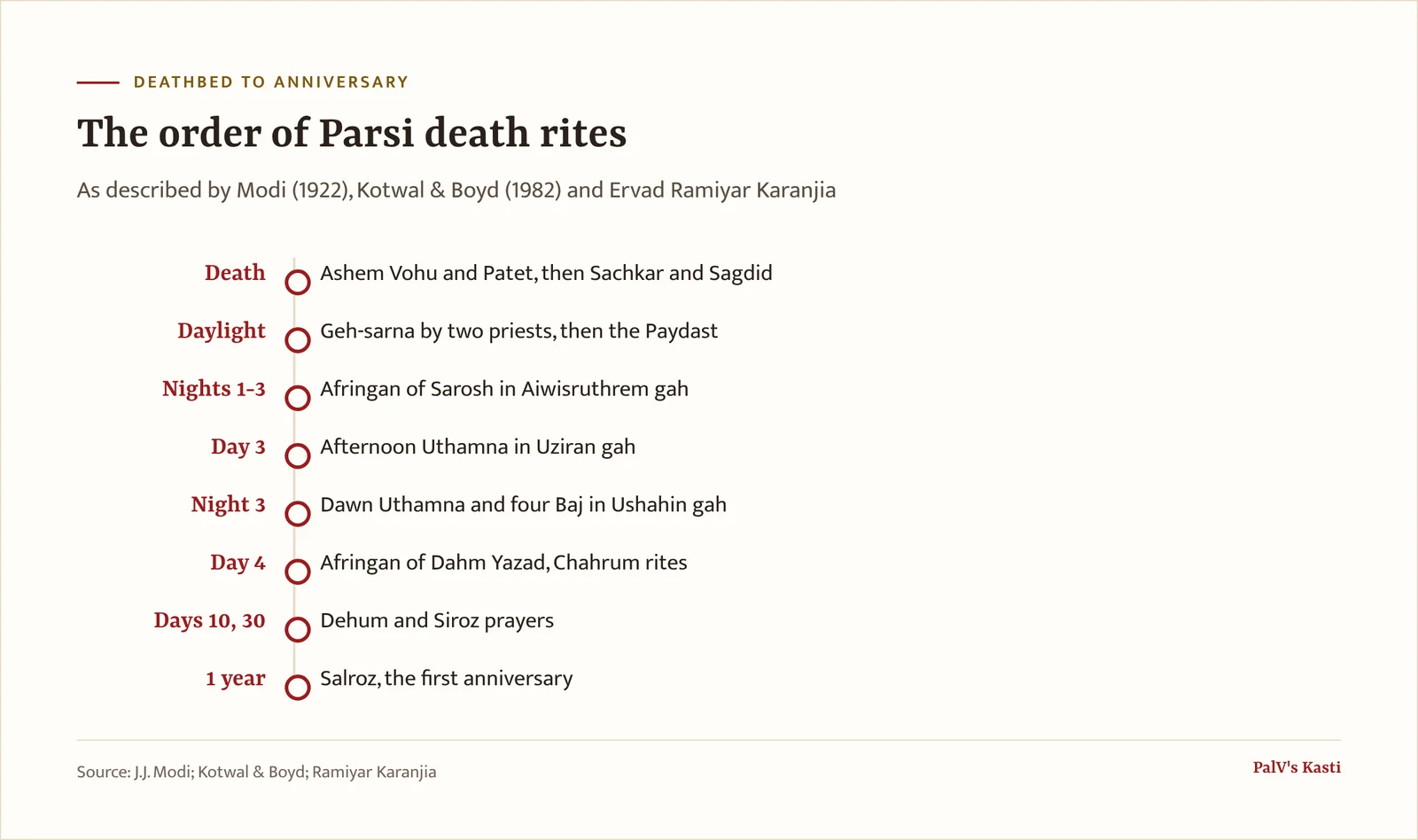
When a Parsi dies, the rites follow a set order over four days. Prayers are said at the deathbed. The body is given a last ritual bath, the Sachkar, and is shown to a dog, the Sagdid. In daylight two priests chant the Gathas over it (the Geh-sarna), and mourners walk behind it in pairs to the dakhma (the Paydast). For three days and nights priests pray to Sarosh, the divine guardian of the newly departed soul. The Uthamna follows on the third day, and at dawn on the fourth day, writes Ervad Ramiyar Karanjia, the soul crosses the Chinwad bridge into the spiritual world. Ceremonies then return on the tenth and thirtieth days and on the anniversary. This guide walks through each stage in order and points you to our fuller page on each one.
શહેરેવર રોજ
Shehrevar Roj, Tir Mah · 1396 Y.Z.
What should the family do when death is near?
The first prayers belong to the deathbed. The 1869 catechism of Dastur Erachji Meherjirana, translated by Dastur Firoze Kotwal and James Boyd in 1982, says that if the dying person is still conscious and can say the Ashem Vohu and the Patet (the prayer of repentance), it is "of very great merit". If he cannot, his children or relatives should say one Ashem Vohu near him, and the Patet too. J.J. Modi, writing in 1922, records the same custom: a short Ashem Vohu said by the dying person, or by a relation when the dying person cannot, "is considered meritorious".
Kersey Antia's guide in the FEZANA Journal (Winter 2005) adds that relatives and friends should stay close and sit by the bed, and that it is common for Zoroastrians to say an Ashem Vohu as soon as they hear of a death.
Death rites are one part of a wider set of ceremonies that our overview of Zoroastrian rituals covers.
Practice varies between families and Agiaries; your family priest's guidance comes first.
What are the first practical steps after a death in Mumbai?
For deaths within Mumbai city limits, the Bombay Parsi Punchayet's Doongerwadi page (read on 16 November 2026) sets out these steps:
- Get the death certificate from the doctor: Form 4 if the death was at home, Form 4A if it was in a hospital or nursing home. Check the spelling of the name and that the doctor's stamp, signature and registration number are clear.
- Call your Atash Behram or Agiary and tell the head priest, so that priests can be arranged at Doongerwadi.
- Call the Doongerwadi office for the hearse van. They ask for the full name, age and date of death, a blood relative's contact details, the address for pickup, any bungli preference, whether the family wants four days or one day at Doongerwadi, and the name of your Agiary.
- Send a relative to the BMC D Ward office at Nana Chowk for the Statement of Death Registry. The BPP says the bathing and Sachkar begin only once a copy of this has been received.
The BPP also lists what to bring: a towel, six or seven men's sadras for the Paydast to be laid on the bier, a used but washed Navjote.">sadra and lenga for the deceased to wear after the bath, two or three white bed sheets and a bottle of cologne. It says all of these can also be had at Doongerwadi. For a death outside Mumbai but within India, the page adds a police NOC from the local police station and a fresh one from Malabar Hill Police Station. The BPP notes that its rules change from time to time, so call the front office first. If the death happened overseas, see our guide to Parsi death abroad.
What are Sachkar and Sagdid?
Sachkar is the last ritual bath. Karanjia describes it as usually given by the Doongerwadi staff or the relatives: the body is washed, dried and dressed in a sadra, and the kusti is tied with its prayers, preferably by a family member. The BPP's page says the body is bathed with taro (cow or bull urine) and that the kusti is tied by the next of kin. The body is then laid on three stone slabs. The BPP says an iron nail is used to draw a kash, a boundary around the body, and Modi describes the same three circles drawn with a metal bar or nail to mark ground set apart for the dead. Both Karanjia and the BPP say that after the Sachkar, non-Zoroastrians no longer see the body.
The Sagdid, "the sight of a dog", follows. Modi explains that a dog, usually one with two eye-like spots above its eyes (chathru-chashma, "four-eyed"), is made to look at the body, and that the Sagdid is repeated at the start of every gah while the body awaits the funeral. Karanjia gives the same rule. Modi lists several explanations offered for it over the centuries, from testing that life had truly gone to the dog's faithfulness as a sign of the bond between the living and the dead. Modi records that a fire fed with sandalwood and frankincense is then kept burning in the room. Karanjia and the BPP both say a priest sits reciting prayers, and that a lay Zoroastrian may recite them when no priest is available.
Each of these steps, and the reasons given for them, is set out in our guide to Rituals before the funeral.
Practice varies between families and Agiaries; your family priest's guidance comes first.
What happens at the funeral?
The funeral itself has two parts. First comes the Geh-sarna, in which two priests recite the Ahunavaiti Gatha (Yasna 28 to 34) over the body. Modi, Karanjia and the BPP all describe a pause partway through, while the body is moved from the stone slabs to an iron bier. Karanjia and the BPP add that the Sagdid is done again at that point. Family and friends then file past to pay their last respects, the sezdo, and Modi records that the face is then covered.
Then comes the Paydast. The khandias carry the bier, two priests follow, and the mourners walk behind them in pairs, each pair holding a handkerchief between them as a paiwand, a ritual connection. Karanjia says the mourners recite the Sarosh Baj up to the words "Astavaitish ashahe" and finish it only after the body has been placed in the dakhma. Modi and Karanjia both record that a clap of the hands tells the mourners when that is done. You can read more in our pages on Parsi funeral ceremonies, How to attend a Paydast and the Paivand.
All of this happens in daylight. Kotwal and Boyd's book says that if death comes in the evening, the funeral can be held next morning at the earliest, and never at night. Modi writes that removing the body at night "is strictly forbidden". The BPP's page puts the Geh-sarna between sunrise and an hour before sunset. Why the body goes to the dakhma at all is covered in What Parsis do with dead bodies. For how a Bombay funeral looked more than 150 years ago, see our 1844 Parsi funeral account.
Practice varies between families and Agiaries; your family priest's guidance comes first.
What if there is no Tower of Silence?
The BPP's Doongerwadi page lists five dokhmas there. Where there is no dakhma, as in North America, the rites are adapted. Antia's FEZANA guide describes the Geh-sarna prayers being said at the funeral home in daylight hours, after which the body goes by hearse to the crematorium or cemetery. Firoze Jungalwala and Farhad Panthaki, writing on avesta.org, also place the Geh-sarna at the funeral home, with the body in a casket, and say that in North America cremation is the preferred mode of disposal.
How families decide, and what each choice means for the prayers, is a subject with strong views on more than one side. We cover it in separate pages: Parsi funeral alternatives, Zoroastrian funeral traditions among Parsis, Iranis and the diaspora, Body composting as an alternative and Dokhmenashini in the UK.
Practice varies between families and Agiaries; your family priest's guidance comes first.
What happens over the next three days and nights?
Karanjia writes that for three days and nights the soul remains in this material world, cared for by Sraosha (Sarosh). The Kotwal and Boyd catechism says it stays in the house where the person died and near the place where the body is kept. Modi explains that for this reason the ceremonies of the first three days are all performed in Sarosh's name.

Prayers to Sarosh
Modi describes priests and relatives saying the Sarosh Baj, the prayers of the gah and the Patet at the start of every gah. Each night, at the start of the Aiwisruthrem gah, two priests perform an Afringan in honour of Sarosh. Karanjia calls this night ritual the Sarosh-nu-Patru, or Kardeh of Srosh, and says it is done by two priests for the first three nights. Modi adds that the Yasna, and sometimes the Vendidad, are recited in Sarosh's name at a nearby fire temple, and Karanjia lists a Baj of Sarosh in every gah at the Agiary or Atash Behram until the Chahrom. Our page on Sarosh-no-Kardo explains the night ritual. Food customs in these days are covered in Vegetarian days after death.
The Uthamna on the third day
The Uthamna is held on the third day. Modi says the word comes from an Indian verb, uthvun, "to get up, to depart". Karanjia and Kotwal and Boyd both describe two: one in the afternoon of the third day (Uziran gah) and one before dawn of the fourth day (Ushahin gah). Modi called the dawn one the most proper and said the afternoon one was held so that friends and relations could attend. Kotwal and Boyd's 1982 book notes a disagreement over which is correct and advises families to do both, adding that "Ninety percent of the people now do both". After the prayers, Karanjia writes, rose petals and rose water are passed round and mourners pledge a good deed or a charity in the deceased's memory. Modi, too, describes relations announcing donations to charity in the deceased's memory at this gathering.
The dawn of the fourth day
In the Ushahin gah of the third night, four Baj ceremonies are performed at the Agiary, in honour of Rashn-Ashtad, Mino Ram, Sarosh and the Fravashis (Ardafravash). Karanjia and the catechism both list these, and both place an Afringan in honour of Dahm Yazad on the morning of the fourth day. Modi writes that the soul is then judged by Meher Davar, assisted by Rashne and Ashtad, and the catechism says the judgement takes place at the Chinwad bridge before Mihr Yazad. What the faith teaches about these days is covered in First four days after death, and the prayers families say are in our earlier article on After-death prayers.
Practice varies between families and Agiaries; your family priest's guidance comes first.
How long do Parsi death rituals last?
The core rites take four days, from the death to the morning of the fourth day, which Modi and Antia call the Cheharum or Chahrum. As of 16 November 2026, the BPP's Doongerwadi page asks families to choose either four days or one day of obsequies there.
The remembrance does not end there. Modi lists the Cheharum, Dehum, Siroz and Salroz, held on the fourth, tenth and thirtieth days and one year after death, as the main later occasions for prayers for the dead. The catechism Kotwal and Boyd translated sets out ceremonies for the tenth and thirtieth days as well. The monthly and yearly calendar is explained in First-year death ceremonies.
Mourning itself is meant to be kept within bounds. Asked whether it is proper to lament after a death, the catechism answers "No", and says over-lamenting makes the soul unhappy. Antia writes that prolonged mourning "ties down the soul to this earth".
Practice varies between families and Agiaries; your family priest's guidance comes first.
Frequently asked questions
What are the rituals after death in the Parsi religion?
In order: prayers at the deathbed, the Sachkar bath and the Sagdid, the Geh-sarna prayers by two priests, and the Paydast procession to the dakhma by daylight. Then come three days and nights of prayers to Sarosh, the Uthamna on the third day, and four Baj ceremonies and an Afringan to Dahm Yazad at the fourth dawn.
What happens when a Parsi dies?
The family calls its Agiary so priests can be arranged. In Mumbai they also call Doongerwadi for the hearse and register the death at the BMC, since the BPP says the Sachkar starts only after that. The body is bathed, dressed in a sadra and kusti, laid on stone slabs and kept with fire and prayer until the funeral.
How long are Parsi death rituals?
The main rites run four days, ending on the morning of the fourth day, the Chahrum. J.J. Modi lists later prayers on the tenth day, the thirtieth day and the first anniversary. The catechism Kotwal and Boyd translated also sets out tenth-day and thirtieth-day ceremonies. At Doongerwadi, the BPP lets families choose four days or one day of obsequies.
What is the Uthamna?
The Uthamna is the third-day ceremony for the departed. Modi derives the name from the verb uthvun, "to depart", because the soul leaves this world at the end of the third night. It is held in the afternoon and again before dawn, and mourners pledge a good deed or charity in the deceased's memory.
Why is the fourth day important?
Karanjia, Modi and the catechism Kotwal and Boyd translated all describe the soul staying near this world for three days and nights and reaching the Chinwad bridge at the fourth dawn. Modi writes that it is judged there by Meher, assisted by Rashne and Ashtad. The four Baj ceremonies and the Afringan of Dahm Yazad are performed around this dawn.


