 PalV's Kasti
On this page
A Parsi wedding in Mumbai is usually held at a baug, the garden ground attached to an Agiary. Parsi Times wrote in 2016 that the venue's doorways and stairways are dressed with flowers and elaborate rangolis. On the stage the bride and groom sit side by side facing east, the groom on the bride's right, with lamps on tables beside them. Ervad Dr Ramiyar Karanjia adds that the fire is kept in a small vase on one side of the stage. The Lagan usually starts after sunset. Then comes the reception, where guests sit at tables and eat off banana leaves.
ખોરદોદ રોજ
Khordad Roj, Tir Mah · 1396 Y.Z.
What is a Parsi baug?
O Heraldo, in a piece published in January 2015 about a Mumbai wedding its writer went to, described baugs as gardens attached to an Agiary, or Parsi fire temple, and said Parsi wedding feasts are held there. That wedding was at the Seth Jeejeebhoy Dadabhoy Agiary Baug, at the far end of Colaba, inside a naval area. Parsi Times, in its 2016 piece on wedding rituals, also said the venue is usually a baug, and that the stage can be set at the baug or at a fire temple.
We could not find a current, sourced list of which Mumbai baugs host weddings today or what they charge, so we have not given one. If you are booking a venue, our Parsi wedding planning guide sets out the order of things to arrange.
Where were Parsi weddings held before the baugs?
At home. J.J. Modi wrote in 1922 that the marriage generally took place at the bride's house, with the men seated in the compound and the women inside. Dosabhai Framji Karaka, writing in 1884 about the wedding of a wealthy family, gave a similar picture: men on chairs and benches in the verandah and along both sides of the road, and the rooms of the house left to the women.
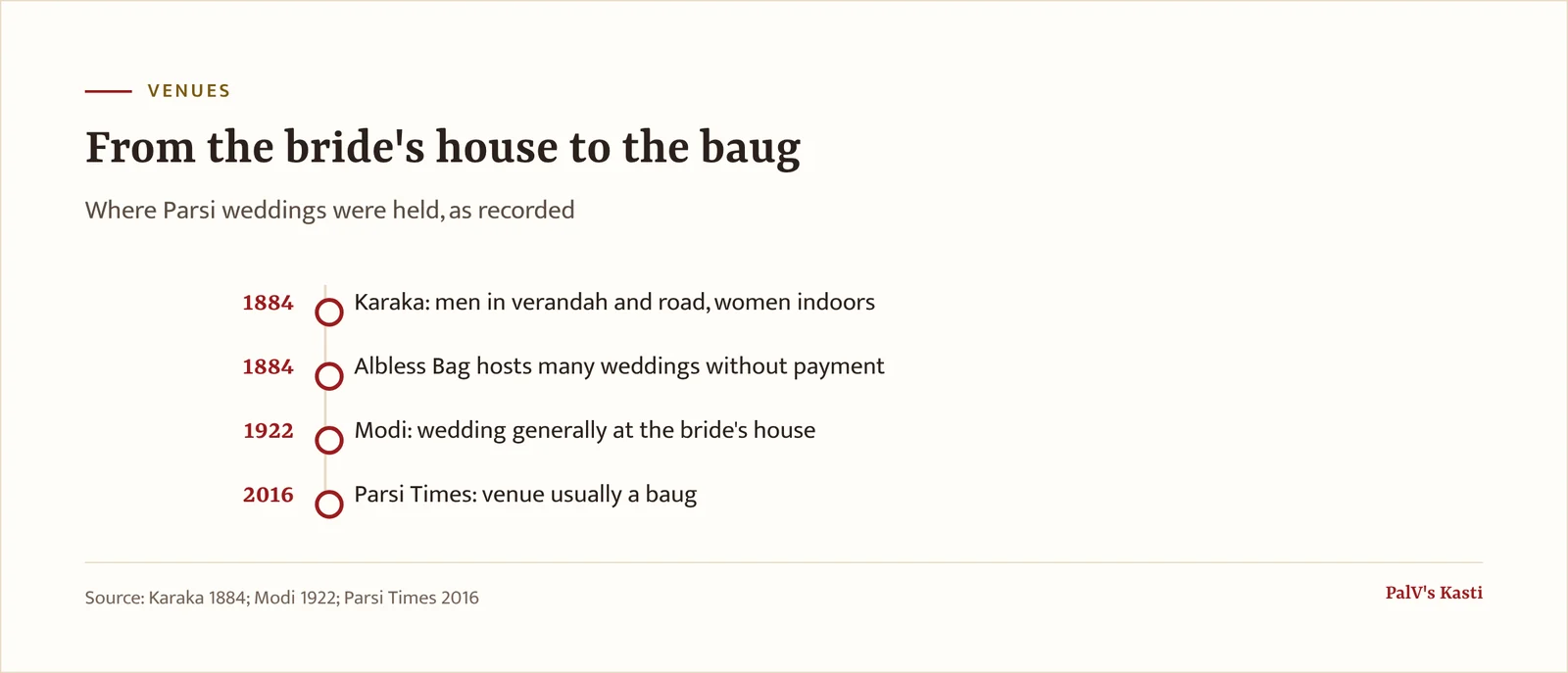
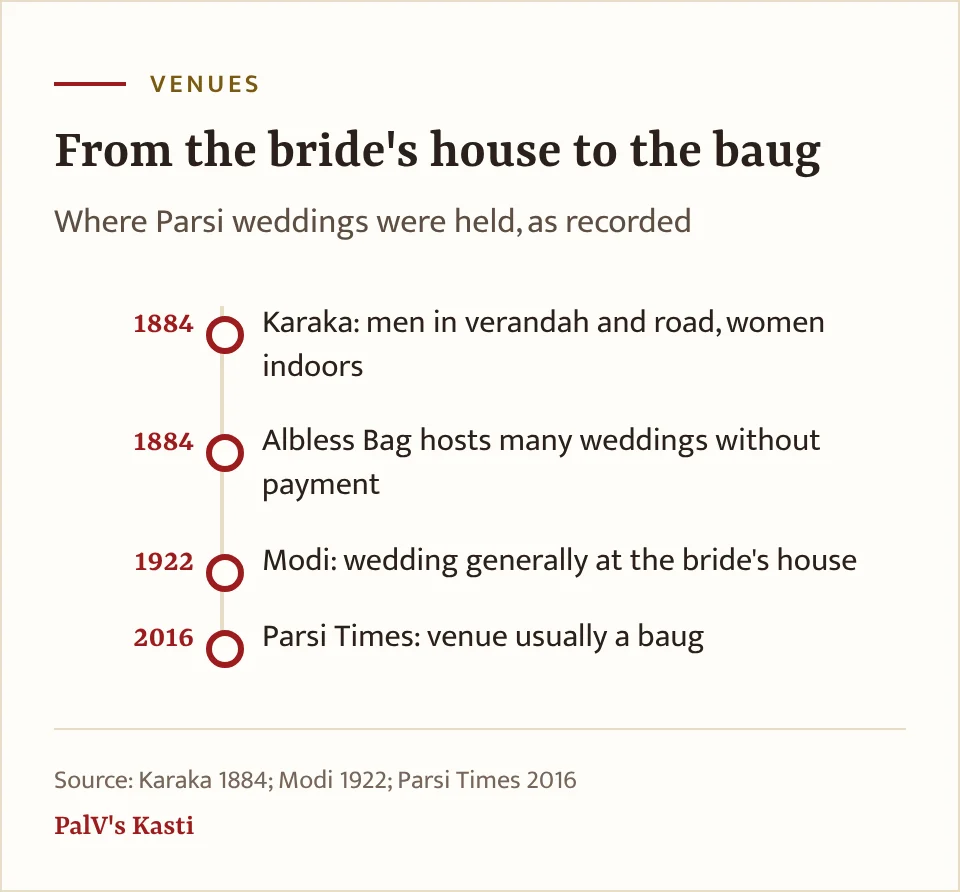
Karaka also noted one answer to the space problem. For families without enough room at home to entertain large parties, the sons of Edalji Framji Albless had put up a building called Albless Bag, and he says many marriages were celebrated there without payment.
What will you see at the gate and entrance?
Flowers and rangoli. Parsi Times (2016) described the venue decorated with flowers and its stairways and doorways covered in elaborate rangolis. Older accounts describe the same kind of welcome at home. Modi recorded a wedding powder called chauk spread over the thresholds of both families' houses, and a string of flowers called a toran hung over the bride's door. Karanjia (2019) writes that on the wedding morning the house is decorated with chalk patterns and flowers.
What is on the wedding stage?
Modi's 1922 description has two chairs, the groom on the bride's right and both facing east. Beside them stand stools with metal trays of rice, which the priests throw over the couple during the blessings, and a small pot of ghee and molasses by the bride's chair. There is a candle by each of the pair, and a servant holds a censer of burning fire. Karanjia's 2019 account also seats the couple facing east with the groom on the bride's right, and says the fire is kept in a small vase on one side of the stage. He adds that the couple light a divo together before the ceremony and that a Ses with new clothes is kept on the stage. Parsi Times (2016) and Noshir Dadrawala, writing in Parsi Times in 2023, both mention lamps placed on tables beside the couple.
The prayers said on this stage are explained in our post on the Parsi wedding Ashirwad, and the full order of the day is on our Parsi wedding page.
Practice varies between families and Agiaries; your family priest's guidance comes first.
What does the wedding dinner at a baug look like?
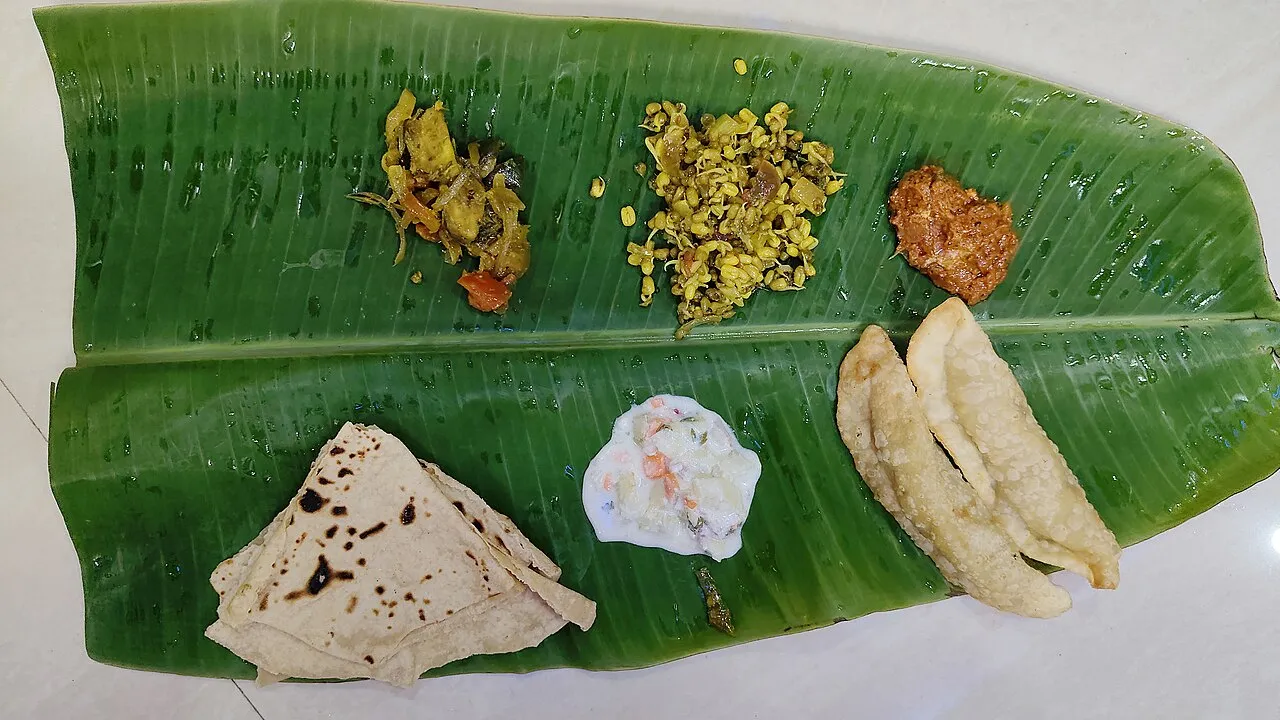
Tables and banana leaves. At the Colaba wedding O Heraldo wrote about in 2015, dinner was a sit-down meal at about 30 tables, each seating up to 40 people. FEZANA's 2012 cookbook Eat, Live, Pray describes how the leaf has traditionally been used. It is laid only after the guests are seated, with side dishes and condiments served on the top part and the main courses and rice on the lower part. When they finished, guests would fold the ends of the leaf to tell the servers to clear. If you are going as a guest, our Parsi wedding guest guide covers what to expect at the table.
What does the baug look like after dark?
Hoshang H. Mandviwalla, in a guest post on the Frashogard website in February 2015, described baugs at night decorated with bright coloured lights hung on the branches of the trees. He wrote it as a critic of the practice and suggested holding receptions in the daytime instead.
Frequently asked questions
What is a Parsi baug?
O Heraldo described baugs in 2015 as gardens attached to an Agiary, where Parsi wedding feasts are held. Parsi Times wrote in 2016 that the wedding venue is usually a baug. Karaka's 1884 history spells the word "Bag", as in Albless Bag, a building where he says many Bombay weddings were held free of charge.
Where do Parsi weddings take place in Mumbai?
Parsi Times wrote in 2016 that the wedding venue is usually a baug and that the stage is set at the baug or at a fire temple. Older accounts point to the home: J.J. Modi recorded in 1922 that the wedding was generally held at the bride's house, with the men in the compound and the women indoors.
What time does a Parsi wedding at a baug start?
Usually in the evening. Ervad Dr Ramiyar Karanjia writes that the ceremony generally begins at the onset of the Aiwisruthrem geh, after sunset, and that some families also hold one in the morning. Parsi Times reported in 2016 that most Lagans begin at 6:40 pm. Check the time printed on your invitation.
Why do Parsis eat on banana leaves at weddings?
FEZANA's 2012 cookbook Eat, Live, Pray calls banana leaves an environmentally friendly kind of plate for feasts serving hundreds of people, since leftovers go to animals and the rest breaks down. It adds that the leaf helps keep the food's flavour and aroma. Guests traditionally folded the leaf's ends when finished, signalling servers to clear.


