 PalV's Kasti

On this page
The Parsi wedding feast is a sit-down meal that FEZANA's 2012 cookbook describes as customarily served on banana leaves, and two writers ninety years apart say it is not complete without fish. In 1922 the scholar-priest J.J. Modi wrote that fish, "a symbol of good omen and luck", was essential at every marriage feast, along with a sweet course. Around that meal sit older food customs: sev with sweet curd and boiled eggs at the Adarni, a consecrated sweet called varadh in memory of the departed, a quiet khichdi day before the wedding, toasts, and the call to dinner, "Jamva Chaloji!" Below we go through each custom, who records it, and where accounts differ.
અસપંદામેદ રોજ
Asfandarmad Roj, Tir Mah · 1396 Y.Z.
Why is fish essential at a Parsi wedding?
Two independent sources say the same thing almost a century apart. Modi's The Religious Ceremonies and Customs of the Parsees (1922) states that fish is considered a symbol of good omen and luck and that "no marriage feast can be complete without it". FEZANA's 2012 cookbook Eat, Live, Pray says a Parsi wedding feast without fish on the menu "is not complete".
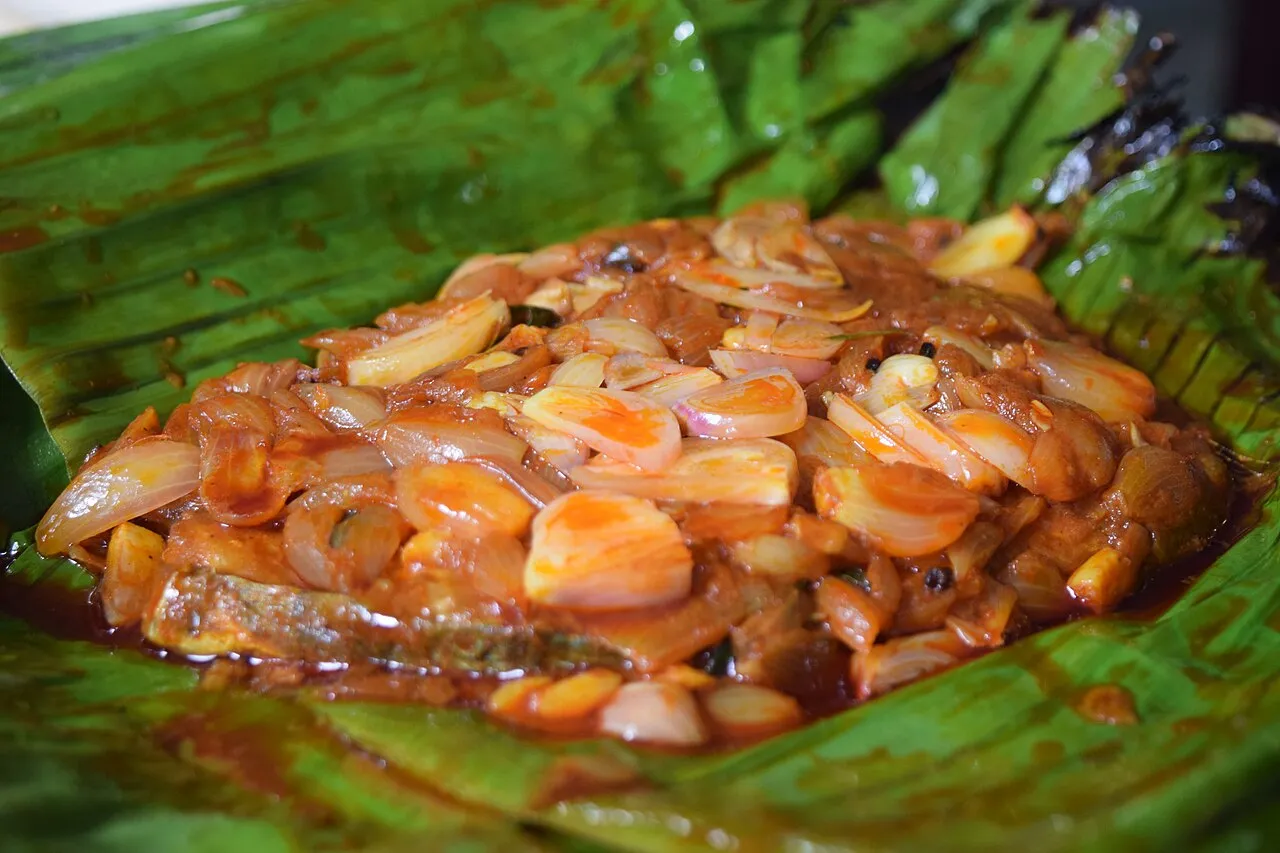
Fish also appears before the wedding, in the Ses (the ceremonial tray). FEZANA records that fresh uncooked fish was once kept on the Ses with the other auspicious items and has since been replaced by mawa ni boi, a sweet shaped like the boi fish. Ervad Dr Ramiyar Karanjia describes the engagement tray as the dahi machli ni ses, holding curd, the horoscope, rock sugar and fish, which may be fresh fish, a sweet or a chocolate in the shape of a fish.
Practice varies between families and Agiaries; your family priest's guidance comes first.
What is eaten at the ceremonies before the wedding?
Food runs through the days before the main ceremony, and each occasion has its own dish.
Betrothal and Adarni
Modi records that after the early exchange of silver-coin gifts, the visiting ladies took "a little refreshment" of fish, sweets, curd, plantains and sugar. At the Adarni, Noshir Dadrawala writes in Parsi Times (2023) that the families enjoy sweet sev with sweet curd and boiled eggs, which he says "symbolizes and celebrates sweetness and fertility". A Parsi Times report from 2016 says the Adarni menu must include sev-dahi, bananas and boiled eggs.
Varadh, the sweet for the departed
Varadh (also called varadh-vara or varadh-pattar) is a sweet made from flour, semolina, ghee and sugar, according to FEZANA's cookbook. Karanjia writes that Satum is recited over it at the fire temple, which he describes as symbolically inviting the departed to the festivities and seeking their blessings. A separate article on Frashogard, the site of Ervad Marzban Hathiram, describes the same observance: Baj, Afringan, Farokshi and Stum for the departed in the morning, with the Varadh nu Stum seeking blessings from Mino Ram, whom it calls the divine being looking after marriages. The two accounts differ on timing. Karanjia places the varadh prayers on the second of the four days of festivities, while the Frashogard article places them on the day before the wedding. Karanjia adds that in the evening the young people of the two sides play Ukardi, a game of playfully "stealing" the varadh offerings.
Khichdi day
Karanjia calls the third day of the four-day festivities a rest day. Khichdi is cooked because it is light and easy to digest, and nothing significant is done.
Practice varies between families and Agiaries; your family priest's guidance comes first.
Did the couple share food at the wedding itself?
Modi describes a rite called dahi-koomro: the newly married couple ate from the same dish, each feeding the other morsels that included curd. He explains it as a sign that they will now share each other's happiness and grief. Even in 1922 he placed it among customs that were very rare in Bombay but still kept to some extent in the mofussil towns. We found no recent source on whether families still do it. For what the other ceremonies of the day mean, see our post on the significance of marriage customs, and for the order they happen in, the guide to Parsi wedding rituals.
How is the Parsi wedding feast served?
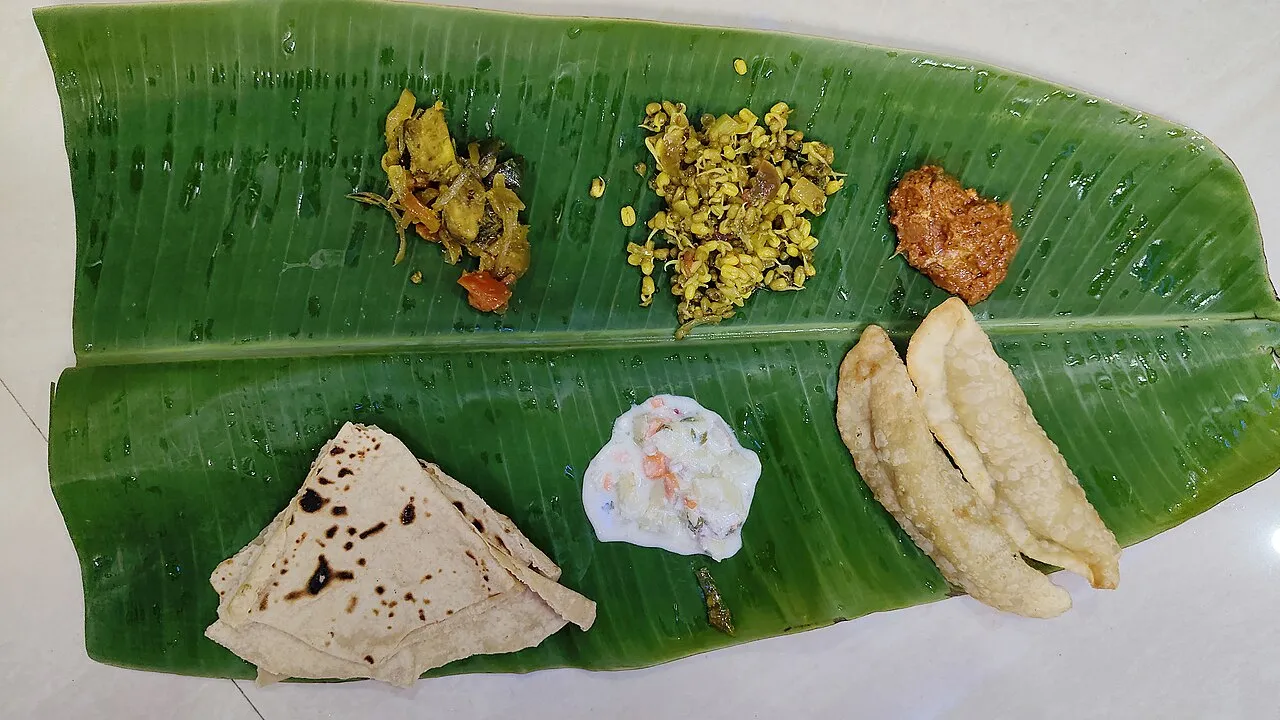
In India the feast was customarily a sit-down meal with banana leaves for plates, according to FEZANA's cookbook, which describes the custom in detail. The leaf is laid only after guests are seated. The upper part takes the side dishes and condiments and the lower part takes the main courses and rice. When guests finish, they fold the ends of the leaf, which tells the serving staff to clear the place. The cookbook calls the leaf an environmentally friendly alternative to paper plates for a large gathering, and says it holds in the flavour and aroma of the food. A 2016 Parsi Times report on wedding rituals also describes guests eating out of banana leaves at the reception.
The scale can be large. Reporting on a wedding at the Seth Jeejeebhoy Dadabhoy Agiary Baug in Colaba, O Heraldo (25 January 2015) counted about 30 tables seating up to 40 people each. That meal ran from sarya and achaar-rotli through patra ni machhi, salli marghi and pulao dal to lagan nu custard, washed down with raspberry soda. Dadrawala's 2023 list is close: Bharuchi akoori, patra or saas ni machhi, salli marghi and pulao daar, with "chilled Raspberry or Ginger".
Dadrawala writes that once the religious ceremony ends there is music and dancing, followed by the "much awaited" call to the feast: Jamva Chaloji! In older accounts the order of service was fixed. Writing in 1884, Dosabhai Framji Karaka says ladies were served first, and the table was set again for the gentlemen once they had left.
What toasts are drunk at a Parsi wedding dinner?
Modi lists the toasts "generally proposed" at marriage feasts in his day:
- In remembrance of God (Yazdan-ni yad)
- The married couple
- The sacred fire temples, that their fires may burn for ever
- The guests
- The host, proposed by one of the guests
- The King
A pious host sometimes added a toast to the departed, Asho Farohar ni yad. Modi notes that no speeches were made, that toasts were drunk during the meal and not after it, and that large gatherings had professional health-proposers whose "only qualification" was a loud, clear voice. Karaka's 1884 account also lists toasts to the couple, their parents and the leading guests, and to the Queen.
Why was meat once kept off the wedding menu?
Older writers agree that meat was avoided but give different reasons. Karaka (1884) says Parsis refrained from meat on the wedding day "to avoid giving offence to the feelings of the Hindus", since a large party would need many sheep to be killed. Modi cites the French scholar Anquetil for the same explanation, tied to Surat. But Modi also points to the record of a community meeting in Bombay on 18 October 1823, called to control funeral and marriage costs, which shows meat was barred for economy, because meat courses were expensive.
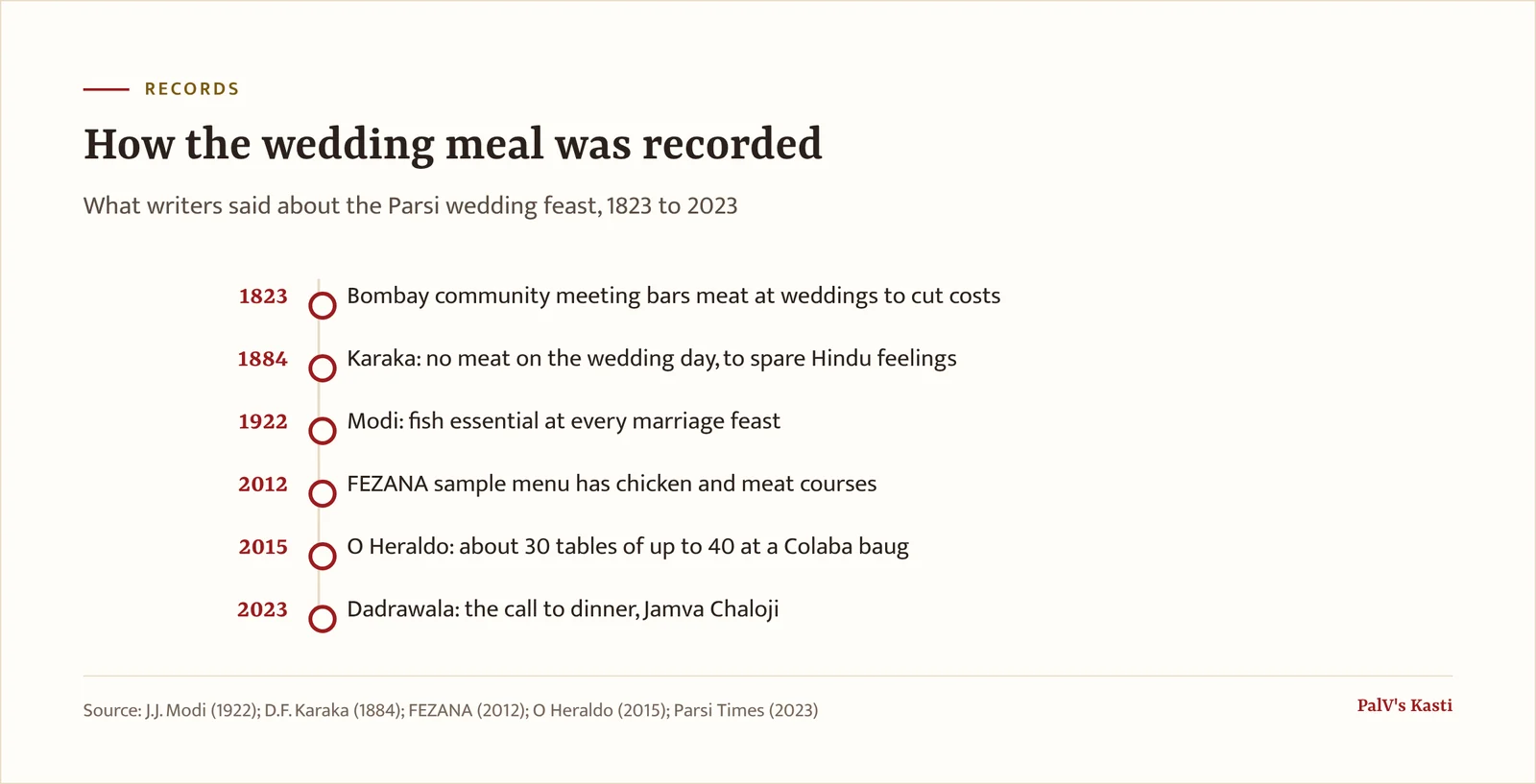

Menus changed later. The sample wedding menu in FEZANA's 2012 cookbook runs to six courses: vegetables (lagan nu achaar, rotli and laganshala), chicken (salli marghi and farcha), meat (masala nu ros gos and dahi nu gos), fish (including patra ni machhi), rice (pulao with masala ni daar) and sweet (lagan nu custard and kulfi).
For the full order of the day, from the stage to the Parsi wedding Ashirwad and the dinner, start with our guide to the Parsi wedding.
Frequently asked questions
What food is served at a Parsi wedding?
FEZANA's 2012 cookbook gives a six-course sample menu: vegetables with lagan nu achaar and rotli, then chicken, meat, fish such as patra ni machhi, pulao with masala ni daar, and lagan nu custard. O Heraldo's 2015 report on a Colaba baug wedding lists a similar run, from sarya and achaar-rotli to pulao dal and custard.
Why is fish served at Parsi weddings?
Fish is treated as a sign of good omen and luck. J.J. Modi wrote in 1922 that no Parsi marriage feast could be complete without it, and FEZANA's 2012 cookbook says the same of today's feast. FEZANA records that a fish-shaped sweet, mawa ni boi, has replaced the fresh fish once kept on the ceremonial Ses tray.
What does "Jamva Chaloji" mean?
"Jamva Chaloji!" is the call that brings guests to the wedding dinner. Noshir Dadrawala, writing in Parsi Times in January 2023, describes it as the much-awaited call to feasting that comes once the religious ceremony is over and the music and dancing have begun. The meal itself is the sit-down banana-leaf feast.
Why do Parsis eat on banana leaves at weddings?
FEZANA's 2012 cookbook says the Parsi wedding feast in India was customarily a sit-down meal with banana leaves as plates. It calls them an environmentally friendly answer to paper plates for hundreds of guests, and says the leaf holds the flavour and aroma of the food. Side dishes go on the top half and main courses on the lower half.
What is varadh at a Parsi wedding?
Varadh is a sweet of flour, semolina, ghee and sugar made for weddings, according to FEZANA's cookbook. Ervad Ramiyar Karanjia writes that Satum is recited over it at the fire temple before the wedding, symbolically inviting the family's departed and seeking their blessings. He links the word to the Gujarati vruddhi, meaning prosperity.


