 PalV's Kasti
On this page
- What are the solar concentrators at the Tower of Silence?
- Why did the Bombay Parsi Punchayet turn to the sun?
- How do solar concentrators work, and how hot do they get?
- Did the solar concentrators work? What each side says
- Are the solar concentrators at Doongerwadi still in use?
- Frequently asked questions
Solar concentrators are large mirror-like reflectors that the Bombay Parsi Punchayet (BPP) set up at the dakhmas at Doongerwadi, Mumbai, from around 2001, after the vultures that once did the work of dokhmenashini disappeared. Each one focuses sunlight and heat onto the body so that it dries out (desiccates) faster. Reported temperatures range from 110°C to 125°C. They do not work after sunset or under monsoon cloud, and Parsis are still divided over how well they worked at all. In February and March 2025 the Free Press Journal reported that the Doongerwadi concentrators were not working, and the BPP chairman said they broke down just before the Covid pandemic.
અસપંદામેદ રોજ
Asfandarmad Roj, Tir Mah · 1396 Y.Z.
What are the solar concentrators at the Tower of Silence?
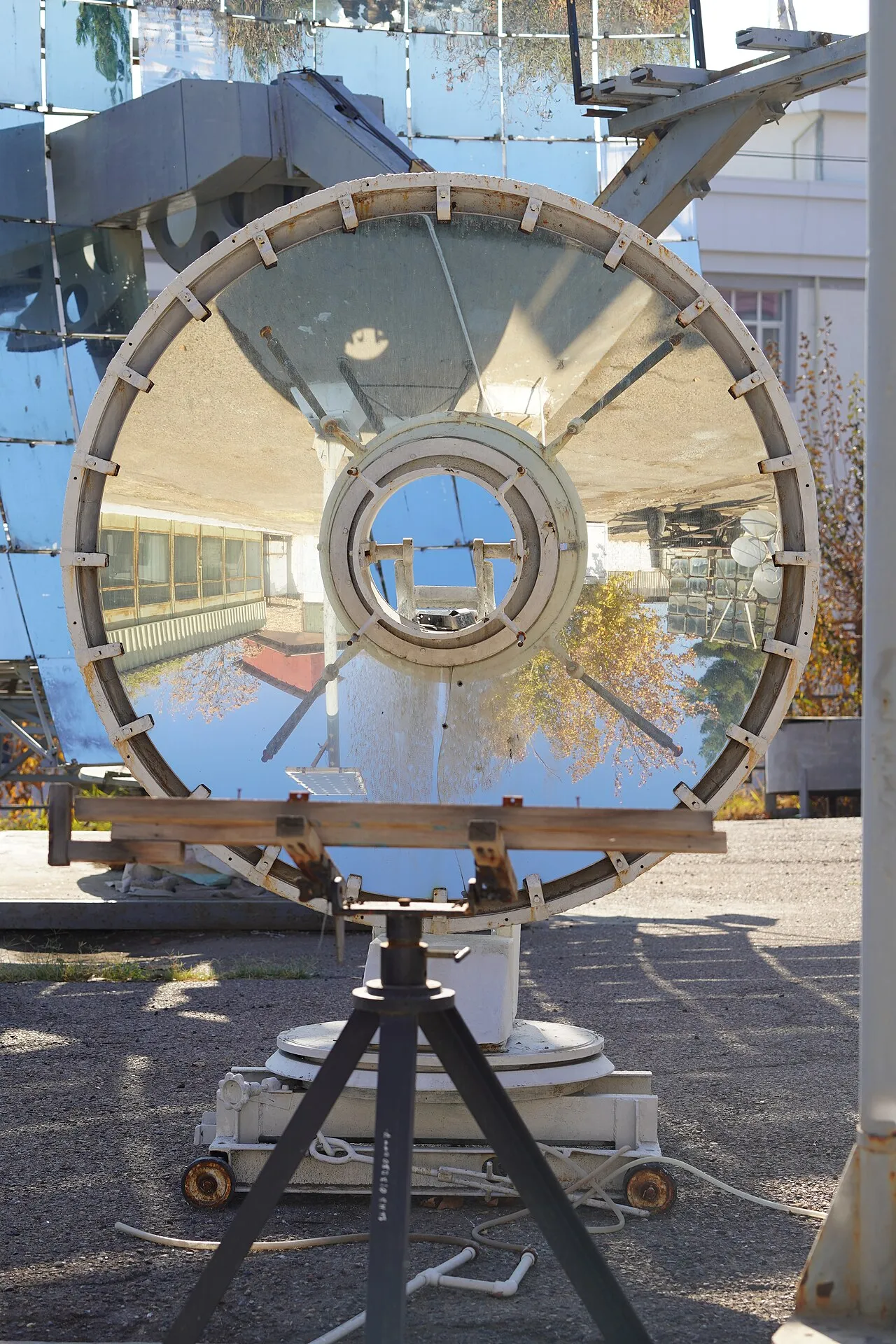
They are large reflectors placed at the dakhmas. The Irish Times called them "giant reflectors" in 2001, Scroll described "large solar reflectors" put up around the Towers in 2016, and Open wrote in 2014 that the BPP used them to dehydrate bodies in the wells. If you are new to how a dakhma is laid out, our guide to the Tower of Silence covers the structure itself.
When were they installed, and how many are there?
The Irish Times reported on 23 July 2001 that the Punchayet had recently put up eight large reflectors in the Bombay towers. The Free Press Journal, writing in February 2025, dated the start to "around 2001" and said they were fitted at three towers. The BPP's Doongerwadi web page, undated and read in November 2026, gives a larger figure: 12 solars, four each at the Anjuman, Sethna and Bisni dokhmas, with their own engineers and operators. No source we found explains or dates the change in numbers.
Why did the Bombay Parsi Punchayet turn to the sun?
Because the vultures were gone. India's vulture collapse and its cause are covered in our post on Vultures and the Tower of Silence. For Doongerwadi, the arithmetic was stark. "For 800 deaths a year, we need at least 250 vultures," BPP member Dinshaw Rusi Mehta told Al Jazeera in April 2015, adding that with no vultures left, solar concentrators were "the only way out now".
The sun was not a new element. J.J. Modi, in The Religious Ceremonies and Customs of the Parsees (1922), describes the Tower of Silence as the place where the dead are exposed to the sun and to flesh-eating birds. The priest-scholar Ervad Dr Ramiyar Karanjia lists exposure to the sun's rays (khurshed nagirashni) as one of four principles of dokhmenashini, alongside an elevated place, distance from homes and birds of prey. He writes that the birds-of-prey principle has weakened over roughly two decades while the other three still work, and that a body is laid in the dakhma only by daylight, under the gaze of the sun.
Whether the high priests approved the change is reported only second-hand. A Free Press Journal report in February 2025, in a passage giving the views of Dr Viraf Kapadia, a Nepean Sea Road resident, states that the panels "were approved by the high priests", who said the process does not violate religious traditions. We did not find a published ruling from the high priests themselves. Practice varies between families and Agiaries; your family priest's guidance comes first.
What was tried before the concentrators?
Dinshaw Tamboly, who became a BPP trustee in the late 1990s, told Open magazine in 2014 that the trust had first approved a part-herbal, part-chemical preparation to hasten decomposition. Tamboly recalls that it left sludge in the wells, where corpse bearers often slipped. "It wasn't pleasant at all and we had to stop it," he said. The reflectors came after that.
How do solar concentrators work, and how hot do they get?
A concentrator focuses sunlight onto a small area. Khojeste Mistree, head of the Zoroastrian Studies Institute, described it to NPR in 2012 as a way to dehydrate the body faster by focusing heat on it. NPR's reporter added that the heat keeps crows away by day and that the method is slower than vultures were. Dr Homi Dhalla, a Zoroastrian scholar, told the Asian Age in 2017 that it is "not a quick process". Tamboly put it at about five days at least for an adult body (Open, 2014).
Sources disagree on the temperature, so here are all four figures we found:
| Report | Year | Temperature given |
|---|---|---|
| The Irish Times | 2001 | "over 180 degrees" (unit not stated) |
| Al Jazeera | 2015 | 110°C |
| The Asian Age | 2017 | 110°C |
| Free Press Journal | 2025 | 120°C to 125°C |
Why don't they work at night or in the monsoon?
They depend on direct sunlight. Mistree told NPR in 2012 that the concentrators don't work in the monsoon because of the clouds. Mehta told Al Jazeera in 2015 that they are "useless" once the sun sets and during the rains.
Did the solar concentrators work? What each side says
Supporters said they did enough. Trustee Muncherji Cama told Open in 2014 that the religion puts its emphasis on the sun rather than on the birds, and that with the panels' help the system was "working well enough". Dr Homi Dhalla of the World Zarathushti Cultural Foundation was part of a group that promoted the panels about two decades ago, according to the Free Press Journal.
Critics disagree. Scroll reported in April 2016 that Tamboly and other community members found the reflectors ineffective. The scholar Anne Rademacher, writing for the Rachel Carson Center's Environment & Society Portal in 2019, judged the results "insufficient". In February 2025, Mehernosh Fitter of the Save Doongerwadi Committee told the Free Press Journal that a fire at one dakhma "could have been caused by the heat from the solar concentrators".
The wider dispute, from the 2006 photographs to the court cases, is covered in our post on the Dokhmenashini controversy.
Does every Tower of Silence need them?
No, according to one priest outside Mumbai. In Bengaluru, Dastur Fardoon told the Deccan Chronicle in August 2016 that the community is small and its Tower of Silence is hardly used, with bodies there simply exposed to the sun. "So we don't need to install solar panels," he said.
Are the solar concentrators at Doongerwadi still in use?
Not according to the latest news reports. On 26 February 2025 the Free Press Journal reported that the panels had stopped working around four years earlier and that a group of Parsis had told the BPP donors were ready to pay for repairs. BPP chairman Viraf Mehta said the equipment failed shortly before Covid and the lockdown stopped repairs. He said the present system was "functioning without any hiccups" without the panels, adding that the BPP would consult the high priests before doing anything. On 10 March 2025 the same paper again described the panels as "now dysfunctional".
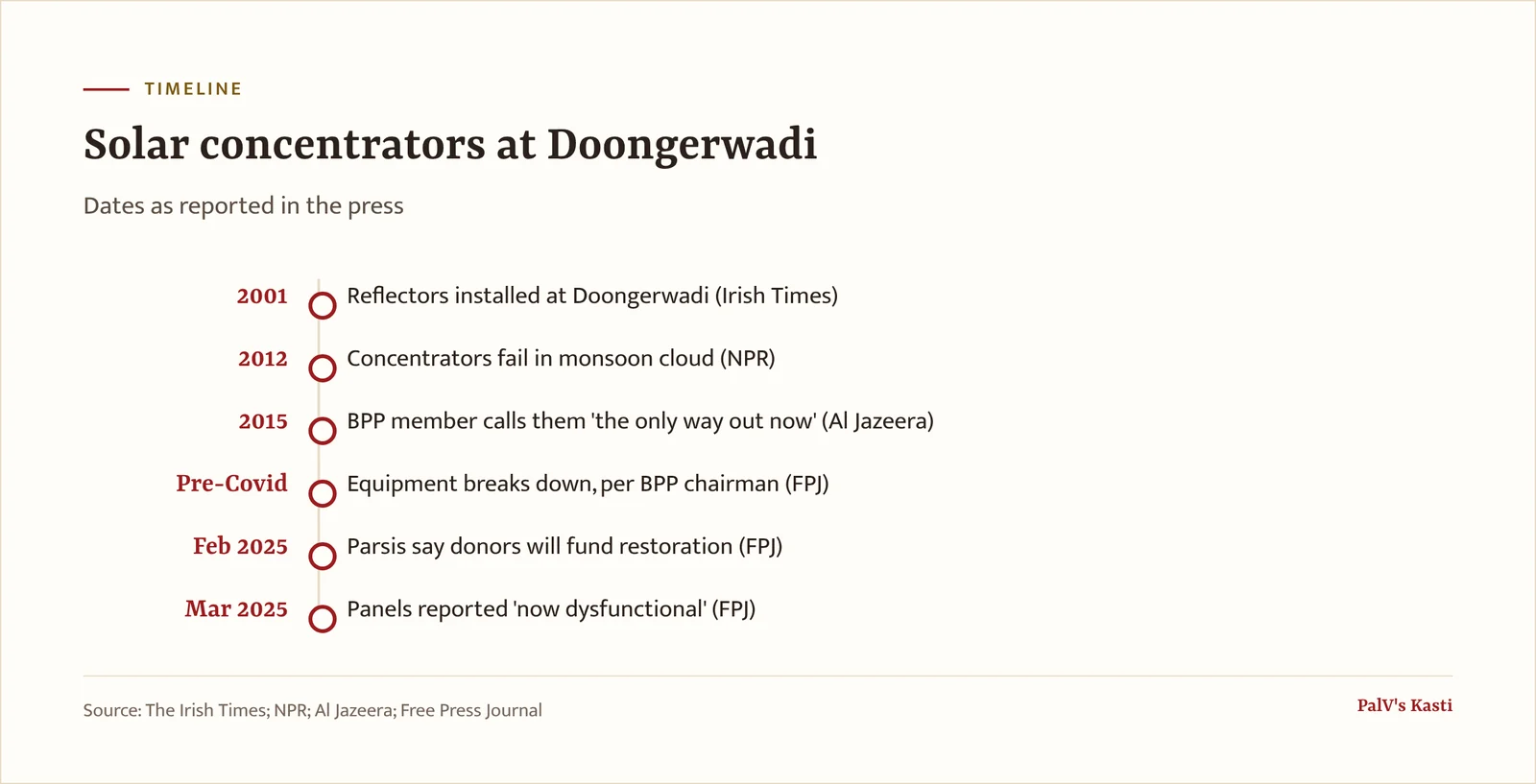
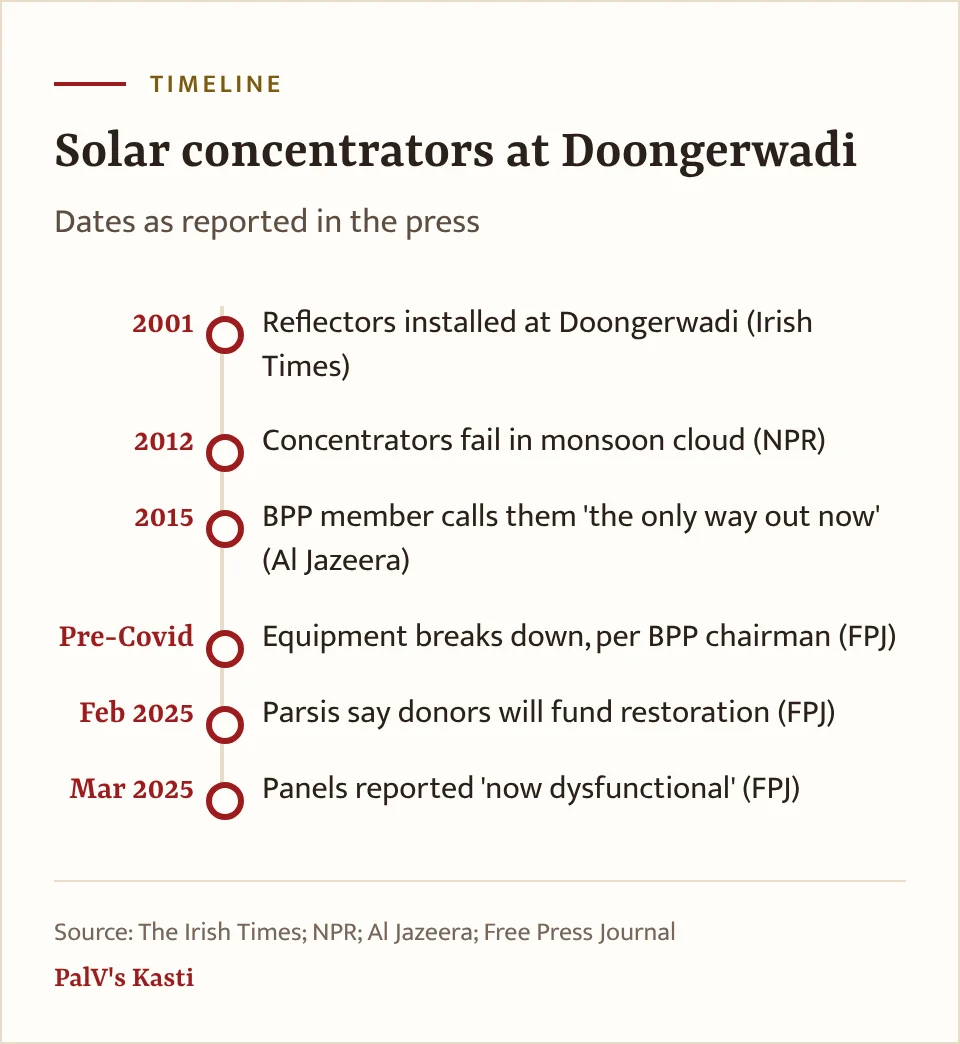
The BPP website, read in November 2026, still lists 12 solars and a team of operators. That page carries no date, so it may describe the setup before the breakdown. We found no report from later than March 2025 saying the concentrators have been repaired. For a different angle on the same tradition, see our post on Sky burial and Tata philosophy.
Frequently asked questions
Are solar concentrators the same as solar panels?
At Doongerwadi, news reports use the terms for the same equipment. The Irish Times and Scroll wrote of solar reflectors, Al Jazeera and NPR of solar concentrators, and the Free Press Journal of solar panels. All describe sunlight and heat focused onto the body so that it dries faster, which the Asian Age called solar desiccation.
Did the high priests approve the solar concentrators?
Only second-hand reports say so. A Free Press Journal report in February 2025, giving the views of Dr Viraf Kapadia, states that the high priests approved the panels and said the process does not violate religious traditions. We found no published ruling from the high priests themselves. Practice varies between families and Agiaries; your family priest's guidance comes first.
How many solar concentrators are there at Doongerwadi?
Figures differ. The Irish Times reported eight reflectors in July 2001. The Free Press Journal said in 2025 that panels were fitted at three towers. The Bombay Parsi Punchayet's undated website lists 12, four each at the Anjuman, Sethna and Bisni dokhmas. As of March 2025, the Free Press Journal reported they were not working.
Why don't solar concentrators work in the monsoon?
A solar concentrator only works when direct sunlight reaches the mirror. Khojeste Mistree told NPR in 2012 that clouds stop them working in the monsoon, and BPP member Dinshaw Rusi Mehta told Al Jazeera in 2015 that they are useless after sunset and during the rains. NPR also reported that the method is slower than vultures were.


