PalV's Kasti
On this page
Zoroastrianism has no single, published ruling on surrogacy or assisted reproduction such as IVF. In researching this article we could not find a statement on either from a recognised Dastur, a Zoroastrian federation or a scholarly reference work, so we cannot tell you what the faith requires here. What is on record is practical. The medical help under the Government of India's Jiyo Parsi scheme covers IVF and, according to a 2022 reply in Parliament, surrogacy for Parsi couples. And any surrogacy in India must follow the Surrogacy (Regulation) Act, 2021, which allows only altruistic surrogacy (the surrogate receives expenses and insurance, nothing more) for married couples, and some widows and divorcees, with a certified medical need.
શહેરેવર રોજ
Shehrevar Roj, Tir Mah · 1396 Y.Z.
Does Zoroastrian scripture or any Dastur rule on surrogacy and IVF?
Not in any source we could verify. We found no ruling on IVF, or on carrying a child for another couple, from a high priest, the Bombay Parsi Punchayet or a Zoroastrian federation that we could read and quote in full. We know of newspaper reports from 2015 and 2016 that quoted priests on surrogacy, but we could not open the original articles, so we have left those quotes out rather than repeat them second-hand.
So a couple weighing IVF, a donor egg or a surrogate has no rulebook to look up. That conversation happens with your own priest.
What do Zoroastrians themselves think about donor eggs and embryos?
The only published survey we found comes from Iran, not India. In 2012, researchers from Shahid Sadoughi University of Medical Sciences in Yazd questioned 318 Zoroastrians in Yazd and Kerman about oocyte (egg) donation and embryo donation for infertile couples. Their paper, by Halvaei and colleagues in the Journal of Reproduction & Infertility (2014), reports that 69.7% supported egg donation and 71.3% supported embryo donation. On religion the answers were far less certain: more than half did not know whether their religion accepts donation, and about one-third believed it was permissible.
That study measures opinion among Iranian Zoroastrians. It is not a statement of doctrine, and it says nothing about Parsis in India.
Why do donor eggs and donor sperm raise questions about who counts as Parsi?
Because of the rule on descent. Demographers Zubin Shroff and Marcia Castro, writing in Demographic Research in 2011, describe the community as requiring a Parsi father as a legal condition for a newborn to be counted as Parsi. How that rule applies to a child conceived with a donor's egg or sperm is a question we have found no published ruling on, and we do not try to answer it here.
Practice varies between families and Agiaries; your family priest's guidance comes first.
Does the Jiyo Parsi scheme pay for IVF or surrogacy?
Official replies to Parliament say its medical help covers IVF, and two of them named surrogacy. Minister Mukhtar Abbas Naqvi told the Rajya Sabha on 21 March 2022 that the scheme's medical component covers assisted reproductive technologies, including IVF, ICSI "and other modes including surrogacy". Parsi Times reported a similar answer to the Lok Sabha on 6 February 2020, which mentioned surrogate pregnancies.
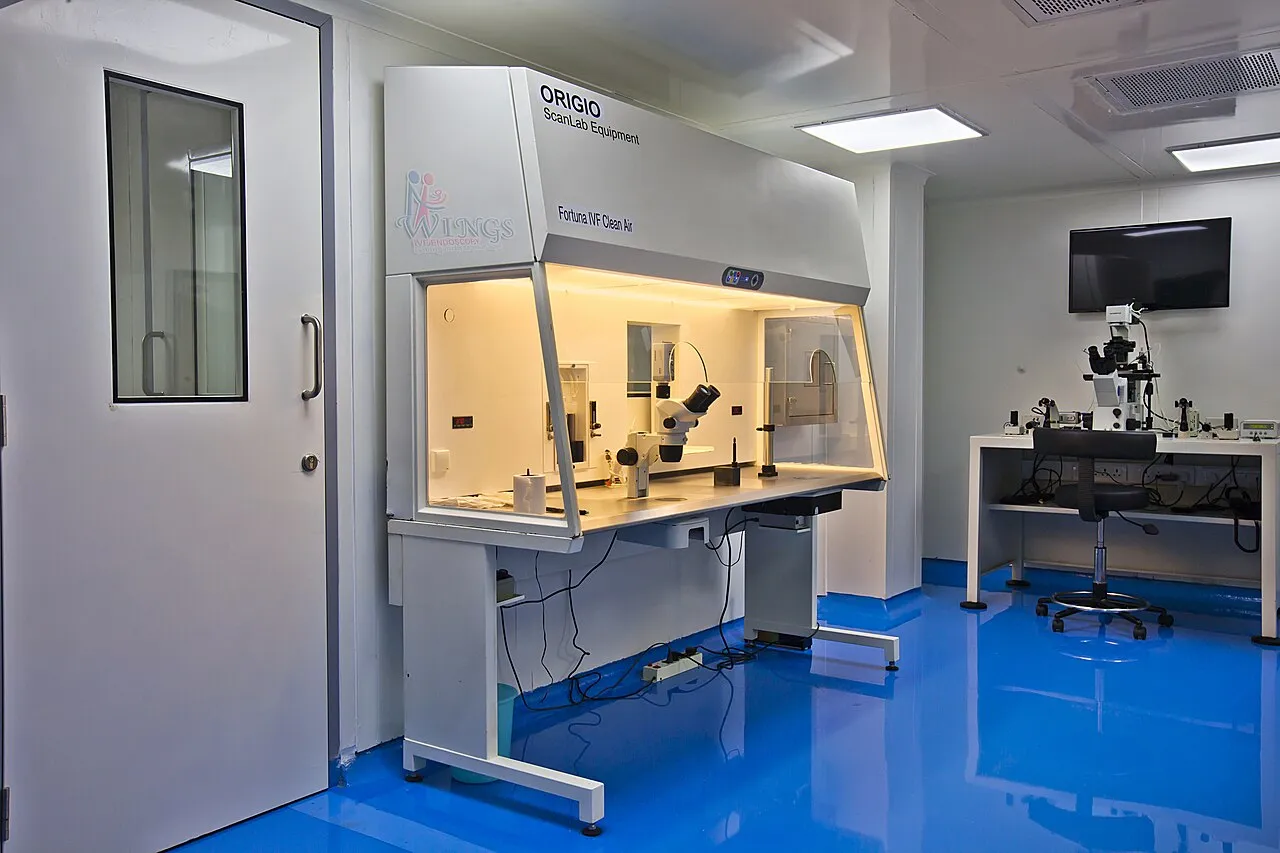
The latest official description is shorter. In a Lok Sabha reply published by PIB on 17 December 2025, the Ministry of Minority Affairs described the medical component as help with treatment for infertility, pregnancy complications and new-born complications, for Parsi couples with an annual family income of up to Rs 30 lakh. That reply does not mention surrogacy by name, and it says 232 babies were born under the scheme between 2020-21 and 2024-25. If you are planning surrogacy, ask the scheme directly whether your case is covered today. Our guide to the Jiyo Parsi scheme covers eligibility and the other benefits.
What does Indian law say about surrogacy?
The Surrogacy (Regulation) Act, 2021 (No. 47 of 2021) received the President's assent on 25 December 2021. It applies to every couple in India, Parsi or not. Under section 4, surrogacy is allowed only when an intending couple has a medical indication that needs gestational surrogacy, only as altruistic surrogacy, and never for commercial purposes. Section 2(1)(b) defines altruistic surrogacy as one where the surrogate mother receives nothing except medical expenses, other prescribed expenses and insurance cover.

Who can use surrogacy under the 2021 Act?
- A married Indian couple, with the wife aged 23 to 50 and the husband 26 to 55 on the day of certification (section 4(iii)(c)).
- The couple must not already have a surviving child, whether biological, adopted or born through surrogacy. There is an exception where that child is mentally or physically challenged or has a life-threatening or fatal illness, approved by the authority with a District Medical Board certificate.
- An "intending woman": an Indian widow or divorcee aged 35 to 45 (section 2(1)(s)).
- The couple needs a certificate of essentiality, which includes a District Medical Board certificate of medical need, a Magistrate's order on parentage and custody, and 36 months of insurance for the surrogate.
Couples who already have an adopted child are therefore outside the Act's main route. Our post on Palak (adoption) looks at adoption in Zoroastrian families.
Who can be a surrogate mother?
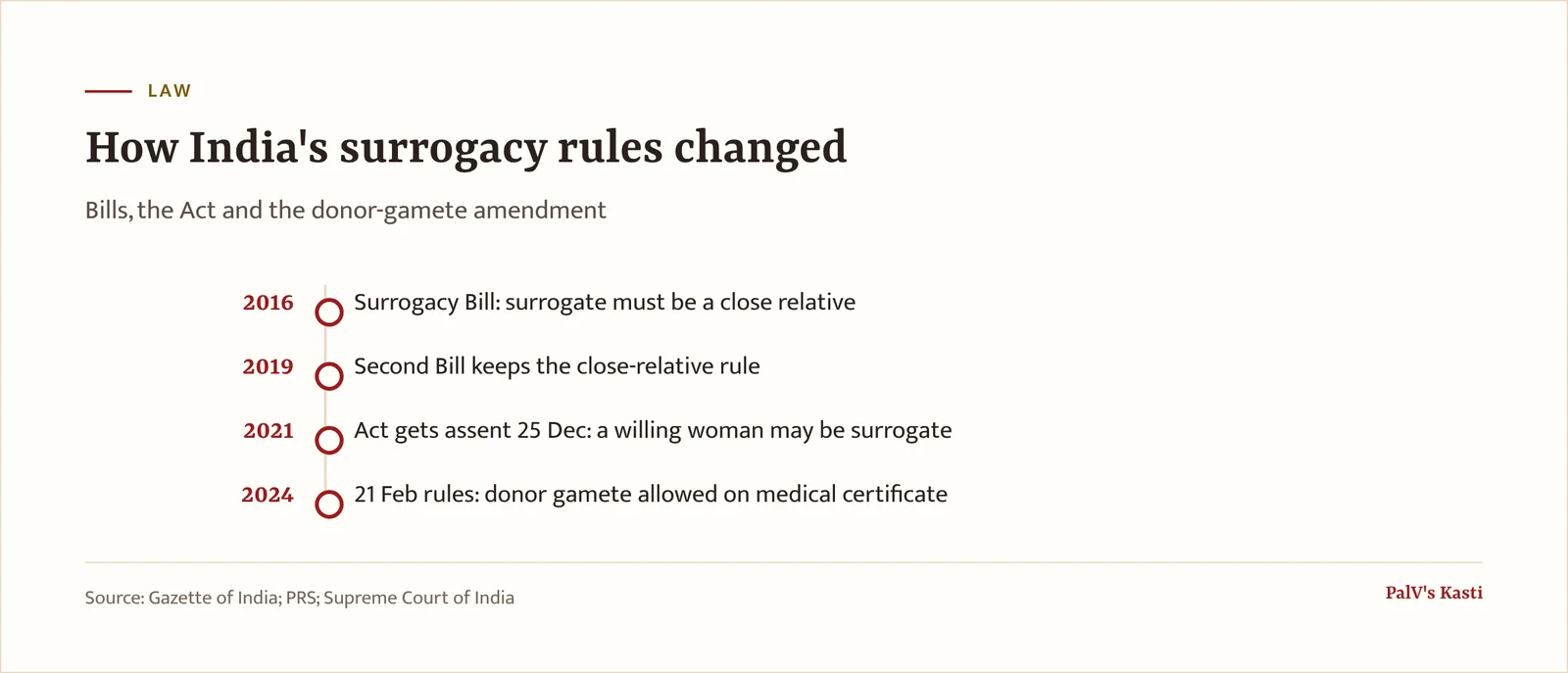
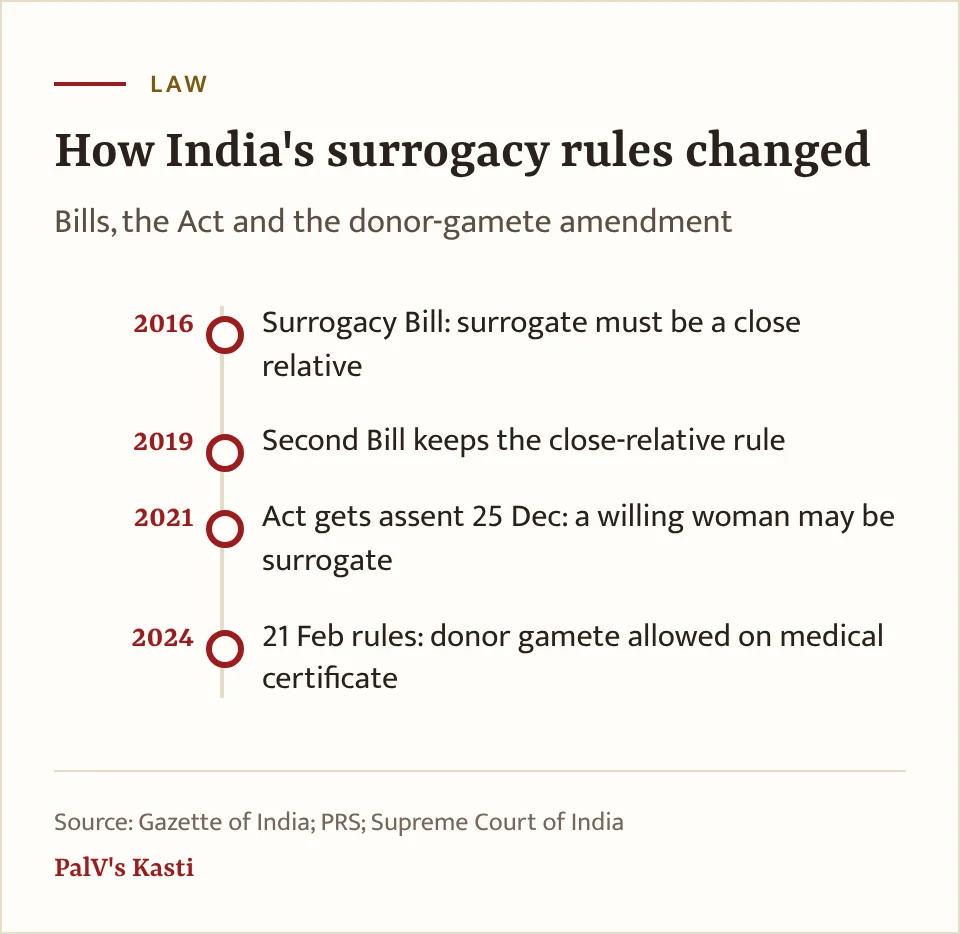
Under section 4(iii)(b), only an ever-married woman with a child of her own, aged 25 to 35 on the day of implantation. She cannot use her own eggs, so the child is never genetically hers. And she can be a surrogate only once in her lifetime. The earlier Surrogacy (Regulation) Bills of 2016 and 2019 would have allowed only a "close relative" of the couple. The Act as passed says instead that "a willing woman" may act as surrogate, so the surrogate need not be a relative.
Can a donor egg or donor sperm be used in surrogacy?
Yes, within limits set in 2024. The Surrogacy (Regulation) Amendment Rules, 2024, notified on 21 February 2024 as G.S.R. 119(E), as quoted by the Supreme Court in its order of 23 February 2024 in Arun Muthuvel v. Union of India, say a couple should normally use both their own gametes. Where a District Medical Board certifies that the husband or wife has a medical condition requiring a donor gamete, a donor egg or sperm may be used, provided the child has at least one gamete from the couple. A single woman (widow or divorcee) must use her own eggs with donor sperm. The Calcutta High Court applied the same notification on 5 March 2024. These are the rules as quoted in those 2024 orders; ask your clinic whether anything has changed since.
Whose child is a baby born through surrogacy?
The intending couple's, in law. Section 8 of the 2021 Act deems a child born through surrogacy to be the biological child of the intending couple or intending woman, with all the rights of a natural child. Section 7 bars the couple from abandoning the child for any reason, including a birth defect, the child's sex or a multiple birth. The Act also refers throughout to a companion law, the Assisted Reproductive Technology (Regulation) Act, 2021.
Frequently asked questions
Does Zoroastrianism allow IVF?
We found no published ruling from a recognised Dastur or Zoroastrian body that either allows or forbids IVF. In practice, the Government of India's Jiyo Parsi scheme, launched in 2013-14, lists IVF under its medical help for Parsi couples, according to a 2022 reply in the Rajya Sabha. Families who want religious guidance on IVF should ask their own priest.
Is surrogacy allowed for Parsis?
Under Indian law, Parsi couples follow the same Surrogacy (Regulation) Act, 2021 as everyone else. It allows altruistic surrogacy only, for a married Indian couple with a certified medical need and no surviving child. On the religious side, we found no published ruling on surrogacy, so the decision rests with the couple and their family priest.
Does Jiyo Parsi pay for surrogacy?
A Rajya Sabha reply of 21 March 2022 said the scheme's medical help covers assisted reproduction "including surrogacy". The Ministry's December 2025 description speaks of infertility, pregnancy and new-born complications without naming surrogacy, for families earning up to Rs 30 lakh a year. Confirm with the scheme before planning a surrogacy around it.
Can a Parsi couple use a donor egg?
For surrogacy, the rules notified on 21 February 2024, as quoted by the Supreme Court, allow a donor egg or sperm only when a District Medical Board certifies a medical need, and the child must carry one of the couple's gametes. Whether a donor-conceived child is accepted as Parsi is a separate community question with no published ruling.
Can a surrogate mother be paid in India?
No. The Surrogacy (Regulation) Act, 2021 bans commercial surrogacy. A surrogate mother may receive only her medical expenses, other expenses the rules prescribe, and insurance cover. Before the procedure, the couple must hold a certificate that includes 36 months of insurance for her, covering complications after delivery.
This is general information, not legal advice; for a specific case, speak to a lawyer.