PalV's Kasti
On this page
- Why are these questions so hard to settle?
- Why is there a shortage of Parsi priests?
- Are Parsis allowed to convert others to the faith?
- Can a Parsi woman who marries outside enter a fire temple?
- What is the Parsi excommunication case in the Supreme Court?
- Do Parsis still use the Towers of Silence?
- Frequently asked questions
The religious challenges the Parsi community faces today come down to four open questions. There are too few priests, and the Dadar Athornan Institute in Mumbai had 14 students in 2023 against at least 25 two decades earlier. Parsis disagree about who may belong, meaning converts and the children of Parsi women who marry outside. A Parsi woman who marries a non-Parsi may lose access to Agiaries and funeral rites, and that question now sits with a nine-judge bench of the Supreme Court, whose verdict was still awaited as of 2 October 2026. Funerals raise a fourth: Mumbai's Towers of Silence are still in use, and Encyclopaedia Iranica recorded in 1993 that orthopractic Bombay priests would not perform rites after a cremation. None of these has one agreed answer. Below, we set out what each side says, in its own words.
શહેરેવર રોજ
Shehrevar Roj, Tir Mah · 1396 Y.Z.
Why are these questions so hard to settle?
No single body can decide them. Encyclopaedia Iranica's entry on conversion points out that Zoroastrians have no central hierarchy, so they are run by councils and high priests whose authority reaches only their own area.
It's one reason the same question gets different answers in Mumbai, Pune, Nagpur and North America, as the sections below show. For a picture of who practises the faith today and where, see our guide to Zoroastrianism today. For the beliefs themselves, start with our page on Zoroastrianism.
Why is there a shortage of Parsi priests?
Fewer boys are training, and fewer of those who train stay on as full-time mobeds. Religion News Service reported in November 2023 that the Dadar Athornan Institute had 14 students, where two decades earlier at least 25 were enrolled. Ramiyar Karanjia, the institute's principal, gave National Geographic the same figure in 2024: "Presently we have just 14."
The shortage shows most in the higher ceremonies. Noshir Dadrawala, a Mumbai scholar of the faith, told RNS that fewer than 20 priests are now available to perform them.
Pay and conditions
Pay is one reason given. Khurshed Dastoor, a high priest who heads what RNS called the most sacred fire temple in Gujarat, told RNS that priests "are paid meagerly", work unusual hours and get no pension or holidays. The figures reported differ. Karanjia told National Geographic a mobed may earn only 50,000 rupees a year, with no medical plan. Parsi Times reported in February 2022 that Karanjia told a community meeting the salary is at most Rs 40,000, and that only one in 15 graduates became a full-time mobed. National Geographic reported that most mobeds therefore work part-time and take up other professions.
Some temples have filled the gap with para-priests, lay people licensed for the lower ceremonies. Dinshaw Tamboli of the World Zoroastrian Organization Trust Funds told RNS that where no mobed is available, para-priests "tend to the fires". Vispy Wadia of the Association for Revival of Zoroastrianism wants the system opened further, saying the faith "should make space for the laity" to enter the priesthood if they feel called to it.
Who can become a priest, and can women be priests?
In India the priesthood passes from father to son. The Bombay High Court described the rule in the 1908 Petit v. Jeejeebhoy judgment: "A Mobed must be the son of a Mobed," and a Behdin, a lay Zoroastrian, can never become one. National Geographic reported the same practice in 2024, adding that women are taking on priestly roles outside India.
Not every priest in India accepts the rule. Avesta Irani, head priest of the Asha Vahishta Agiary in Pune, told ThePrint in 2023 that the restriction exists only in India and that he was "shocked to see there are no female priests at all."
Practice varies between families and Agiaries; your family priest's guidance comes first.
Are Parsis allowed to convert others to the faith?
Among Indian Parsis, the established answer is no. Encyclopaedia Iranica records that Indian Parsi councils have generally refused to accept as Zoroastrians anyone other than the children of Parsi parents. National Geographic made the same contrast in 2024, describing India's Parsis as a community that neither seeks nor accepts converts, while most Zoroastrian groups in North America are open to all.
According to Iranica, those who favour accepting converts most often quote Yasna 31.3, which they read as proof that Zoroaster's message was meant for everyone. Opponents, in Iranica's summary of their view, fear that converts would "dilute the ethnic strength of the religion" and end in its "complete annihilation". Iranica also notes that only a handful of non-Persians had been formally admitted in North America.
Practice varies between families and Agiaries; your family priest's guidance comes first.
Can a Parsi woman who marries outside enter a fire temple?
Officially she is not allowed in, campaigners for change told ThePrint, though in practice the rule is applied unevenly. The rule is also different for men. ThePrint reported in August 2023 that a Parsi man who marries a non-Parsi can have children who enter the fire temple and have their Navjote, while a Parsi woman's children with a non-Parsi husband can't. The rules of the Nagpur Parsi Panchayat put it in writing. LiveLaw reported in May 2026 that under its Rule 5(2), a Parsi or Irani Zoroastrian woman who has children with a non-Parsi husband won't be accepted as a Parsi Zoroastrian, and nor will those children.
Those who want change describe the gap between rule and practice. Vispy Wadia, president of the Association of Intermarried Parsis, told ThePrint it is "an open secret" that such women and their children enter Agiaries, "but officially it's not allowed." He also said: "There's social acceptance of women marrying outside now... But there's religious othering of women." ThePrint reported that families from across India bring their children to the Asha Vahishta Agiary in Pune for Navjote, describing it as the only temple in India open to people of all faiths.
The other side holds to the existing rule. Parsi Times, reporting the Supreme Court hearing of 7 December 2017, wrote that the community's traditional section opposes the reformers' view on religious grounds and relies on the Gujarat High Court ruling against Ms Gupta.
Several women have gone to court. ThePrint reported that the author Prochy N. Mehta petitioned the Calcutta High Court in 2017 after her grandchildren were refused entry to the city's only fire temple because their father wasn't Parsi.
Practice varies between families and Agiaries; your family priest's guidance comes first.
What is the Parsi excommunication case in the Supreme Court?
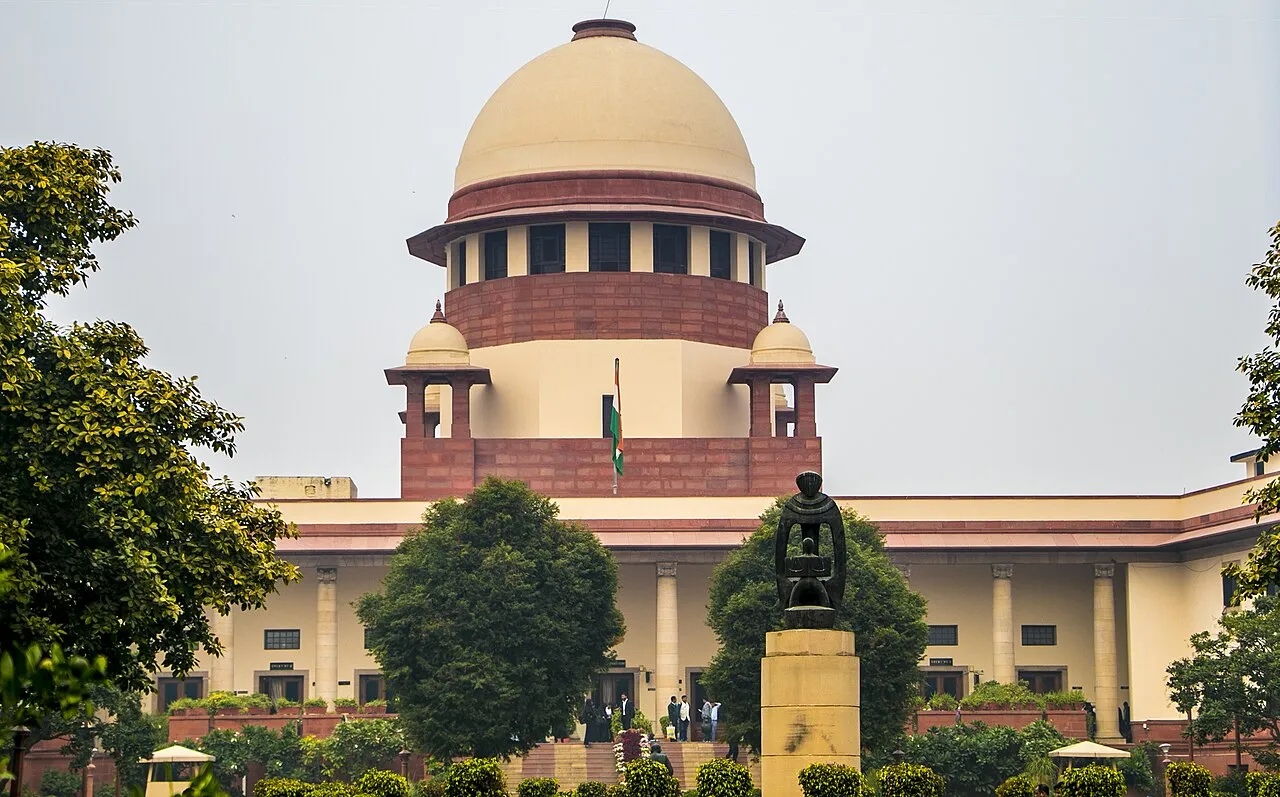
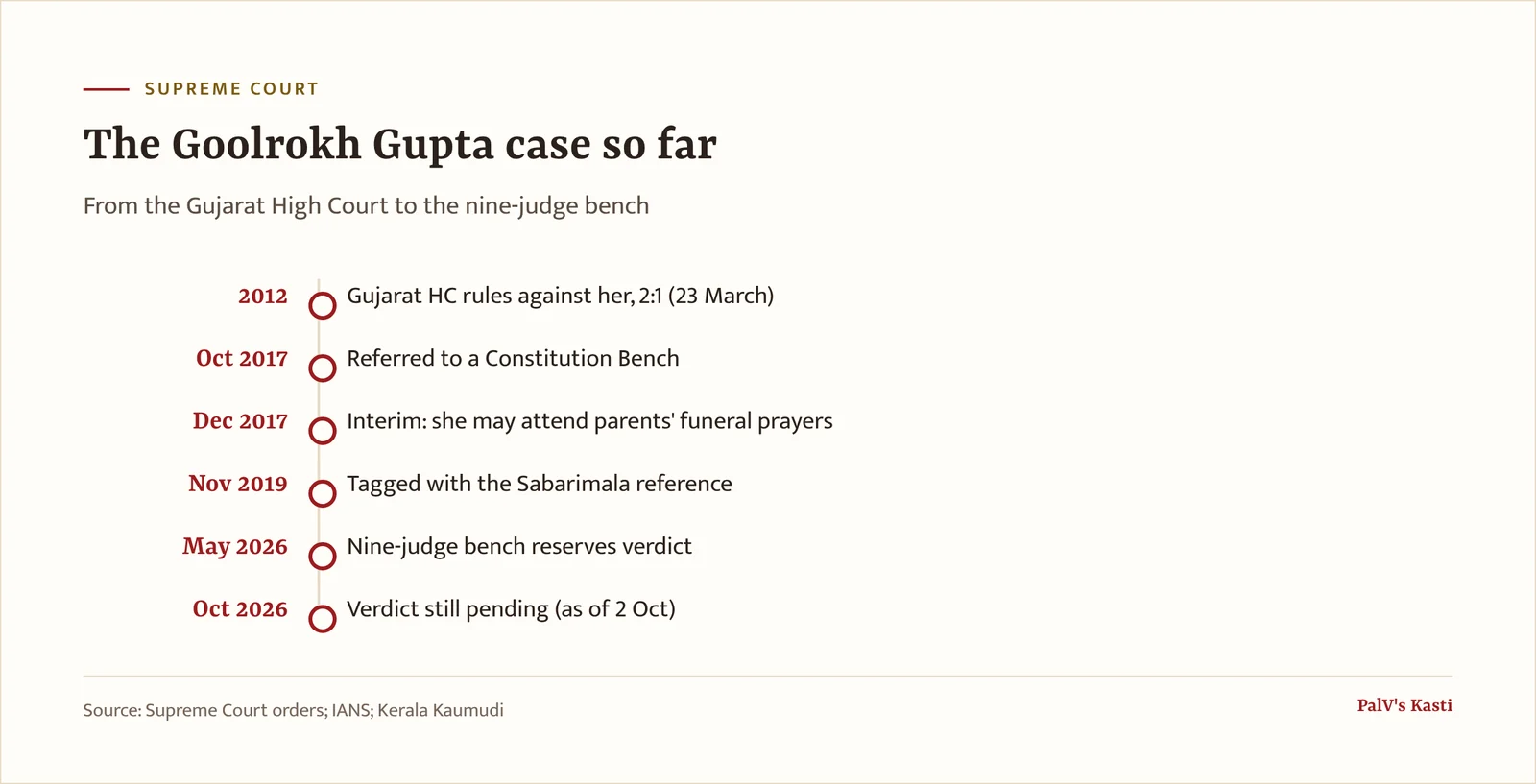
The main case before the Supreme Court is Goolrokh M. Gupta v. Burjor Pardiwala, Special Leave Petition (Civil) No. 18889 of 2012. Ms Gupta, a Parsi woman, married a Hindu man under the Special Marriage Act. The Gujarat High Court, in a judgment of 23 March 2012, dismissed her petition by a 2:1 majority. Supreme Court Observer summarises the majority's view: a Parsi woman who marries a non-Parsi under that Act stops being a Parsi unless a competent court declares that she has continued to practise the faith. Scroll described it as a ruling that she was deemed to have converted.

What has the Supreme Court done so far?
- 9 October 2017: a bench led by the Chief Justice referred the case to a Constitution Bench, "regard being had to the importance of the matter."
- 7 December 2017: at a hearing reported by Scroll, Chief Justice Dipak Misra called her choice "sacred" and asked, "Who can take away the religious identity of a woman?"
- 14 December 2017: the Valsad trustees agreed, on compassionate grounds, that she could attend her parents' funeral prayers (the Paidust) in the prayer hall of the Bungli at the Towers of Silence complex in Valsad. The court called the arrangement interim, one that "shall always be interim" until the final decision.
- 14 November 2019: in the Sabarimala review order, the court named her petition among pending cases whose issues overlap with the questions it sent to a larger bench.
- 14 May 2026: a nine-judge bench headed by Chief Justice Surya Kant reserved its verdict after 16 days of hearings. IANS reported that the questions before it include whether Parsi women who marry outside the faith may enter fire temples.
Kerala Kaumudi reported on 2 October 2026 that the verdict was expected that month. We found no report of a judgment, so the matter is pending as of 2 October 2026.
Other cases now before the court
Two newer petitions raise the same question. On 10 February 2026, a bench of Justices B.V. Nagarathna and Ujjal Bhuyan heard Master Rian R. Kishnani v. Union of India, filed by a child through his Parsi mother, who is married to a non-Parsi. LawBeat reported that it asks the court to declare the 1908 Petit judgment bad law. Senior Advocate Percival Billimoria, for the petitioners, called that judgment "blatantly discriminatory to women." On 25 May 2026, LiveLaw reported, a bench of Chief Justice Surya Kant with Justices Joymalya Bagchi and Vipul Pancholi heard the challenge to Nagpur's Rule 5(2). The bench said it would avoid any order that hinted at a view on issues pending before the nine-judge bench.
This is general information, not legal advice; for a specific case, speak to a lawyer.
Do Parsis still use the Towers of Silence?
Yes. The Bombay Parsi Punchayet describes Doongerwadi, its 58-acre estate at Cumballa Hill, as the final resting place for Parsi and Irani Zoroastrians of Mumbai and nearby districts and states, with dokhmas in use. Its website also lists a Modi Dokhma kept for Parsi women married to non-Parsis who continued to profess the faith until death.
Cremation is the point of difference. Mary Boyce, writing in Encyclopaedia Iranica in 1993, recorded that orthopractic priests in Bombay would not perform funeral rites for a body that has been cremated. She also noted that Zoroastrians abroad use ordinary undertakers and public crematoriums, and that the London community has its own chapel at Brookwood cemetery.
Practice varies between families and Agiaries; your family priest's guidance comes first.
Frequently asked questions
Why is there a shortage of Parsi priests?
Fewer boys are entering training, and pay is low. The Dadar Athornan Institute had 14 students in 2023, down from at least 25 two decades earlier, Religion News Service reported. Principal Ramiyar Karanjia told National Geographic a mobed may earn only 50,000 rupees a year, with no pension, so most priests work part-time.
Can a Parsi woman who marries outside enter a fire temple?
Vispy Wadia of the Association of Intermarried Parsis told ThePrint in 2023 that such women and their children do enter Agiaries, "but officially it's not allowed." ThePrint reported that Parsi men who marry outside face no such bar for their children. A nine-judge Supreme Court bench has the question, verdict pending as of 2 October 2026.
Are Parsis allowed to convert?
Indian Parsi councils have generally accepted as Zoroastrians only the children of Parsi parents, according to Encyclopaedia Iranica. Supporters of conversion cite Yasna 31.3 as proof that Zoroaster's message is universal. Opponents fear converts would dilute the community. National Geographic reports that most North American Zoroastrian groups, unlike India's Parsis, accept converts.
Do Parsis still use the Towers of Silence?
Yes. The Bombay Parsi Punchayet describes Doongerwadi, its 58-acre estate at Cumballa Hill in Mumbai, as the final resting place for Parsi and Irani Zoroastrians of the city and nearby areas, with dokhmas in use. Mary Boyce recorded in 1993 that orthopractic Bombay priests would not perform funeral rites for a cremated body.