PalV's Kasti
On this page
- What is the Jiyo Parsi scheme?
- What do the three components cover?
- How much money does Jiyo Parsi give?
- Who is eligible for the Jiyo Parsi scheme?
- How do you apply, and how is the money paid?
- Who runs Jiyo Parsi today?
- Has the scheme worked, and why is it debated?
- Jiyo Parsi scheme: key facts for UPSC revision
- Frequently asked questions
The Jiyo Parsi scheme is a Central Sector Scheme of the Ministry of Minority Affairs, launched in 2013-14, that pays Parsi couples to help reverse the fall in India's Parsi population. It has three parts. Medical Assistance covers infertility treatment, medical costs after conception and newborn care. Health of Community pays a monthly sum for each child and each dependent elderly relative. Advocacy funds awareness work and pays nobody directly. Applicants must be Parsi/Zoroastrian and live in India. Annual family income has to be within Rs 30 lakh for the Medical part and Rs 15 lakh for Health of Community. Couples apply online, the State Government verifies the application, and the money arrives by Direct Benefit Transfer (DBT) after biometric checks.
શહેરેવર રોજ
Shehrevar Roj, Tir Mah · 1396 Y.Z.
What is the Jiyo Parsi scheme?
Jiyo Parsi (often written "Jio Parsi" in the press) is a Central Sector Scheme run by the Ministry of Minority Affairs. The Ministry's own description of its aim is to stop the population decline, stabilise the numbers and then grow them, using what it calls a scientific protocol and structured interventions.
The Ministry ties the scheme to census figures. In its Rajya Sabha reply of 9 December 2024, the Ministry said the Parsi (Zoroastrian) population fell from 1,14,000 in 1941 to 57,264 in 2011, and it repeated those figures in a Lok Sabha reply on 17 December 2025. We go through the census series year by year on our page about the Parsi population in India.
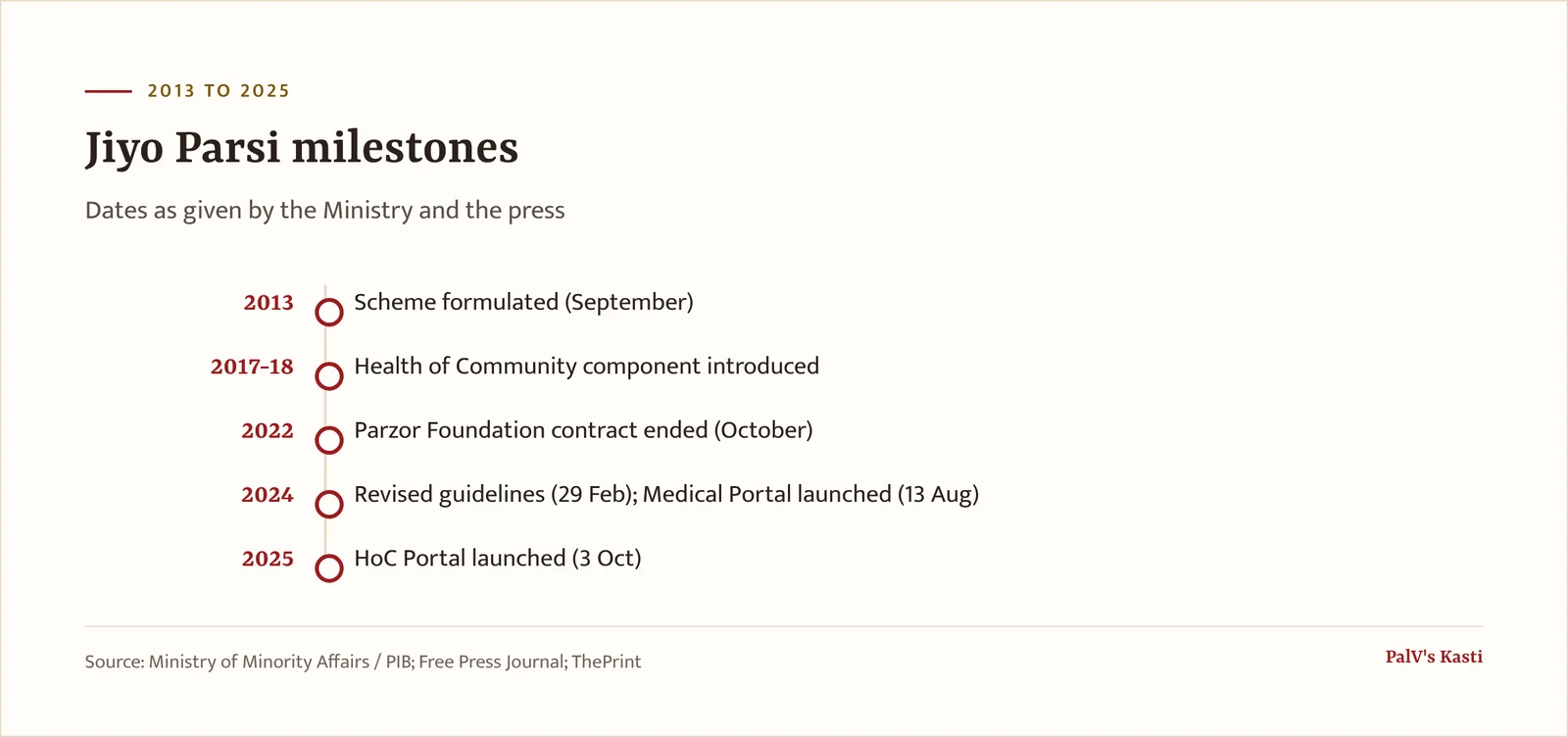
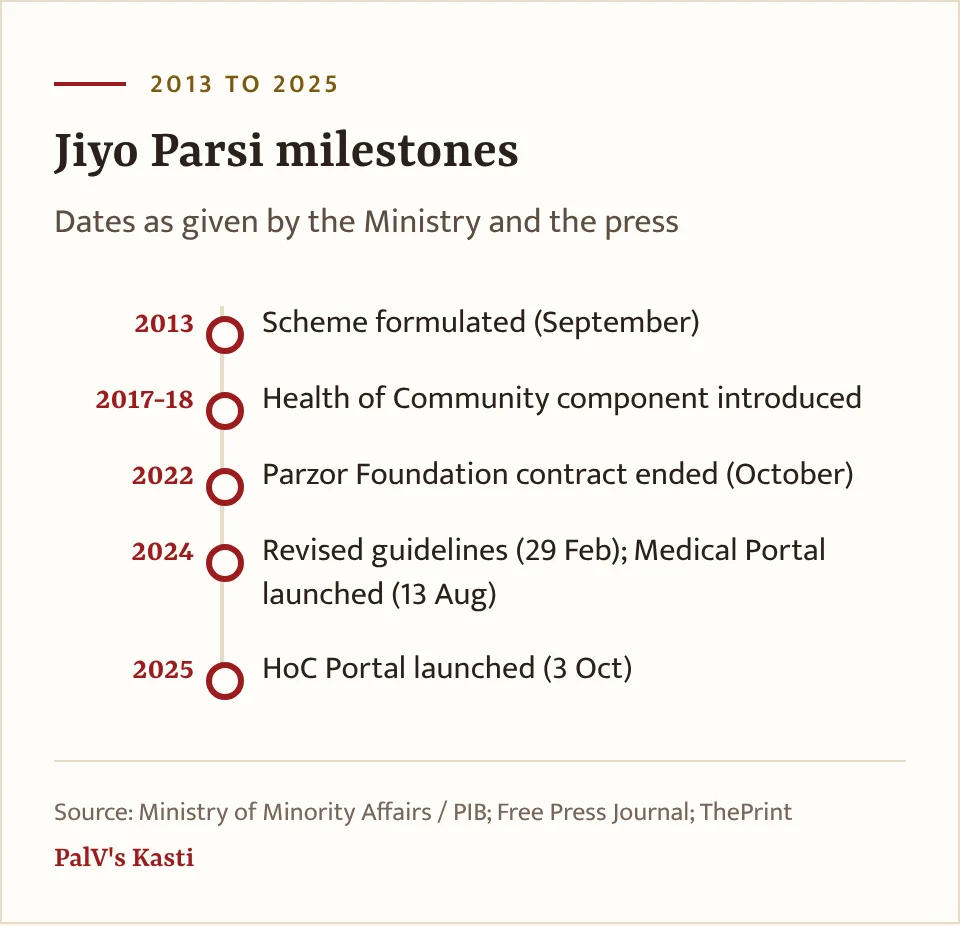
On dates, the official wording differs slightly. The Ministry's 2024 Rajya Sabha reply says it formulated the scheme in September 2013, and Scroll.in, reporting in November 2014, also described it as announced that month. Press Information Bureau releases and the scheme's own portal give the launch year as 2013-14.
What do the three components cover?
Medical Assistance
In the Ministry's words, this part pays for medical treatment "under standard medical protocol". The Ministry's December 2025 reply spells it out as treatment for infertility, for complications in pregnancy and for complications in a newborn.
Health of Community
A monthly payment to Parsi couples towards bringing up their children and looking after elderly family members who depend on them.
Advocacy
The awareness arm. The Ministry describes it as reaching young people of marriageable age and young couples, and nudging couples to seek early diagnosis and treatment where needed. A July 2024 reply adds counselling for couples with fertility problems, and workshops. In February 2026 the Ministry told the Rajya Sabha that no Advocacy money goes to beneficiaries. It is spent on publicity, outreach and awareness work, workshops with the community are held, and news of the scheme goes out every month through the main Parsi newspapers. Why fewer young Parsis marry, and later, is covered in our piece on Parsi marriage rates.
How much money does Jiyo Parsi give?
These are the amounts the Ministry listed in its Rajya Sabha reply of 9 December 2024. Medical sums are ceilings: the scheme pays the stated maximum or the actual cost, whichever is lower.
| Component | What it pays for | Amount |
|---|---|---|
| Medical | Infertility treatment | Up to Rs 6 lakh in all, at Rs 1.5 lakh a cycle for at most 4 cycles |
| Medical | Other medical costs after conception, towards childbearing | Up to Rs 4 lakh |
| Medical | Care of the newborn from birth to six weeks | Up to Rs 2.50 lakh |
| Health of Community | Childcare | Rs 8,000 a month per child, until the child turns 18 |
| Health of Community | Each dependent elderly family member aged 60 or more | Rs 10,000 a month |
Does family income change the Medical amount?
Yes. The scheme's FAQ ties the share of Medical help to total family income from all sources. A family earning up to Rs 15 lakh a year gets 100%. Between Rs 15 lakh and Rs 25 lakh, it is 75%. From Rs 25 lakh up to Rs 30 lakh, 50%. The Ministry's December 2025 reply puts the overall income limit for Medical help at Rs 30 lakh.
Who is eligible for the Jiyo Parsi scheme?
The scheme's FAQ says it is only for the notified minority community, Parsi/Zoroastrian, living in India. Beyond that, the income ceiling depends on which part you apply for.
- Medical Assistance: annual family income up to Rs 30 lakh, with the sliding share above.
- Health of Community: annual family income up to Rs 15 lakh. The FAQ words this as "less than" Rs 15 lakh, the December 2025 reply as "upto".
- Health of Community has a timing condition too. According to the FAQ, only couples whose child was born after the component was brought in, in 2017-18, can claim it.
How do you apply, and how is the money paid?
Applications are online, through two portals reached from the Ministry's website (minorityaffairs.gov.in).
- Choose the portal. Medical claims go through the scheme's Medical Portal, which Minority Affairs Minister Kiren Rijiju launched on 13 August 2024. Health of Community claims go through the HoC Portal, which the Ministry says was launched on 3 October 2025.
- Apply and track. Rijiju said at the launch that couples could apply online, check where their application stood and receive money online.
- Verification. The State Government concerned checks every Medical and HoC application. For HoC, eligible beneficiaries are authenticated biometrically through the Beneficiary Satyapan App.
- Payment. Once checks are done, the money goes straight to the beneficiary's bank account by DBT.
We could not open a current official list of the documents each claim needs. The Ministry says the scheme guidelines are on its website, so read those, or ask your State Government's office, before you file.
Who runs Jiyo Parsi today?
The scheme's portal says it is implemented through State Governments with the help of Parsi institutions in each state. That is a change from the first decade. ThePrint reported in August 2023 that the Centre had worked with the Parzor Foundation, one of the scheme's architects, and ended that contract in October 2022 so that payments could move to DBT.
The new arrangement was set out at a meeting in New Delhi on 29 February 2024 between the then minister Smriti Irani and members of the community, according to the Free Press Journal. Its report said state governments would run the plan with the help of Parsi anjumans, money would go directly into beneficiaries' accounts, and new committees would work at district and state level. It said the changes followed recommendations from the International Institute for Population Sciences and the Tata Institute of Social Sciences, and that the scheme would be reviewed at the end of the 15th Finance Commission period. In December 2025 the Ministry said continuation into the next Finance Commission cycle was under consideration.
Has the scheme worked, and why is it debated?
On 3 February 2026 the Ministry put the total at more than 490 Parsi children born with the scheme's help and Rs 35.05 crore given to couples. How those counts have moved over the years, and what evaluators found, is on our page about Jiyo Parsi results.
The Advocacy advertisements are another matter. When the first print ads appeared in late 2014, Scroll.in reported angry reactions from within the community. Who objected, and how the organisers answered, is set out in Jiyo Parsi campaign criticism.
Jiyo Parsi scheme: key facts for UPSC revision
- Ministry: Minority Affairs. Type: Central Sector Scheme.
- Formulated September 2013; launch year 2013-14.
- Components: Medical Assistance, Health of Community, Advocacy.
- Payment: DBT after biometric authentication and State Government verification.
- Census basis cited by the Ministry: 1,14,000 Parsis in 1941, 57,264 in 2011.
Frequently asked questions
What is the Jiyo Parsi scheme?
Jiyo Parsi is a Central Sector Scheme of the Ministry of Minority Affairs, launched in 2013-14, to reverse the decline in India's Parsi population. It pays for infertility and pregnancy-related treatment, gives a monthly sum for children and dependent elderly relatives, and funds awareness work. Money reaches beneficiaries by Direct Benefit Transfer.
Who is eligible for Jiyo Parsi?
The scheme's FAQ says it is only for Parsi/Zoroastrians living in India. Annual family income must be within Rs 30 lakh for Medical Assistance and within Rs 15 lakh for Health of Community. Health of Community also applies only to couples whose child was born after the component began in 2017-18.
How much money does Jiyo Parsi give?
According to the Ministry's December 2024 Rajya Sabha reply, Medical help is up to Rs 6 lakh for infertility treatment, up to Rs 4 lakh after conception and up to Rs 2.50 lakh for newborn care. Health of Community pays Rs 8,000 a month per child until 18 and Rs 10,000 a month per dependent elder.
How do I apply for Jiyo Parsi?
You apply online. Medical claims use the Medical Portal, launched in August 2024, and Health of Community claims use the HoC Portal, launched on 3 October 2025. Both are reached through minorityaffairs.gov.in. Your State Government verifies the application, biometric checks follow, and payment comes by Direct Benefit Transfer.
When was the Jiyo Parsi scheme launched?
The Ministry of Minority Affairs told the Rajya Sabha in December 2024 that it formulated the scheme in September 2013. Government press releases and the scheme's portal give the launch year as 2013-14. The first Advocacy advertisements followed in late 2014, and online application portals came in 2024 and 2025.