 PalV's Kasti
On this page
The English prayer-poem on the Tower of Silence is a short prose-poem by Dastur Dr Maneckji Nusserwanji Dhalla, High Priest of the Parsis of Karachi. It is chapter 95 of Part I of his book Homage unto Ahura Mazda, and Parsi Times reprinted it in July 2018. Its message is that death cancels every rank. People who were unequal in life pass through the same iron gate, lie on the same bare stone and end as bones in the same central well. The chapter sums this up in one line: "Unequal in life, all lie equal in death." It closes not on the dakhma but on a prayer, asking God to teach humility to the proud, comfort to the poor, and a warning to young and old that pride without goodness is empty.
શહેરેવર રોજ
Shehrevar Roj, Tir Mah · 1396 Y.Z.
Who wrote the Tower of Silence prayer-poem?
Dastur Maneckji Nusserwanji Dhalla was born in Surat on 22 September 1875 and died in Karachi on 25 May 1956, according to the Encyclopaedia Iranica entry by K.M. JamaspAsa. He became High Priest of Karachi's Parsis on 19 September 1909, and Roshan Rivetna's biography of him says he held that office for over 45 years. Before that he studied with A.V.W. Jackson at Columbia University and took his PhD there in May 1908.
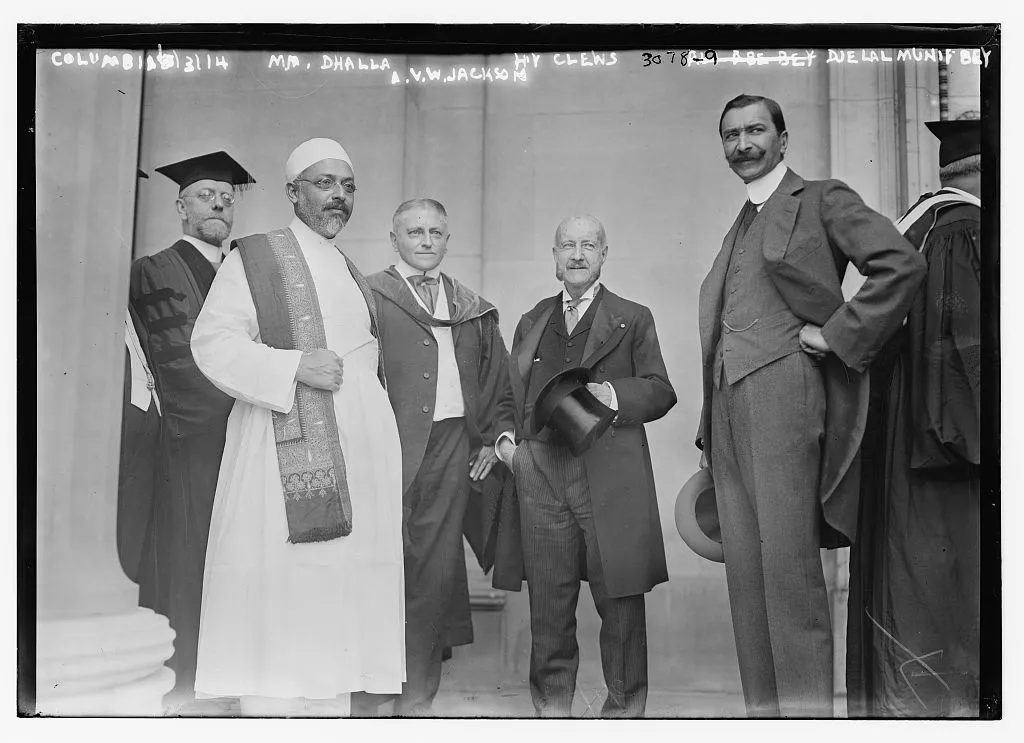
Iranica also notes two things that help in reading the chapter. The majority of orthodox laymen of his day, it says, saw Dhalla as a reformist Dastur. And in his later years he came to regard ethics as the highest form of religion. Iranica dates Homage unto Ahura Mazda to Karachi, 1941 to 1947. We could not find the exact year in which Part I first appeared.
Is it a poem or a prayer?
It is written as prose, in four paragraphs, with no rhyme or metre. What makes it read like a poem is its sound: long runs of paired words, repetition and a closing address to God. The book is divided into short numbered chapters; the one just before it, chapter 94, is itself a prayer to Ahura Mazda for a painless death. This one ends in a direct prayer too. "Prose-poem" or "prayer-meditation" describes it better than "poem".
What does Dhalla's Tower of Silence passage say?
The chapter moves in four steps.
- The gate. The heavy iron gate swings open and the dead are brought in. Dhalla stresses what the place lacks: no roof, no rooms, only a round enclosure open to the sky and a stone bed without pillow or cover.
- The crowd. He lists who is carried here in pairs of opposites, such as high and low, rich and poor, laymen and priest, master and servant. Then he pairs qualities: wealth lies beside poverty, virtue beside vice. This is where the line about equality in death comes.
- The birds and the well. The vultures on the walls take the flesh, and the dried bones of every class end up mixed together in the common well, where weather and time turn them to dust. Dhalla writes this part bluntly, without softening it.
- The prayer. Addressing the "Teacher Divine", he asks for different lessons for different people: humility for the haughty, comfort for the downtrodden, and a reminder that birth, power, beauty and riches mean nothing without goodness.
Vultures are central to Dhalla's picture of the Tower. What has happened to them since his day is a separate story, told in our post on Vultures and the Tower of Silence.
How does the passage show death levelling all?
Through the lists. Every pair Dhalla names is a social difference people care about in life, and the passage sets each one down on the same stone. The repetition is the argument. By the time the reader reaches the bones in the well, the categories have stopped mattering, and he says so plainly: nothing is mine or thine any more.
But the levelling is not offered as comfort. The tone is stark from the first sentence, and the point is aimed at the living. The closing prayer turns away from the dead and asks what the reader should learn. Read beside Iranica's note that Dhalla put ethics at the top of religion, the ending makes sense: equality in death is a reason to live humbly and do good now.
Did Parsi writers link the Tower of Silence with equality before Dhalla?
Yes. In 1891 J.J. Modi read a paper on Parsi funeral ceremonies to the Anthropological Society of Bombay. He wrote that the simplicity of the rites teaches survivors a lesson, and he gave it through a Persian couplet which, in his translation, says that death levels everybody, the king who dies on his throne and the poor man who dies on the ground without a bed.
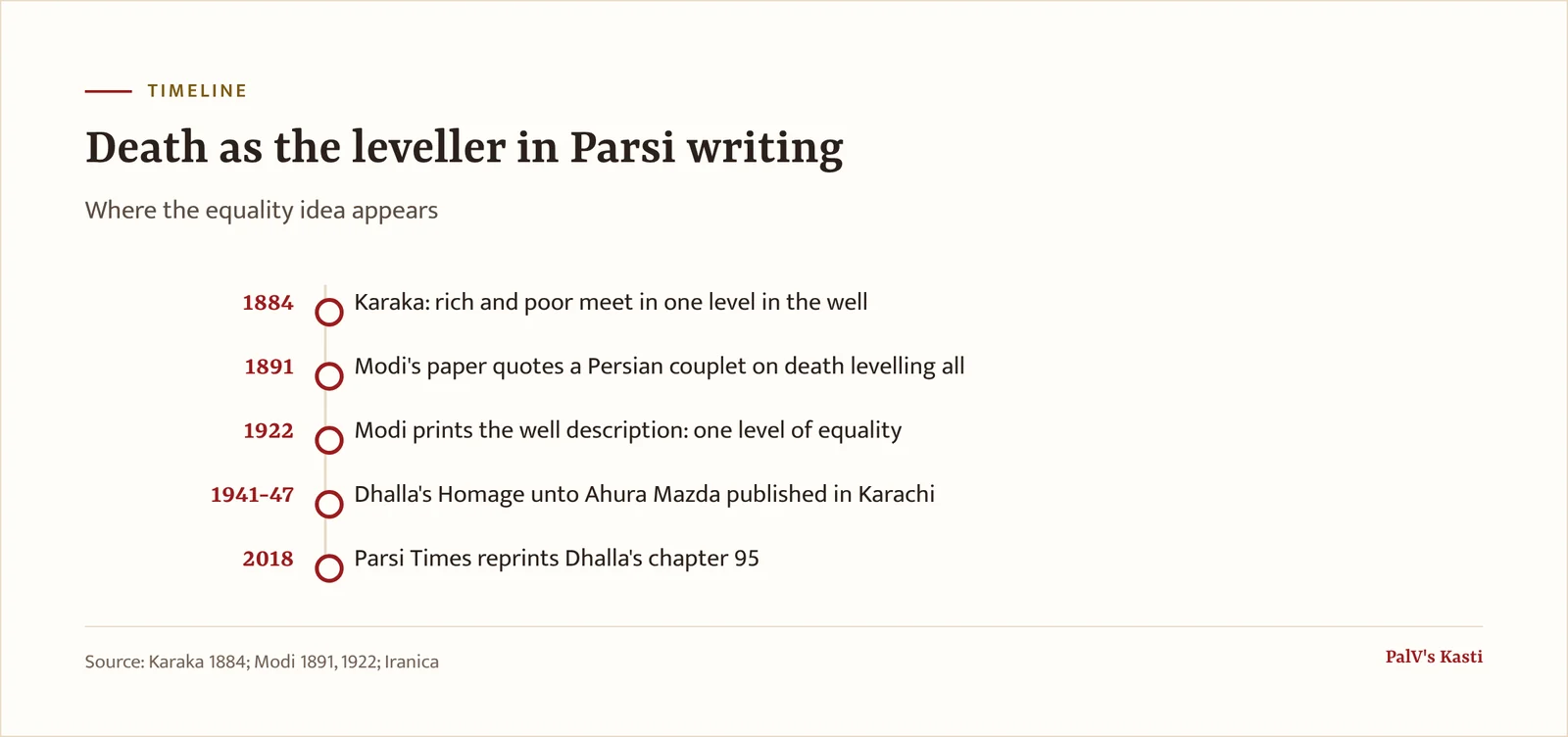
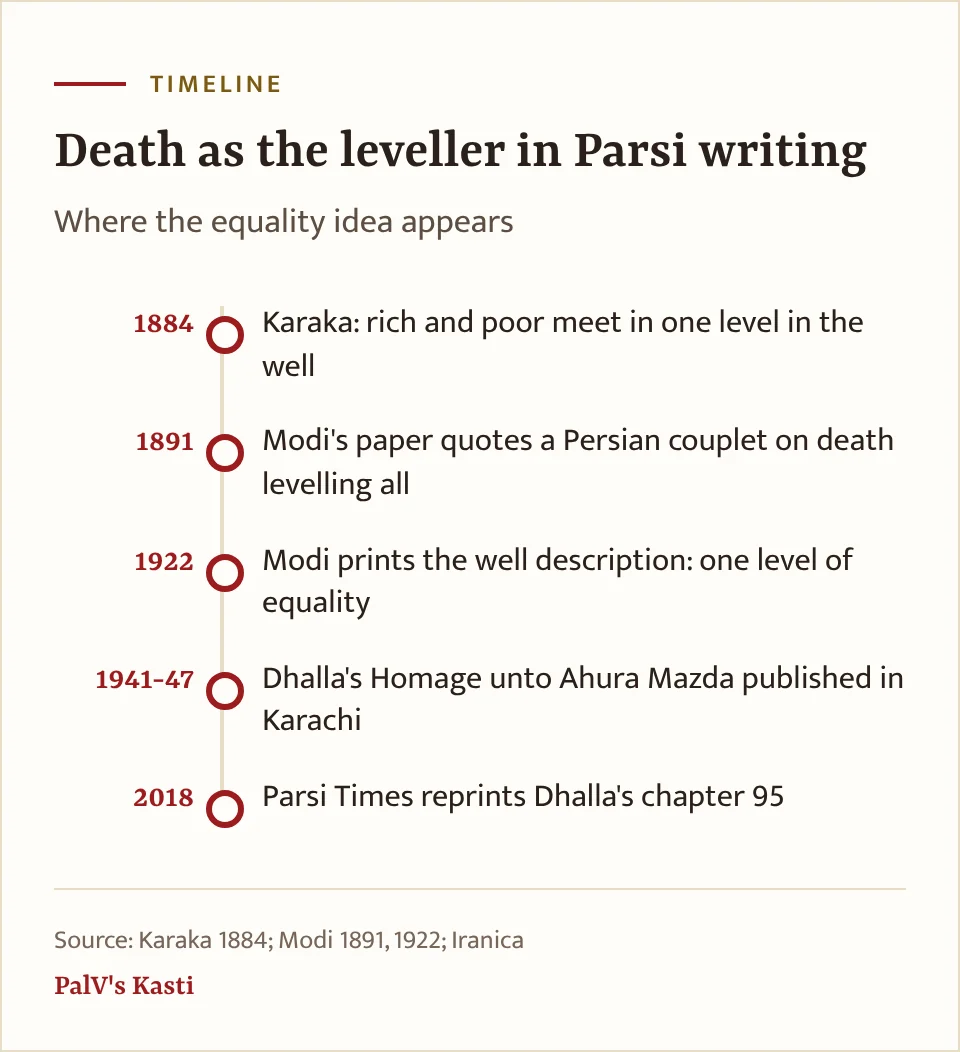
The same idea was attached to the central well itself. Dosabhai Framji Karaka's History of the Parsis (1884) and a description Modi printed in his 1922 book on Parsi ceremonies both say that in the well the bones of rich and poor come together on one level of equality after death. So Dhalla did not invent the theme. He turned an old Parsi way of explaining the dakhma into a meditation and a prayer. Our Tower of Silence guide explains how the dakhma is used, and Dakhma construction and consecration covers how the platform and well are built and blessed.
Practice varies between families and Agiaries; your family priest's guidance comes first.
Where can you read the full text?
The full chapter is in Homage unto Ahura Mazda, Part I, chapter 95, "The Tower of Silence". The text of Part I is also online at zarathushtra.com, which also carries Roshan Rivetna's biography of Dhalla. Parsi Times ran it in July 2018 as one of its weekend excerpts from the book. The two versions differ slightly: the Parsi Times text leaves out the pair "beautiful and ugly" from the list of those carried to the Tower. Dhalla's tower is the Indian-style dakhma; how it compares with the older towers of Iran is covered in Dakhmas of Iran vs India.
Frequently asked questions
Who wrote the poem on the Tower of Silence?
Dastur Dr Maneckji Nusserwanji Dhalla wrote it. He was High Priest of the Parsis of Karachi from 1909 until his death in 1956, and a scholar with a Columbia University PhD. The piece is chapter 95 of Part I of his devotional book Homage unto Ahura Mazda, published in Karachi between 1941 and 1947.
What does "Unequal in life, all lie equal in death" mean?
It means that the differences people build in life, of wealth, rank, learning and virtue, do not follow them into the Tower of Silence. Everyone lies on the same stone and their bones end in the same central well. Dhalla uses this to warn the living against pride, not to comfort them.
Is the Tower of Silence prayer-poem recited at Parsi funerals?
We found no source saying it forms part of the funeral rites. It is a chapter from a devotional book by a priest-scholar, written to be read and reflected on. For what the funeral itself will include, your family priest's guidance comes first.
Was Dastur Dhalla orthodox or reformist?
The Encyclopaedia Iranica says the majority of orthodox laymen of his time considered him a reformist Dastur. It also says that he came to consider ethics the highest form of religion and felt drawn to mysticism. His Tower of Silence chapter, which ends on conduct rather than ritual, fits that description.


