 PalV's Kasti
On this page
Parsis do not bury, burn or sink their dead in water. After the prayers, the body is carried to a dakhma, the stone structure known in English as the Tower of Silence, and laid open to the sun and to birds of prey. This way of disposal is called dokhmenashini. J.J. Modi's 1922 account of Parsi customs gives the reason: earth, fire and water are sacred, and the religion forbids bringing them into contact with decaying flesh. The aim, in Modi's words, is to treat the dead with every respect while doing the least possible harm to the living. The practice is under strain. The Free Press Journal reports that vultures have not been seen in large numbers at Mumbai's towers since the 1990s, some families now choose cremation, and abroad, Mary Boyce noted in 1993, Zoroastrians have to use ordinary undertakers and public crematoriums.
અસપંદામેદ રોજ
Asfandarmad Roj, Tir Mah · 1396 Y.Z.
What happens to a Parsi body after death?
In outline, the Bombay Parsi Punchayet's Doongerwadi page sets out the order followed in Mumbai. The deceased is bathed and dressed in a Navjote.">Sudreh (Sadra), and the next of kin tie the Kusti. This is the Sachkar. A dog is brought to look at the body, the Sagdid. Two Mobeds then recite the Geh Sarna between sunrise and an hour before sunset. After the last farewell at the salutation slab, the khandias, the professional bearers, carry the body to the dokhma to which it has been assigned. Ervad Dr Ramiyar Karanjia's account of the death rituals agrees on the washing, the Sudreh and Kusti, and the Geh Sarna by two priests in daytime only. The full sequence from the deathbed to the fourth day is in our guide to Parsi death rituals.
The BPP page also states that once the Sachkar is done, non-Zoroastrians may not see the body, because they do not wear the Sudreh and Kusti that protect against the Druj-e-Nasu, the spirit of decay.
Practice varies between families and Agiaries; your family priest's guidance comes first.
Why don't Parsis bury or cremate their dead?
Because each of those methods brings the dead into contact with something the faith holds sacred. Modi quotes Nusserwanjee Byramjee, the late secretary of the Parsee community's public charity funds, who explained that earth, fire and water are sacred and useful to mankind, and that the religion therefore forbids burying the dead, burning them or putting them in seas and rivers. Karanjia, answering a reader's question in May 2017 that he keeps on his website, gives the same reason in his own terms: every other method uses up natural resources and pollutes one element of nature or another.
Behind this lies the idea of nasu. Karanjia describes the dead body as the greatest source of contagion and putrefaction, which the Avesta calls nasu, so it must be disposed of in a way that causes least harm to people and the rest of creation. The concern extends to the ground itself. In the 1869 catechism of Dastur Erachji Meherjirana, translated by Dastur Firoze Kotwal and James Boyd in A Guide to the Zoroastrian Religion (1982), a dakhma must be built so that fluids from the body never soak into the soil, since that would make nearby wells and streams impure.
Practice varies between families and Agiaries; your family priest's guidance comes first.
What is dokhmenashini, and what are its four principles?
Dokhmenashini is the name for this whole system of disposal in a dokhma. Karanjia sets out four principles on which it rests:
- The body is placed away from where people live.
- It is placed on high ground.
- It is exposed to the rays of the sun.
- It is exposed to birds of prey.
The older texts give the same picture. Modi cites the Vendidad, where Ahura Mazda answers the question of where the dead should be carried with "on the most elevated place", and he adds that the spot chosen is isolated and away from homes. The catechism translated by Kotwal and Boyd suggests a reason for the height: foul air from the body rises into the sky instead of affecting the living. On the birds, it says they were created for this work and remove impurity without becoming impure themselves.
The same treatment applies to everyone. Dastur Kersey Antia, writing in the FEZANA Journal in 2005, points out that the same iron bier, the same dokhma and the same essential rites serve the body of a baronet and a beggar. How the dakhma is built and used is covered in our post on the Tower of Silence.
Practice varies between families and Agiaries; your family priest's guidance comes first.
Do vultures still do this work today?
Hardly. The Free Press Journal wrote in January 2024 that vultures were last seen in significant numbers at the Tower of Silence in the 1990s, and linked their decline across India to diclofenac, a drug used in veterinary medicine. NPR reported in 2012 that by 2007 vulture numbers in India had fallen by 99 percent.
To make up for the birds, the BPP trustees introduced solar concentrators to dry the bodies faster, as Khojeste Mistree told NPR. The BPP's Doongerwadi page, which carries no date, lists 12 "Solars", four each at the Anjuman, Sethna and Bisni dokhmas. In February 2025 the Free Press Journal reported that the panels had stopped working about four years earlier and that a group of Parsis had offered to pay for their repair. BPP chairman Viraf Mehta told the paper that the existing system was working "without any hiccups" even with the panels out of action, and that the trust would consult the high priests before acting.
Whether the system still works well is disputed. Karanjia writes that the fourth principle, the birds, has weakened considerably over about two decades, but that the other three are working well. BPP trustee Muncherji Cama told Open magazine in February 2014 that Zoroastrianism places its emphasis on the sun rather than the birds, and that with solar panels the system was "working well enough". In the same Open report, former BPP trustee Dinshaw Tamboly recalled learning in the late 1990s that people living nearby had complained of a foul smell from the towers. Open reported that Tamboly had formed the Prayer Hall Trust, for Parsis who choose cremation, the year before.
Bringing the birds back is still only a plan. On 9 August 2026 the Free Press Journal quoted Mehta saying a donor had come forward to pay for an aviary at Doongerwadi and a plot had been identified, but that the trust still needed a test, not too intrusive, to tell which bodies contained diclofenac. That, he said, is where they are stuck.
What other choices do Parsi families have?
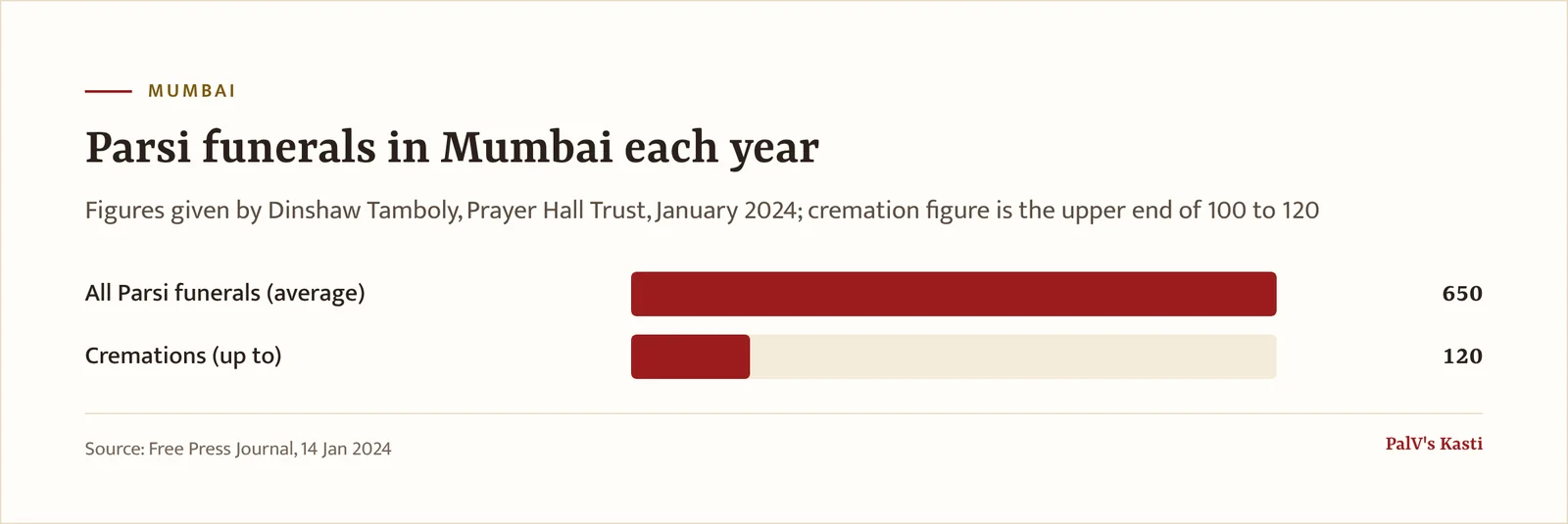
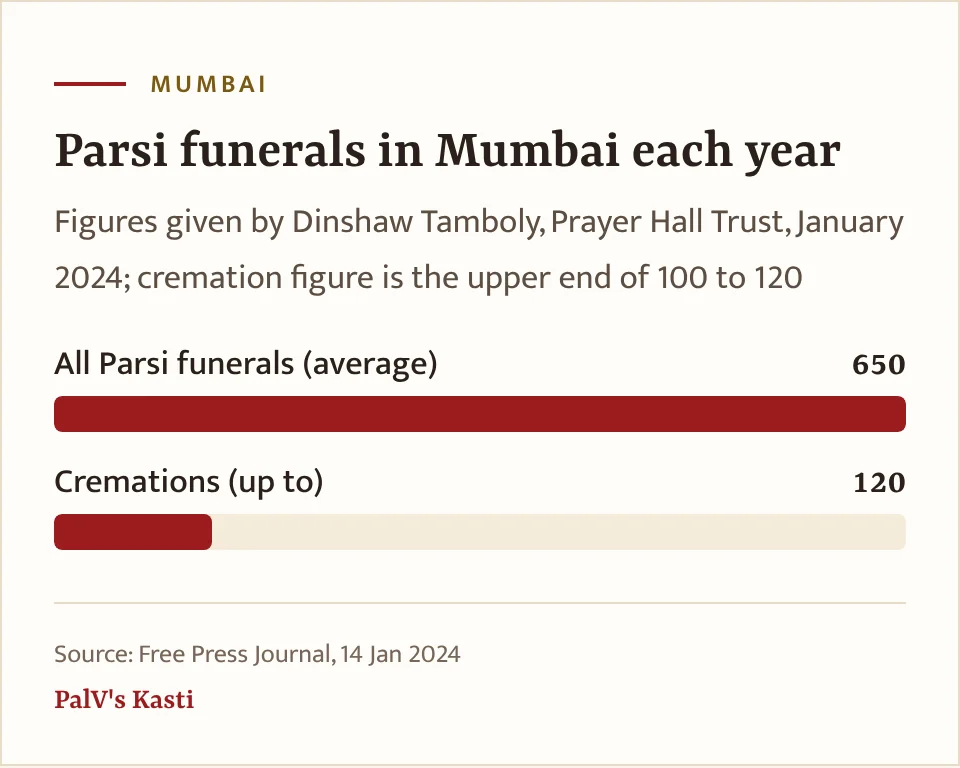
In Mumbai, some families now choose cremation, though, as Open noted in 2014, the high priests have strictly forbidden cremation and burial. Tamboly, now a member of the Prayer Hall Trust that runs a prayer hall at the Worli crematorium, told the Free Press Journal in January 2024 that between 100 and 120 of the roughly 650 Parsi funerals in Mumbai each year were cremations. The Trust's own estimate is that 15 to 20 percent of funerals now take place at crematoriums. The options, and the arguments on each side, are set out in Parsi funeral alternatives.
Abroad, Mary Boyce noted in the Encyclopaedia Iranica in 1993, Zoroastrians have to use ordinary undertakers and public crematoriums, and a North American guide on avesta.org, by Firoze Jungalwala and Farhad Panthaki, names cremation as the preferred choice there. How those families adapt the prayers, and how practice in Iran changed, is explained in Zoroastrian funeral traditions.
What happens to the bones?
An early English account got this wrong. Mrs Postans, in Western India in 1838, wrote that a sacred fire burned in the pit at the centre of the tower and that the bones either fed it or were washed away into nearby waters. The description by Nusserwanjee Byramjee that Modi reproduces says otherwise. Once dried by the sun, the bones are placed in the deep central well, the bhandar, where they slowly crumble to dust. Rainwater that passes over them is led through drains into sand-bottomed wells, with charcoal and sandstone as filters, so that the earth is not defiled. Fire plays no part, in keeping with the rule Modi records against burning the dead.
Frequently asked questions
What do Parsis do with dead bodies?
After the funeral prayers, the body is placed in a dakhma, or Tower of Silence, open to the sun and to birds of prey, as J.J. Modi described in 1922. The bones are later placed in the central well. Some Parsis now choose cremation instead, and a North American guide calls cremation the preferred choice there.
Why don't Parsis cremate or bury their dead?
Zoroastrian teaching holds earth, fire and water sacred and treats the body after death as a source of contagion and decay, called nasu. Burial would defile the earth, cremation the fire, and disposal in water the water. J.J. Modi recorded this reasoning in 1922, and Ervad Ramiyar Karanjia gave the same reason in a 2017 answer to a reader.
What is dokhmenashini?
Dokhmenashini is the Zoroastrian system of disposing of the dead in a dokhma, or dakhma. Ervad Ramiyar Karanjia lists its four principles: the body is placed away from human habitation, on high ground, exposed to the sun's rays and exposed to birds of prey. J.J. Modi traces the high ground to the Vendidad's "most elevated place".
Do vultures still eat bodies at the Tower of Silence?
Not in the old numbers. The Free Press Journal reported in 2024 that vultures were last seen in significant numbers at the Tower of Silence in the 1990s, a decline linked to the drug diclofenac. As of August 2026, the BPP chairman said an aviary had a donor and a plot, but the diclofenac problem was unsolved.
What happens to the bones of the dead?
According to the description J.J. Modi reproduces, the bones, once dried by the sun, are placed in the bhandar, the deep well at the centre of the dakhma, where they gradually crumble to dust. Drains lead rainwater into sand-bottomed wells, with charcoal and sandstone filters, so that it is cleaned before reaching the earth.


