 PalV's Kasti
On this page
- Where is the Parsi crematorium in Worli?
- Who runs the Worli prayer hall, and how did it start?
- What facilities does the Worli prayer hall offer?
- Is the Worli prayer hall only for Parsis?
- Do you need to book the Worli prayer hall, and what does it cost?
- How many families have used the hall?
- How has the community received the Worli crematorium?
- Frequently asked questions
The Worli Parsi crematorium is the prayer hall built beside the municipal electric crematorium at Vaikunth Dham, E. Moses Road, Worli, Mumbai 400 018. It gives Parsi and Irani Zoroastrian families who choose cremation a place to hold the four days of funeral prayers, since families who opt for cremation are barred from the prayer halls at Doongerwadi, as the Free Press Journal reported in October 2024. A charitable body, The Prayer Hall Services and Maintenance Trust, runs it. According to the Trust's own rules page, the hall has two connected rooms seating 200 people in all, there is no booking system, using the hall costs nothing, and a Chief Priest appointed by the Trust coordinates the arrangements. The crematorium next door has two electric furnaces.
This page is about the place itself. For the wider picture, start with our guide to Parsi cremation.
અસપંદામેદ રોજ
Asfandarmad Roj, Tir Mah · 1396 Y.Z.
Where is the Parsi crematorium in Worli?
The Trust gives its hall's address as Prayer Hall, Vaikunth Dham, E. Moses Road, opposite the Four Seasons Hotel, Worli, Mumbai 400 018. Vaikunth Dham is the municipal crematorium, and the hall stands within it. The Trust's office is separate, in Hermes House near Opera House in south Mumbai, so families going for a funeral should head to Worli, not to the office.
People search for it under several names: Worli crematorium, Worli prayer hall, the Parsi crematorium at Worli. They all mean the same site.
Who runs the Worli prayer hall, and how did it start?
The hall is managed by The Prayer Hall Services and Maintenance Trust, registered in Mumbai as No. E-31041 on 13 March 2015, according to the Trust's letterhead. The building itself, its rules page says, is the property of the Municipal Corporation of Greater Mumbai.
Sources differ slightly on the opening month. The Free Press Journal (January 2024) says the hall opened in August 2015. Open magazine (July 2016) and a March 2016 Parsi Times interview with trustee Dinshaw Tamboly both give September 2015. Everyone agrees on 2015.
The Free Press Journal traces the idea back to the 1980s, when J.R.D. Tata asked the then Municipal Commissioner, Jamsheed Kanga, about a suitable crematorium for his brother D.R.D. Tata's funeral, and the Dadar crematorium was used. The same report says the A.H. Wadia Trust gave a founding grant of one and a half crore rupees. The Trust's About Us page names Rusi Khambata as the architect who designed the hall.
Why was it needed at all? The Free Press Journal reported in October 2024 that the management of the Tower of Silence had barred families who opted for cremation from using its prayer halls for the four-day rites, and quoted a member of the Prayer Hall Trust saying the Worli hall was created because of that. How the traditional system works is explained in our guide to the Tower of Silence, and the reasons families choose cremation are in the Parsi cremation hub.
In a public notice dated 2 December 2024, the Trust listed nine trustees and announced that its priest-coordinator was stepping down. From 1 December 2024 it appointed a Chief Priest for the arrangement of obsequies, and said it would separately appoint a manager to look after cleanliness, security and upkeep.
What facilities does the Worli prayer hall offer?
Everything in this list comes from the Trust's rules page as we read it on 16 November 2026. Facilities can change, so confirm with the Chief Priest before you rely on any of it.
- Two inter-connected halls that can be used one at a time or together, with seating for 200.
- Washrooms and a water cooler for the family.
- No cold storage. If the body has to wait for relatives coming from outside Mumbai, the Chief Priest can give you the names of funeral directors.
- No overnight stay for relatives inside the hall.
- Two sets of afarghans, khumchas and other ceremony equipment, kept in locked cupboards at the hall.
- Daily cleaning and security round the clock.
- In the adjoining municipal crematorium, two electric furnaces, one of them kept on standby. The Trust says a cremation takes about two hours.
There are no nasesalars at Worli. The Trust says relatives and friends usually wheel the body from the hall to the crematorium on an ambulance trolley along a short path, and the crematorium staff help when needed.
What the Chief Priest arranges
The rules page says the Trust's Chief Priest helps families with:
- phone numbers for a hearse and for funeral directors
- telling the security staff and municipal officials when the body will arrive, making sure crematorium operators are present, and arranging the bamboo bier
- paperwork, registering the death and guidance on getting the death certificate
- sandalwood and flowers, and the equipment used during the ceremonies.
He also decides which of the two halls a family uses and when, because more than one set of ceremonies can fall at the same time. His contact numbers are on the Trust's website, prayerhalltrust.org.
Is the Worli prayer hall only for Parsis?
No. The Trust's rules say the hall belongs to the municipal corporation and is available for use by all communities, but members of the Parsi-Irani Zoroastrian community are given priority. The Free Press Journal reported the same in October 2024: the hall is not used only by Parsis.
Non-Parsi relatives can sit with the family. Jehangir Patel, editor of Parsiana, told the Free Press Journal in 2024 that non-Zoroastrians are not made to sit separately at Worli, as they are at Doongerwadi. Open magazine reported in 2016 that the main difference from a Doongerwadi funeral is that the family, including non-Parsi members, may attend the rites.
The rules page also says the hall is to be used only for funerary services, meaning the customary four-day Zoroastrian prayers. And a family can hold any of those four days of prayers at Worli even if the cremation, or the paidast, took place somewhere else.
Do you need to book the Worli prayer hall, and what does it cost?
There is nothing to book. In the Trust's words, no municipal crematorium in Mumbai has a prior booking system, so a family gets the hall if it is free, in the order people arrive, or at a time fixed with the Chief Priest. What the rules do require is that you tell the Chief Priest in advance and keep him informed of the timing, even if your own family priest will lead the prayers. You are free to bring any priest you like.
Using the hall is free. The Trust says families may make a voluntary donation afterwards towards its corpus, by cheque, cash against a receipt, or bank transfer.
Priests' fees are a separate matter. The only published figures we found are from March 2016, when Dinshaw Tamboly told Parsi Times that four-day ceremonies by two mobeds cost Rs 22,000, or Rs 25,000 with four to five mobeds, plus Rs 3,600 as tips for security, housekeeping and crematorium staff. Those are ten-year-old numbers. We found no current rate, so ask the Chief Priest or your own priest.
How many families have used the hall?
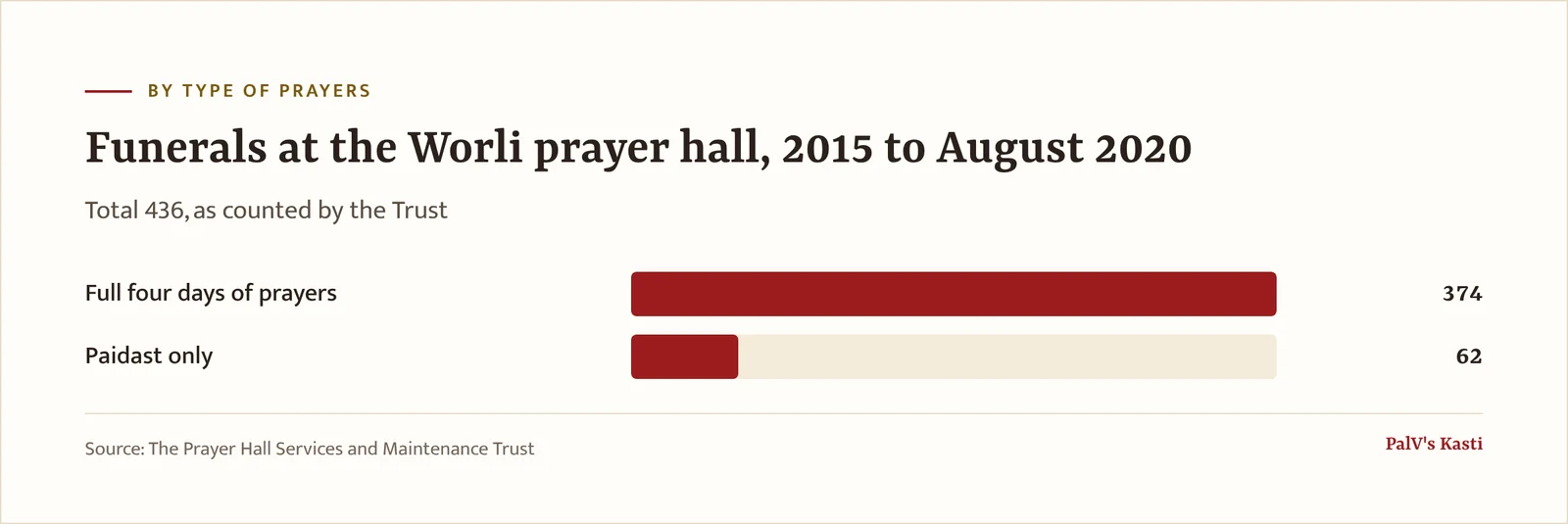
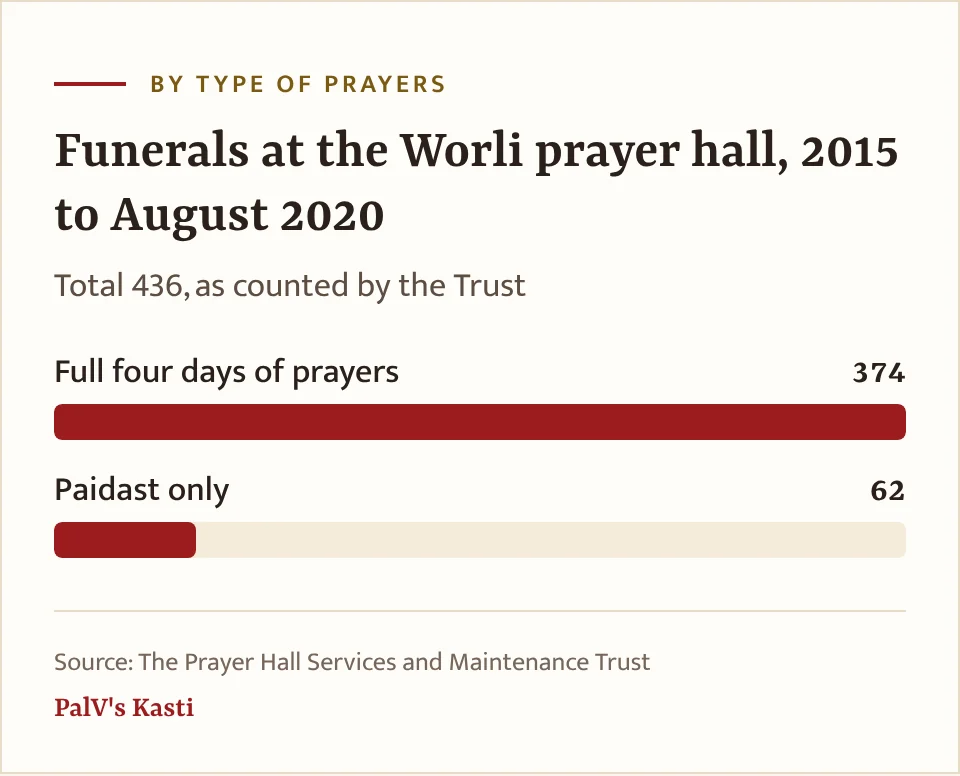
The Trust's own table counts 436 funerals at the hall from 2015 to 31 August 2020. Of those, 374 families held the full four days of prayers there and 62 held the paidast only. The Free Press Journal reported that Ratan Tata's last rites were held at the Worli crematorium on 10 October 2024. We look at the year-by-year numbers, and what they say about funeral choices in the city, in Parsi cremation in Mumbai. What happens on each of the four days is set out in our guide to the Parsi cremation process.
How has the community received the Worli crematorium?
Opinion is divided.

For supporters, the hall answered a real need. Jehangir Patel told the Free Press Journal in January 2024 that it had been "a real blessing" for people who wanted an alternative to Doongerwadi, and that getting a hall or a priest for the post-funeral rites was no longer a problem. Dinshaw Tamboly told Parsi Times in 2016 that the hall was not set up to compete with Doongerwadi, and that the choice was a personal one for each family.
For those who hold to dokhmenashini, cremation itself is the problem. When the hall was new, the orthodox scholar Khojeste Mistree told AFP in June 2016 that the body "cannot be burnt because that's desecrating fire". Yazdi Desai, then BPP chairperson, told the Hindustan Times in February 2019, in a report on the hall's first three years, that cremation "is a sin in our religion" and only the dakhmas are allowed. A reader's letter in Parsi Times in July 2016, written after attending a funeral at Worli, said no sachkar or sagdid had been performed, that relatives had touched the body, and called what was being done at Worli "a mockery" of the religious system of disposal of the dead. The wider argument over cremation and Doongerwadi is set out in our Parsi cremation guide.
Practice varies between families and Agiaries; your family priest's guidance comes first.
Frequently asked questions
Where is the Parsi crematorium in Worli?
It is inside the Vaikunth Dham municipal crematorium on E. Moses Road, Worli, Mumbai 400 018, opposite the Four Seasons Hotel. The Prayer Hall Services and Maintenance Trust runs the prayer hall there, and the electric furnaces are in the crematorium next to it. The Trust's office in south Mumbai is a different address.
Is the Worli prayer hall only for Parsis?
No. The Trust's rules say the hall is municipal property open to all communities, with priority for Parsi and Irani Zoroastrians. Non-Parsi relatives can attend the prayers with the family. The Trust also says the hall is to be used only for funeral services, meaning the customary four-day Zoroastrian prayers, and for nothing else.
Do I need to book the Worli prayer hall?
No booking is possible. The Trust says Mumbai's municipal crematoria have no prior booking system, so the hall goes first-come-first-served or as agreed with its Chief Priest. You must still inform the Chief Priest beforehand and tell him the timing of your ceremonies, even if your own priest will pray.
How much does the Worli prayer hall cost?
Using the hall is free, according to the Trust, and families may give a voluntary donation afterwards. Priests are paid separately. The last published rates we found date from March 2016, when two mobeds for four days cost Rs 22,000. Ask the Chief Priest or your family priest for today's figure.
Can we hold the four-day prayers at Worli if the cremation was elsewhere?
Yes. The Trust's rules say Parsi and Irani Zoroastrian families can use the hall for any of the four days of prayers even if the paidast or the cremation took place somewhere else. Families must still tell the Chief Priest in advance so that he can schedule which of the two halls they use.


