 PalV's Kasti
On this page
A crematorium inside Doongerwadi, the Bombay Parsi Punchayet's funeral estate on Malabar Hill where Mumbai's dakhmas stand, was proposed by reform-minded Parsis, among them a former BPP trustee. They wanted families who chose cremation to have a facility on the estate and to be allowed to pray in its bunglis, which were closed to the cremated. The high priests and orthodox members opposed it on religious grounds, saying cremation defiles fire, and some opponents also feared the estate's land would end up being sold. The idea was rejected. A prayer hall opened at the Worli municipal crematorium in 2015 instead, as the Free Press Journal has reported.
અસપંદામેદ રોજ
Asfandarmad Roj, Tir Mah · 1396 Y.Z.
What is Doongerwadi, and why would a crematorium there matter?
Doongerwadi is the wooded funeral ground of Mumbai's Parsis, run by the Bombay Parsi Punchayet (BPP). The BPP's own page puts the estate at about 57 acres in one place and 58 in another, and press reports give 50, 54 or 55. The same page dates the dakhmas from 1672 onwards and lists 11 prayer halls, or bunglis: seven at the upper level and four at the lower. Our page on the Tower of Silence explains the traditional system, and our hub on Parsi cremation tells the wider story.
Who proposed a crematorium at Doongerwadi, and why?
The best-documented proposal came from Dinshaw Tamboly, who was a BPP trustee from 1996 to 2008, according to the Free Press Journal. Open magazine reported in February 2014 that he had urged his fellow trustees to build an electric crematorium within Doongerwadi or, if not that, to let the families of the cremated pray in the estate's prayer halls. "But the high priests forbade any of that," he told the magazine.
A reform group pressed the same demand. Outlook, in a report by Manu Joseph whose online copy is dated February 2022, wrote that the Disposal of the Dead with Dignity Action Group wanted Parsis to have alternatives such as cremation and had called for a crematorium inside Doongerwadi. In October 2024 the Free Press Journal reported that a group of prominent Parsis had campaigned for a crematorium in the cemetery and that the request was turned down.
Readers have argued it in print too. A letter in Parsi Times in June 2016 said that repair work then going on at Doongerwadi was the moment to add a crematorium, for a cleaner, more dignified disposal and so that funeral rites could be held in the same place. A reply in the 11 June 2016 issue took a different line. It asked for the bunglis to be open to everyone whatever the mode of disposal, said a separate "cremate ni bungli" had been suggested and refused, and doubted that a crematorium would ever be kept for the community alone. The reasons families give for choosing cremation at all are covered in Why Parsis choose cremation.
Why is a crematorium at Doongerwadi opposed?
The religious objection
J.J. Modi's 1922 book on Parsi ceremonies quotes Nusserwanjee Byramjee, a former secretary of the community's charity funds, as writing that the religion "strictly enjoins" that the dead are not to be buried, burnt or put into seas and rivers, because earth, fire and water are sacred. Coomi Kapoor's history of the Parsis, drawing on the Vendidad, gives the same reason: cremation pollutes fire. Kapoor writes that Dastur Firoze Kotwal saw accepting the change as "a strike at the very foundation of our religion". Open quoted Tamboly in 2014 as saying the high priests called cremation "sacrilegious". The orthodox scholar Khojeste Mistree told AFP in June 2016 that "from a religious point of view clearly it's wrong". And in February 2019 the Hindustan Times quoted the then BPP chairperson, Yazdi Desai, as saying "fire is the son of God".
Practice varies between families and Agiaries; your family priest's guidance comes first.
The view that dokhmenashini still works
Orthodox voices have argued that a crematorium isn't needed because the dakhmas still function. BPP trustee Muncherji Cama told Open in 2014 that the faith puts its emphasis on the sun, not on the birds, and that with solar panels the system was "working well enough". Mistree told AFP in 2016 that sky burials still "work effectively, although slightly slower". The BPP's Doongerwadi page lists 12 solars, four each at three dakhmas. The Free Press Journal, in March 2025, described the panels as "now dysfunctional". We found no BPP reply to that report.
Fears for the land
Some opponents tie the proposal to the value of the estate. In the Outlook report, Mistree said he suspected "a handful of realtors" had a 15-year plan for the land. Parsiana editor Jehangir Patel answered in the same piece that the dakhma system was not working and alternatives had to be found. In March 2025 a community member quoted by the Free Press Journal worried that a crematorium would end with Doongerwadi "sold to the builder lobby".
Outlook also reported how the clergy read the reform group's call for a crematorium inside Doongerwadi: as a wish "to have the cake and eat it too".
What happened to the proposal?
It was turned down. Tamboly told the Free Press Journal in January 2024 that the trust had debated whether other methods such as cremation should be allowed at the cemetery, and that the idea was dropped after opposition from the clergy and orthodox members. Those who wanted another method were asked to make their own arrangements. Kapoor writes that, on Dastur Kotwal's advice, the BPP also kept the bunglis closed to prayers for those who would be cremated. Outlook reported one attempt to change that: a 6:1 BPP resolution allowing prayers for the cremated at Doongerwadi, put on hold after an outcry led by the community's eight high priests.
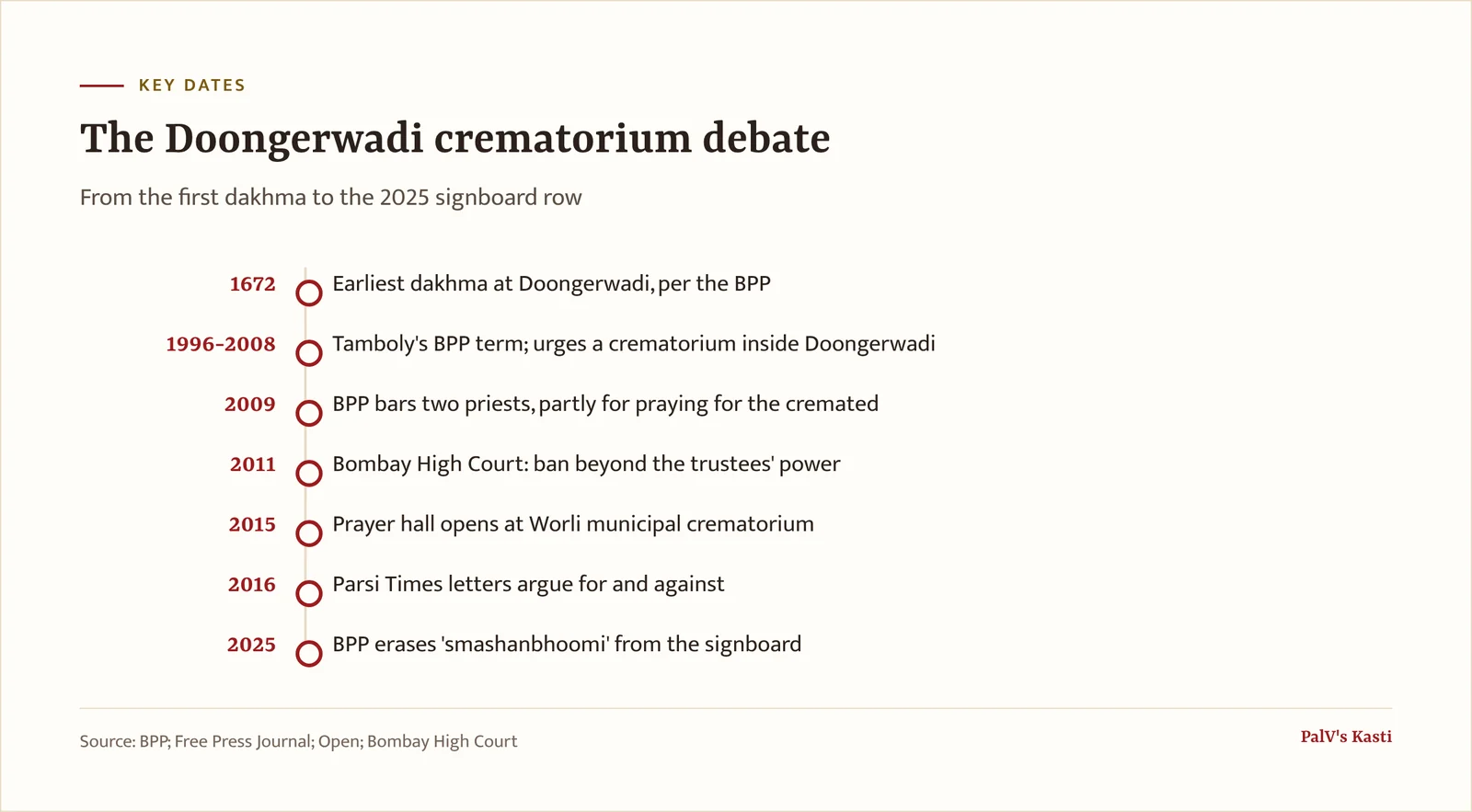

The reformists then looked elsewhere in the city. Outlook reported that land near a crematorium on Princess Street was offered for prayers and refused, with former municipal commissioner Jamsheed Kanga calling it "a very squalid place". The hall that finally opened, in August 2015 according to the Free Press Journal, stands at the Worli municipal crematorium. The Prayer Hall Trust's rules describe it as municipal property open to all communities, with priority for Parsi-Irani Zoroastrians. How many families now use it is covered in Parsi cremation in Mumbai.
What did the courts decide?
The courts were asked about priests, not about building a crematorium. In June 2009 the BPP trustees barred two priests from Doongerwadi and two Agiaries under the trust's control, citing among other things their prayers for the cremated. On 11 March 2011, in Jamsheed Kanga & Anr v. Parsi Panchayat Funds and Properties & Ors (Appeal No. 256 of 2010), a Bombay High Court bench of Justices D.Y. Chandrachud and Anoop V. Mohta held that the ban was not within the trustees' power under the Deed of Trust. The bench said its decision did not adopt either side's view, and that whether cremation is acceptable to the faith did not fall for determination. Open reported in 2014 that the BPP had appealed to the Supreme Court, which appointed a mediator. Kapoor writes that neither side was satisfied with the mediator's final order. We could not find the text of that order.
This is general information, not legal advice; for a specific case, speak to a lawyer.
Is a Doongerwadi crematorium still being discussed?
The question came up again in March 2025. The Free Press Journal reported that the BPP had added a Marathi name at the cemetery gates that used the word "smashanbhoomi", and orthodox members wondered whether a crematorium was being planned against their wishes. The management said the word was a literal translation of "cemetery", not "crematorium", and BPP chairman Viraf Mehta told the paper it had been erased from the board. One member quoted in the report thought it a good time to consider a crematorium on the grounds; another opposed it. We found no BPP statement from 2024 to 2026 of any plan to build one.
Frequently asked questions
Why is there no crematorium at Doongerwadi?
Proposals for one were rejected after the high priests and orthodox members objected, the Free Press Journal reported in 2024 and 2025. Their religious objection, set out in J.J. Modi's 1922 book and in Coomi Kapoor's history, is that cremation pollutes fire, which is sacred. Those wanting cremation were asked to make their own arrangements.
Who opposed a crematorium at the Tower of Silence?
The community's high priests led the opposition, according to Open magazine (2014) and the Free Press Journal (2025). Coomi Kapoor writes that Dastur Firoze Kotwal saw accepting the change as a strike at the foundation of the religion. Scholar Khojeste Mistree and BPP trustee Muncherji Cama argued that the traditional system still worked.
Who proposed a crematorium at Doongerwadi?
Former BPP trustee Dinshaw Tamboly urged one, Open magazine reported in 2014, and so did the Disposal of the Dead with Dignity Action Group, according to Outlook. The Free Press Journal wrote in 2024 that a group of prominent Parsis had campaigned for it. A reader's letter in Parsi Times made the case again in June 2016.
Did the Bombay High Court rule on cremation?
No. In its 11 March 2011 judgment in Jamsheed Kanga & Anr v. Parsi Panchayat Funds and Properties, the Bombay High Court held that the BPP trustees had no power to bar two priests from Doongerwadi. It said plainly that whether cremation is acceptable to the faith was not a question before it.


