 PalV's Kasti
On this page
Parsi cremation is the choice some Parsi Zoroastrian families now make to have the body of the deceased consigned to an electric crematorium, instead of a dakhma at a Tower of Silence, and then to hold the customary four days of prayers. It is a minority practice and a contested one. Zoroastrian tradition, as J.J. Modi recorded it in 1922, forbids burning the dead, and leaders of the Bombay Parsi Punchayet and high priests have opposed it on record. In Mumbai, families who choose cremation can hold the prayers at a hall built for them beside the Worli municipal crematorium, which opened in 2015. Priests there conduct prayers that Open magazine described in 2016 as similar to those said for a funeral at the Towers of Silence.
અસપંદામેદ રોજ
Asfandarmad Roj, Tir Mah · 1396 Y.Z.
Do Parsis cremate their dead?
A minority do. Estimates of how many differ by source. In October 2024 the Free Press Journal reported the Prayer Hall Trust's figure that between 100 and 120 of the roughly 650 Parsi funerals held in Mumbai each year were cremations. Jehangir Patel, editor of Parsiana, told the same paper in April 2024 that "just over 10%" of funerals were done in non-traditional ways. Year-by-year counts and how they have shifted are in our piece on Parsi cremation in Mumbai.
Some well-known Parsis have been cremated at Worli. The Free Press Journal reported the cremations of Cyrus Mistry in 2022, of former BPP chairman Minoo Shroff in April 2024 (which it called a first for a former chairman in the Punchayet's recorded history), and of Ratan Tata, whose last rites were held there on 10 October 2024.
Where there is no dakhma at all, families have fewer choices. The Times of India reported in August 2025 that Nagpur's Parsis now opt for cremation. Mary Boyce, writing in the Encyclopaedia Iranica (1993), noted that Zoroastrians abroad have to rely on ordinary undertakers and public crematoriums.
Is Zoroastrian cremation allowed?
The traditional teaching is no. Modi, in The Religious Ceremonies and Customs of the Parsees, explains that earth, fire and water are sacred and that the religion forbids the dead to be buried, burnt or put into water. The Bombay Parsi Punchayet's own Doongerwadi page describes its dokhmas as the place for disposal of the dead in keeping with traditional Zoroastrian custom.
Those who hold to that teaching have said so plainly. Yazdi Desai, then BPP chairperson, told the Hindustan Times in February 2019 that "cremation is a sin in our religion" and that only the dakhmas are allowed. The orthodox scholar Khojeste Mistree told AFP in June 2016 that the body "cannot be burnt because that's desecrating fire", adding that those who want cremation can have it but "from a religious point of view clearly it's wrong". Coomi Kapoor, in her book The Tatas, Freddie Mercury & Other Bawas, records that Dastur Firoze Kotwal called acceptance of cremation "a strike at the very foundation of our religion".
Other priests and reformers see it differently. Kersey H. Antia, writing for North American Zoroastrians in the FEZANA Journal (Winter 2005), agrees that dokhmenashini is the only method that pollutes no element, but calls cremation "the second best alternative for us" where it cannot be done. Dinshaw Tamboly, a former BPP trustee, told Open magazine in 2014 that once trustees saw conditions in the wells, they realised "the entire system had collapsed". The faith arguments on both sides are set out in our companion piece, Dokhmenashini vs cremation.
Practice varies between families and Agiaries; your family priest's guidance comes first.
When did Parsi cremation start in Mumbai?
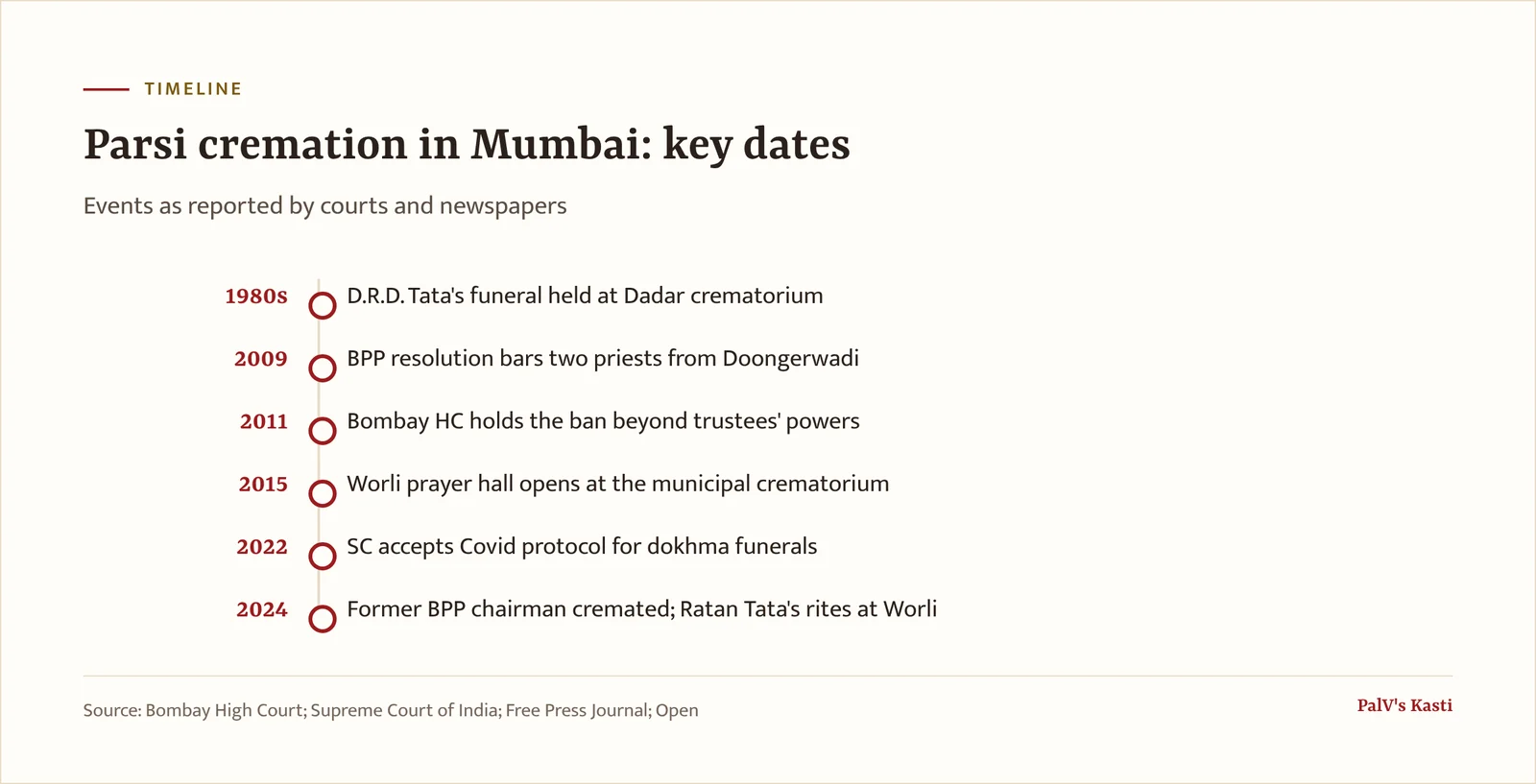
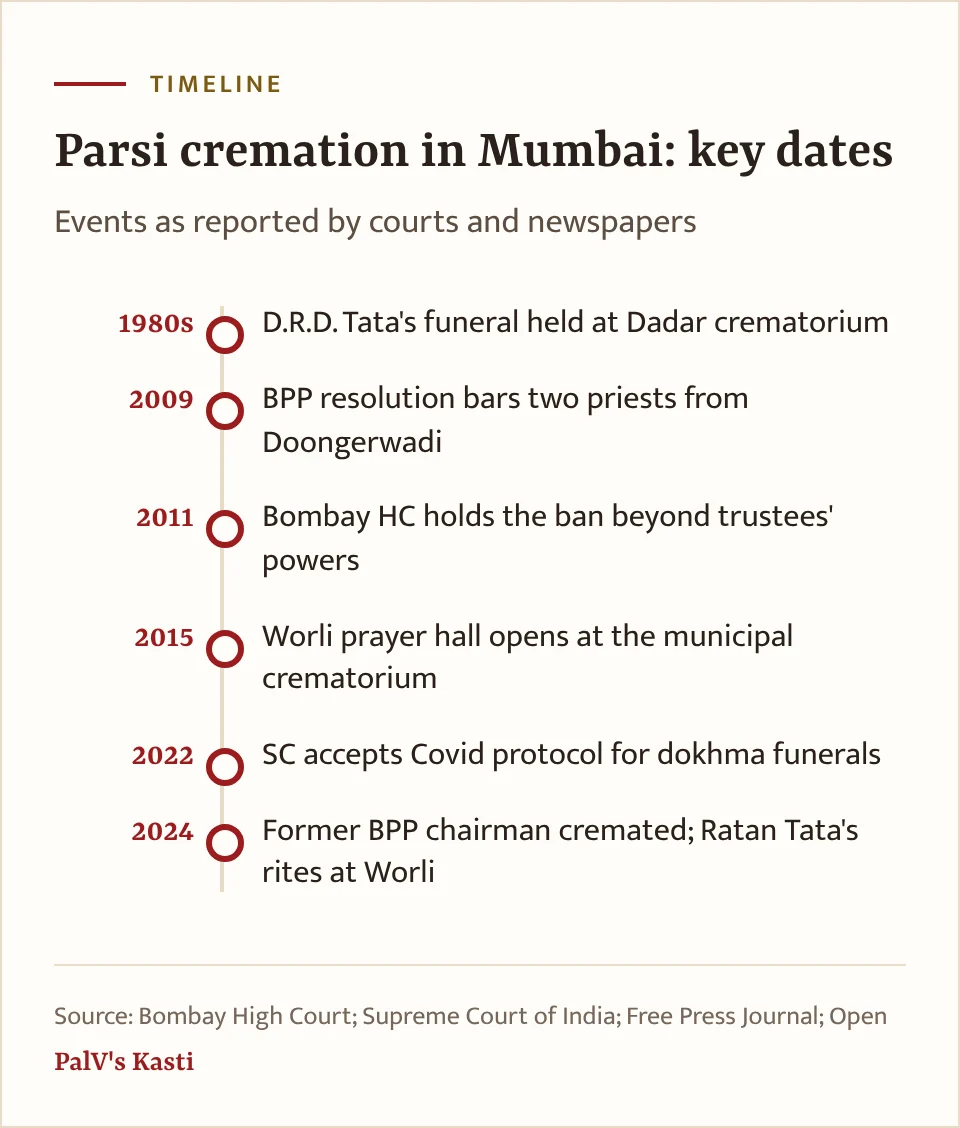
We could not find a reliable date for the first Parsi cremation in India. What the record does show is a slow build-up. The Free Press Journal (January 2024) traces the Worli prayer hall back to the 1980s, when J.R.D. Tata asked the then Municipal Commissioner, Jamsheed Kanga, which crematorium would be suitable when his brother D.R.D. Tata died. The family used the Dadar crematorium. In April 2024, Tamboly told the same paper that cremations were taking place elsewhere before the hall existed, but there was nowhere for the prayers that follow.
The reasons families give for choosing it, chiefly the loss of the vultures and slow decomposition at the dakhmas, are covered in Why Parsis choose cremation. Open (July 2016) adds two more: a cremation lets the family stay with the body to the end, and Parsis who have married outside the community cannot be laid at the Towers of Silence.
The FPJ reported that while Tamboly was a BPP trustee (1996 to 2008), the trust debated allowing methods such as cremation at the cemetery, and dropped the idea after opposition from the clergy and orthodox members. Coomi Kapoor writes that, on Dastur Kotwal's advice, the BPP did not let the Doongerwadi bunglis be used for prayers for those who would be cremated. Open reported in 2014 that he urged an electric crematorium inside Doongerwadi, or at least access to its prayer halls for the cremated, and that the high priests refused both. The BPP's answer, as the Free Press Journal put it, was that those wanting another method should make their own arrangements. That led to the Worli hall, which the FPJ says opened in August 2015 and Open and AFP date to September 2015. Why a crematorium at Doongerwadi itself was proposed and resisted is the subject of our piece on the Doongerwadi crematorium debate.
What have the courts said?
On 9 June 2009 the BPP trustees passed a resolution barring two priests, Framroze Mirza and Khushroo Madon, from praying at Doongerwadi and at two Agiaries under the trust. Among the reasons recorded was that they prayed for the dead who had been cremated. In Jamsheed Kanga & Anr v Parsi Panchayat Funds & Ors (Bombay High Court, Appeal 256 of 2010, 11 March 2011, Justices D.Y. Chandrachud and Anoop V. Mohta), the court held that the ban was beyond the trustees' powers under the trust deed. It said clearly that it was not deciding whether cremation is acceptable to the faith.
The BPP appealed to the Supreme Court. Open reported in February 2014 that the court had appointed a mediator and no breakthrough had been reached. Coomi Kapoor's later account says the settlement barred the BPP from banning priests from Doongerwadi and its two Agiaries for "irreligious acts" done elsewhere, with the two original priests as the only exceptions, and that neither side was satisfied with the mediator's final order. We could not locate the Supreme Court's order itself.
During the Covid-19 pandemic, the bodies of Parsis who died of the disease were not allowed into the Tower of Silence. Framroze Mirza, who coordinated the Worli hall until he stepped down in December 2024 according to the Trust's public notice, told the FPJ in January 2024 that this caused a spike in cremations there. The Surat Parsi Panchayat Board challenged the Union Government's March 2020 disposal protocols as contrary to the faith. In The Surat Parsi Panchayat Board v Union of India (Supreme Court, Civil Appeal 1067 of 2022, order of 4 February 2022), the court accepted an agreed protocol allowing Parsi Covid victims to be consigned to a dokhma, and set aside the Gujarat High Court's judgment of 23 July 2021.
This is general information, not legal advice; for a specific case, speak to a lawyer.
Where are Parsis cremated in Mumbai?
Families who choose cremation in Mumbai can hold the prayers at the hall beside the Worli municipal crematorium, run by The Prayer Hall Services and Maintenance Trust. Cremations also take place at other crematoria, as Tamboly told the FPJ. According to the Trust's rules page, the hall belongs to the Municipal Corporation of Greater Mumbai and is open to all communities, with priority for Parsi-Irani Zoroastrians. It is used only for the customary four days of prayers, and families may hold those prayers there even if the cremation took place somewhere else. Facilities, booking and the Trust's other rules are covered in our guide to the Worli Parsi crematorium.
How are the rites done at a Parsi cremation?
Open (July 2016) reported that the prayers and rituals at Parsi cremations are similar to those at the Towers of Silence, the main difference being that family members, including non-Parsis, may attend. The Prayer Hall Trust's rules refer to the customary four days of prayers, and Modi (1922) explains the belief behind them: the soul stays near this world for three days and passes on at the dawn after the third night. At one service in the hall in 2016, AFP watched two priests in white chant from the Avesta for about an hour.

For the step at the crematorium, Antia's "Guide to Funeral Ceremonies and Prayers" (FEZANA Journal, 2005), written for North America, says the casket is opened in the crematorium's antechamber for last respects. Led by the priests, the mourners recite the Ashem Vohu, the Yatha Ahu Vairyo and a homage to the souls of the departed. The full sequence, day by day, is in our Parsi cremation process guide. Where there is no crematorium, some families choose burial instead; see Parsi cemetery and burial.
Practice varies between families and Agiaries; your family priest's guidance comes first.
Frequently asked questions
Do Parsis cremate their dead?
Some do. The customary Parsi funeral is dokhmenashini at a Tower of Silence, but a minority of Mumbai families now choose an electric crematorium, with the prayers at the Worli hall. The Prayer Hall Trust put cremations at 100 to 120 of about 650 Mumbai Parsi funerals a year, as reported in October 2024.
Is Zoroastrian cremation allowed?
Traditional teaching forbids it, because earth, fire and water are held sacred. J.J. Modi recorded this in 1922, and in 2019 the BPP chairperson called cremation a sin. Kersey Antia (FEZANA Journal) calls it the second best option where dokhmenashini is impossible. In 2011 the Bombay High Court declined to decide the question. Your family priest's guidance comes first.
Where are Parsis cremated in Mumbai?
The Worli municipal crematorium is the one with a prayer hall built for Parsi families, opened in 2015 and run by The Prayer Hall Services and Maintenance Trust. The hall is municipal property, open to all communities with priority for Parsi-Irani Zoroastrians, and is used for the four days of prayers. Some cremations happen at other crematoria.
When did Parsi cremation start?
No reliable date for the first one has been published. Parsis were being cremated in Mumbai before 2015, but families could not use the Doongerwadi prayer halls afterwards. The Free Press Journal traces the idea of a dedicated hall to the 1980s, when J.R.D. Tata asked about a crematorium for his brother's funeral. The Worli prayer hall opened in 2015.
Can non-Parsis attend a Parsi cremation?
At Worli, yes. Open magazine reported in 2016 that the main difference from a Tower of Silence funeral is that family members, including non-Parsis, may attend the rites in the prayer hall. Parsiana editor Jehangir Patel told the Free Press Journal in 2024 that non-Zoroastrians there are not made to sit apart, as they are at Doongerwadi.


