 PalV's Kasti
On this page
- What is a batasa biscuit made of?
- Is batasa sweet or salty?
- Why is it called Surti batasa, and is it the same as a makhania biscui…
- Where did batasa come from?
- How is batasa different from nankhatai and the Irani biscuit?
- How do Parsis eat batasa?
- How do you make batasa at home?
- Where can you buy batasa today?
- Frequently asked questions
Batasa is a small, round butter biscuit from Surat, and it is savoury, not sweet. It is baked at a low, falling heat until it is dry right through, then kept in an airtight container. The dough is plain flour rubbed with butter or ghee, often flavoured with caraway or cumin seeds. It is a teatime biscuit, made for dunking in a strong cup of tea. Dotivala Bakers in Surat, the family bakery that says its ancestor invented the biscuit, sells it today as "Farmasu Surti Batasa". The Parsi cook and author Niloufer Mavalvala describes it simply as a savoury butter biscuit, one of the teatime treats meant for dunking.
અદીબેહેસત રોજ
Ardibehesht Roj, Tir Mah · 1396 Y.Z.
What is a batasa biscuit made of?
A batasa needs very little. Niloufer Mavalvala's recipe uses all-purpose flour, a spoon of semolina, baking powder, salt, soft butter and a few tablespoons of water. That's the whole dough. No egg, no milk.
The fat has changed over time. In an interview published on ParsiCuisine.com, Cyrus Dotivala, the sixth generation of the Surat baking family, said that for roughly a hundred years after his forefather Faramji created the batasa, the bakery shortened it with pure ghee. Later it moved to vanaspati, a change his grand-uncle accepted only after much persuasion from his brothers. Mavalvala's home recipe uses butter.
Caraway or cumin?
It depends on who you ask. In that ParsiCuisine.com interview, Cyrus Dotivala says Faramji flavoured the biscuit with caraway seeds. Rita Jamshed Kapadia of ParsiCuisine.com is firm on the point too: caraway, she writes, and not shahi jeera, which many shoppers are given in stores as a cheaper substitute. The writer Farrukh Dhondy, in an essay for Outlook, remembers batasa as "jeera-dotted" savoury biscuits. Mavalvala leaves the choice to you, listing caraway or cumin, cardamom, toasted slivered almonds or almond flour as add-ins, and her published recipe also offers a multi-seed version with chia, flax, sesame and millet.
Is batasa sweet or salty?
Salty, or more exactly savoury. Mavalvala calls batasa a savoury butter biscuit in two separate articles on Parsi food, and sets it against nankhatai, which she describes as a sweet baked semolina biscuit. Some home recipes put a little sugar in the dough as well: Kapadia's makhania biscuit uses a teaspoon. Mavalvala's own recipe has no sugar at all.
Why is it called Surti batasa, and is it the same as a makhania biscuit?
"Surti" means from Surat. Dotivala's own website calls its version the "Farmasu Surti Batasa or Butter Biscuits". Kapadia uses a third name, Butter Makhania biscuits, explaining that makhania means butter, and her recipe is titled "Butter Makhania Biscuits or Batasa", treating the two as one biscuit.
Where did batasa come from?
The Dotivala family traces the batasa to ovens left behind in Surat by Dutch bakers, but the dates and the rival claims of other towns need a longer telling, which we give in our piece on Batasa history. For the bakery itself, see our guide to Dotivala Bakery.
How is batasa different from nankhatai and the Irani biscuit?
The Dotivala bakery's own account ties three biscuits together.
- Irani or sada biscuit: bread dried hard in the oven, with no extra fat. In the Dotivala account this came first.
- Batasa: the dried biscuit made richer with more shortening and seasoned with seeds. Savoury.
- Nankhatai: a sweet biscuit. Dotivala says its ancestors created it by baking "Dal", a sweet that local people made in those days, and an SBS report gives the same account. Mavalvala describes it as sweet and semolina-based.
If you want the sweet one, our Nan khatai guide covers how it is made.
How do Parsis eat batasa?
Dunked. Mavalvala counts batasa among the teatime treats meant for dipping into a strong cup of tea. She has described her own childhood version of the habit to The Better India: every morning at seven, a plate of round, fawn-coloured biscuits arrived beside her father's tea, and the two of them dunked them together. She remembered the crisp bite giving way to the taste of melting ghee. In Farrukh Dhondy's Outlook essay, his grandmother kept her batasa in glazed china jars, alongside bhakra.
Mavalvala's cookbook The Art of Parsi Cooking carries a batasa recipe, and her later book The Vegetarian Parsi includes batasa in "Choi ni Saathay", its chapter on teatime.
How do you make batasa at home?
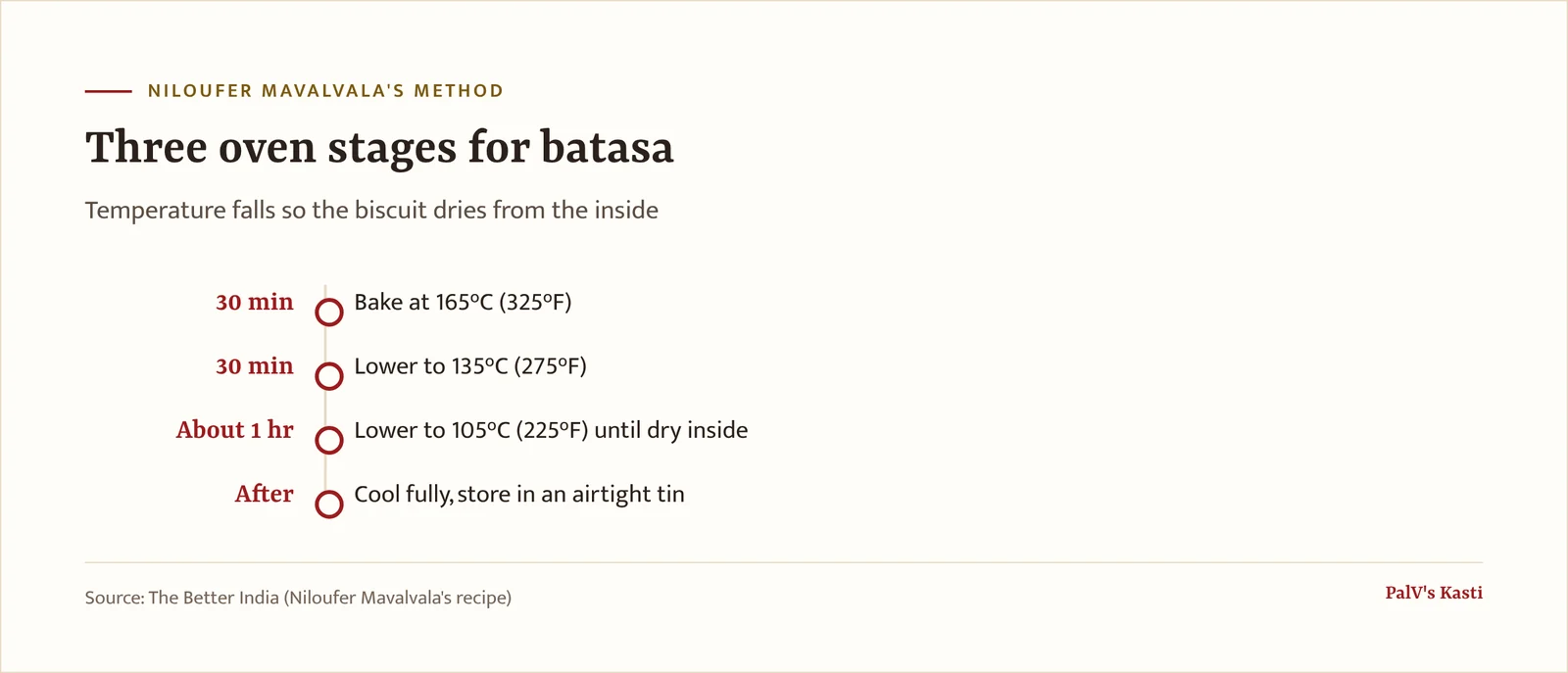
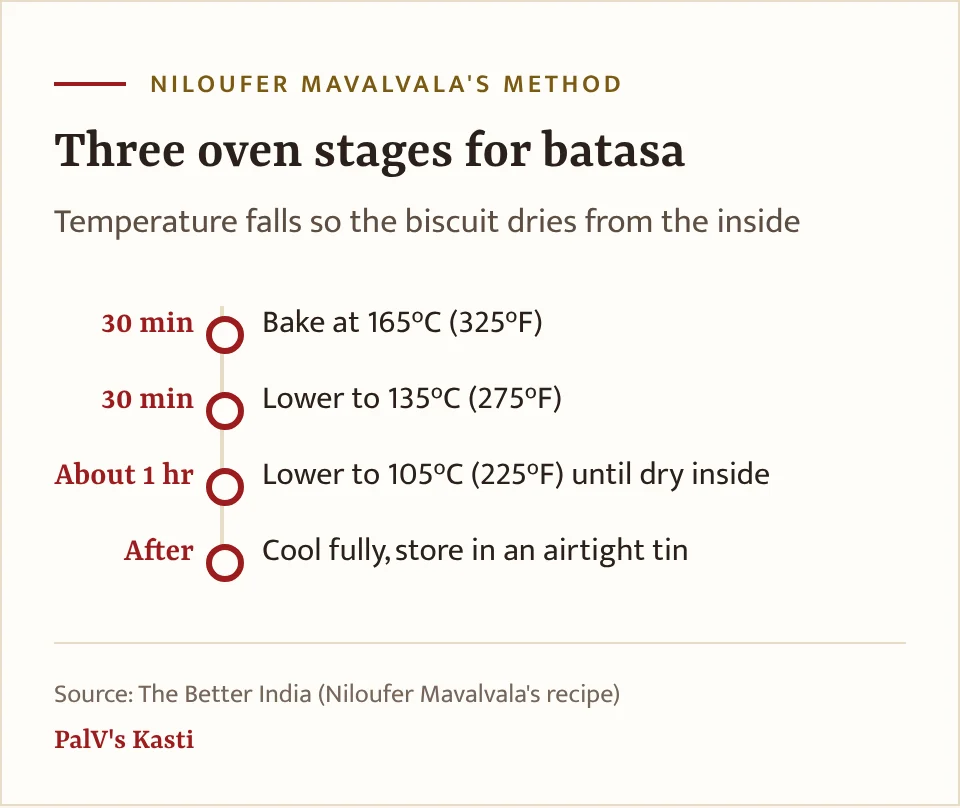
This method follows Niloufer Mavalvala's batasa recipe as published in The Better India in January 2020, in its plain form. It makes 48 to 60 biscuits. What matters is the falling oven temperature, which dries each biscuit from the inside.
Ingredients: 4 cups all-purpose flour (sifted), 1½ tsp salt, 3 tsp baking powder, 1 tbsp semolina, 1 cup (226 g) soft butter, about 8 tbsp water. For flavour, Mavalvala suggests 2 tsp caraway or cumin seeds. She does not say at which stage to add them. We stir them in with the dry ingredients.
- Stir the flour, semolina, baking powder and salt together in a bowl.
- Add the butter in small pieces and rub it in with your fingertips until the mix looks like tiny beads.
- Add water a tablespoon at a time until the dough just holds. It should feel soft and smooth, like rotli dough. Don't over-knead.
- On a lightly floured board, roll the dough into a long, even log and cut it into 48 to 60 pieces. Roll each piece gently into a ball and set it on a lined or lightly buttered tray.
- Bake at 165°C (325°F) for 30 minutes, then at 135°C (275°F) for 30 minutes.
- Drop to 105°C (225°F) and bake for about another hour, until the biscuits are dry inside.
- Cool and store in an airtight container.
Mavalvala's tip is to watch the colour: a finished batasa should be a light pink, not white. She also notes that plenty of recipes add a little yeast for aroma and texture, which she leaves to personal taste.
Where can you buy batasa today?
Surat is the obvious first stop. Dotivala Bakers & Confectioners, on Ardeshir Kotwal Road in Nanpura, names Surti Batasa beside its pure ghee nankhatai on its website, which also has an online shop and an order line. Kapadia names two more bakeries for these butter biscuits: Hormazd Bakery in Udvada and Kayani Bakery in Pune. She adds that they are usually found in Udvada, Surat and Navsari.
In the big cities it is harder. The Better India reported in 2020 that batasa could still be found in Irani tea houses in Mumbai and Pune, though fewer of them carried it. Ring ahead before you make the trip.
Frequently asked questions
What is batasa made of?
Batasa is made of all-purpose flour, butter or ghee, salt, a raising agent and a little water, often with caraway or cumin seeds. Niloufer Mavalvala's recipe adds a spoon of semolina and baking powder and uses no egg or milk. The Dotivala account describes it as dried bread made richer with extra shortening.
Is batasa sweet or salty?
Batasa is savoury. Parsi cookbook author Niloufer Mavalvala calls it a savoury butter biscuit and contrasts it with nankhatai, the sweet one. A few home recipes add a little sugar, but Mavalvala's own recipe uses only salt, and the biscuit is eaten as a savoury bite dipped into a strong cup of tea.
Where can you buy batasa?
Dotivala Bakers in Nanpura, Surat, sells Surti Batasa and takes orders through its website. Rita Kapadia of ParsiCuisine.com also names Hormazd Bakery in Udvada and Kayani Bakery in Pune. A 2020 Better India report found batasa in some Irani tea houses in Mumbai and Pune, though fewer of them carried it than before.
Is a makhania biscuit the same as batasa?
Yes, by Rita Jamshed Kapadia's account. Her ParsiCuisine.com recipe is titled "Butter Makhania Biscuits or Batasa", and she explains that makhania means butter. Her version uses butter, flour, baking powder, salt, caraway seeds and a teaspoon of sugar, which Niloufer Mavalvala's batasa leaves out altogether.
Why is batasa baked so slowly?
Mavalvala's recipe says the trick is to dry the batasa from the inside, so the change in heat matters. She bakes the biscuits at three falling temperatures, from 165°C down to 105°C, for about two hours in all. A finished batasa should look light pink rather than white, and it is stored airtight.


