 PalV's Kasti
On this page
- What does the word Navjote mean?
- At what age is the Navjote done?
- What happens at a Navjote?
- Why is the Navjote so significant?
- Is the Navjote the Parsi thread ceremony?
- What do Iranian Zoroastrians call the Navjote?
- How has the Navjote changed over the last century?
- Planning a Navjote for your child?
- Frequently asked questions
A Navjote is the ceremony at which a Parsi Zoroastrian child, boy or girl, is invested by a priest with the sacred shirt (sadra) and the sacred girdle (kusti) for the first time. The child first has a ritual bath, then declares the faith, is dressed in the sadra, has the kusti tied around the waist while prayers are recited, and receives the priest's blessing. Modi and Karanjia give seven as the starting point, Karanjia puts the usual range at seven to nine, and both give fifteen as the latest. From that day the child is held answerable for its own thoughts, words and deeds, and is expected to wear the sadra and kusti for life.
This page is our overview. Each part of the ceremony has its own detailed post, linked below where the topic comes up.
અસપંદામેદ રોજ
Asfandarmad Roj, Tir Mah · 1396 Y.Z.
What does the word Navjote mean?
The usual explanation splits the word in two: nav, new, and zot, a person who offers prayers. Dr. Jivanji Jamshedji Modi gave this reading in the 1914 second edition of his pamphlet on the ceremony, and Ervad Dr. Ramiyar Karanjia gives it today as "a new offerer of prayers". Modi explained the name this way: once the ceremony is done, the child carries the duty of praying and keeping the religious customs.
There is a second reading. In his 1922 book on Parsi ceremonies, Modi noted that some people took Naojote to be another form of naozad, a new birth, in the sense of a spiritual birth. The Encyclopaedia Iranica also describes the navjote, or naojote, as the "new birth" ceremony among Parsis. You will see the word spelt Navjote, Navjot and Naojote; all refer to the same rite.
At what age is the Navjote done?
The sources agree on a childhood ceremony with an upper limit of fifteen, but they give slightly different ages:
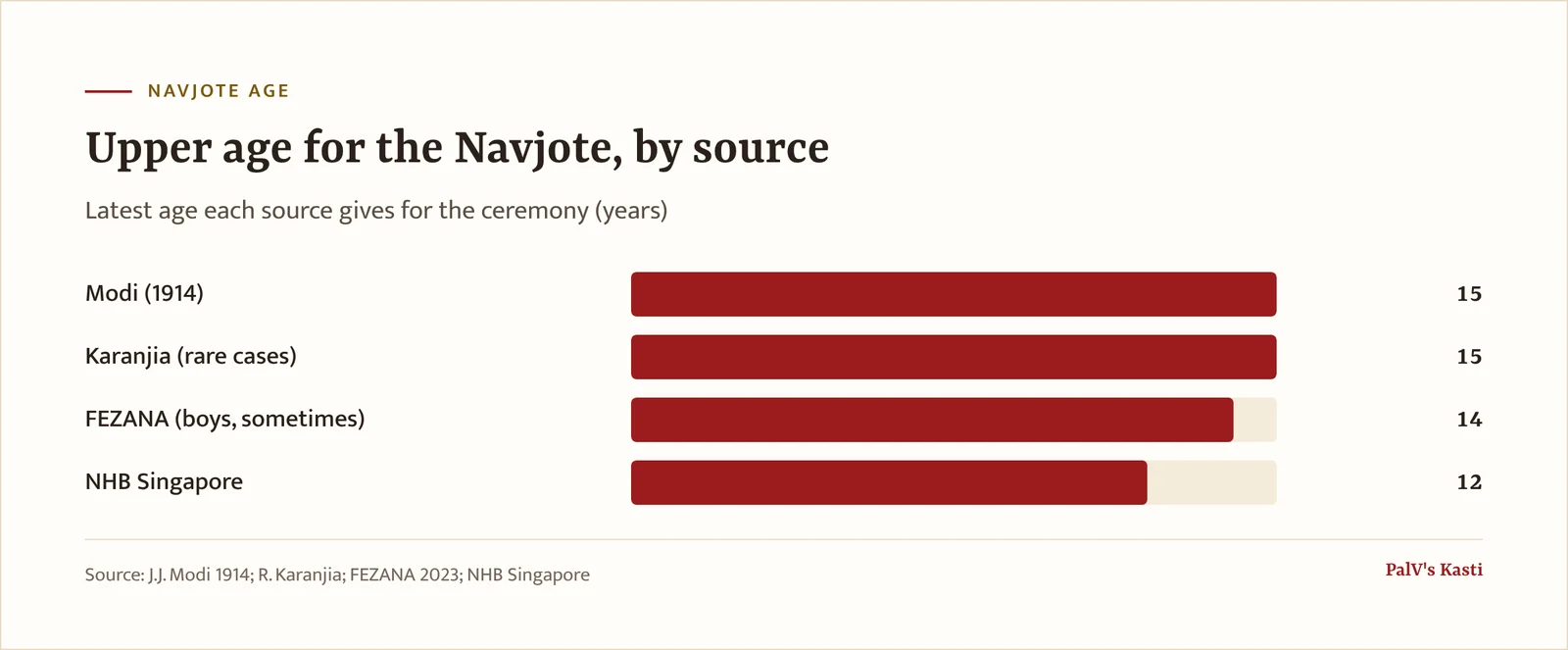
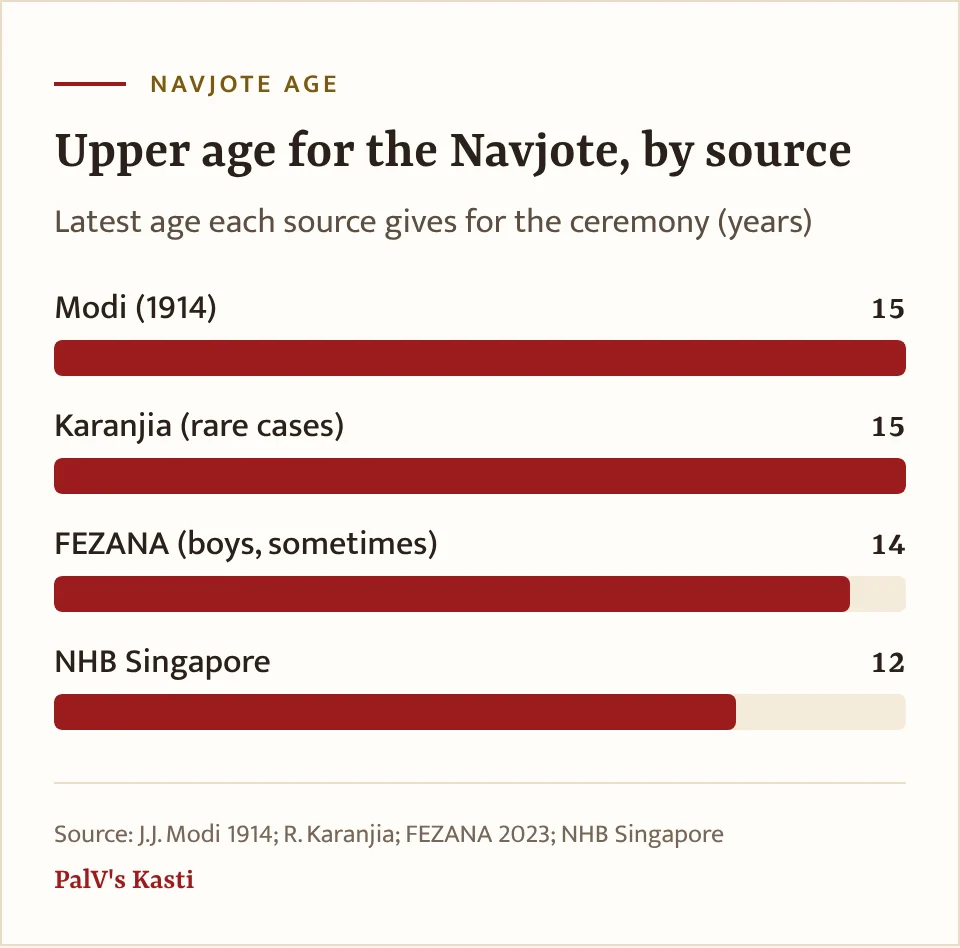
- Modi (1914) wrote that seven is the age at which the ceremony is enjoined, and that it may be put off for an unavoidable reason up to fifteen, but no later.
- Ervad Karanjia writes that it is generally performed between seven and nine, and only in rare cases up to fifteen. In a 2022 talk reported by Parsi Times, he put it between six complete and nine complete years.
- A 2023 FEZANA lesson plan for children gives seven to eleven, and sometimes up to fourteen for boys.
- Dosabhai Framji Karaka, writing in 1884, said the investiture could take place any time after the child reached six years and three months, but not before.
Both boys and girls have a Navjote. Karanjia, FEZANA and Karaka all say so in plain terms. Ervad Dr. Kersey Antia, writing in the FEZANA Journal in 1997, notes that in ancient Iran the step came at fifteen, and wrote that waiting until adulthood was then still the custom among Iranian Zoroastrians, while Parsis held it in childhood.
Practice varies between families and Agiaries; your family priest's guidance comes first.
What happens at a Navjote?
Modi divided the investiture proper into four parts, and Karanjia and Antia describe the same order. In outline:
- Nahan. The child is given a ritual bath, which Karanjia describes as cleansing body, mind and soul.
- Patet. Seated before the priests, the child joins the prayer of repentance. Antia writes that today the child is at least encouraged to recite the Ashem Vohu and Yatha Ahu Vairyo while the priests recite the Patet, and Karanjia describes the same practice.
- Declaration of faith. Standing, the child recites the Din no Kalmo, and the priest puts the sadra on the child.
- The kusti. The priest stands behind the child and ties the kusti around the waist while both recite the kusti prayer.
- Articles of faith. Child and priest recite the short statement of faith beginning "Jasa me avanghe Mazda", which Modi called the articles of faith.
- Blessing. The priest recites the Tandarosti blessing and showers the child with a mixture that, in both Modi's and Karanjia's accounts, includes rice, almonds and raisins.
Our Navjote ceremony steps post goes through each of these in detail, from the bath to the final blessing. What the child actually says, and what it means to call oneself Mazdayasni, is in our post on the Navjote declaration of faith. The things laid out on the trays for the day are covered in Navjote Ses tray, and clothing for the child and guests in What to wear to a Navjote.
Karanjia writes that the Navjote was traditionally held in the morning in a fire temple. Modi recorded in 1922 that it had always been a morning ceremony until a few years earlier, but was by then also held in the evening, to suit the family. Afterwards, family and friends give the child gifts and good wishes, and a meal usually follows.
Practice varies between families and Agiaries; your family priest's guidance comes first.
Why is the Navjote so significant?
The main shift is one of responsibility. Karanjia writes that from the day of the Navjote a child becomes responsible for all its actions. Antia says the initiate is answerable for his or her deeds from then on, which frees the parents of that responsibility. FEZANA's lesson plan puts it the same way: before the Navjote, the parents are responsible for the child's actions.
The second shift is daily practice. Modi wrote that, except while bathing, a Zoroastrian must always have the sadra and kusti on the body. Karanjia adds that after the Navjote the kusti is untied and retied with prayers several times a day. Not every child keeps this up, and we look at the reasons given in Why children stop wearing sadra-kusti. For the meaning of the garments themselves, see our pages on the Parsi Sadra meaning and the Parsi Kusti.
In a 2022 talk reported by Parsi Times, Karanjia summed up three things that happen at a Navjote: the child receives the gift of the sadra and kusti, a connection with Prophet Zarathushtra is made through the priest, and the child takes a lifelong vow to God, the prophet and the religion in the Din no Kalmo. Karanjia also calls the sadra a spiritual armour, a theme we cover in Navjote as spiritual protection.
Is the Navjote an entry into the faith, or a confirmation of a faith the child was born into? Writers disagree on this, and our Navjote myths and facts post sets out both views.
Practice varies between families and Agiaries; your family priest's guidance comes first.
Is the Navjote the Parsi thread ceremony?
The phrase "Parsi thread ceremony" compares the Navjote with rites of other faiths, and writers have drawn several such comparisons. Modi likened the Navjote to Confirmation among Christians. Antia compared it with the Hindu Janoi (sacred thread) ceremony and the Jewish Bar and Bat Mitzvah. He also pointed to a difference: the Janoi is given to males only, while Zoroastrian boys and girls alike have the Navjote. The kusti itself, as Modi and Karanjia describe it, is a girdle woven from 72 threads of lamb's wool; Karanjia adds that it goes three times around the waist.
What do Iranian Zoroastrians call the Navjote?
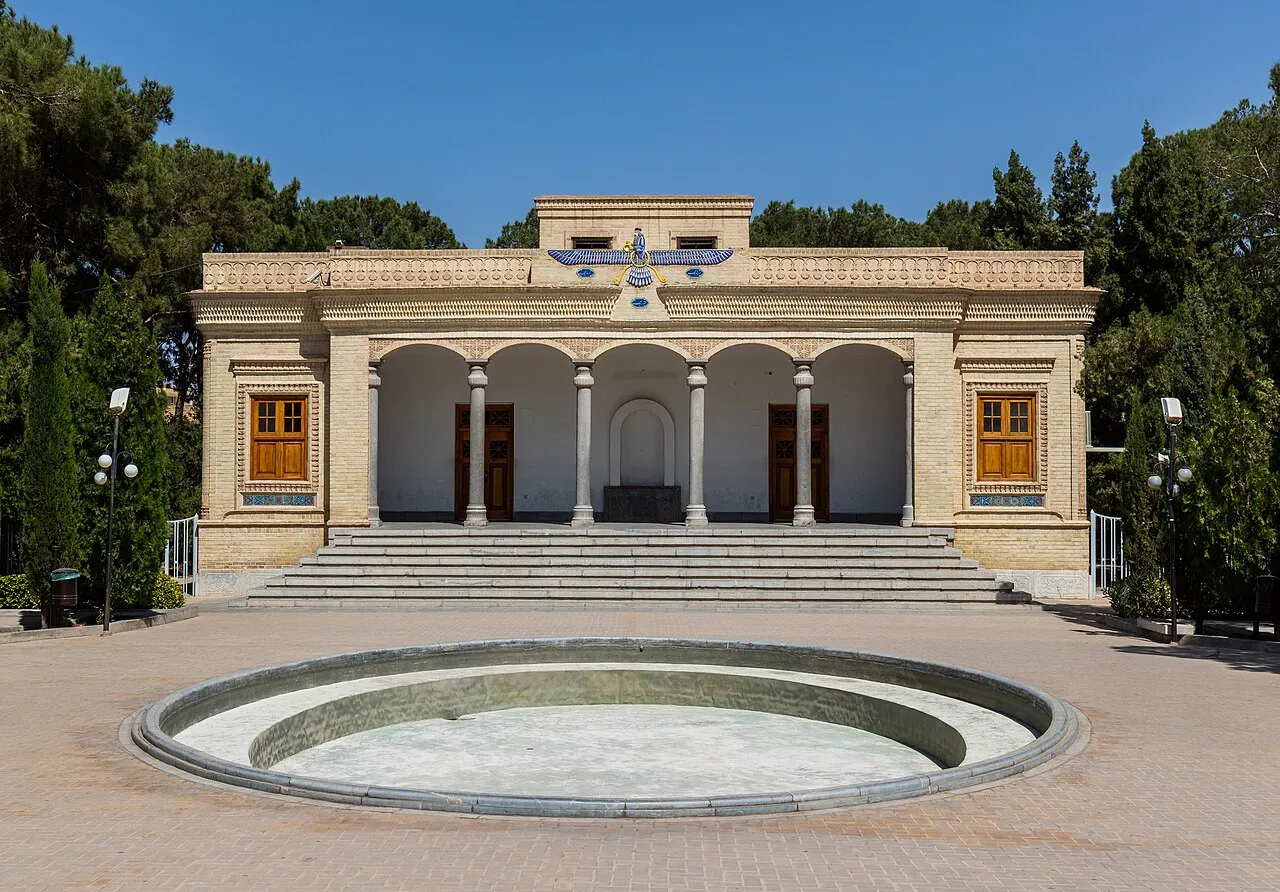
Iranian Zoroastrians call it Sedreh-pushi. The Encyclopaedia Iranica spells it sedra-pušun and translates it as "putting on the holy undershirt". Karanjia, in the same 2022 talk, said: "Our Iranian brothers refer to it as Sudreh-pushi." Both names describe the investiture with sadra and kusti; how the two differ, including the age Antia mentions, is set out in our Sedreh-Pushi vs Navjote post. In the diaspora, Singapore's National Heritage Board lists the Navjote in its intangible heritage inventory, giving the age there as seven to twelve.
How has the Navjote changed over the last century?
Some details have shifted since Modi wrote: fewer prayers are now learnt by heart, and evening ceremonies became acceptable. The full comparison is in our Navjote ceremony history post, which follows Modi's 1914 account step by step.
Planning a Navjote for your child?
Start by fixing the date and time with your family priest. Our Navjote preparation checklist covers the prayers the child should learn and what to arrange. Guests often ask about Navjote gifts, and if you are sending cards, our post on Navjote invitation wording has sample text you can adapt.
Frequently asked questions
What is a Navjote ceremony in simple words?
It is the ceremony at which a Parsi Zoroastrian child is dressed by a priest in the sadra and kusti for the first time. After a ritual bath, the child declares the faith, the priest puts on the sadra and ties the kusti with prayers, and then blesses the child. Family and friends celebrate afterwards.
What does Navjote mean?
Modi and Karanjia both explain it as nav, new, plus zot, one who offers prayers, so "a new offerer of prayers". Modi also recorded a second reading, from naozad, meaning new birth, and Encyclopaedia Iranica calls the navjote the "new birth" ceremony among Parsis. Naojote and Navjot are other spellings.
At what age should a child have a Navjote?
Modi wrote in 1914 that seven is the enjoined age and fifteen the latest. Ervad Karanjia gives seven to nine as usual, and FEZANA's lesson plan gives seven to eleven, sometimes up to fourteen for boys. Your family priest will advise on timing for your own child, especially if the ceremony has been delayed.
Do girls have a Navjote too?
Yes. Ervad Karanjia, FEZANA and the 1884 historian Dosabhai Framji Karaka all state that both boys and girls are invested with the sadra and kusti. Antia points out that this sets the Navjote apart from the Hindu Janoi, which is given to males only. Your family priest can tell you how the ceremony is arranged for a girl.
What is the Navjote called in Iran?
Iranian Zoroastrians call it Sedreh-pushi, sometimes written Sudreh-pushi or sedra-pušun. Encyclopaedia Iranica translates the name as "putting on the holy undershirt". The central act is the same as in the Parsi Navjote, the investiture with sadra and kusti. Antia wrote in 1997 that Iranian Zoroastrians then still waited until adulthood.


