 PalV's Kasti
On this page
- What are the two sides in the Parsi intermarriage debate?
- What are the main arguments against intermarriage?
- What are the main arguments for accepting intermarried Parsis?
- What do the population studies add to the debate?
- Why do Parsis marry outside the community?
- Where do Parsis stand on the question today?
- Frequently asked questions
The Parsi intermarriage debate has two broad camps, and each speaks in its own words below. Those against marrying out argue from scripture, from the wish to keep a distinct Parsi identity, and from who should share in community trusts. Those who want intermarried Parsis and their children accepted argue that the scriptures contain no ban, that women are treated worse than men who do the same thing, and that a shrinking community cannot afford to turn its own away. Researchers who study the numbers add a third strand: they point to very low fertility, and to late marriage or none at all, as the main causes of decline. We set out each position as its proponents stated it, with names and dates, and take no side.
અસપંદામેદ રોજ
Asfandarmad Roj, Tir Mah · 1396 Y.Z.
What are the two sides in the Parsi intermarriage debate?
Encyclopaedia Iranica's entry on conversion in modern times (Pargol Saati, 1993) describes Zoroastrian opinion as clustering around "two general tendencies, reformist and traditionalist". Between them sit moderates, some of whom, the entry says, accept the spouses and children of mixed marriages. At the strict end are those who will not accept even Zoroastrians who marry outside the faith.
Each side also says it speaks for most Parsis. Outlook reported on 21 April 2003 that Dastur Firoze Kotwal, a high priest, believed that in their hearts most Parsis prefer to marry other Parsis. In the same report the solicitor Berjis Desai answered that "the liberals are the majority but they are silent". A 2023 survey, described further down, gives some figures.
For the legal position and the court case pending as of 16 November 2026, see our main guide, Can Parsis marry non-Parsis.
What are the main arguments against intermarriage?
The scriptural argument
Dastur Firoze Kotwal told the Christian Science Monitor in May 1998 that, in his reading, the Zoroastrian scriptures outlaw all intermarriages. In a resolution published in March 2003, six high priests declared marriages outside the community irreligious and barred the children of such marriages, Outlook reported, and they cited the Vendidad in its support. Asked how the community would survive, Kotwal told Outlook: "It's better to have fewer, more devout Parsis."
Ervad Marzban Hathiram gave a spiritual reason on his Frashogard site on 13 October 2016. He wrote that married life is beneficial when the "Fire Energies" of both partners are of the same type, which is why, in his words, a union between people of two differing faiths is "strictly discouraged" for men and women alike.
A related charge, that of "religious adultery", is examined on its own page, the Religious adultery debate.
Practice varies between families and Agiaries; your family priest's guidance comes first.
Keeping a distinct identity
At the Udwada, Gujarat, one of the holiest Zoroastrian fire temples.">Iranshah Udvada Utsav in January 2016, Gordafrid Aresh objected from the floor to a speech by the lawyer Darius Khambata. Asian Voice reported her saying that a person who wants to follow Zoroastrianism is welcome to do so at home, but that she found entry into consecrated Agiaries intolerable. Asian Voice summarised her view that the community's unique identity would have vanished long ago if Parsis had opened their doors and integrated.
Some argue from family duty. Khushnood Viccaji, who with two friends ran the free Parsimatrimonials.com site, told Open magazine in December 2014 that marrying out "is unacceptable" from a religious point of view, and that a child raised in a Parsi family knows "it is a sin to marry out". In the same Open report, Kaiyan Mistree said his parents had told him from the beginning that it was his responsibility to protect the community, and his fiancée Shireen Havewala said that once she was sure she would not give up the Zoroastrian way of life, marrying a non-Parsi was not an option.
Who should share in community trusts
A trustee of the Bombay Parsi Punchayet, speaking without being named, told ThePrint in August 2023 that the BPP allots houses according to the legal definition of who is a Parsi. Opening up that definition, the trustee said, would mean that everyone would want to sign up for "cheap housing in Mumbai". Twenty years earlier, the matchmaker Mithu Jessia put a related point to Outlook about intermarried Parsis who still want community rights: "They can't have it both ways."
What are the main arguments for accepting intermarried Parsis?
No scriptural ban, and no rule that treats women differently
In the same 1998 Christian Science Monitor report, the vice-chairperson of the Association of Inter-married Zoroastrians, a member of the Godrej family who had married a Christian, said there was "no injunction against intermarriage in our holy books" and asked why people should look down on intermarried women. Noshir Dadrawala wrote in Parsi Times on 28 October 2017 that the Vendidad and the Pahlavi Dinkard do discourage inter-faith unions, but that no sacred text says men may marry out and women may not, and none says a person stops being Zoroastrian by marrying a non-Zoroastrian.
Dr Kersey Antia, in The Argument for Acceptance in Zoroastrianism (2015, expanded from his 1985 reply to three high priests published by Parsiana Publications), quotes the scholar Martin Haug's finding that no extant Avesta text appears to directly prohibit intermarriage between Zoroastrians and non-Zoroastrians. Outlook's 2003 report also noted that others say the Gathas, which it described as more central scriptural texts, make no such demand.
Practice varies between families and Agiaries; your family priest's guidance comes first.
Equal treatment for women
The Udvada head priest, Dasturji Khurshed Dastoor, spoke at the same 2016 Utsav. Asian Voice reported that he condemned the practice of admitting the children of Parsi men who marry non-Parsi women while excluding those of Parsi women, and quoted him asking: "Why should we shy away from the problem?"
That difference between sons and daughters goes back to how Parsi descent has been defined in court and custom, which is the subject of Parsi patrilineal lineage. Vispy Wadia, president of the Association of Intermarried Parsis, told ThePrint in 2023 that women who marry out are no longer socially ostracised, "but there's religious othering of women". Our article on Half-Parsis covers the cases intermarried women and their children have taken to court.
A small community cannot afford to turn its own away
Jehangir Patel, editor of Parsiana, told Business Standard in September 2017 that the government's Jiyo Parsi scheme could have been used as a chance to welcome intermarried women and their children back. He accepted that many would say such a move "would destroy the community", but said that on weighing the pros and cons, "it would be worth it". The author Prochy N. Mehta put it more starkly to t2 in December 2022: if the community excommunicates a quarter of its women and their children, "you are left with nothing".
Darius Khambata went further at the 2016 Utsav, arguing for converts too. Asian Voice quoted him warning against trying to save "our ethnicity at the cost of our religion".
What do the population studies add to the debate?
Researchers who study the numbers do not all draw the same lesson. Zubin Shroff and Marcia Castro, in a 2011 study in Demographic Research, concluded that at current fertility, accepting the children of intermarried women would have a negligible effect on Mumbai's decline, which is "driven chiefly by extremely low fertility". Dinyar Patel, a Harvard researcher of Parsi history, told Open in 2014 that the significant reasons were "non-marriage and late marriage". Simin Patel, then an Oxford doctoral student, told the same magazine that the decline was terminal unless the community gave up on race purity.
Why do Parsis marry outside the community?
The most common answer from within the community is that it has become hard to meet another Parsi. Viraf Mehta, a founding member of the youth group ZYNG and a BPP trustee, told ThePrint in 2023 that almost half of Parsi marriages in Mumbai were interfaith "because young Parsis are unable to meet eligible Parsis". He estimated that only about 60% of Mumbai's community lived in Parsi-owned buildings. Zarine Havewala of the BPP's matrimonial bureau told Open in 2014 that people who came to the bureau were serious about marrying Parsis, but that after a few years without success it was natural for them to look beyond the community.
SOAS's 2023 survey "Gen Z and Beyond" (Engineer, Turtle and Stewart; 5,003 respondents) found that among respondents aged 18 to 25 who were in a relationship, nearly half (49.5%) had a non-Zoroastrian partner or spouse.
Where do Parsis stand on the question today?
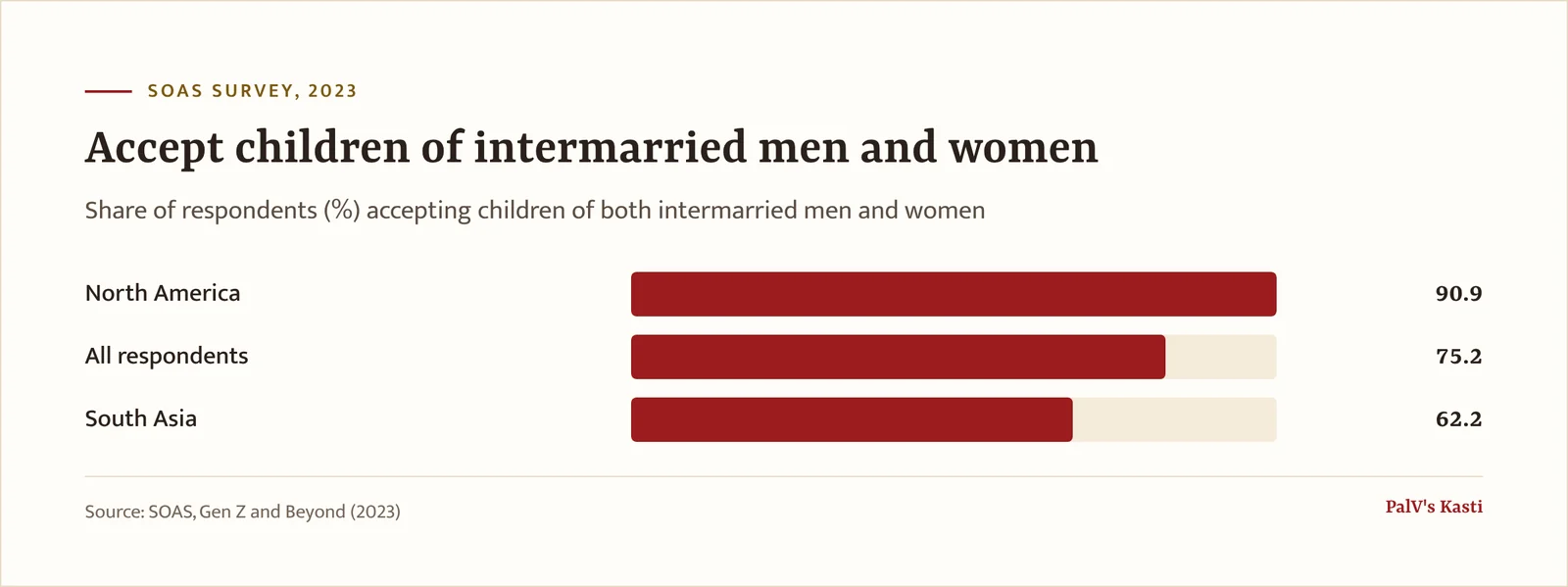
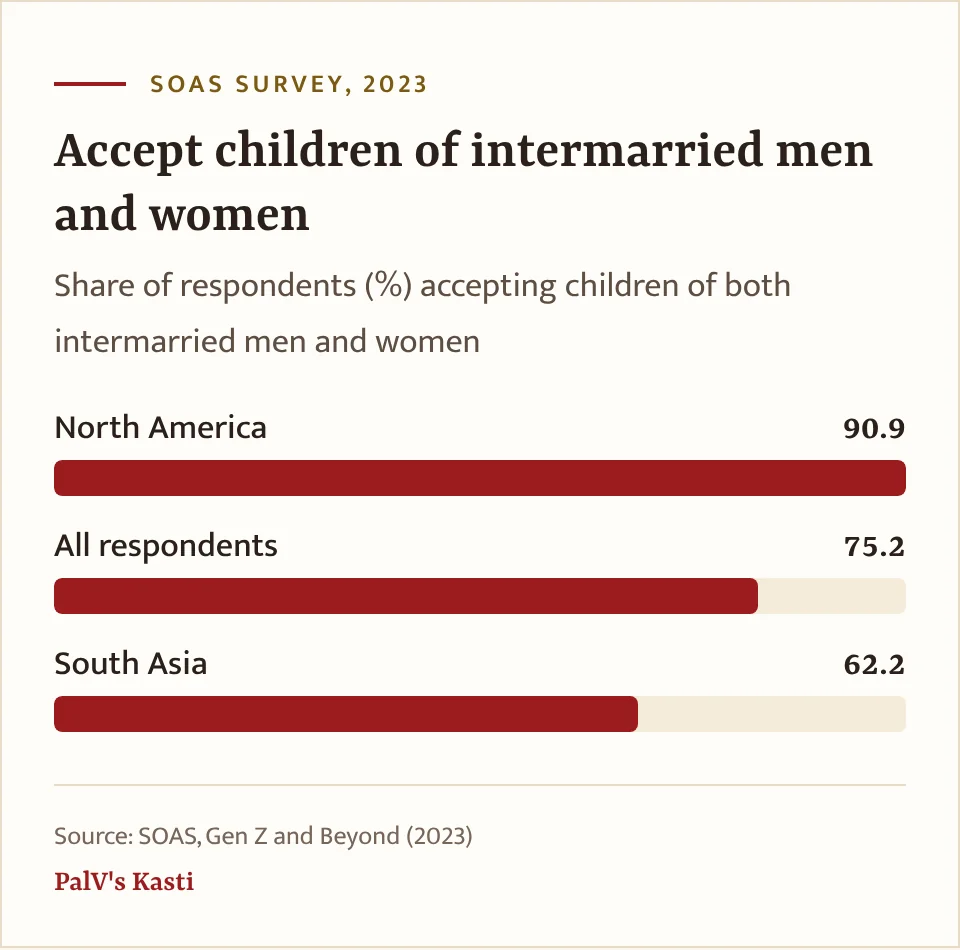
The same SOAS survey gives the clearest recent snapshot. Across all respondents, 77.4% accepted intermarried Zoroastrian men and women as Zoroastrian, and 10.6% accepted neither. On children, 75.2% accepted the children of both intermarried men and intermarried women. That figure was 90.9% among respondents in North America and 62.2% in South Asia.
Among single respondents, 47.6% wanted only a Zoroastrian partner and 50.8% were open to either. Respondents in South Asia were much likelier than those in North America to want only a Zoroastrian partner (62.4% against 23.9%).
Frequently asked questions
Why do some Parsis oppose intermarriage?
Their reasons fall into three groups. Some high priests, such as Dastur Firoze Kotwal in 1998, have said the scriptures forbid it. Others, like Gordafrid Aresh in 2016, argue that a distinct Parsi identity would not have survived integration. A BPP trustee told ThePrint in 2023 that widening the definition would bring a rush of claims on cheap community housing.
Why do some Parsis want intermarried members accepted?
They argue that no holy book bans intermarriage, as the vice-chairperson of the Association of Inter-married Zoroastrians said in 1998, and that no text treats women differently from men, as Noshir Dadrawala wrote in 2017. In 2016 Udvada's Dasturji Khurshed Dastoor criticised admitting only Parsi men's children. Parsiana's Jehangir Patel argued in 2017 for welcoming them back.
Why do Parsis marry outside the community?
Most often because meeting another Parsi has become hard. BPP trustee Viraf Mehta told ThePrint in 2023 that almost half of Mumbai's Parsi marriages were interfaith for that reason. In SOAS's 2023 survey, 49.5% of respondents aged 18 to 25 who were in a relationship had a non-Zoroastrian partner or spouse.
Should the children of intermarried Parsis be accepted?
Opinion is split. Outlook reported in 2003 that six high priests had resolved to bar the children of marriages outside the community. In 2016 Udvada's Dasturji Khurshed Dastoor condemned admitting only the children of Parsi men who marry out. In SOAS's 2023 survey, 75.2% of respondents accepted the children of both intermarried men and women.
Do most Parsis accept intermarried members today?
In SOAS's 2023 survey of 5,003 respondents, 77.4% accepted intermarried men and women as Zoroastrian and 10.6% accepted neither. Views differ sharply by region: 90.9% in North America accepted the children of intermarried men and women, compared with 62.2% in South Asia. Singles in South Asia were also far likelier to want only a Zoroastrian partner.


