 PalV's Kasti
On this page
According to the main projection study on the question, intermarriage plays only a small part in the future size of Mumbai's Parsi community while fertility stays as low as it is. Zubin Shroff and Marcia Castro modelled Mumbai's Parsi population from 2001 to 2051 in the journal Demographic Research in 2011. At current fertility, they found, whether the children of mixed marriages are counted makes only a few hundred people's difference by 2051, against a fall of more than half (our calculation). The rules would start to matter far more if fertility rose sharply. A second question is whether those children grow up Zoroastrian at all. In SOAS's 2023 survey, 66.2% of intermarried respondents were raising their children as Zoroastrian. How to weigh these findings is itself contested, and below we give each side in its own words.
અસપંદામેદ રોજ
Asfandarmad Roj, Tir Mah · 1396 Y.Z.
How many Parsis marry outside the community?
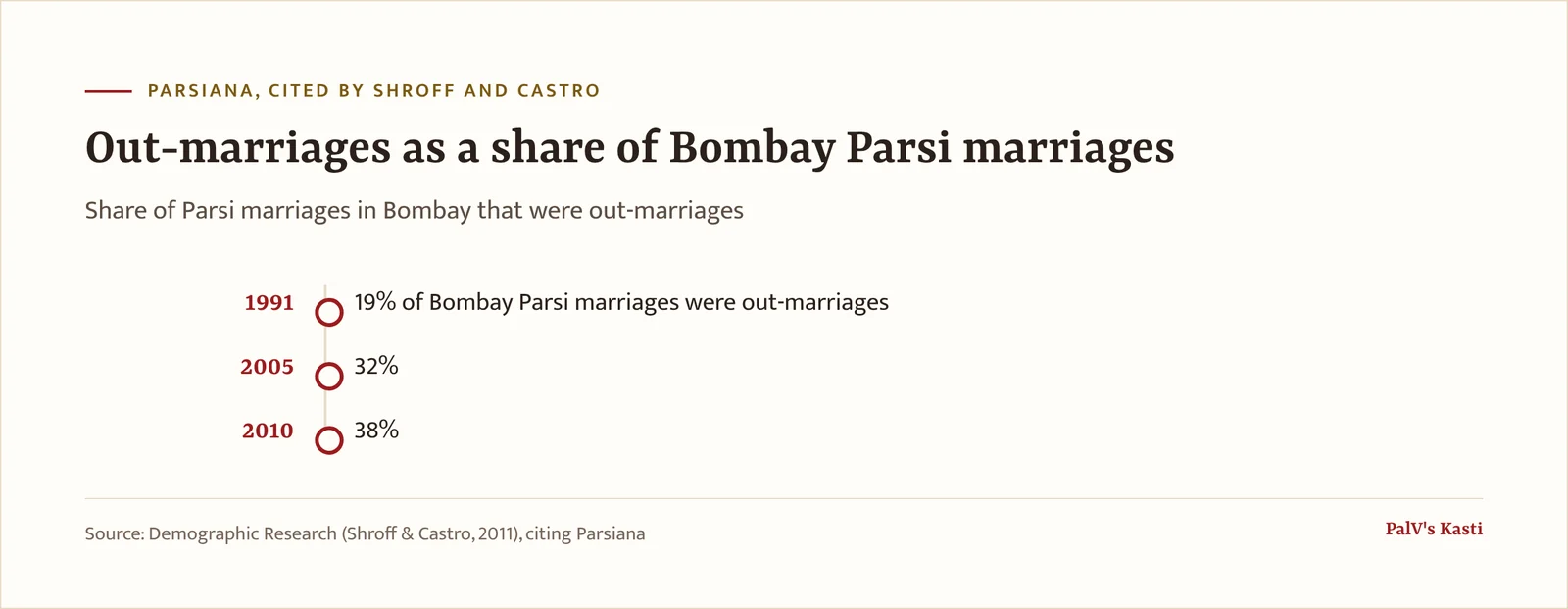
A rising share. Shroff and Castro, citing Parsiana, report that in 1991, 19% of Bombay's Parsi marriages were out-marriages. The share reached 32% in 2005 and 38% in 2010. The background is a small and shrinking base: the 2011 Census counted 57,264 people in India under "Parsi/Zorastrian", 55,306 of them in urban areas. What the law and the faith say about marrying out is in our main guide, Can Parsis marry non-Parsis.
What did the Mumbai projections find?
Shroff and Castro started from the 2001 Census figure of 46,557 Parsis in Mumbai and ran three scenarios.
- "Current trends": children of Parsi men who marry out are counted, children of Parsi women who marry out are not. Projected 2051 population: 20,122.
- "Accept all children": the children of Parsi women who marry out are counted too. Projected: 20,535.
- "No acceptance of intermarriage": children of both men and women who marry out are excluded. Projected: 19,136.
At the fertility the authors measured, the gap between the most open and the strictest rule is 1,399 people in 2051 (our calculation). Their conclusion was that changing social norms "on their own" have a negligible effect on the decline, which their abstract says is "driven chiefly by extremely low fertility". How the debate over these children plays out in practice is covered in Half-Parsis.
When would accepting the children make a difference?
Only if fertility rose a long way, according to the same study. Shroff and Castro reran each scenario with fertility doubled and with it trebled.
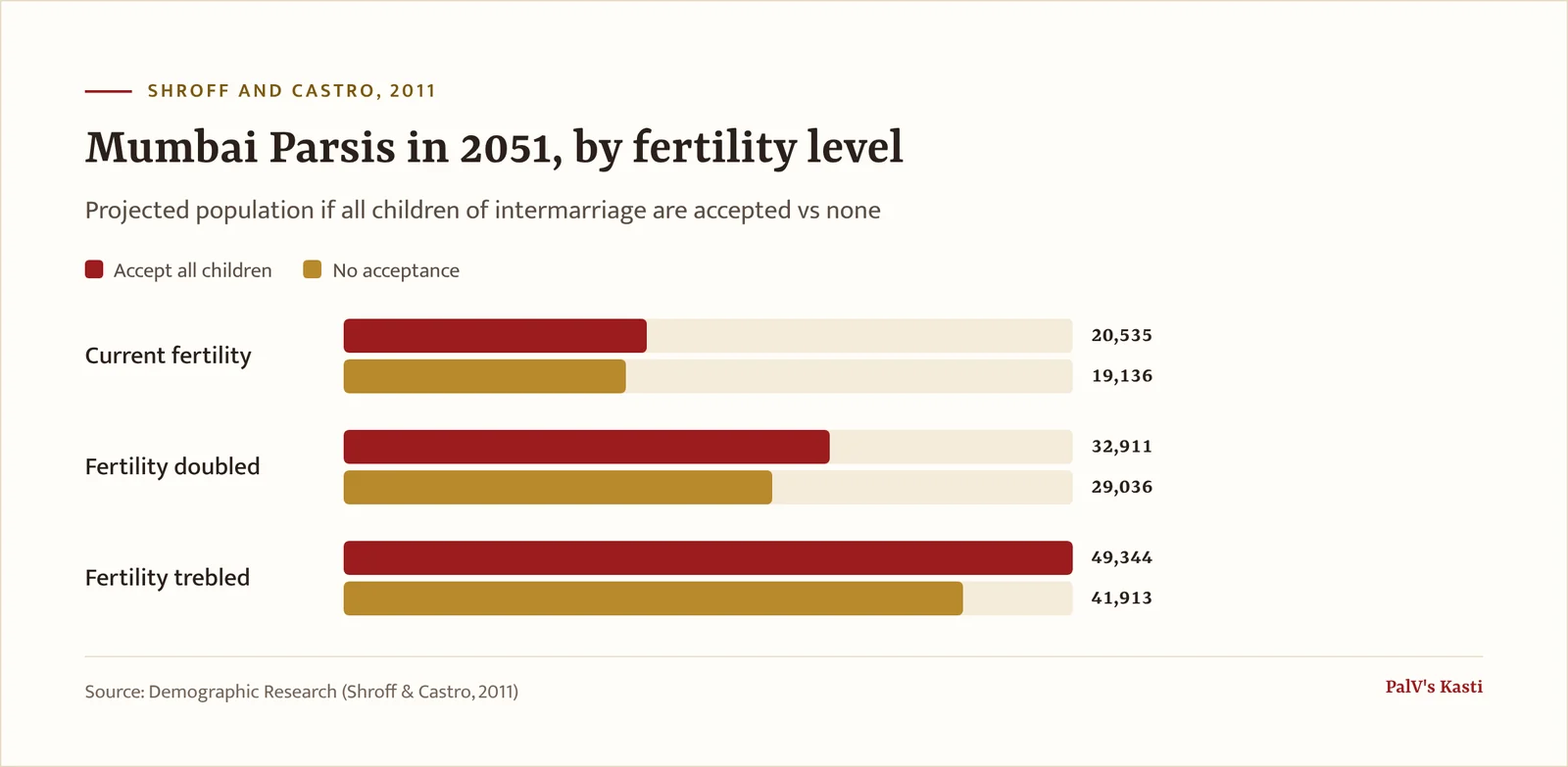
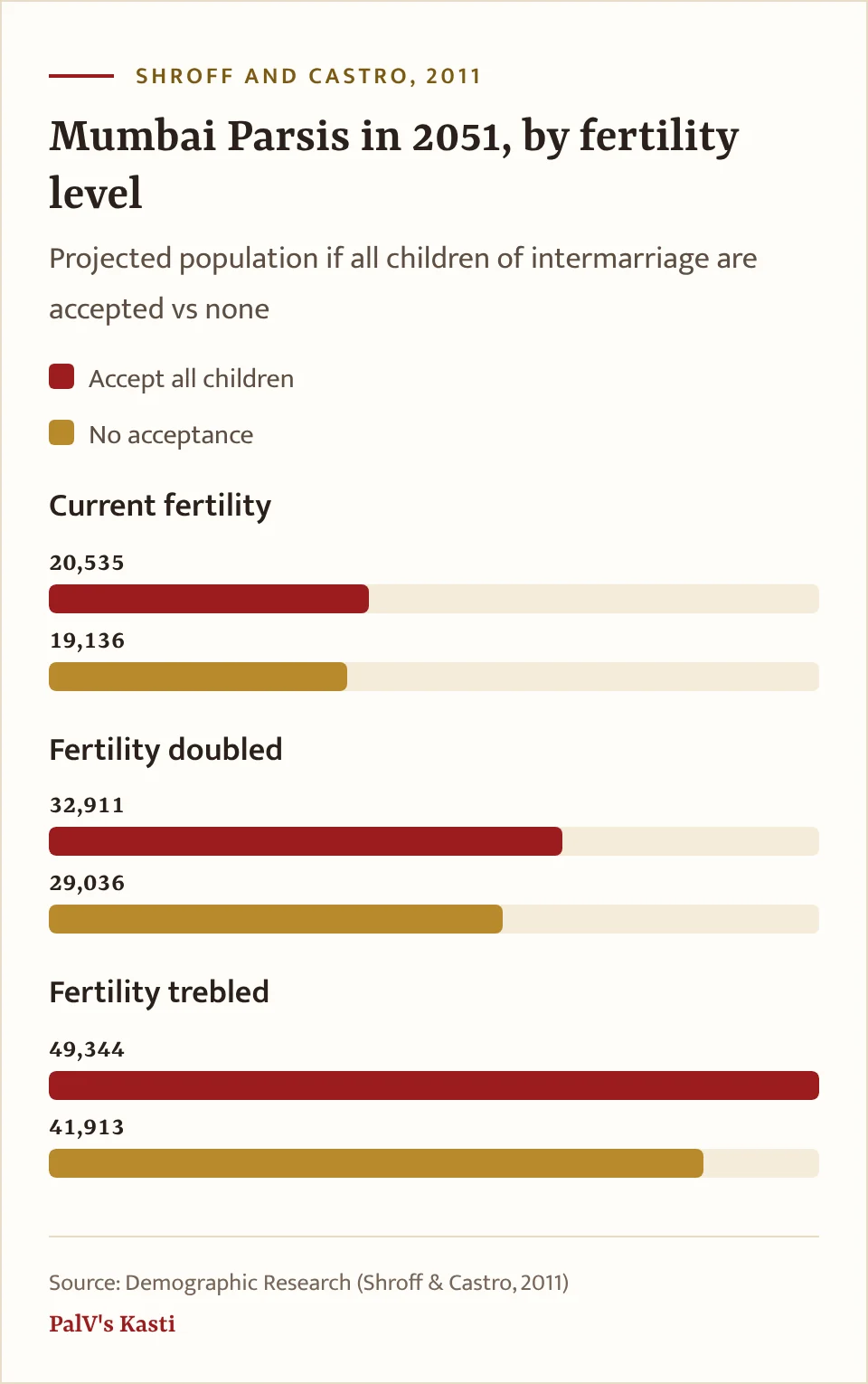
- With fertility doubled, Mumbai's 2051 population would be 32,911 if all children were accepted, 31,756 under current rules and 29,036 with no acceptance.
- With fertility trebled, the community would dip and then recover: 49,344 if all children were accepted, 47,116 under current rules and 41,913 with no acceptance.
In the authors' words, at higher fertility "the effect of intermarriage is more pronounced", and with fertility trebled the acceptance question "plays a far more significant role". They also tested doubling the number of Parsis marrying out. That made little difference, they found, because non-Parsi wives of Parsi men having Parsi children more than offsets the extra Parsi women who marry out. The 2051 figures were 21,052 with all children accepted, 20,215 under current rules and 18,277 with none.
The authors flag limits of their own. The 2001 baseline includes some Parsi women already married outside the community, so the projection overstates the population, though the comparison between scenarios still holds. The study also covers Mumbai only.
Do children of mixed marriages grow up Zoroastrian?
Many do, though not all. SOAS's "Gen Z and Beyond" survey (Nazneen Engineer, Joe Turtle and Sarah Stewart, April 2023; 5,003 respondents) found that 66.2% of respondents whose partner wasn't Zoroastrian were raising their children as Zoroastrian. Intermarried women were slightly less likely to do so than intermarried men, 63.3% against 68.8%.
The same report cites an earlier study by Bharat (2017), which found that 12% of intermarried men and 20% of intermarried women had not performed, or did not intend to perform, their child's navjote.
North America has its own figures. NY City Lens reported in 2015 that FEZANA's 2012 demographic study found more than 25% of children from intermarriages choosing not to follow the Zoroastrian faith, and a 36% rise in intermarriages between 2009 and 2011. Why the community has discouraged marrying out in the first place is covered in Why out-marriage is discouraged.
What do community voices say about numbers and intermarriage?
People in and around the community read the same figures in different ways. We set out each view as it was given, without a verdict of our own.
Those who say exclusion is shrinking the community
The author Prochy N. Mehta told The Telegraph's t2 in December 2022 that 50 per cent of marriages were now interfaith, and that excommunicating "25 per cent of the women and their children" leaves the community "with nothing". Parsiana's editor Jehangir Patel told Business Standard in 2017 that the Jiyo Parsi scheme could have been a chance to bring intermarried women and their children back into the fold.
Those who say marriage and fertility are the real issue
Others point away from intermarriage. Dinyar Patel, then a researcher of Parsi history at Harvard, told Open in 2014 that most Parsis don't know "the really significant reasons" for the decline, which he named as "non-marriage and late marriage". Open itself put the unmarried share of the community at almost 30%. Three years later, Business Standard wrote that researchers had found over 30% of Parsis were "never married". Shroff and Castro's projections, above, likewise put low fertility first.
Other voices
Those behind Jiyo Parsi, which Business Standard described in 2017 as an initiative of the minority affairs ministry, the Parzor Foundation and the Bombay Parsi Punchayet, among others, have said the membership question is not theirs to settle. Shernaz Cama, who was spearheading it, told the paper that the issue of intermarried women is for the whole community to decide, and that changing the definition is "beyond the remit" of the scheme. The adman Sam Balsara, chairman of Madison World, speaking about its advertising campaigns in the same report, said no one had handed the team "the mandate to decide who is Parsi". On the global picture, SOAS's Almut Hintze, a professor of Zoroastrianism, told the Associated Press in an email published in July 2022 that numbers "could well" stabilise, "although secularisation and the marriage laws pose threats".
Meeting a Parsi partner is its own difficulty, discussed in Dating within the faith.
Frequently asked questions
Would accepting children of intermarried Parsi women stop the decline?
Not on its own, according to Shroff and Castro's 2011 projections for Mumbai. At current fertility, counting all those children gave 20,535 Parsis in 2051, against 20,122 under current rules. With fertility trebled, the gap widened to 49,344 against 47,116, so the rule matters more if birth rates rise.
How many Parsis marry outside the community?
Citing Parsiana, Shroff and Castro report that out-marriages were 19% of Bombay's Parsi marriages in 1991, reaching 32% in 2005 and 38% in 2010. The author Prochy N. Mehta gave a higher figure, telling t2 in 2022 that 50 per cent of marriages were interfaith.
Do children of intermarried Parsis follow the Zoroastrian faith?
Most do, going by SOAS's 2023 survey, in which 66.2% of intermarried respondents were raising their children as Zoroastrian: 68.8% of men and 63.3% of women. In North America, FEZANA's 2012 study, as reported by NY City Lens, found more than 25% of children from intermarriages not following the faith.
How many Parsis are there in India?
The 2011 Census recorded 57,264 people in India under the label "Parsi/Zorastrian": 28,115 males and 29,149 females. Of these, 55,306 lived in urban areas and 1,958 in rural areas. Shroff and Castro's projections start from the 2001 Census count for Mumbai, 46,557.
Does intermarriage cause the Parsi population decline?
The Mumbai projections suggest a limited part. Shroff and Castro found the decline was not very sensitive to the rate of intermarriage, because fertility is so low. Researcher Dinyar Patel told Open in 2014 that non-marriage and late marriage were the significant reasons. Prochy N. Mehta argues that excluding intermarried women adds to the losses.


