PalV's Kasti
On this page
- What did the 1908 Parsi Punchayet case say about these children?
- What did the Privy Council decide in Saklat v Bella?
- Can trustees stop priests from performing these children's Navjotes?
- What is before the Supreme Court now?
- How do trusts and priests treat these children today?
- Do Zoroastrians accept the children of intermarried women?
- Frequently asked questions
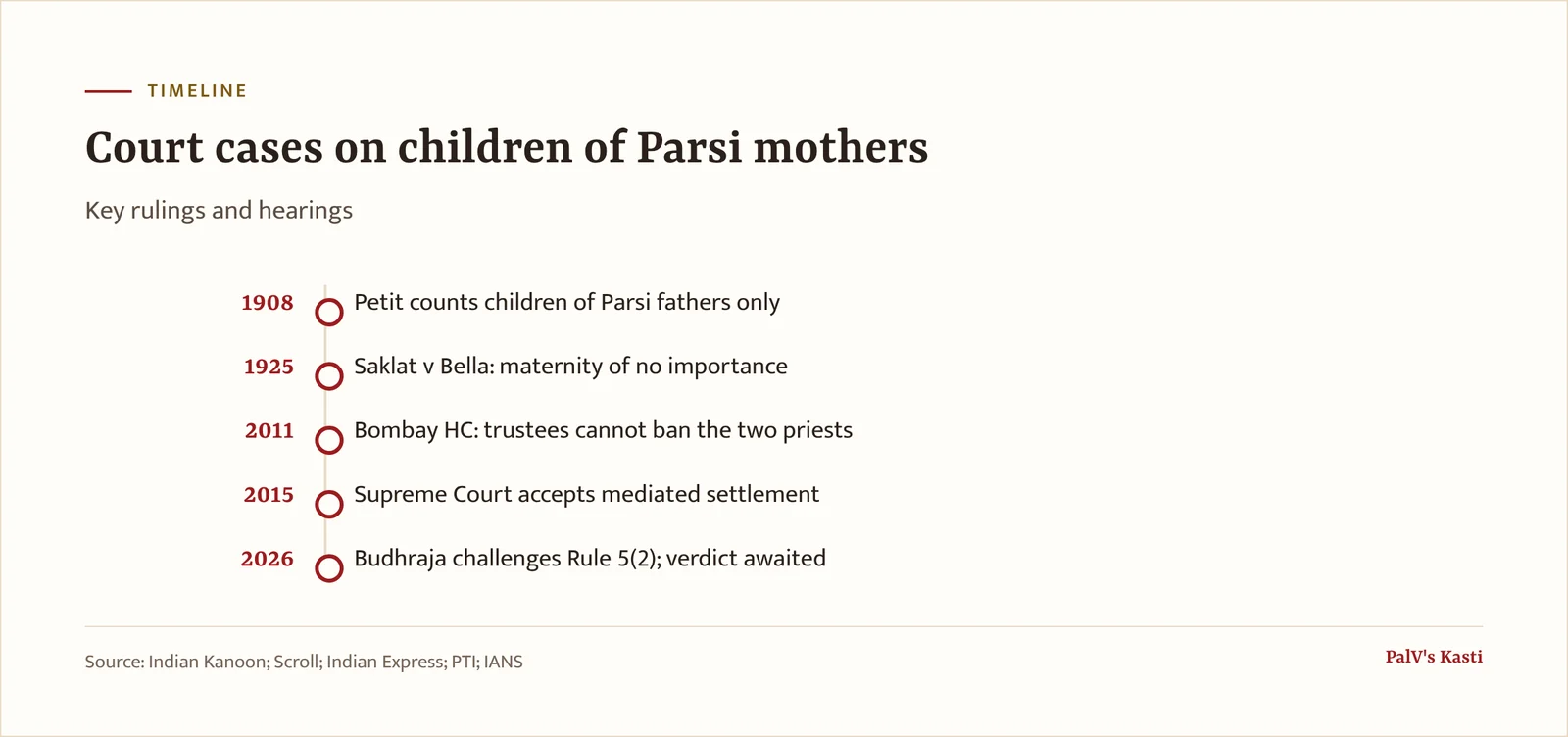
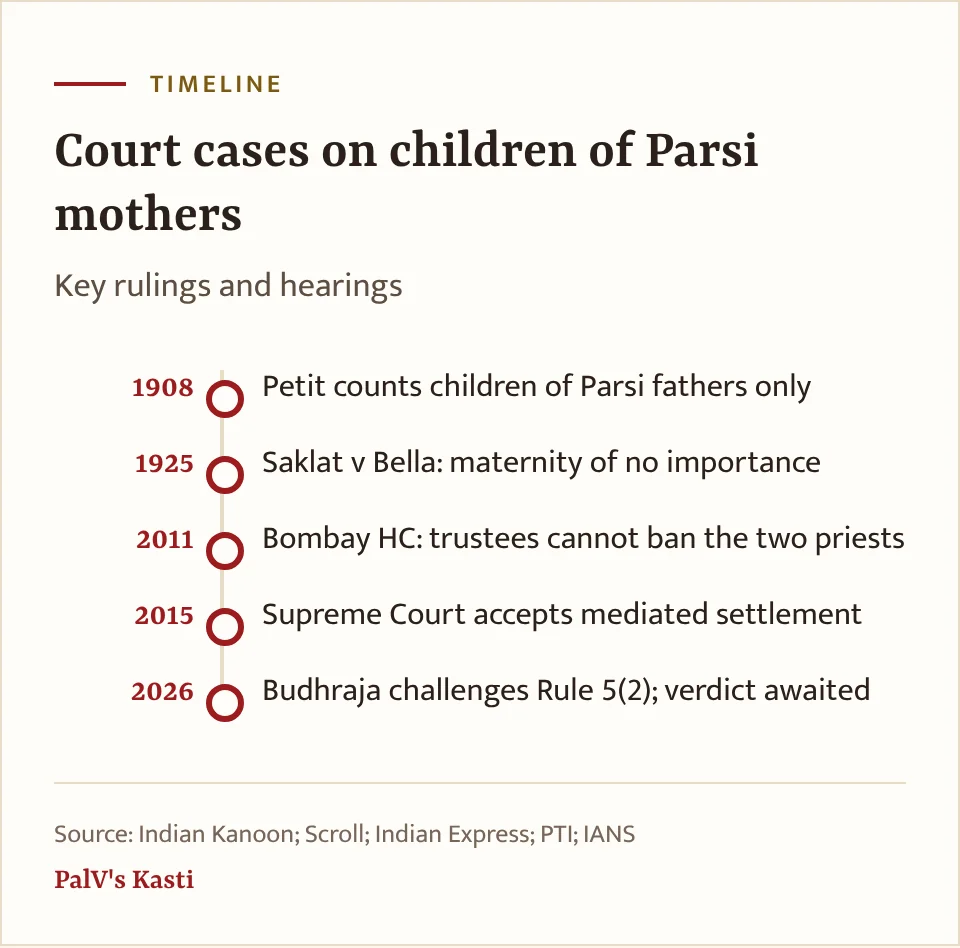
We have found no Indian judgment declaring that the children of a Parsi mother and a non-Parsi father are Parsis in law. The two old rulings that still frame the question, the Bombay High Court's Petit judgment of 1908 and the Privy Council's decision in Saklat v Bella in 1925, read the word "Parsi" through the father when deciding who may use community trusts and fire temples. Saklat accepted that such a child could be a Zoroastrian after her Navjote, but held she had no right as such to use the temple. In 2011 the Bombay High Court ruled that trustees could not ban priests for performing these children's Navjotes. The children's status is now part of cases before the Supreme Court, pending as of 16 November 2026.
અસપંદામેદ રોજ
Asfandarmad Roj, Tir Mah · 1396 Y.Z.
What did the 1908 Parsi Punchayet case say about these children?
In Petit v Jeejeebhoy, decided on 27 November 1908 and reported at (1909) ILR 33 Bom 509 and 11 Bom LR 85, Justice Davar set out who belonged to the Parsi community for the purpose of its funds and institutions. His list included Parsis born of two Zoroastrian parents, Iranis professing the religion, and the "children of Parsi fathers by alien mothers", once properly admitted into the faith. Children of Parsi mothers and non-Parsi fathers were not on it. Noshir Dadrawala noted in Parsi Times on 28 October 2017 that the definition leaves them out. The background to the case is in our article on Half-Parsis.
What did the Privy Council decide in Saklat v Bella?
Saklat v Bella turned on a child of a Parsi mother. Bella was born around 1899, soon after her mother came to Rangoon with a Goan Christian named Jones. Her mother said she was a Parsi, and after both parents died Bella was brought up in a Parsi household. When she was nearly fourteen, the local head priest refused to perform her Navjote, so a visiting priest did it. After she attended the fire temple on 21 March 1915, three members of the Rangoon community sued.
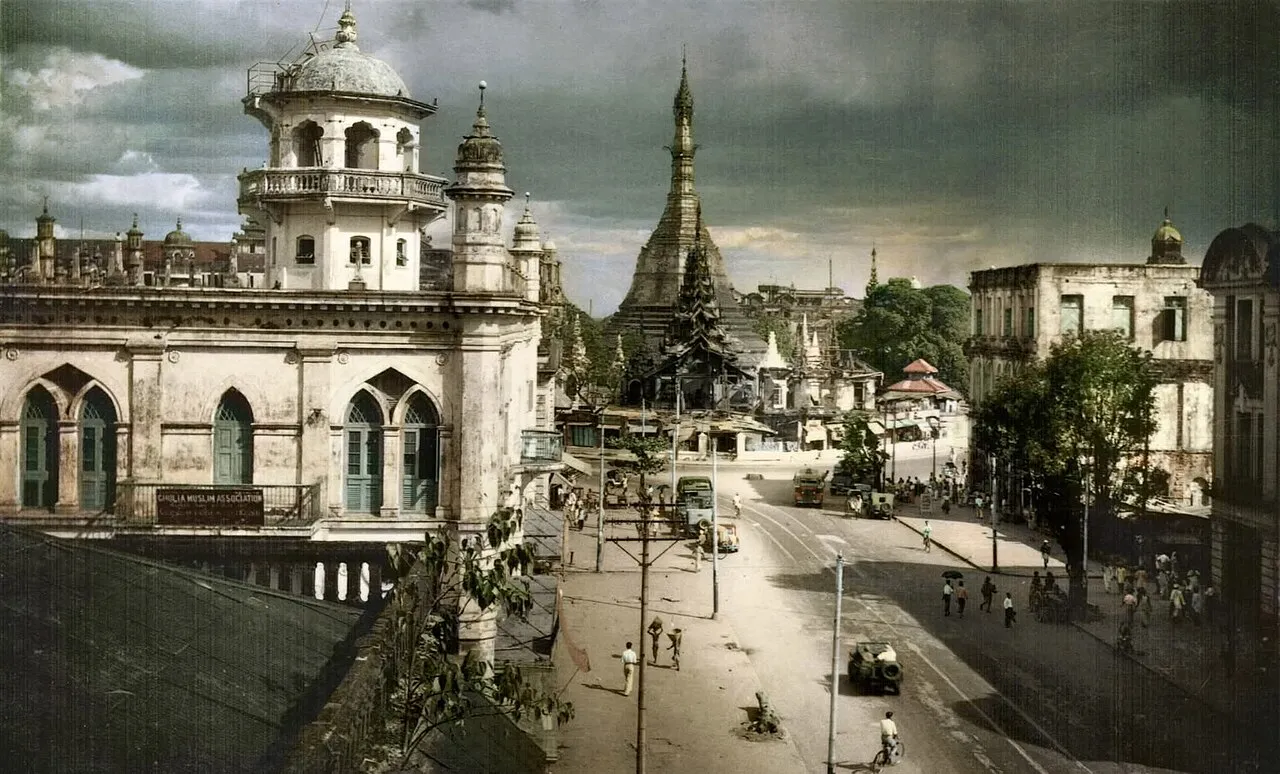
The Privy Council gave judgment on 22 October 1925, reported at (1926) 28 Bom LR 161. It agreed with the courts below that Bella's initiation into the religion had not been shown to be invalid. But it held that the temple's benefits were confined to people with "the double qualification of Zoroastrians and racial Parsis", and it added that "as regards the racial claim, maternity is of no importance". Its declaration was that she had no right, as such, to use the temple or join its ceremonies. So the court treated her as a Zoroastrian but not as a Parsi for the trust's purposes.
Can trustees stop priests from performing these children's Navjotes?
Not under the Bombay trust deed, the Bombay High Court held in 2011. On 9 June 2009 the trustees of the Bombay Parsi Punchayet resolved to keep two priests, Framroze Mirza and Khushroo Madon, from praying at Doongerwadi and two Agiaries. Among the ceremonies the resolution called unreligious was performing Navjotes of children of Parsi women married to non-Parsis. In Jamsheed Kanga v Parsi Panchayat Funds and Properties (Appeal No. 256 of 2010, decided 11 March 2011), Justices D.Y. Chandrachud and Anoop V. Mohta held that the ban "was not within the power and authority of the trustees". The court did not decide whether the children themselves are Parsis.
The trustees appealed. On 27 April 2015 the Supreme Court accepted a mediated settlement, Scroll reported: trustees could not limit any Parsi Zoroastrian's choice of priest in those three places, but Mirza and Madon could pray there only for immediate family funeral rites and only after filing an affidavit. Jamsheed Kanga said the settlement upheld the 2011 judgment. Kerssie Wadia, of the Association for the Revival of Zoroastrianism, called it "a complete sell-out". The wider rules on intermarried women are in our piece on Restrictions on intermarried women.
What is before the Supreme Court now?
Two matters touch the children's position. The first is Dina Budhraja's petition against the Nagpur Parsi Panchayat (W.P.(C) No. 381/2026). Rule 5(2) of the panchayat's constitution, as quoted by ThePrint and the Indian Express in March 2026, says a Parsi woman who marries a non-Parsi man and has children by him will not be accepted as Parsi, and nor will "her children". In 2023 Budhraja organised a Navjote for her son, and the panchayat's managing committee objected publicly, the Indian Express reported. Parsi Times reported on 4 November 2023 that the Bombay Parsi Punchayet had declared the child would not be recognised as Parsi, "in keeping with the law". Her petition argues that "Parsi" denotes descent and points out that people who are, in its words, "biologically 50% Parsi" through their fathers are accepted with full rights. On 30 May 2026 the court said it would await the nine-judge bench's judgment before deciding her case, PTI reported.
The second is Goolrokh Gupta's appeal (SLP (C) No. 18889/2012) against the Gujarat High Court's 2012 ruling that a Parsi woman who marries a non-Parsi under the Special Marriage Act is presumed to take her husband's religious status. Her case concerns her own standing, and she has spoken about what it means for children. "Children of women like me who marry non-Parsis are out," she told the Hindustan Times in February 2018. Her appeal was tagged to the Sabarimala reference, whose nine-judge bench reserved its verdict on 14 May 2026, as IANS and the Deccan Chronicle reported. LiveLaw's page on the reference, checked on 16 November 2026, shows no verdict. Both matters are pending as of 16 November 2026.
This is general information, not legal advice; for a specific case, speak to a lawyer.
How do trusts and priests treat these children today?
It depends on the trust and the priest. Dadrawala told the Hindustan Times in 2018 that no such bar applies to the children of men who marry out once their Navjote is done. Priyanka Sunjay, writing on the Oxford Human Rights Hub blog on 26 February 2018, said trusts that bar these children rely on a century-old case reading "Parsi" through a "patrilineal prism".
Prochy N. Mehta, author of Who is a Parsi? (2022), told The Telegraph's t2 on 7 December 2022 that at her Calcutta fire temple such children attended until the priests changed, and that the trust deed dated from 1915. She argues that children of interfaith couples who keep their religion became possible only after the Special Marriage Act of 1954, so "There can be no custom regarding that."
Priests are divided. Outlook reported on 21 April 2003 that six high priests had resolved to bar all children of mixed marriages, even those with Parsi fathers. Ervad Marzban Hathiram wrote on Frashogard on 13 October 2016 that where either partner is Zoroastrian, "male or female, it doesn't matter", the child cannot be classified as Zoroastrian. On the other side, Dasturji Khurshed Dastoor, the Udvada head priest, criticised admitting only the children of men who marry out, Asian Voice reported in January 2016. The Nagpur dispute and the priests' positions on these Navjotes are set out in Navjote of children of intermarried women.
Practice varies between families and Agiaries; your family priest's guidance comes first.
Do Zoroastrians accept the children of intermarried women?
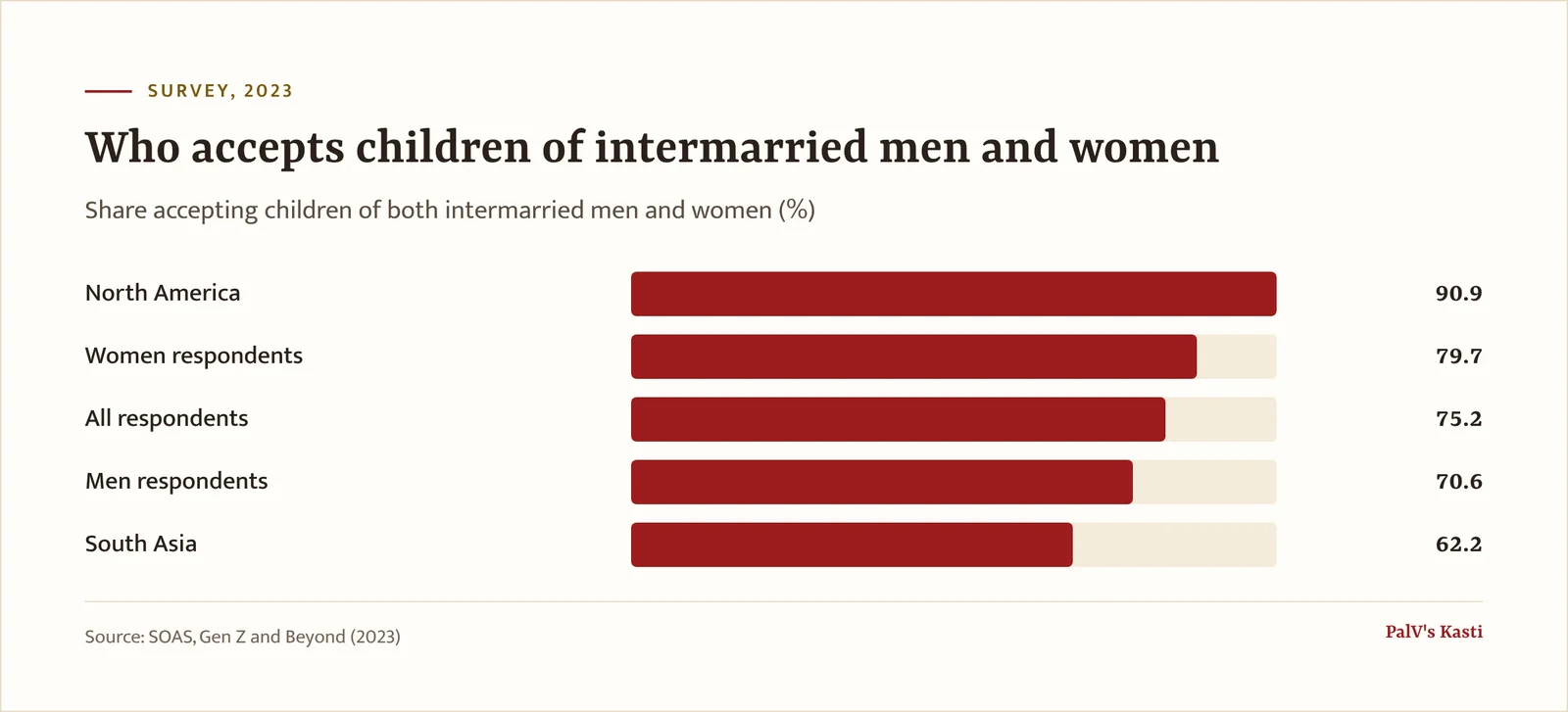
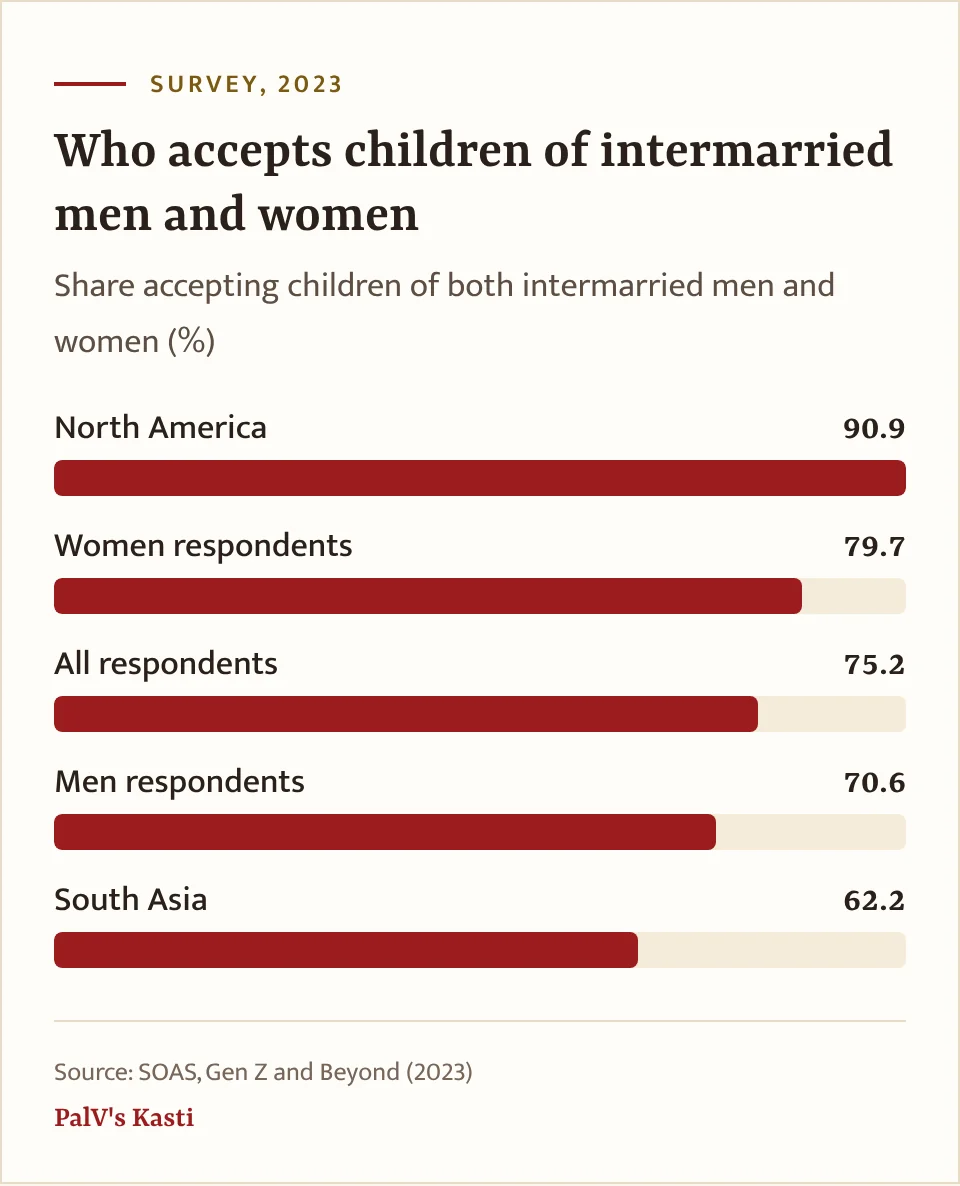
Most respondents to one large survey do, though fewer in South Asia. In "Gen Z and Beyond" (Nazneen Engineer, Joe Turtle and Sarah Stewart, SOAS, April 2023; 5,003 respondents worldwide), 75.2% accepted the children of both intermarried Zoroastrian men and intermarried women. Another 5.4% accepted only the children of intermarried men. Acceptance of the children was 90.9% among respondents in North America and 62.2% in South Asia. Women were more accepting than men, at 79.7% against 70.6%. For the day-to-day side, see Mixed marriage challenges, and the legal basics are in Can Parsis marry non-Parsis.
Frequently asked questions
Are children of Parsi mothers and non-Parsi fathers legally Parsi?
We have found no judgment declaring them Parsis. The 1908 Petit judgment counted children of Parsi fathers by non-Parsi mothers, not the reverse, and the Privy Council said in 1925 that maternity is of no importance to the racial claim. Whether trusts may exclude them today is part of cases pending before the Supreme Court as of 16 November 2026.
What did the court decide in Saklat v Bella?
The Privy Council, on 22 October 1925, accepted that Bella, a Rangoon girl whose father was a Goan Christian, had been validly initiated as a Zoroastrian. It still held that the temple was for those who were both Zoroastrians and racial Parsis, and declared she was not entitled, as of right, to use it.
Can a child of a Parsi mother and non-Parsi father have a Navjote?
Some priests have performed such Navjotes, and in 2011 the Bombay High Court held that the Bombay Parsi Punchayet's trustees had no power to ban two priests for doing so. Other priests and trusts refuse to recognise them. Dina Budhraja held one for her son in 2023, and the Nagpur panchayat objected publicly.
Does the Nagpur rule apply to the children too?
Yes. Rule 5(2) of the Nagpur Parsi Panchayat's constitution, as quoted in Dina Budhraja's petition, says that a Parsi woman who marries a non-Parsi man and has children by him will not be accepted, and nor will her children. She has asked the Supreme Court to strike the rule down. The case awaits the nine-judge bench's verdict.