 PalV's Kasti
On this page
Parsis who discourage marrying out give reasons of two kinds, religious and communal, and the disapproval itself has a long recorded history. On the religious side, Dastur Firoze Kotwal said in 1998 that the scriptures outlaw intermarriage, and Ervad Marzban Hathiram explains it as a spiritual mismatch between partners of different faiths. On the communal side, families speak of keeping a Zoroastrian home, of compatibility, and of sparing children the stigma mixed families can face. The Bombay High Court's 1908 judgment records Punchayet resolutions from 1829-1830 and 1836 against admitting the children of Parsi men by non-Parsi mistresses. Not everyone accepts these reasons. Noshir Dadrawala has written that the unequal treatment of women is "mainly historical and not necessarily doctrinal", and The Better India called the stance out of date in 2017. Below, each view is given in its holders' own words.
Whether a Parsi can legally marry a non-Parsi is a separate question, covered in Can Parsis marry non-Parsis.
અસપંદામેદ રોજ
Asfandarmad Roj, Tir Mah · 1396 Y.Z.
What religious reasons are given for not marrying out?
The strongest statements have come from high priests. Dastur Firoze Kotwal, then one of the high priests, told the Christian Science Monitor in May 1998 that, as he read them, the Zoroastrian scriptures outlaw all intermarriages.
Five years later, six high priests put their view in writing. Outlook reported on 21 April 2003 that six high priests had passed a resolution declaring marriages outside the community irreligious, published in the Jam-e-Jamshed on 23 March. Defending it, the priests told Outlook that, according to the Vendidad, Ahura Mazda "would be displeased" by a marriage between a Zoroastrian and a non-Zoroastrian. Asked how the community would survive such restrictions, Kotwal told the magazine, "We have survived hundreds of years of persecution, so where's the question of dying out?" and said it was "better to have fewer, more devout Parsis." What the Vendidad and the Gathas actually contain is the subject of our page on Scripture on mixed marriages.
The spiritual explanation in Ilm-e-Khshnoom writing
Ervad Marzban Hathiram, writing on his Frashogard site on 13 October 2016, gave a fuller account in a letter declining a friend's invitation to a Navjote. He described marriage as a sacrament and said married life is beneficial when "the Fire Energies of both persons" are of one type. Every faith, in his account, has its own kind of spiritual fire in its followers, and when partners of two faiths unite, those energies clash rather than mix well. That, he wrote, is why a union of two faiths is "strictly discouraged" in Zoroastrianism, for men and women alike. He added that for the same reason, marriage between priestly families and Behdins was once discouraged too.
Hathiram, who names the Khshnoom writers Jehangirji and Dr Framroze Chiniwalla in the post, also holds that "One can never be initiated in Zoroastrianism", because a person is born into the faith, and that a Zoroastrian who enters such a union "cannot, unfortunately, continue to call himself or herself as Zoroastrian."
Not every scholar draws that conclusion. Dadrawala, writing in Parsi Times on 28 October 2017, agreed that the Avestan Vendidad and the Pahlavi Dinkard discourage inter-faith unions, but added that no scripture says a person stops being a Zoroastrian by marrying a non-Zoroastrian.
Practice varies between families and Agiaries; your family priest's guidance comes first.
How far back does the disapproval go?
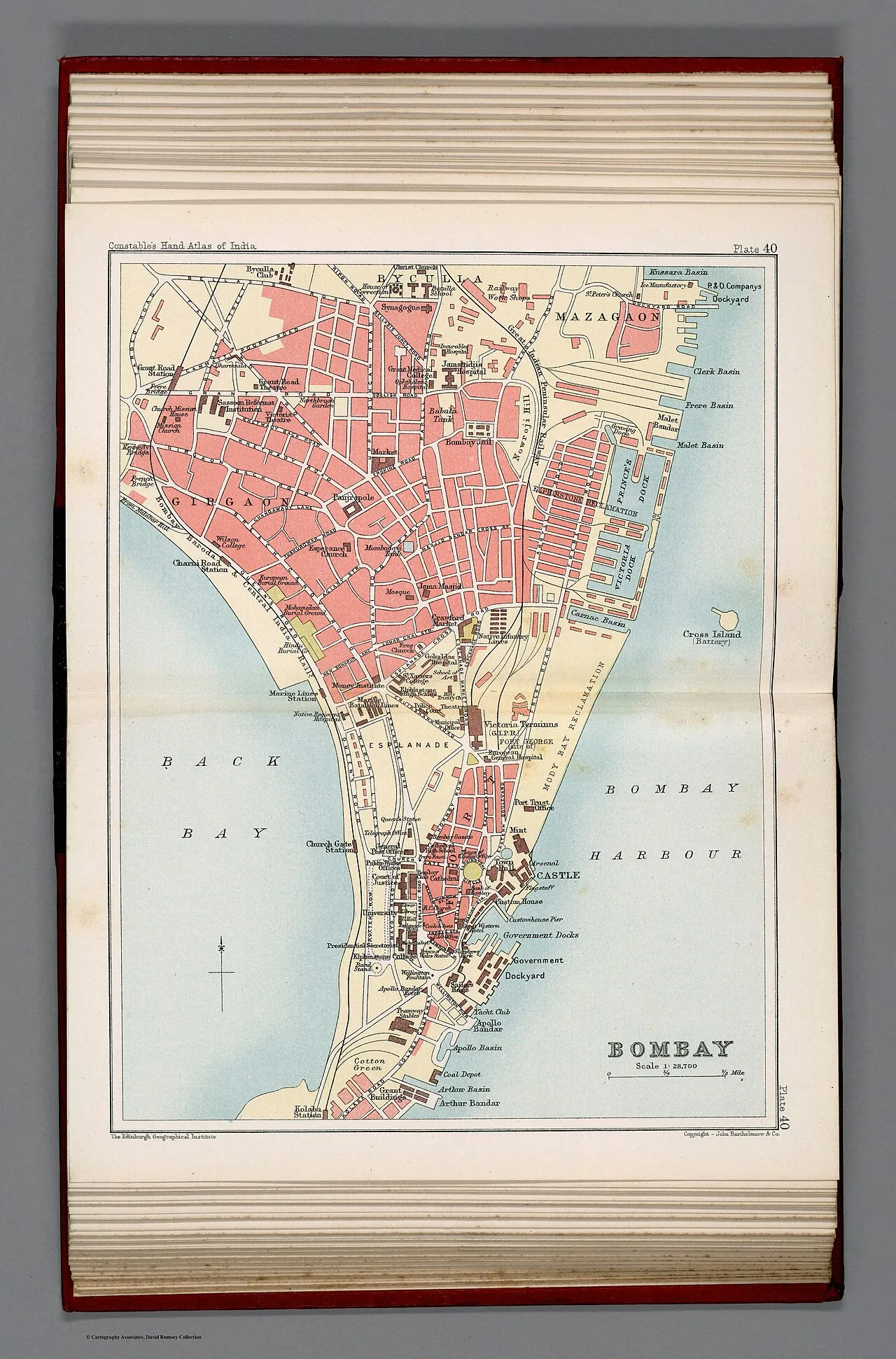
Further back than the modern debate. In Petit v Jeejeebhoy, decided by the Bombay High Court on 27 November 1908, Justice Davar went through old Punchayet records. He cited a resolution of Samvat 1886 (1829-1830) against "taking into the religion the children by kept-women", which was read again at a meeting on 23 June 1836, and a minute by Framji Cowasji Banaji condemning Parsi men who kept mistresses from outside the community and brought their children into the religion.

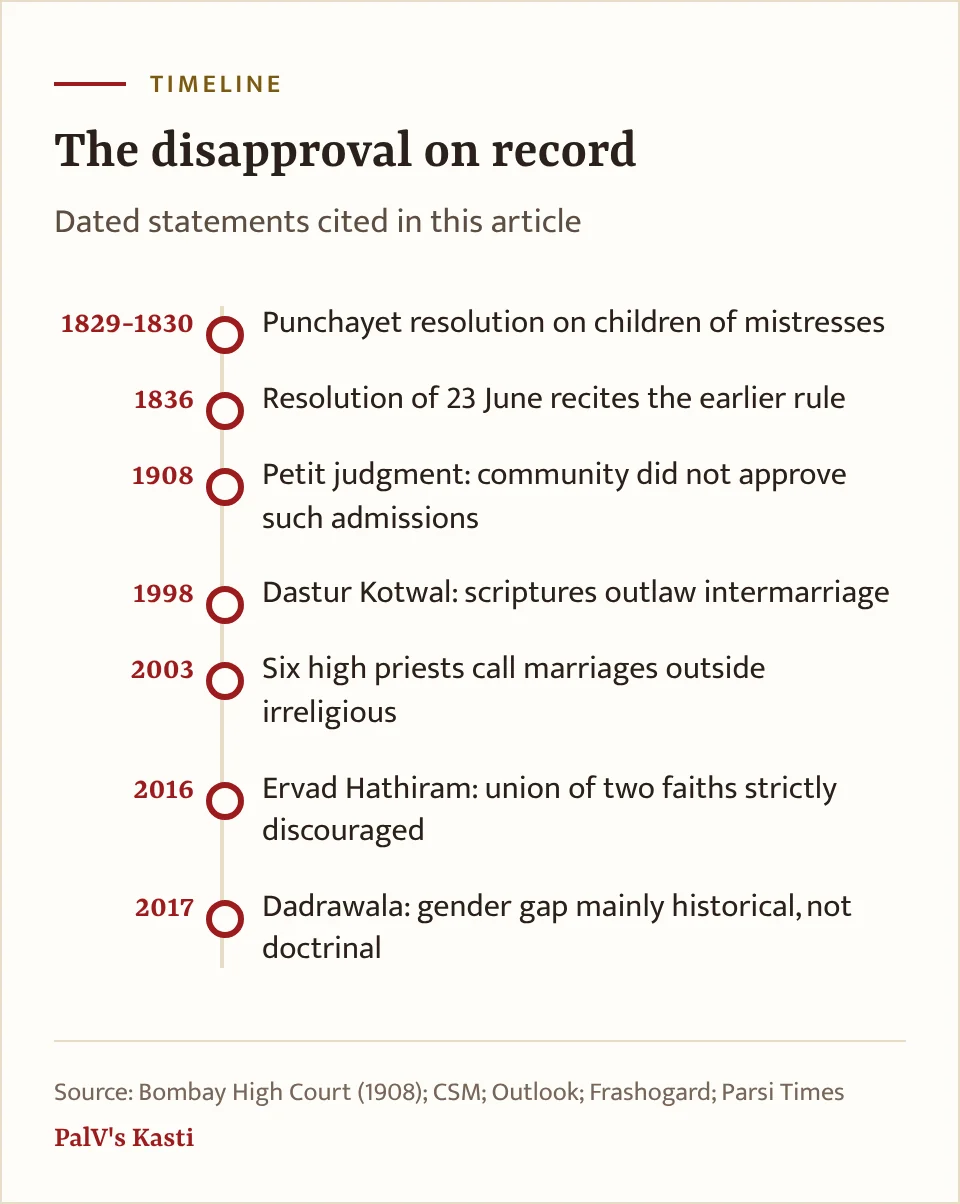
Davar took Banaji's words as the voice of the community. Some of these children had been admitted, he wrote, but the community "did not look upon such admission with anything like approval." Those who argued for admitting them did so, according to the judgment, because they did not want a Parsi father's child to live and die without his father's religion. The court's wider findings on who counts as a Parsi are covered in our article on Half-Parsis.
Dadrawala reads this history as the root of today's gender gap. In his 2017 article he argued that a century ago it was largely Parsi men who married or kept partners outside the community, which is why a rule favouring fathers' children was pressed in court, despite what he sees as the scriptures' even-handedness.
Others read the history the other way. Outlook reported in 2003 that, according to historians, the Parsis multiplied through marrying out, and quoted Mani Kamerkar, co-author of a book on the Parsis' arrival in India. In Kamerkar's view, the faith's spread to other countries shows "there must have been an element of conversion and intermarriage."
What family and community reasons do Parsis give?
For many families the reason is the home itself. Kaiyan Mistree told Open magazine in December 2014 that his parents had told him from the start, "It is your responsibility to protect your community", and that he therefore had to marry a Parsi. His fiancée, Shireen Havewala, told the magazine she had questioned her family's rule at first, but once she knew she did not want to give up the Zoroastrian way of life, marrying a non-Parsi was not an option for her.
Compatibility comes up too. In a letter to Parsi Times on 10 October 2020, Piroja Homi Jokhi wrote that "we all wish" children would marry within the fold for greater compatibility, stability and happiness, and to protect the dignity and acceptance of their children, since "a social stigma exists" for intermarried women and their children. In the same letter she argued that the rules applied to intermarried men's children should apply to women's children as well.
Some see the rule as what has kept the community distinct. At the Udwada, Gujarat, one of the holiest Zoroastrian fire temples.">Iranshah Udvada Utsav in January 2016, Gordafrid Aresh argued, as Asian Voice reported, that had Parsis opened their doors and integrated, "their unique identity would have vanished long ago." In 2003 the matchmaker Mithu Jessia, who was working to promote marriages within the community, told Outlook that couples who married out "knew marrying out was wrong" yet still wanted every right. "They can't have it both ways," she said.
Concern about numbers sits behind many of these views. What studies say marrying out does to the community's size is covered in Intermarriage and Parsi population.
Is marrying out discouraged for men and women alike?
In principle, those who oppose it say yes. Hathiram wrote that the rule applies equally to both sexes, and Dadrawala found no sacred text that lets men marry out but not women.
In practice the two have been treated differently. Jokhi wrote in her 2020 letter that the children of intermarried Parsi men had been accepted into the religion for over a century. The 2003 resolution closed that gap from the other side: Outlook noted that it excluded all half-Parsis, "even those with Parsi fathers", where until then only the children of women who married out had been shut out.
Who says the old reasons no longer hold?
Reformers argue the stance has outlived its time. Reporting in December 2017 on a new fire temple in Pune that welcomes people of all faiths, The Better India wrote that in the community "marrying outside is frowned upon, and actively discouraged", and called this "a dated viewpoint, not applicable in the 21st century." Vispy Wadia, who raised funds with his brother to build that temple, told the site that in the end people marry because they are in love.
Some answer the purity argument directly. The archaeologist Kurush Dalal, who married a Bengali friend from college, told Outlook in 2003, "Our blood has been diluted over centuries anyway," and asked who had given "six people" the right to issue such orders.
Frequently asked questions
Why can't Parsis marry outside the community?
The objection some Parsis raise is religious and communal. Dastur Firoze Kotwal said in 1998 that the scriptures outlaw intermarriage, and six high priests called such marriages irreligious in 2003. A family quoted by Open in 2014 and a 2020 letter to Parsi Times speak of keeping a Zoroastrian home and sparing children social stigma.
Why are mixed marriages frowned upon by some Parsis?
Opponents give religious reasons, such as Ervad Marzban Hathiram's teaching that partners of different faiths are spiritually mismatched, and communal ones, such as preserving a distinct identity and family compatibility. Reformers reply that these views are dated. The Better India called the disapproval "a dated viewpoint" in 2017, and others say ancestry was mixed long ago.
Does the Zoroastrian religion forbid marrying out?
Opinions differ. Dastur Firoze Kotwal said in 1998 that the scriptures outlaw all intermarriages, and the 2003 high priests' resolution cited the Vendidad. Noshir Dadrawala wrote in 2017 that the Vendidad and Dinkard discourage inter-faith unions but never say a person stops being Zoroastrian by marrying out.
Is marrying out discouraged for Parsi men as well as women?
Those who oppose it say it applies to both. Ervad Marzban Hathiram wrote in 2016 that the rule applies equally to men and women. In practice, children of Parsi fathers have long been accepted while those of Parsi mothers have not, and the 2003 high priests' resolution was unusual in excluding both.
When did Parsis start disapproving of marrying out?
The written record goes back at least to 1829-1830. The Bombay High Court's 1908 judgment in Petit v Jeejeebhoy cites Punchayet resolutions of 1829-1830 and 23 June 1836 against admitting children of Parsi men by non-Parsi mistresses, and finds that the community did not approve of such admissions.


