PalV's Kasti

On this page
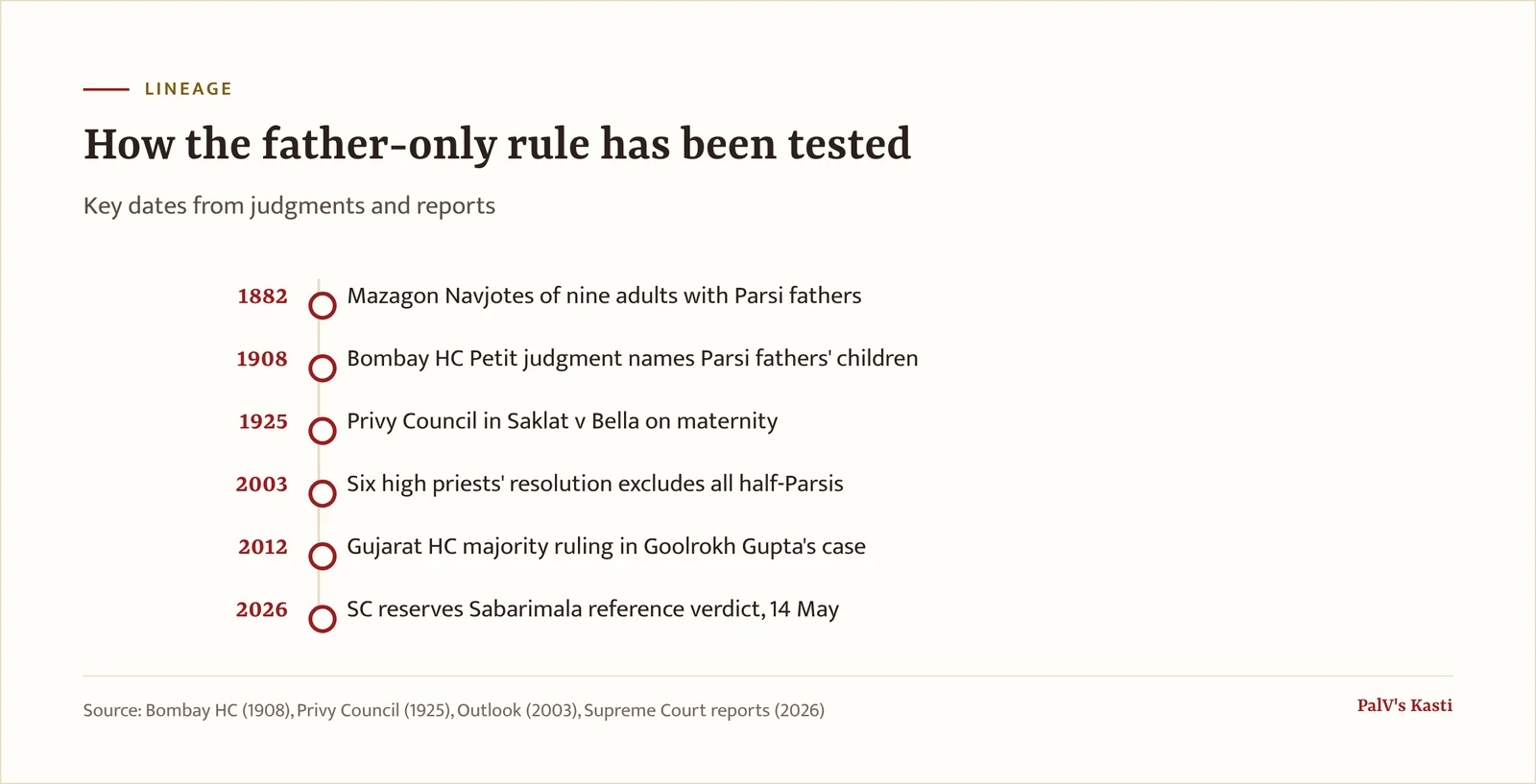
Under the law as the Bombay High Court laid it down in 1908, largely yes: a child of a mixed marriage could count as a Parsi through a Parsi father, not through a Parsi mother. The rule rests on the Bombay High Court's 1908 judgment in Petit v Jeejeebhoy, which counted as Parsis the children of Parsi fathers by non-Parsi mothers who had been properly admitted into the religion, and said nothing of the reverse. It has never been the only view. Six high priests resolved in 2003 that no child of a mixed marriage should be accepted, whichever parent is Parsi. Noshir Dadrawala, writing in Parsi Times in 2017, called the difference historical rather than doctrinal. A Parsi woman's challenge built on descent is before the Supreme Court, pending as of 16 November 2026.
અસપંદામેદ રોજ
Asfandarmad Roj, Tir Mah · 1396 Y.Z.
Where does the father-only rule come from?
It comes from the Parsi Punchayet case, Sir Dinshaw Manockji Petit and Others v Sir Jamsetji Jeejeebhoy and Others, decided by Justices Dinshaw Davar and Frank Beaman of the Bombay High Court on 27 November 1908. It is reported at (1909) ILR 33 Bom 509, 11 Bom LR 85 and 2 Ind Cas 701.
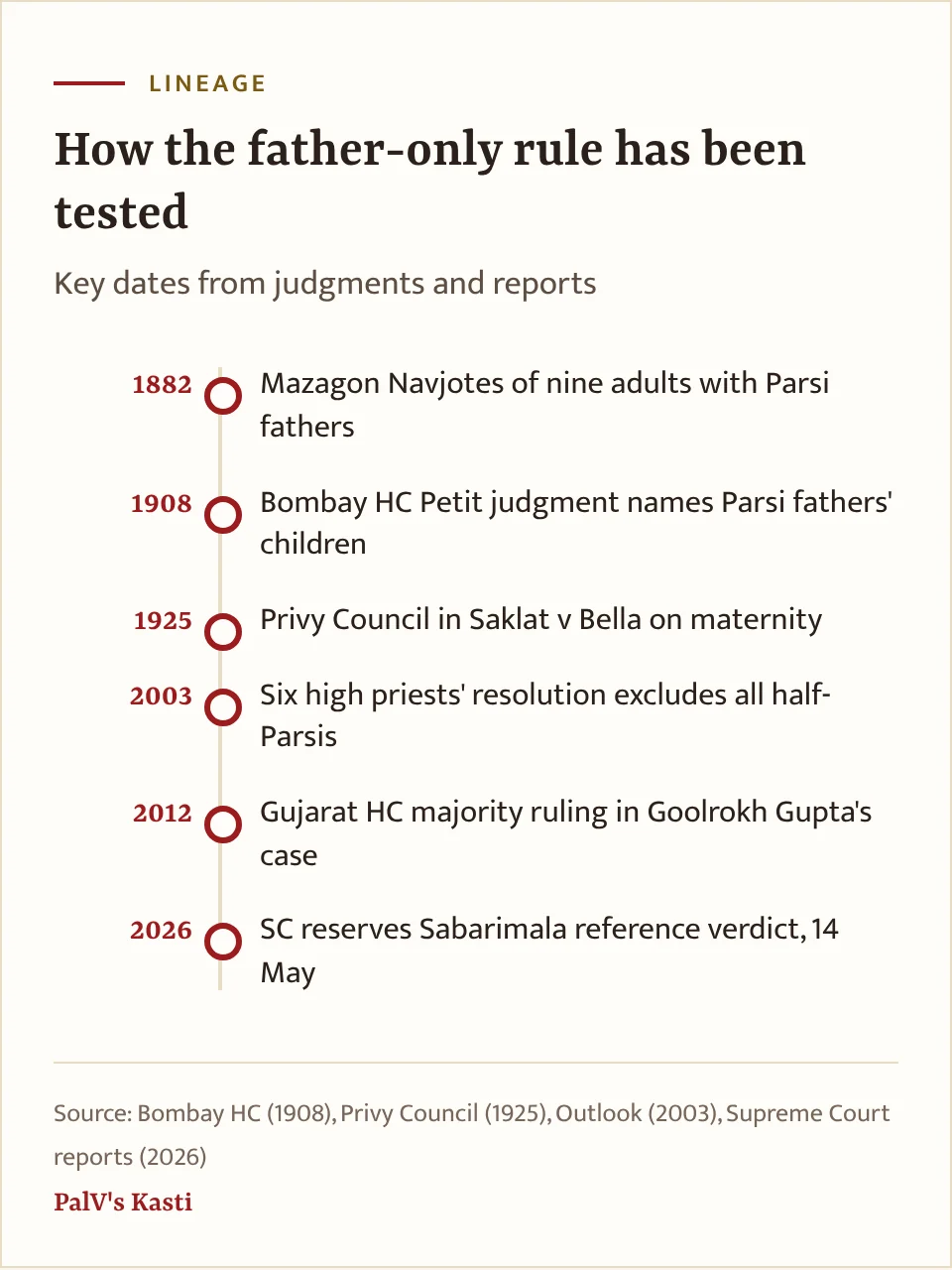
The suit was about who could benefit from the community's trust funds and institutions. Davar J concluded that the Parsi community consists of Parsis descended from the original Persian emigrants and born of two Zoroastrian parents, Iranis from Persia who profess the religion, and "children of Parsi fathers by alien mothers", once duly admitted into the religion.
That third group was not new in 1908. The trustees told the court that an exception had been made for the children of Parsi fathers "since ancient times", that the community did not view it with favour, and that they accepted it out of deference to long usage.
How did the judge explain the exception?
Davar J set out his understanding from the evidence. In earlier times, he wrote, many Parsi men went to work in villages far from Bombay and the Gujarat towns, often without their wives, and some had children with local women. A friendly priest would perform the Navjote, and the children later came home with their fathers. Davar J added that this never had the community's open sanction, that such families were long regarded with disapproval, and that by his time the practice had almost died out. The children were accepted, in his account, because they were taken to be born in the faith of their fathers: of Parsi "boon", meaning seed, and Parsi "olad", meaning origin.
The judgment also records the Mazagon Navjotes of 1882, when Dastur Jamaspji Minochurji invested nine adults with Sudreh and Kusti after satisfying himself that each had a Parsi father. Dastur Peshotan, the other high priest, called them Juddins, people of another faith. Davar J disagreed, writing that he did not think Peshotan was right to give children of a Parsi father that name.
In 1925 the Privy Council, in Saklat v Bella, added that "as regards the racial claim, maternity is of no importance". Those older cases are covered in our article on Half-Parsis.
Is the rule part of the religion, or a custom?
Those who have written on it disagree, and each view below is given in its holder's words.
- Historical, not doctrinal. Noshir Dadrawala, writing in Parsi Times on 28 October 2017, said the gender difference is "mainly historical and not necessarily doctrinal". He noted that the 1908 definition leaves out the children of Parsi mothers by non-Parsi fathers, and that the Vendidad and Dinkard, while they discourage inter-faith unions, nowhere say men may marry out and women may not. A century ago, he wrote, it was largely Parsi men who were marrying out.
- A borrowed social rule. Vispy Wadia, president of the Association of Inter-Married Parsis, told ThePrint in August 2023 that Parsis arriving in India found a "watertight caste system" and, in his words, "adopted the same culture", deciding who could enter the temple.
- Neither parent passes it on. Outlook reported on 21 April 2003 that a new resolution by six high priests shut out all "half-Parsis", including those with Parsi fathers. Until then, Outlook noted, only the children of women who married out had been excluded. Asked about the 1908 judgment, Dastur Firoze Kotwal told Outlook: "Those judges only consulted reformist priests." Ervad Marzban Hathiram took the same line on his website Frashogard on 13 October 2016: where only one partner is Zoroastrian, whether male or female, he wrote, the child cannot be classified as Zoroastrian.
Encyclopaedia Iranica's entry on conversion in modern times (Pargol Saati, 1993) states the general practice from another angle. Since the 18th century, it says, Indian Parsi councils have generally accepted as Zoroastrians only the children of Parsi parents, with occasional rulings in favour of children of mixed marriages.
Practice varies between families and Agiaries; your family priest's guidance comes first.
How have the courts treated a Parsi woman's lineage?
The question returned to court with Goolrokh M. Gupta v Burjor Pardiwala. As summarised by the Supreme Court Observer (Gauri Kashyap, 28 May 2021), the Gujarat High Court majority in 2012 held that a woman's religion is her father's before marriage and her husband's after it. Writing on the Oxford Human Rights Hub blog on 26 February 2018, law student Priyanka Sunjay called this the doctrine of coverture, noted Justice Kureshi's dissent, and said trusts that bar such women and their children find support in a century-old case read through "a patrilineal prism". The ruling itself and the appeal, SLP (C) 18889/2012, are covered in our guide Can Parsis marry non-Parsis.
In 2026 Dina Budhraja turned the descent argument the other way, in her Supreme Court petition (W.P.(C) 381/2026) against the Nagpur Parsi Panchayat. As the Indian Express reported on 26 March 2026, the petition cites the Petit judgment (reported in 1909) to argue that "Parsi" denotes descent and "Zoroastrian" denotes religion, so that a person born to Parsi parents stays a Parsi by birth after marriage. ThePrint (Ruchi Bhattar, 24 March 2026) reported her pointing out that a Parsi man's grandchildren, perhaps "25% genetically Parsi", get full access, while she, "100% biologically Parsi", does not.
The nine-judge Constitution Bench reserved its verdict in the Sabarimala reference, which takes in the Goolrokh Gupta appeal, on 14 May 2026. PTI reported on 30 May 2026 that the court would await that verdict before deciding Budhraja's petition. Both were pending as of 16 November 2026, when LiveLaw's page on the Sabarimala reference still showed the 14 May order as its latest item.
This is general information, not legal advice; for a specific case, speak to a lawyer.
Where to read next
A priest's phrase from the wider intermarriage debate, used for worship outside the faith, is explained in the Religious adultery debate. How young Zoroastrians meet partners within the community is covered in Dating within the faith.
Frequently asked questions
Is Parsi identity passed through the father?
Under the 1908 judgment, largely yes. The Bombay High Court's 1908 Petit judgment counted children of Parsi fathers by non-Parsi mothers, once properly admitted, as Parsis, but not children of Parsi mothers. Noshir Dadrawala has called the distinction historical, and six high priests resolved in 2003 that neither kind of child should be accepted.
Is the child of a Parsi mother and a non-Parsi father a Parsi?
The 1908 definition names only children of Parsi fathers, and Outlook reported in 2003 that children of women who married out had long been excluded. Encyclopaedia Iranica notes sporadic rulings that accepted children of mixed marriages. Whether a Parsi woman who marries out keeps her own identity is pending before the Supreme Court as of 16 November 2026.
Why are children of Parsi fathers accepted and not those of Parsi mothers?
In the 1908 judgment, Justice Davar explained that such children were accepted as born of their father's faith, of Parsi "boon" and "olad". Noshir Dadrawala wrote in 2017 that the difference is mainly historical, not doctrinal. Vispy Wadia, of the Association of Inter-Married Parsis, has compared it to India's caste rules about temple entry.
What did the 1908 Parsi Punchayet case say about lineage?
Petit v Jeejeebhoy, decided by the Bombay High Court on 27 November 1908, held that the community's trusts were for Parsis born of two Zoroastrian parents, Iranis professing the religion, and children of Parsi fathers by non-Parsi mothers duly admitted into the religion. Converts with no Parsi parent had no right to those trusts' benefits.