 PalV's Kasti

On this page
- What does Indian law say about a Parsi marrying a non-Parsi?
- How do Parsis get married, and can a priest marry a mixed couple?
- What does the Zoroastrian religion say about marrying out?
- Does a Parsi who marries out stop being a Parsi?
- Where does the Supreme Court case stand?
- How many Parsis marry outside the community?
- Frequently asked questions
Yes, in Indian law a Parsi can marry a non-Parsi, but not under the Parsi Marriage and Divorce Act, 1936, which covers only marriages between Parsis. A mixed couple marries under the Special Marriage Act, 1954, which does not ask either partner to convert. What happens after that is where Parsis disagree. Some high priests have said the scriptures forbid such marriages, while others read the texts as discouraging them without shutting out those who marry. Trusts and Anjumans also treat intermarried members differently, and some of their rules apply only to women. Whether a Parsi woman who marries out keeps her place in the community is now before the Supreme Court, and that question is pending as of 16 November 2026.
અસપંદામેદ રોજ
Asfandarmad Roj, Tir Mah · 1396 Y.Z.
What does Indian law say about a Parsi marrying a non-Parsi?
Two Acts matter here, and they do different jobs.

The Parsi Marriage and Divorce Act, 1936 is the community's own marriage law. Section 2 defines "marriage" as a marriage between Parsis, and defines a Parsi as "a Parsi Zoroastrian". Under section 3(1)(b), a marriage is not valid unless it is solemnised by the Ashirvad ceremony, performed by a priest, with two Parsi witnesses present besides that priest. A couple in which one partner is not a Parsi falls outside that definition. Our guide to the Parsi Marriage and Divorce Act explains the rest of the 1936 law.
The Special Marriage Act, 1954 is the civil route. Section 4 allows a marriage "between any two persons" if the conditions in that section are met: neither partner has a living spouse, both can give valid consent, both have reached the legal age, and they are not within the prohibited degrees of relationship. Religion is not one of the conditions. Under section 5, the couple gives written notice to the Marriage Officer of a district where at least one of them has lived for 30 days or more before the notice.
Writing in Parsi Times on 28 October 2017, Noshir Dadrawala pointed to a change from the older law. Under the Special Marriage Act of 1872, he wrote, a Parsi woman who wanted to marry under it had to declare that she did not profess the Zoroastrian religion. The 1954 Act has no such declaration.
Does marrying under the Special Marriage Act change inheritance?
Yes, it can. Section 21 of the 1954 Act says succession to the property of a person married under it, and of their children, follows the Indian Succession Act, 1925, as if its chapter of "Special Rules for Parsi Intestates" had been left out. So the special Parsi rules for a person who dies without a will do not apply to that family.
This is general information, not legal advice; for a specific case, speak to a lawyer.
How do Parsis get married, and can a priest marry a mixed couple?
A wedding between two Parsis is solemnised by the Ashirvad, as section 3 of the 1936 Act requires. For a mixed couple, the legal marriage is the civil one under the 1954 Act, whatever prayers the family also arranges.
Whether a priest may perform Zoroastrian wedding prayers for a mixed couple has been fought over in court. On 9 June 2009 the trustees of the Bombay Parsi Punchayet resolved to keep two priests, Framroze Mirza and Khushroo Madon, from praying at Doongerwadi and two Agiaries under their control. The resolution, quoted in the later judgment, accused them of performing Zoroastrian wedding rites where one Parsi married a non-Parsi, and Navjotes for children of Parsi women married to non-Parsis. In Jamsheed Kanga v Parsi Panchayat Funds and Properties (Appeal No. 256 of 2010, decided 11 March 2011), Justices D.Y. Chandrachud and Anoop V. Mohta of the Bombay High Court held that the ban was not within the trustees' power under the trust deed. How priests approach these weddings today is the subject of our piece on the Priest's view of interfaith marriage.
What does the Zoroastrian religion say about marrying out?
Authorities within the faith give different answers, and each is stated here in its own words.
- Against. Dastur Firoze Kotwal, then one of the high priests, told the Christian Science Monitor in May 1998 that, in his reading, the scriptures outlaw all intermarriages. Outlook reported on 21 April 2003 that six high priests had passed a resolution calling marriages outside the community irreligious and barring the children of such marriages. It was published in the Jam-e-Jamshed on 23 March 2003. Outlook quoted the priests citing the Vendidad, and added that Kotwal had since begun to call the resolution a guideline rather than a fatwa.
- Discouraged, for both sexes. Ervad Marzban Hathiram wrote on his Frashogard site on 13 October 2016 that a union between people of two different faiths is "strictly discouraged" and that the rule applies equally to men and women.
- Discouraged, but not a ground for exclusion. Noshir Dadrawala wrote in 2017 that the Vendidad and the Pahlavi Dinkard discourage inter-faith unions, but that no text allows men to marry out and not women, and none says a person stops being Zoroastrian by marrying a non-Zoroastrian.
- Acceptance. The Udvada head priest, Dasturji Khurshed Dastoor, said at the Iranshah Udvada Utsav in January 2016, as Asian Voice reported, "We cannot hide from the fact that intermarriage is taking place". He also criticised the practice of admitting the children of Parsi men who married out but not those of Parsi women.
Encyclopaedia Iranica's entry on conversion in modern times (Pargol Saati, 1993) sorts these views into reformist and traditionalist tendencies, and notes that some moderates accept the spouses and children of mixed marriages. For the texts each side cites, see Scripture on mixed marriages. For the reasons given for the traditional stance, see Why out-marriage is discouraged, and for what the phrase "religious adultery" means in this argument, see the Religious adultery debate.
Practice varies between families and Agiaries; your family priest's guidance comes first.
Does a Parsi who marries out stop being a Parsi?
The law and community practice do not give one answer, and the answer has long differed for men and women.
For men, the Bombay High Court's 1908 judgment in Petit v Jeejeebhoy counted among Parsis the children of Parsi fathers by non-Parsi mothers who had been properly admitted into the religion. That list did not include the children of Parsi mothers by non-Parsi fathers. How that rule grew is covered in Parsi patrilineal lineage, and the children's position in Children of intermarried women. Our earlier article on Half-Parsis sets out the older court cases.
For women, the Gujarat High Court held by a 2:1 majority in 2012, in Goolrokh M. Gupta v Burjor Pardiwala, that a Parsi woman who married a Hindu man under the Special Marriage Act ceased to be a Parsi unless a competent court declared otherwise. Her appeal, SLP (C) 18889/2012, was referred to a Constitution Bench and tagged to the Sabarimala review petitions. We cover the identity question in Interfaith marriage and Parsi identity.
Trusts differ. The Nagpur Parsi Panchayat's rule 5(2), as quoted by ThePrint on 24 March 2026, says a Parsi or Irani Zoroastrian woman who marries a non-Parsi man and has children by him will not be accepted as a Parsi, and nor will her children. The Delhi Parsi Anjuman's rules, as quoted in the same report, give Parsi Zoroastrians married to non-Parsis who keep practising the religion the right to use all of its facilities. ThePrint reported that the Parsi panchayats in Kolkata and Delhi do not follow the Nagpur practice. The day-to-day effects are covered in Restrictions on intermarried women, Excommunication for marrying out and Mixed marriage challenges.
Where does the Supreme Court case stand?
A nine-judge Constitution Bench headed by Chief Justice Surya Kant heard the Sabarimala reference, which also takes in the rights of Parsi women who marry outside the community to enter fire temples, and reserved its verdict on 14 May 2026, as IANS and the Deccan Chronicle reported that day. Kerala Kaumudi reported on 2 October 2026 that a verdict was expected that month. LiveLaw's page on the reference, checked on 16 November 2026, shows no verdict.
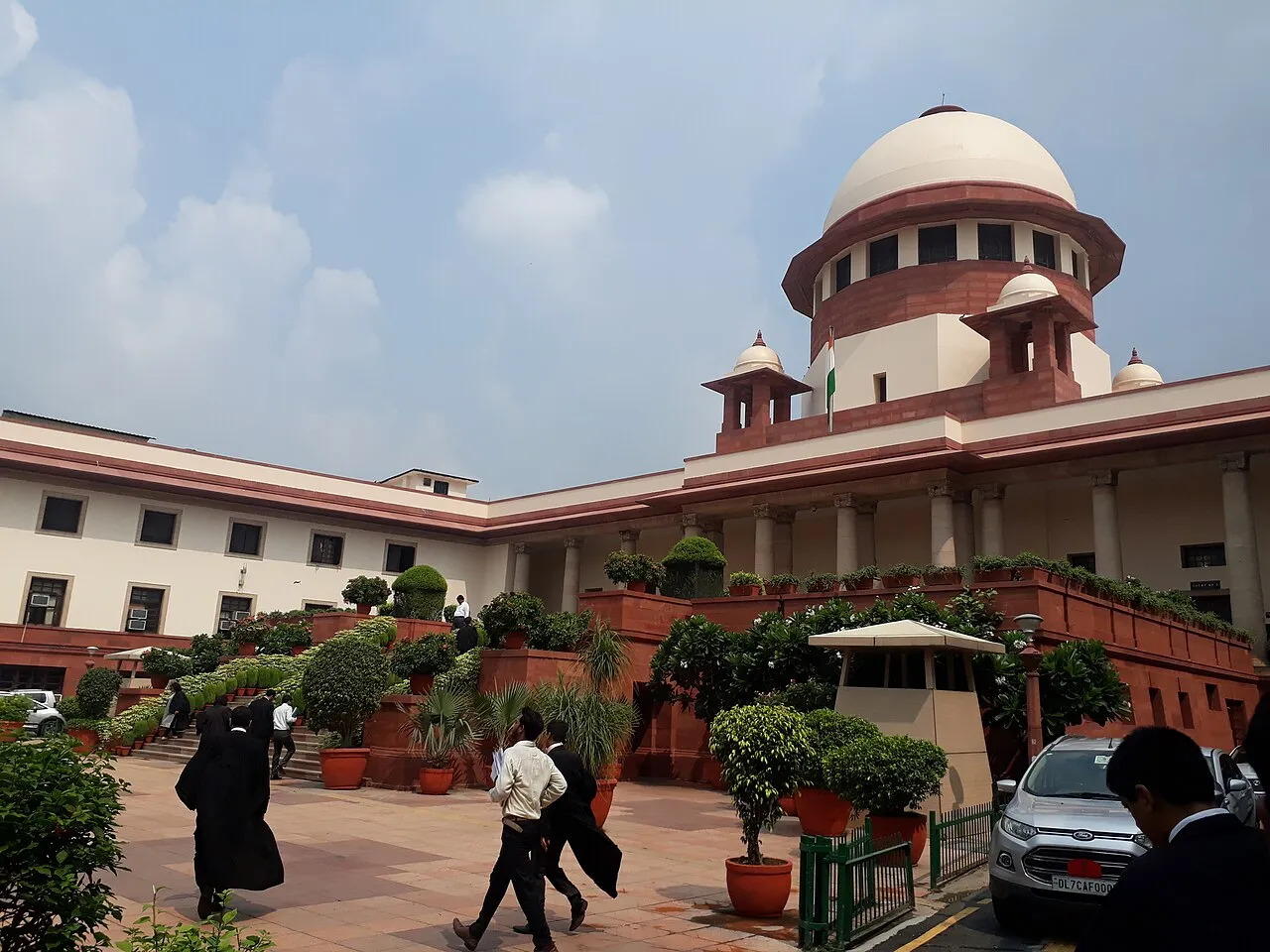
A separate petition by Dina Budhraja against the Nagpur Parsi Panchayat (W.P.(C) No. 381/2026) was heard on 25 May 2026 by a bench of the Chief Justice and Justices Joymalya Bagchi and Vipul M. Pancholi. A PTI report carried by Telangana Today on 30 May 2026 said the court would await the nine-judge bench's judgment before deciding it.
Both questions are pending as of 16 November 2026. This is general information, not legal advice; for a specific case, speak to a lawyer.
How many Parsis marry outside the community?
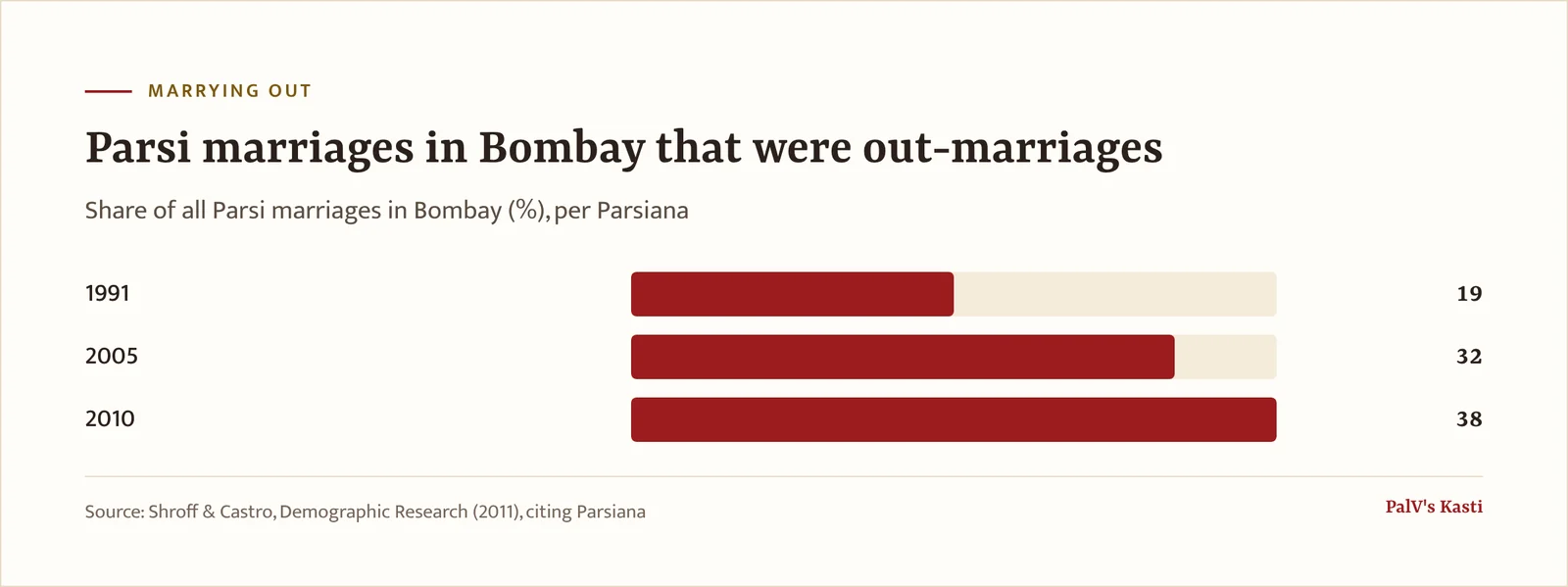
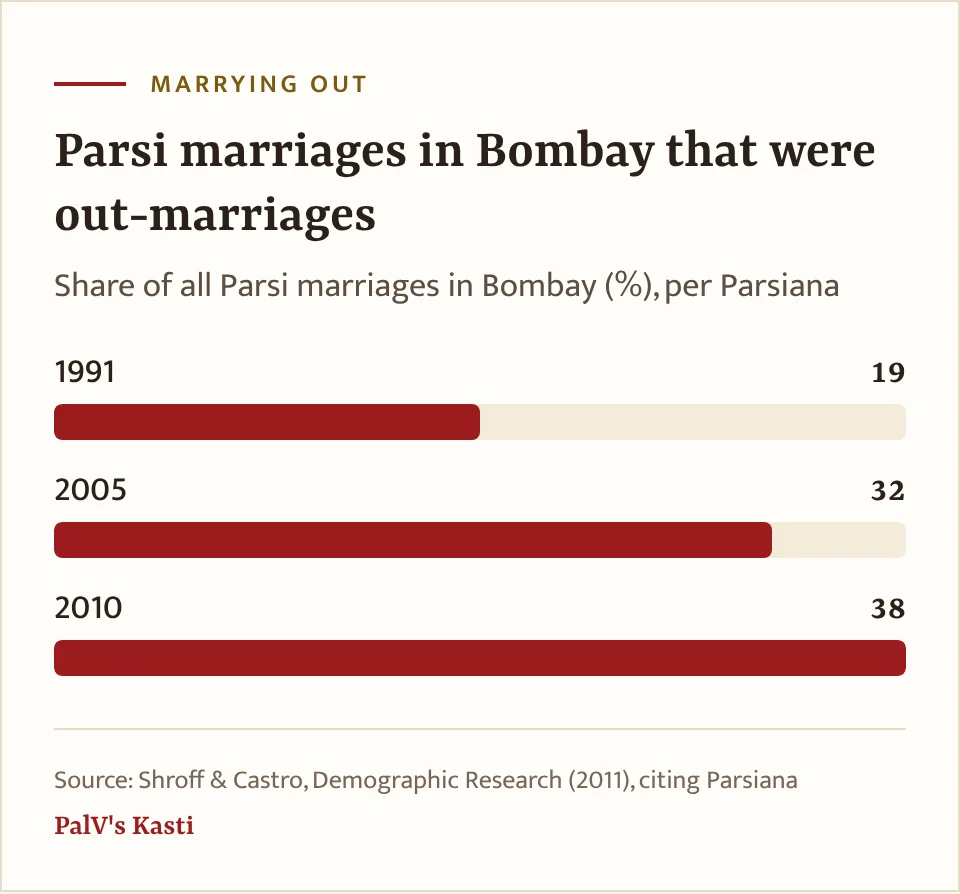
The most cited figures come from Parsiana. As set out in a 2011 study in Demographic Research by Zubin Shroff and Marcia Castro, marriages outside the community made up 19% of Parsi marriages in Bombay in 1991, 32% by 2005 and 38% by 2010. In 2023 ThePrint reported that, by Parsiana's analysis, close to half of Parsi marriages in Mumbai were interfaith. What these trends may mean for numbers is covered in Intermarriage and Parsi population.
Attitudes are shifting too. In SOAS's "Gen Z and Beyond" survey (Engineer, Turtle and Stewart, April 2023; 5,003 respondents worldwide), 77.4% accepted intermarried Zoroastrian men and women as Zoroastrian, and 10.6% accepted neither. Among single respondents, 47.6% wanted only a Zoroastrian partner and 50.8% were open to either. Respondents in South Asia were much likelier than those in North America to want only a Zoroastrian partner (62.4% against 23.9%). How young Parsis meet partners today is in Dating within the faith, and the arguments on each side are laid out in the Parsi intermarriage debate.
Frequently asked questions
Can a Parsi girl marry a non-Parsi?
Yes. A Parsi woman can marry a non-Parsi man under the Special Marriage Act, 1954, without converting. The 1936 Parsi Act covers only marriages between Parsis. The dispute is over what follows: Nagpur's panchayat rule excludes her and her children once she has children by him, but Delhi's Anjuman does not. The Supreme Court case is pending.
Can a Hindu marry a Parsi?
Yes, under the Special Marriage Act, 1954. Section 4 allows a marriage between any two persons who meet its conditions on spouses, consent, age and prohibited relationships. Religion is not among them. Neither partner has to convert. The couple gives notice to the Marriage Officer of a district where one of them has lived for at least 30 days.
Can a Muslim marry a Zoroastrian in India?
Yes. The Special Marriage Act, 1954 applies to any two persons who meet its conditions, whatever their religion, so a Muslim and a Parsi Zoroastrian can marry under it without either converting. A marriage under the Parsi Marriage and Divorce Act, 1936 is open only to two Parsis, so it is not available to that couple.
How do Parsis get married?
When both partners are Parsis, the wedding is solemnised by the Ashirvad ceremony. Section 3 of the Parsi Marriage and Divorce Act, 1936 requires a priest to perform it in the presence of two Parsi witnesses besides the priest. Couples in which one partner is not a Parsi marry under the Special Marriage Act, 1954.
Does a Parsi woman stop being Parsi if she marries out?
The Special Marriage Act, 1954 asks no one to renounce a religion. But the Gujarat High Court ruled 2:1 in 2012 that Goolrokh Gupta ceased to be a Parsi on marrying a Hindu under that Act. Her appeal, tagged to the Sabarimala review petitions in the Supreme Court, is pending as of 16 November 2026.
This is general information, not legal advice; for a specific case, speak to a lawyer.


