 PalV's Kasti
On this page
- Where does the Alpaiwalla Museum collection come from?
- What ancient Iranian objects can you see?
- Which manuscripts and documents are on display?
- Does the museum have a fire temple replica?
- Is there a Tower of Silence model in the museum?
- What Parsi textiles and costumes are shown?
- What does the China trade gallery show?
- What else is in the galleries?
- How can you get the most out of a visit?
- Frequently asked questions
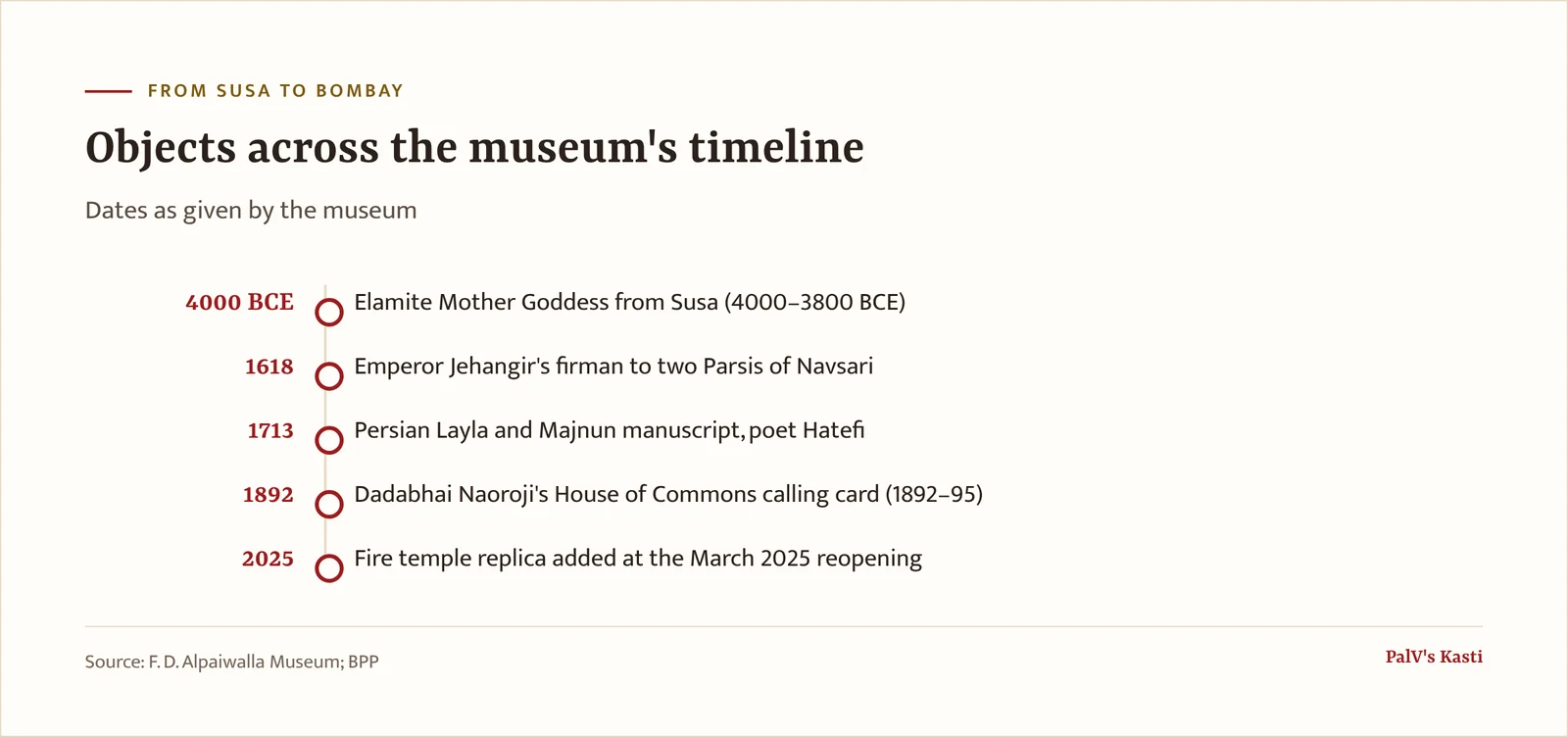
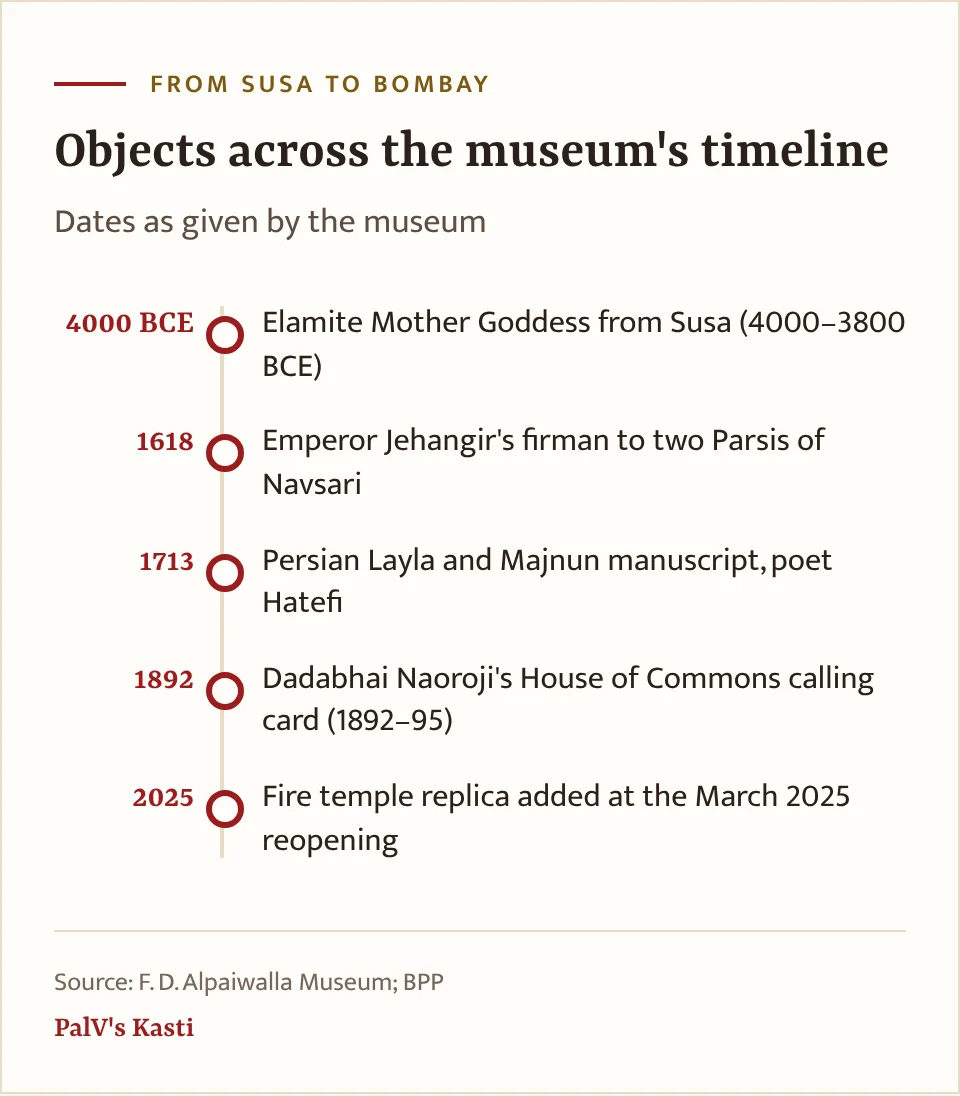
The F. D. Alpaiwalla Museum's collection runs from clay objects excavated at Susa in Iran to the silk saris Parsi women wore in 19th-century Bombay. Visitors can see archaeological finds from Susa and Yazd, manuscripts of the Yasna and the Vendidad, a 1618 firman of Emperor Jehangir, Dadabhai Naoroji's calling card, Chinese export porcelain, Tanchoi and gara saris, a model of a dakhma (Tower of Silence) and a life-size replica of a fire temple with recorded prayers. A migration wall, a Yazd home diorama and portraits of well-known Parsis complete the rooms. Here is what is on show, gallery by gallery, and how to see it well.
અસપંદામેદ રોજ
Asfandarmad Roj, Tir Mah · 1396 Y.Z.
Where does the Alpaiwalla Museum collection come from?
The Bombay Parsi Punchayet describes the museum as resting on two large collections. The first is the antiques gathered by Framji Dadabhoy Alpaiwalla, a collector whose objects, according to the museum's own website, outgrew his eleven-room home. The second is the material that the scholar-priest and archaeologist Ervad (Dr) Jamshed Unvala brought back from the French excavations at Susa, where the museum says he worked from 1927 to 1939.
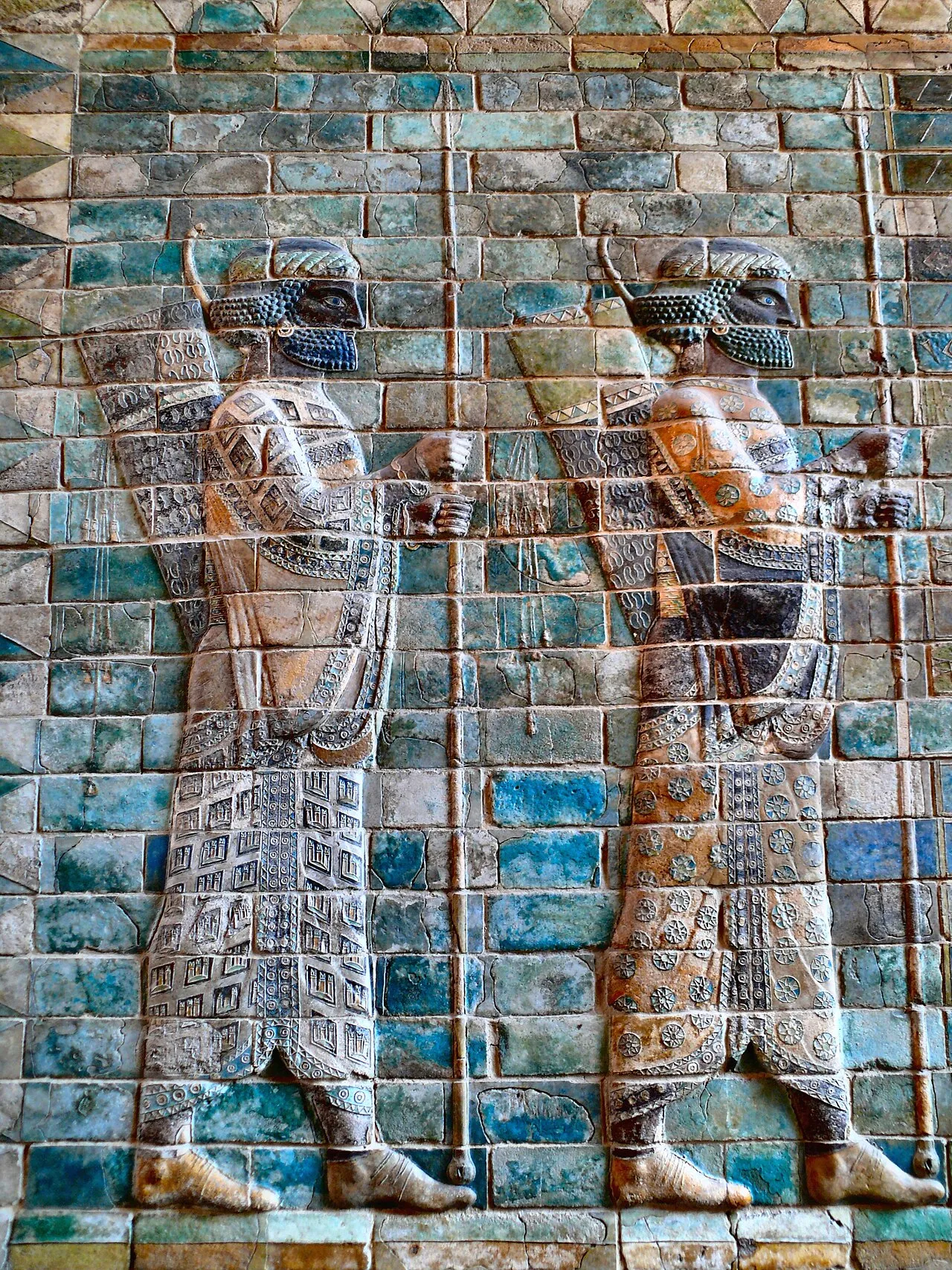
Unvala's gifts include Proto-Elamite tablets, glazed bricks from the "Archer's Frieze" and buff-coloured clay vases and pots. He also excavated a Tower of Silence in Yazd and gave what he found to the museum. The story of the two founders, and the debate over the year the museum opened, is told in our main post on the Alpaiwalla Museum.
What ancient Iranian objects can you see?
The first rooms deal with Iran before and during the Zoroastrian empires. The museum's online timeline lists an Elamite "Mother Goddess" from Susa, dated there to 4000 to 3800 BCE, along with a brick from the palace of Darius, a late Parthian or early Sasanian horse head, a Sasanian terracotta wine bottle, a silver coin of the Parthian king Mithradates II and clay seals, or bullae. Parsi Times, reporting on the reopening, also mentions mother goddess figurines, imperial coins and seals.
Two replicas stand out. One is the Cyrus Cylinder, the clay cylinder of Cyrus the Great that curator Kerman Fatakia told the BBC is among the most important finds of the ancient world. The other, according to Parsi Times, is a nine-foot etched glass copy of the western staircase of Darius' palace at Persepolis, which was shown in London and Delhi before it came to the museum.
Which manuscripts and documents are on display?
The Bombay Parsi Punchayet's page on the museum lists these paper treasures, and the Free Press Journal and Outlook Traveller name most of them in their reports:
- Zoroastrian manuscripts of the Yasna and of the Vendidad, alongside ritual implements.
- A firman issued by Emperor Jehangir in 1618 CE, granting a jagir to two Parsis of Navsari. The BPP and Outlook Traveller put the grant at 100 bighas.
- The calling card Dadabhai Naoroji used when he sat in the British House of Commons, from 1892 to 1895.
- Old photographs and postcards of early Bombay.
The museum's timeline adds a Persian manuscript of the Layla and Majnun story by the poet Hatefi, dated 1713 to 1714 CE. Readers interested in another Parsi institution in the city can turn to our post on the K. R. Cama Oriental Institute.
Does the museum have a fire temple replica?
Yes. A life-size replica of a fire temple, as the BBC describes it, was one of the new exhibits when the museum reopened in March 2025, and it plays recordings of prayers. Parsi Times reports that its façade is modelled on the Maneckji Sett Agiary at Ballard Estate, while its sanctum takes inspiration from the Anjuman Atash Behram on Princess Street. Separately, the British Institute of Persian Studies says the museum has been given the inner sanctum of a fire temple that was commissioned for the Everlasting Flame exhibition at SOAS in London in 2013 and shown at the National Museum in Delhi in 2016.
Why build one at all? The BBC pointed out that real fire temples are typically off-limits to non-Parsis, so the replica lets every visitor see that space. Dr Pheroza J. Godrej, the museum's honorary advisor, gave a second reason to the Free Press Journal: the recorded prayers are ones that are fading from use, since the community is getting smaller and the priesthood no longer draws people the way it once did.
Is there a Tower of Silence model in the museum?
There is. The funerary gallery holds a clay model of a dakhma showing the three tiers and the central well, together with a section drawing of a Tower of Silence at Doongerwadi. Fatakia told the BBC that the model lets visitors see what happens to a body laid in a tower, because only a few people may enter the real ones.
The same gallery shows astodans, the clay vessels in which bones were kept, which Parsi Times singles out as one of the most remarkable exhibits.
Practice varies between families and Agiaries; your family priest's guidance comes first.
What Parsi textiles and costumes are shown?
One piece described by both the museum and Parsi Times is an ivory silk Tanchoi sari more than 170 years old, woven with peacock motifs taken from the crest of the Sir Jamsetjee Jejeebhoy family. The gallery also has embroidered gara saris, and the BBC noted a mannequin draped in a gara with Victorian-style jewellery. Parsi Times also mentions jhablas and caps worked in zari.
The museum's textile pages add more detail:
- a 20th-century embroidered gara donated by Dastur (Dr) Firoze M. Kotwal;
- a black silk evening coat in gara embroidery, with Chinese figures in a garden where deer, monkeys and elephants hide in the foliage, gifted by Ervad Meher Modi;
- a model of a Parsi man in a dagli, the buttonless white coat tied with ribbon bows;
- a child in Navjote.">sudreh (sadra) and kusti, wearing a prayer cap of Tanchoi cloth.
What does the China trade gallery show?
Blue-and-white Chinese export porcelain and brightly coloured decorative pieces fill this gallery. Both the museum and Parsi Times explain that porcelain travelled to India as ship's ballast and was sold on arrival. The museum adds that practical Parsi merchants laid the pieces broken on the voyage into mosaic floors at home.
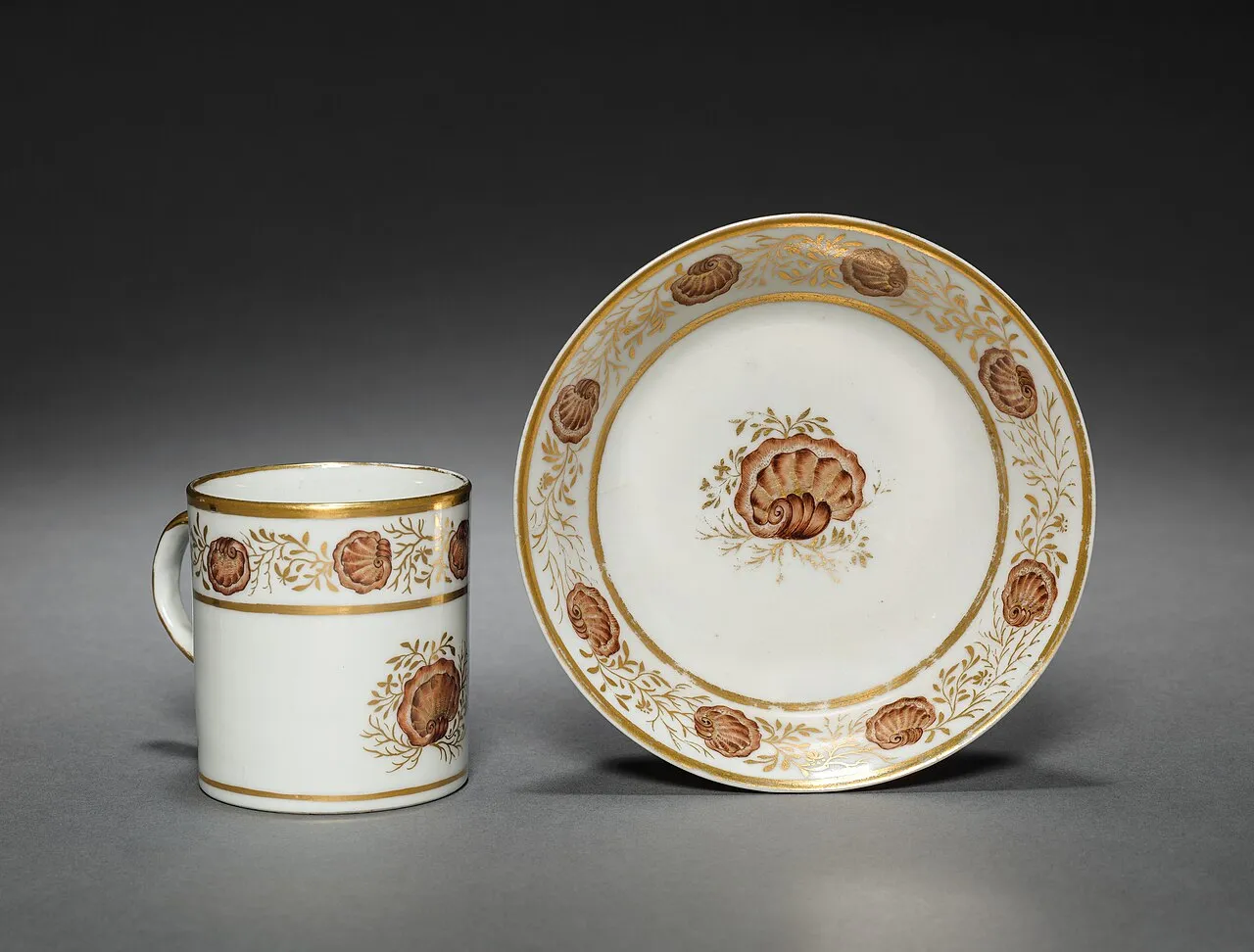
Parsi Times describes a recreated drawing room of a Parsi China merchant, with European-influenced furniture and a round table carved with Chinese dragon motifs, and a rare Chinese figurine dressed as Zoroaster. According to the BBC, the Parsis whose objects fill this section made their fortunes in the early 1800s from the China trade in tea, silk, cotton and opium. The museum's Adopt-An-Antique initiative has a post of its own.
What else is in the galleries?
- The migration wall. A map titled "Parsi Migration Route" traces two journeys shown on the wall: from Khorasan to Sanjan, and much later from Yazd and Kerman to Bombay.
- A Yazd home diorama. The BBC describes it as showing how Iranian Zoroastrians lived in Yazd.
- Portraits and furniture. The BBC mentions a portrait of Jamsetji Nusserwanji Tata. The museum's timeline names Nowroji Rustom Maneck Sett and Dhunbai Cowasji Jehangir among the prominent Parsis shown, plus a pol door and a cupboard with an image of Zarathushtra.
- A reference library. Parsi Times puts it at over 1,900 books on Zoroastrian history and culture.
Much of this layout dates from the restoration. Our post on the Alpaiwalla Museum reopening covers what changed.
How can you get the most out of a visit?
Ask for the curator's tour. The museum's website invites visitors to book a guided tour with Kerman Fatakia by phone or email, and the BBC reported that every visitor is offered one.
According to the museum's own site, it is open every day except Sunday and certain bank holidays, from 10:30 am to 5:30 pm, and visitors should phone ahead before a public holiday. Braille signage runs across all the exhibits. Only the ground floor is wheelchair accessible, through a ramp at the entrance. The site lists a shop selling garas, embroidered purses, books and merchandise inspired by the collection, and says its café kiosk will offer tea, coffee and Parsi snacks.
Frequently asked questions
What is in the Alpaiwalla Museum?
The Alpaiwalla Museum in Mumbai holds archaeological finds from Susa and Yazd, Yasna and Vendidad manuscripts, Jehangir's 1618 firman, Dadabhai Naoroji's calling card, Chinese export porcelain, Tanchoi and gara saris, a dakhma model, a fire temple replica, a migration wall and portraits of prominent Parsis, all built on the Alpaiwalla and Unvala collections.
Does the Alpaiwalla Museum have a fire temple replica?
Yes. Since its March 2025 reopening the Alpaiwalla Museum has had a life-size fire temple replica with recorded prayers. Parsi Times says its façade follows the Maneckji Sett Agiary at Ballard Estate and its sanctum the Anjuman Atash Behram. As the BBC notes, it gives non-Parsis a look at a sacred space typically closed to them.
Is there a Tower of Silence model at the museum?
Yes. The Alpaiwalla Museum's funerary gallery has a clay model of a dakhma, or Tower of Silence, showing its three tiers and central well, with a section drawing of a Doongerwadi tower. Clay astodans, the vessels used to keep bones, are shown in the same gallery.
What Parsi textiles can you see at the Alpaiwalla Museum?
The Alpaiwalla Museum shows an ivory Tanchoi sari over 170 years old with peacock motifs from the Sir Jamsetjee Jejeebhoy family crest, embroidered gara saris, a gara-work evening coat, zari jhablas and caps, a dagli on a model, and a child's sudreh and kusti with a Tanchoi prayer cap.
Does the Alpaiwalla Museum have a library?
Yes. Parsi Times reported in April 2025 that the Alpaiwalla Museum has a reference library of over 1,900 books on Zoroastrian history and culture. The British Institute of Persian Studies, in a 2026 workshop brochure, also describes the museum as having a substantial library alongside its collection of Chinese porcelain and coins.


