PalV's Kasti
On this page
- Why was the Alpaiwalla Museum closed before 2025?
- How was the Alpaiwalla Museum restored, phase by phase?
- Who paid for the Alpaiwalla Museum restoration?
- What changed when the Alpaiwalla Museum reopened?
- Who attended the Alpaiwalla Museum reopening ceremony?
- What has the museum done since it reopened?
- Frequently asked questions
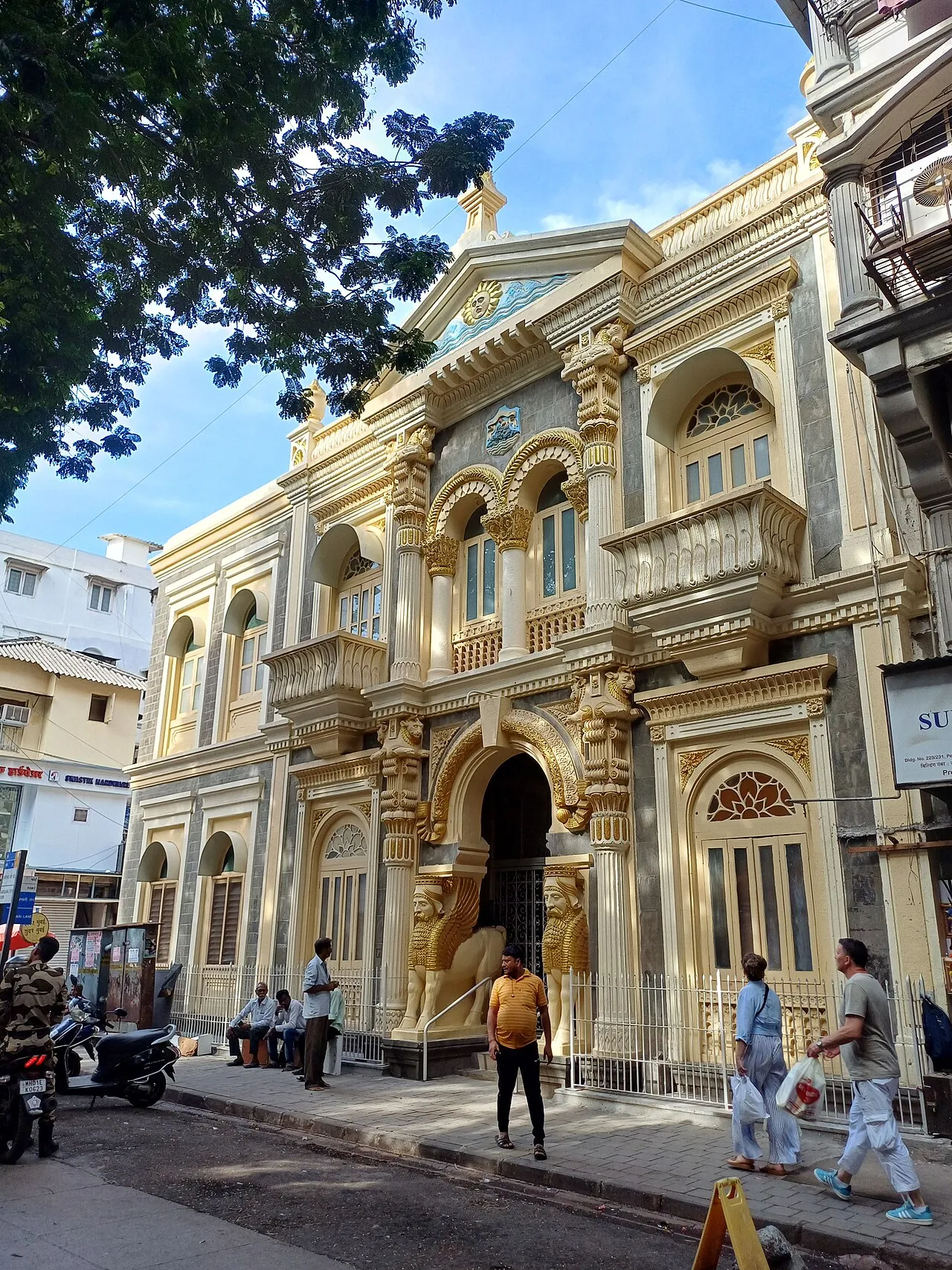
The F. D. Alpaiwalla Museum in Mumbai reopened on 27 March 2025 after a restoration done in stages, the first of which was complete by January 2014. The Bombay Parsi Punchayet (BPP), which owns the building and administers the museum, paid for the first phase of work on the building, and a grant from the Ministry of Culture, Government of India, paid for the upgrade. When the doors opened again, the 1970s display cases and lighting were gone, replaced by modern layouts and spotlights. Labels had been redesigned and carried Braille. And there was a new recreation of a fire temple, with recorded prayers playing inside it.
અસપંદામેદ રોજ
Asfandarmad Roj, Tir Mah · 1396 Y.Z.
Why was the Alpaiwalla Museum closed before 2025?
The building needed serious repair. DNA reported in January 2014 that it dated to the 1920s, had leaking roofs and fell short of what a modern museum needs. Parsi Times, in October 2017, said the museum had been shut "due to much needed repairs" and described the BPP-owned building as a ground-plus-one-storey structure.
The closure was long. In December 2016 The Asian Age wrote that the museum "stands shut today" and could not spare money for its antiques. In December 2017 DNA said it had been shut "for several years" while it waited for restoration funds. In those years a Mumbai teenager raised money from donors to restore some of the museum's Chinese antiques, a story we tell in our post on the Adopt-An-Antique initiative.
"Reopening" also raises the question of when the museum first opened. The museum's website says it was founded in 1952 and, on another page, that it was inaugurated in 1984, while the BPP and the press give 1954. We set these side by side in our main guide to the Alpaiwalla Museum.
How was the Alpaiwalla Museum restored, phase by phase?
According to a DNA report of 12 January 2014, the restoration was planned in three phases.
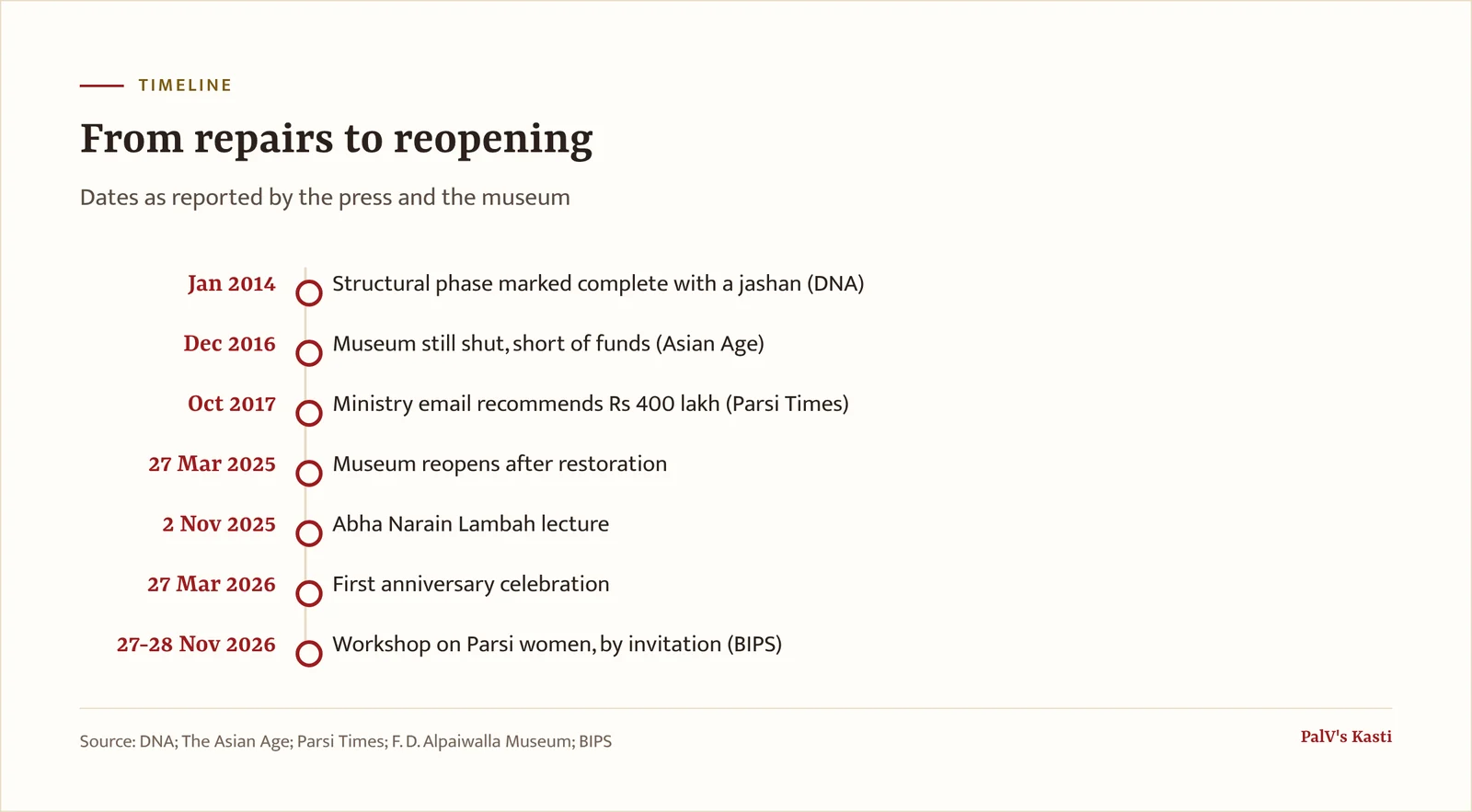
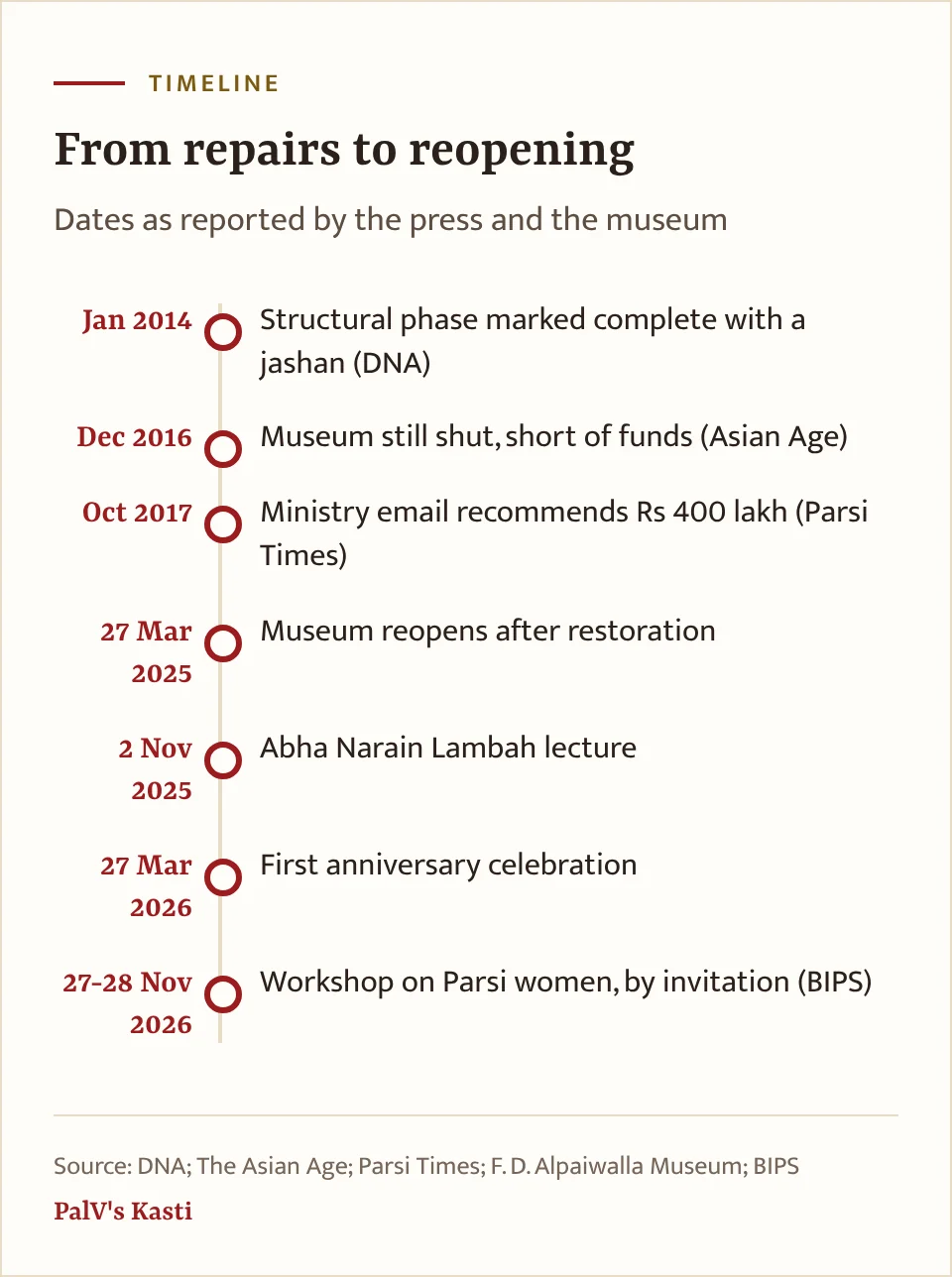
- Structure. A jashan held at the museum on the first day of the new year marked the end of this phase. Dr Pheroza J. Godrej, then described as the renovation consultant, told DNA the structural work was finished.
- Interiors. Lighting, temperature control, TV monitoring and curatorial staff were to come next.
- Access. A hydraulic lift and ramps for wheelchair users.
In the same report, Dinshaw Mehta of the BPP put the overall cost at around Rs 1 crore and expected the museum to open by March or April 2014. It didn't. The 2016 and 2017 reports above show the building still shut, and the work that led to the 2025 reopening came with a much larger government grant, set out in the next section.
The BPP's own page on the museum describes the split between building and collection. It says the BPP supported the first phase of restoring the museum building, and that the Culture Ministry grant was for "the upgradation and restoration of its objects".
We could not find the name of the architect or conservation firm behind the work in any source we opened. If you know it from a BPP report or the museum itself, we would like to add it.
Who paid for the Alpaiwalla Museum restoration?
Two bodies paid: the Ministry of Culture, Government of India, and the Bombay Parsi Punchayet. The Free Press Journal, Parsi Times, Outlook Traveller and the British Institute of Persian Studies all name the Ministry of Culture grant. Parsi Times describes the renovation as "funded by the Union Ministry of Culture and the BPP".
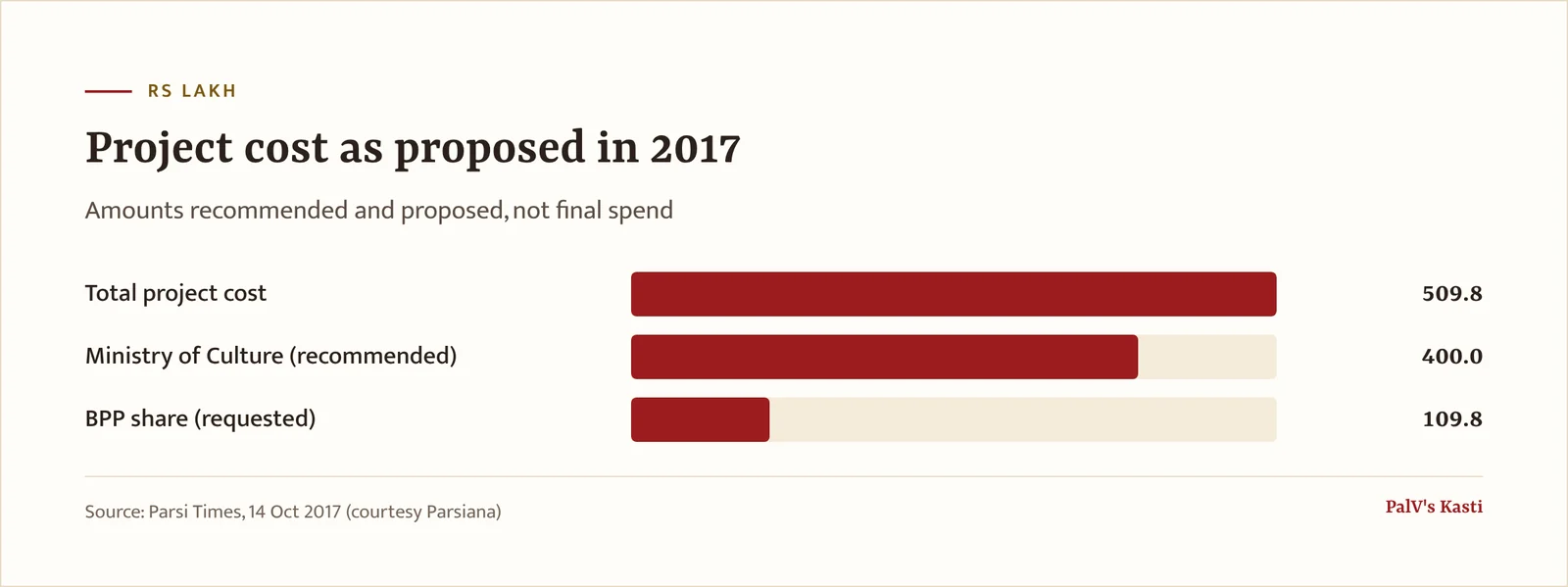
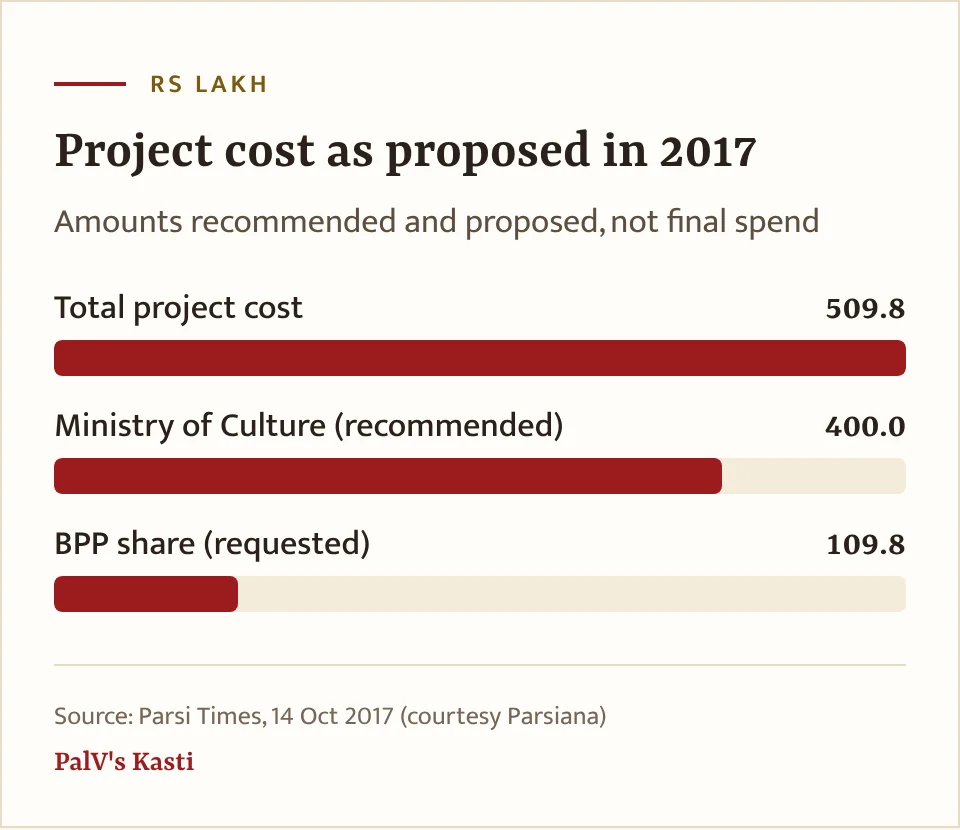
The only figures we found come from a Parsi Times report of 14 October 2017, credited to Parsiana. It quotes a ministry email dated 3 October 2017, in which a committee "recommended Rs 400 lakh financial assistance" to the BPP for setting up the museum. The same email asked the BPP to confirm it would bear Rs 109.79 lakh from its own resources, the remaining part of a total project cost of Rs 509.79 lakh.
Read those numbers with care. They are amounts recommended and proposed in 2017, as one newspaper reported them. We have not seen a later statement of what was finally released or spent, so we don't give a final cost.
What changed when the Alpaiwalla Museum reopened?
The museum reopened on 27 March 2025, a date given by the museum's own website, Parsi Times and the British Institute of Persian Studies. The museum's site calls it "the reimagined museum".
New display cases, lighting and labels
Display cases and lighting from the 1970s were replaced with contemporary layouts and spotlighting. Dr Godrej, by then the museum's honorary director, described the change to the Free Press Journal, and Parsi Times and Outlook Traveller report it too. Exhibit labels were redesigned and now include Braille. Parsi Times added that Marathi and Hindi translations were planned, so treat those as a plan at the time of reopening, not a finished change.
A recreated fire temple with recorded prayers
The biggest single addition is a recreation of a fire temple. Dr Godrej told the Free Press Journal the exhibit would carry "a recitation of prayers that are dying out", and gave her reason plainly: with a shrinking community, "priesthood is not as attractive as it once was". Parsi Times says the façade follows the Maneckji Sett Agiary at Ballard Estate and the sanctum takes its cue from the Anjuman Atash Behram on Princess Street.
Part of this exhibit is older than the reopening. The British Institute of Persian Studies says the inner sanctum of a fire temple made for the Everlasting Flame exhibition (Brunei Gallery, SOAS, London, 2013, and the National Museum in Delhi, 2016) was donated to the museum. DNA's 2014 report also mentions a fire temple sanctum shown at SOAS being donated, and names the donor as Dr Cyrus Poonawala.
New exhibits on migration and Parsi life
Parsi Times reported a newly introduced exhibit, a map titled "Parsi Migration Route", showing two main waves of Zoroastrian migration from Iran to India. The Free Press Journal reported that one exhibit would show how a Parsi merchant lived in 19th-century Bombay, and that photo galleries would cover lesser-known Parsi figures and women who were early pioneers in education and public life. The objects themselves are covered in our separate guide to the museum's collection.
Access for visitors with disabilities
The museum's website says it has Braille signage across all its exhibits and is developing a Braille book with tactile maps and drawings, with help from the Xaviers Resource Center for the Visually Challenged (XRCVC). The lift planned in 2014 is not mentioned. The site says that "currently only the ground floor" is wheelchair friendly, reached by a ramp at the entrance, and asks visitors who need help to contact the museum.
Who attended the Alpaiwalla Museum reopening ceremony?
The ceremony was held on the evening of 27 March 2025 at Khareghat Colony. Parsi Times named three guests: Dr Pheroza J. Godrej, BPP chairman Viraf Mehta, and Cyrus Guzder, whom it described as a heritage conservationist. After the inauguration, honorary advisors Firoza Punthakey Mistree and Dr Godrej led guests through the upgraded galleries. Two short films were screened. The first was "Eternal Flame: Journey of Zoroastrians from Iran to India", and the second, on the merchants, was titled "Gift of Parsi Merchants to Timeless India". A book titled "FD Alpaiwalla Museum" was also launched.
The Free Press Journal also quoted Dr Shehernaz Nalwala, vice-president of the Asiatic Society of Mumbai. She called it "a small museum" and said its worth lay in keeping alive the memory of the people who came to India from Persia.
What has the museum done since it reopened?
At the reopening, the museum announced plans more than finished facilities. Parsi Times and Outlook Traveller reported that the first floor would be used for workshops, lectures and exhibitions. The Free Press Journal and Outlook Traveller listed plans for public lectures, temporary exhibition space and a cafeteria, and all three reported a planned tie-up with Mani Bhavan so that its visitors would be pointed to the museum. We have no 2026 source confirming which of these is now running, so treat them as 2025 plans.
Events are easier to pin down. The museum's homepage lists two since the reopening:
- 2 November 2025: a lecture by Abha Narain Lambah.
- 27 March 2026: the first anniversary celebration.
A workshop, "The Legacy of Parsi Women in India", is set for 27 and 28 November 2026 at the museum, according to a brochure from the British Institute of Persian Studies. Attendance is by invitation only. Parsi Times had mentioned in April 2025 that a workshop on Parsi women was being planned with the British Institute of Persian Studies, SOAS's Shapoorji Pallonji Institute of Zoroastrian Studies and the BPP.
Frequently asked questions
When did the Alpaiwalla Museum reopen?
The F. D. Alpaiwalla Museum at Khareghat Colony, Mumbai, reopened on 27 March 2025, with a ceremony that evening. The museum's website, Parsi Times and the British Institute of Persian Studies all give that date. DNA reported in December 2017 that it had already been shut for several years while it waited for restoration funds.
Who funded the restoration of the Alpaiwalla Museum?
The Ministry of Culture, Government of India, gave a grant for the upgrade and restoration, and the Bombay Parsi Punchayet paid for the first phase of work on the building. A 2017 Parsi Times report quoted a ministry email recommending Rs 400 lakh, with the BPP to bear Rs 109.79 lakh. We have found no published final cost.
What is new at Mumbai's revamped Parsi museum?
The 1970s display cases and lighting were replaced with modern layouts and spotlighting, and labels were redesigned with Braille. A recreated fire temple with recorded prayers was added. Parsi Times also reported a new "Parsi Migration Route" map, and the Free Press Journal reported an exhibit on a 19th-century Parsi merchant's life.
Who inaugurated the reopened Alpaiwalla Museum?
Neither main report names one person as inaugurating it. Parsi Times listed the guests as Dr Pheroza J. Godrej, BPP chairman Viraf Mehta and Cyrus Guzder, with Firoza Punthakey Mistree leading the tour alongside Dr Godrej. The Free Press Journal said the inauguration would take place in the presence of Dr Godrej, Firoza Punthakey Mistree and Viraf Mehta.
Is the Alpaiwalla Museum wheelchair accessible?
Partly. The museum's website says only the ground floor is currently wheelchair friendly, reached by a ramp at the entrance, and that visitors who need help should contact the museum and ask at reception. All exhibits carry Braille signage, and a Braille book with tactile maps is being developed with XRCVC.