PalV's Kasti
On this page
The sources we checked give two accounts of how the Zoroastrian day came to have five Gehs, and they don't fully agree. Mary Boyce thought the Iranians before Zarathushtra prayed three times in daylight, at sunrise, noon and sunset, and that Zarathushtra added prayers at midnight and dawn. Ervad Ramiyar Karanjia's website reads the Gathas as showing three divisions of the day in the prophet's time, morning, mid-day and night, with the five Gehs coming "in the later part of the life of Zarathushtra". Both pictures end in the same place: a day pegged to sunrise, noon, sunset and midnight, with the five Gehs already invoked by name in the opening chapter of the Yasna.
શહેરેવર રોજ
Shehrevar Roj, Tir Mah · 1396 Y.Z.
What do the Gathas say about the times of day?
The key verse is Yasna 44.5, in the Gatha Ushtavaiti. In Bartholomae's translation, as printed from I.J.S. Taraporewala's The Divine Songs of Zarathushtra on avesta.org, Zarathushtra asks Ahura Mazda: "Who made morning, noon, and night". The same verse asks "What artist made light and darkness?" and who made sleep and waking. The times of day, it says, "call the understanding man to his duty".
Karanjia's site takes this verse as evidence that "the day was divided only in 3 parts", which it names Usha, Arempithwa and Khshapa. A 2018 question-and-answer piece on the same site glosses them as morning, mid-day and night, and says the Gathas show "3 divisions of the day" in the prophet's time.
Did the Iranians pray three times a day before Zarathushtra?
Mary Boyce argued that they did. Her Encyclopaedia Iranica entry on gāh calls it "likely" that, before Zoroaster, the Iranians split the hours of daylight into "three periods". Those periods were marked by prayers at sunrise, noon and sunset, with "the night devotionally a blank". The entry gives her 1992 book, Zoroastrianism: Its Antiquity and Constant Vigour (pp. 84-85), as the basis.
On this reading the two new times were Zarathushtra's own doing. Boyce writes that he "required his followers to pray also at midnight and dawn", which added two more times to the three. So Boyce's three are all daylight times, while the three named in Yasna 44.5 run from morning through noon to night. That's the main point on which the two accounts differ, and we've set them side by side below.
| Question | Mary Boyce (Encyclopaedia Iranica) | Ramiyar Karanjia's site |
|---|---|---|
| The older division | Three daylight periods: sunrise, noon, sunset | Three parts named from Yasna 44.5: Usha, Arempithwa, Khshapa |
| The night | "devotionally a blank" | Khshapa, the night, is one of the three |
| How five came about | Zarathushtra added prayers at midnight and dawn | Five Gehs came later, in the later part of Zarathushtra's life |
How did the day become five Gehs?
Karanjia's 2018 piece explains the five as a division built on the sun's course. The five Gehs "came later", it says, set around "four fixed points" of the day: sunrise, mid-day, sunset and midnight. Er. Khoremand Marolia of the Zai Agiary at Bordi, speaking to Parsi Times in May 2018, put it in similar terms. The day, he said, was divided "keeping in mind certain fixed points through the 24 hours".

In the Yasna liturgy the five-fold day is already in place. Yasna 1, in L.H. Mills's translation for the Sacred Books of the East, announces each of the five times in turn, "to Hâvani the holy, the lord of the ritual order", then Rapithwina, Uzayêirina, Aiwisrûthrima and Ushahina, each called a holy lord of the ritual order. Mills explains the title in a footnote: each is a lord of the ritual because it rules "as chief at the time of their mention".
The word gāh may itself point back to the Gathas. Boyce derives it from Avestan gāθā-, the word for Zarathushtra's hymns, though she says why it was applied to the day-divisions "is not certain". Mills suggested the term may have come from chanting the Gathas "at different fixed times in the day". Each Geh's name is taken apart in Geh names explained.
Why does the day drop to four Gehs in winter?
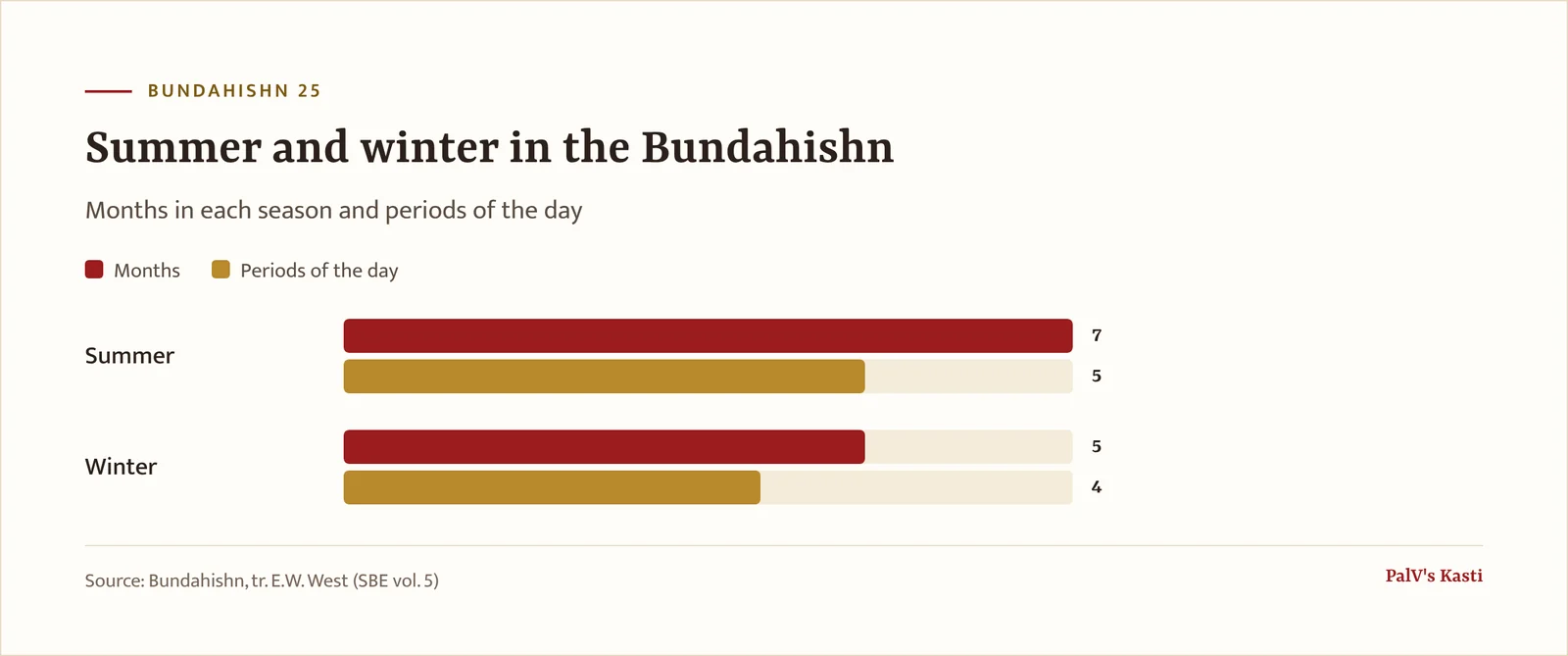
The five-part day is itself seasonal. The Bundahishn, in E.W. West's translation (Sacred Books of the East, vol. 5), says that in the seven months of summer the periods of the days and nights are five, and "In winter are four periods". Its winter runs for five months, from Avan Mah to the end of the five supplementary days. The Bundahishn explains that in winter the time from daybreak "is all Hâvan", and that in those months "one does not celebrate the period of Rapîtvîn".

That is what the old text describes. What families and Agiaries pray in those months today is covered in Second Havan (Biji Havan), and the meaning of Rapithwin in our Rapithwin Geh guide.
Practice varies between families and Agiaries; your family priest's guidance comes first.
What purpose do the five Gehs serve?
Karanjia's site says each day is divided into five Gehs "especially for ritual and prayer purposes". Its 2018 piece puts the purpose as "facilitating prayers, performing rituals, recharging our spiritual energies". It adds that Havan and Ushahin, the first and last Gehs, are longer "to facilitate performance of higher rituals". Er. Marolia, in Parsi Times, also tied the divisions to making prayers and rituals more effective.
The same 2018 piece credits three writers, Sohrab J. Bulsara, Er. Ratansha R. Motafram and Behramsha Pithawalla, with finding "an inherent spiritual message in the idea of the 5 gehs". Boyce's account is historical rather than symbolic: the new prayers at midnight and dawn filled what had been "the night devotionally a blank". The watch from midnight to dawn has its own page, Ushahin Geh. The prayer said in each Geh is described in the five Gah prayers in the Khordeh Avesta, where it sits among the day's prayers in where the Geh prayer fits in daily prayers, and the full set of names and timings is in our guide to the five Gehs.
Practice varies between families and Agiaries; your family priest's guidance comes first.
Frequently asked questions
Who introduced the five Gehs?
Mary Boyce credited Zarathushtra himself. She held that he required his followers to pray at midnight and dawn as well as at sunrise, noon and sunset. Ervad Ramiyar Karanjia's site says the five Gehs came in the later part of Zarathushtra's life, after an earlier three-part day mentioned in the Gathas.
What were the three original divisions of the day?
That depends on the source. Karanjia's site names them Usha, Arempithwa and Khshapa, citing Yasna 44.5, and glosses them as morning, mid-day and night. Mary Boyce described three daylight prayer times, sunrise, noon and sunset, with no devotions at night. Bartholomae's translation of Yasna 44.5 speaks of morning, noon and night.
Which Gatha verse mentions the times of day?
Yasna 44.5, in the Gatha Ushtavaiti. In Bartholomae's translation, printed from Taraporewala on avesta.org, Zarathushtra asks who made morning, noon and night, the times that call the understanding man to his duty. The same verse asks who made light and darkness, and sleep and waking.
Why are there only four Gehs in winter?
The Bundahishn says the day has five periods in the seven summer months and four in winter. Winter runs from Avan Mah to the end of the five supplementary days. In winter, it says, the time from daybreak "is all Hâvan" and the period of Rapithwin is not celebrated, which leaves four periods.
Are the five Gehs fixed to the sun or the clock?
They are fixed to the sun's course, so their clock times shift with sunrise and sunset through the year and from place to place. Karanjia's site says the five Gehs were set around four fixed points: sunrise, mid-day, sunset and midnight. Er. Khoremand Marolia told Parsi Times the day was divided around fixed points through the 24 hours.